
Rotary Kiln Market Size – Industry Structure Evaluation, Demand Drivers Analysis, Regional Growth Analysis and Identification, Competitive Positioning Review & Global Market Size Forecast to 2032
Overview
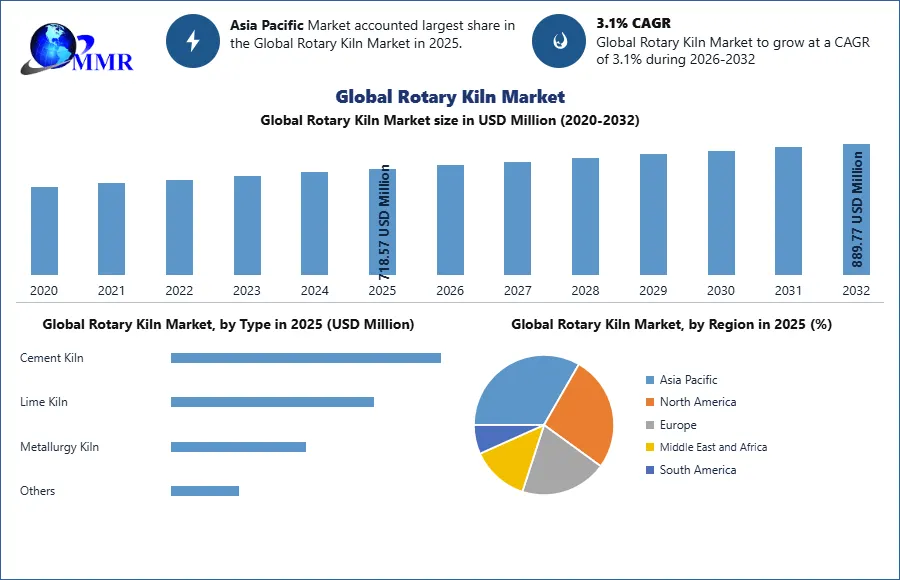
Global Rotary Kiln Market size was valued at USD 718.57 Mn in 2025 and is expected to reach USD 889.77 Mn by 2032, at a CAGR of 3.1 %
Rotary Kiln Market Overview:
The rotary kiln is a refractory-lined horizontal circular cylinder maintained by support station & powered by a girth gear & drive train. These units are widely employed in the silicate, chemical, & pharmaceutical industries, as well as in the minerals, metallurgical, cement, sugar, & food producers as an incinerator and pyrolyser. Rotary kilns have a broad range of applications, including waste lime recovery, activated carbon production, sugar processing, food processing, & pulp and paper production.
 To know about the Research Methodology :- Request Free Sample Report
Incineration of tyres another element influencing the Rotary Kiln Market is the rise in the U. S.:
Cement kilns responsible for 37% of tyre burning in the United States. Cement kilns in the U.S burn 19% of all scrap tyres produced in the country. These are also incredibly polluting, & community groups have already been battling them. Coal is typically used to power a cement kiln. The use of alternative energy sources in cement kilns reduces carbon dioxide emissions throughout the manufacturing process. The waste is fed into the cement kiln, where it replaces a certain amount of coal based on its calorific value.
Global oil supply has achieved a nadir, which indicates that supply can no longer keep up with rising demand, forcing prices to soar. North American natural gas output has peaked, & world production will peak around. In recent years, prices have skyrocketed. Mexico used to export gasoline to the United States, but today it imports it. Several countries employ alternative energy sources such waste oil, solvents, non-recyclable plastics, pre-treated urban and industrial wastes, textiles, and paper residues, and also biomass like animal meal, wood chips, and garbage. Low-carbon alternative fuels can also be made from building & demolition wastes including such demolition wood, worn carpets, and old asphalt shingles
Rotary Kilns Market : Dynamics
Rising Infrastructure Development and Industrial Expansion Driving Rotary Kiln Market Growth
The Rotary Kiln Market growth is primarily driven by rapid expansion in cement production, metallurgy processing, and infrastructure development activities globally. Increasing urbanization and industrialization, especially across emerging economies such as India and China, are accelerating demand for high-temperature processing equipment like rotary kilns used in clinker production, lime calcination, and metal refining. Another major driver is the rising investment in large-scale construction projects, smart cities, and transport infrastructure, which significantly boosts cement consumption.
Additionally, the shift toward energy-efficient rotary kiln systems, alternative fuel integration, and automation technologies is enhancing operational efficiency and reducing carbon emissions. Adoption of digital kiln monitoring systems, IoT-based predictive maintenance, and AI-driven process optimization is further strengthening market expansion. Growth in steel manufacturing and mineral processing industries also contributes to kiln demand. Collectively, these factors position the rotary kiln industry as a critical enabler in global heavy industrial manufacturing and sustainable production transformation.
High Capital Investment and Energy-Intensive Operations Limiting Rotary Kiln Market Adoption
Operational challenges such as high energy consumption, fuel dependency, and maintenance complexity further increase lifecycle costs. Frequent wear and tear of refractory linings and kiln components leads to high maintenance downtime and replacement costs, impacting productivity. Additionally, stringent environmental regulations on carbon emissions and industrial pollution control increase compliance costs and necessitate advanced emission control systems.
Fluctuations in raw material and energy prices also affect profitability margins. Moreover, competition from alternative technologies such as vertical shaft kilns and fluidized bed systems creates substitution pressure. These factors collectively act as restraints on the overall rotary kiln industry expansion and scalability.
Sustainability Shift and Technological Advancements Creating New Growth Opportunities in Rotary Kiln Market
The Rotary Kiln Market presents significant opportunities driven by sustainability transformation and industrial modernization trends. One of the major growth avenues is the adoption of green rotary kiln technologies, including low-emission systems and alternative fuel-based combustion processes. Industries are increasingly integrating waste-derived fuels, biomass, and co-processing technologies, reducing environmental impact while improving cost efficiency.
Expansion of applications in waste management, recycling, and hazardous material treatment is opening new revenue streams beyond traditional cement and metallurgy sectors. Additionally, rapid industrialization in Asia-Pacific, Latin America, and the Middle East & Africa is generating strong demand for new kiln installations.
Technological advancements such as AI-based kiln optimization, digital twin modeling, and predictive maintenance systems are improving efficiency and reducing downtime, creating aftermarket service opportunities. Growth in battery materials processing, lithium refining, and advanced ceramics manufacturing also enhances future demand potential. Overall, innovation-driven transformation and sustainability compliance are shaping a strong long-term growth outlook for the rotary kiln market.
Rotary Kiln Market Segment Analysis
Based On Type : The dominance of cement kilns is primarily driven by sustained global demand for cement in large-scale infrastructure, urban housing, smart city projects, and transportation networks. Rapid urbanization in emerging economies such as India, China, Indonesia, and parts of Africa significantly increased cement consumption, directly boosting rotary kiln installations in cement manufacturing plants.
Cement kilns also benefit from their high production capacity, continuous operation capability, and strong integration with modern energy-efficient technologies, making them the preferred choice for large industrial players. Additionally, governments worldwide are investing heavily in public infrastructure development, road construction, and industrial corridors, which further accelerates cement production requirements.Another key factor is the ongoing shift toward advanced clinker production systems with lower carbon emissions and improved thermal efficiency, where modern cement kilns are increasingly upgraded with automation, waste heat recovery, and alternative fuel usage systems.
Compared to lime and metallurgy kilns, cement kilns serve a broader and more consistent demand base, making them the most commercially significant and widely deployed subtype in the global rotary kiln industry in 2025.

Rotary Kiln Market Regional Analysis
The Rotary Kiln Market exhibits strong regional diversification, with Asia-Pacific dominating global consumption, followed by North America and Europe in 2025. Asia-Pacific holds the largest share due to massive cement production capacity, rapid urbanization, and infrastructure expansion in China and India. The region benefits from large-scale industrialization, government-backed construction projects, and rising demand for cost-efficient rotary kiln systems.
Europe represents a mature but technologically advanced market, driven by energy efficiency regulations, carbon reduction policies, and modernization of existing industrial plants. The region focuses heavily on low-emission kiln technologies and alternative fuel integration.
North America shows steady growth supported by industrial refurbishment, shale-based energy development, and advanced manufacturing systems. Meanwhile, the Middle East & Africa region is emerging as a key growth hub due to mega infrastructure projects, mining expansion, and industrial diversification initiatives.
Latin America also demonstrates moderate growth driven by cement production expansion and mining activities. Overall, regional dynamics highlight a shift toward high-efficiency and sustainable rotary kiln installations globally.

Rotary Kiln Market Recent Developmnets
- 12 November 2025 : Adani Cement partnered with Coolbrook to deploy the world’s first RotoDynamic Heater (RDH) system at its Boyareddypalli cement plant in India. This marks a major breakthrough in rotary kiln decarbonisation technology, replacing fossil fuel-based kiln heating with renewable electricity-powered industrial heat systems. The technology directly reduces emissions in the calcination phase and supports Adani’s net-zero 2050 roadmap. This development highlights the transition of rotary kiln systems toward electrified, low-carbon cement manufacturing infrastructure.
-
24 February 2026 : Shree Cement commissioned a 3.65 Mta clinker production line at its Kodla integrated cement plant in Karnataka, India. This expansion significantly increases clinker capacity to 7.15 Mta, strengthening its position in southern India. The project uses advanced rotary kiln-based clinkerisation systems integrated with modern preheater and process control technologies, improving production efficiency and supporting rising infrastructure demand in India
-
15 January 2026 :Shree Cement expanded its Jaitaran facility by commissioning RAS Unit-11, adding 3.65 Mta clinker and 3 Mta cement capacity. The unit includes an FLSmidth rotary kiln system with a six-stage preheater and Cross-Bar cooler, improving thermal efficiency and reducing energy consumption. The project also integrates waste heat recovery systems and alternative fuel usage, reflecting the growing trend of sustainable rotary kiln operations in India.
| Global Rotary Kiln Market | |||
|---|---|---|---|
| Report Coverage | Details | ||
| Base Year: | 2025 | Forecast Period: | 2026-2032 |
| Historical Data: | 2020 to 2025 | Market Size in 2025: | 718.57 USD Million |
| Forecast Period 2026-2032 CAGR: | 3.1% | Market Size in 2032: | 889.77 USD Million |
| Segments Covered: | by Type | Cement Kiln Lime Kiln Metallurgy Kiln Others |
|
| By Source | Coal-fired Natural gas-fired Alternative fuels Others |
||
| By Capacity | Small capacity (Up to 2,000 tons) Medium capacity (2,000 to 5,000 tons) Large capacity (Over 5,000 tons) |
||
| By Kiln Size | Small Kilns (0.6 to 1.5 meter) Medium Kilns (1.5 to 3.5 meters) Large Kilns (3.5 meters and above) |
||
| By Application | Cement Production Metallurgical Processing Chemical Manufacturing Others |
||
Rotary Kiln Market, by Region
North America (United States, Canada and Mexico)
Europe (UK, France, Germany, Italy, Spain, Sweden, Austria, Turkey, Russia and Rest of Europe)
Asia Pacific (China, India, Japan, South Korea, Australia, ASEAN and Rest of APAC)
Middle East and Africa (South Africa, GCC, Egypt, Nigeria and Rest of ME&A)
South America (Brazil, Argentina, Columbia and Rest of South America)
Rotary Kiln Market Key Players are:
Rotary Kiln Market Key Players:
- FEECO International Inc.
- Riedhammer GmbH
- AGICO Cement Plant
- KHD Humboldt Wedag
- ONEJOON Kilns & Furnaces
- CITIC Heavy Industries
- Ansac Corp
- Boardman LLC
- Deltech Furnaces
- Cress Mfg. Co.
- Bricking Solutions Inc
- Industrial Scale Company
- Accio
- Flsmidth
- Noritake Co., Limited
- O'Connor Kiln
- Shandong Tianli Energy Co., Ltd.
- Henan Hongji Mine Machinery Co., Ltd.
- Aaswathi industries limited
- KINC Group
- SH Scientific Co.,Ltd.
- Metso Outotec Corporation
- Ube Corporation
- Shalimar Engineering
- Chanderpur Group
- Piyali Group
- Remso Control Technologies Private Limited.
- Kaminox Industries
- ANIVI
- Nutec Bickley
Others