
Global Robotic Lawn Mower Market by Range, Type, Navigation Technology, Battery Capacity, End-User, and Region – Global Market Size Estimation, Industry-Wide Analysis, Competitive Landscape Assessment & Long-Term Forecast to 2032
Overview
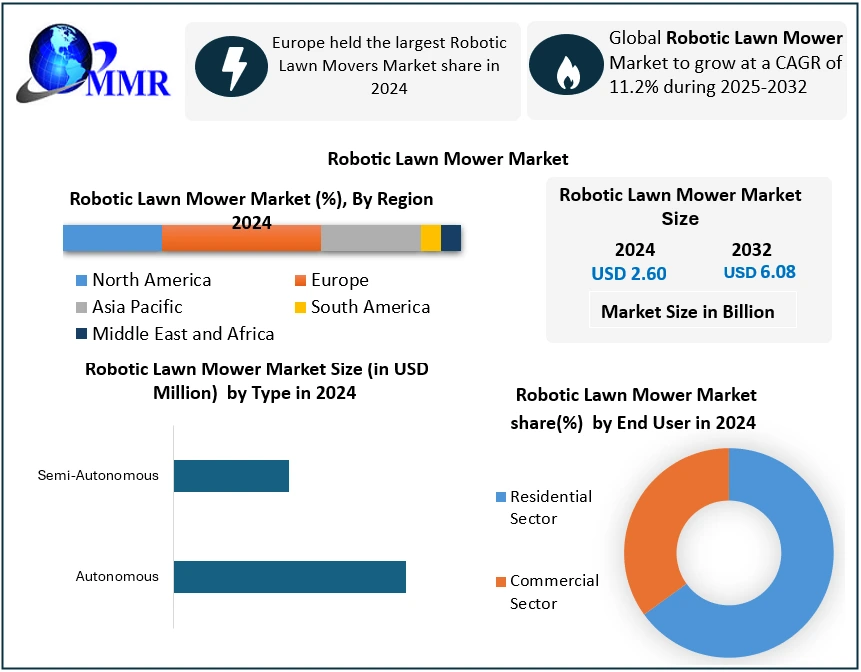
Global Robotic Lawn Mower Market size was valued at USD 2.60 Bn. in 2024, and the total Robotic Lawn Mower Market revenue is expected to grow by 11.2% from 2025 to 2032, reaching nearly USD 6.08 Bn.
Robotic Lawn Mower Market Overview:
A robotic lawn mower, capable of mowing lawns with little to no human interaction, using advanced sensors, GPS, and AI-based navigation systems. The increasing consumer demand for convenient, automated, and eco-friendly lawn care solutions drives the Robotic Lawn Mower Market growth. With the rapid adoption of smart home technologies, homeowners are increasingly seeking devices that can perform routine maintenance tasks with minimal manual intervention, making robotic lawn mowers an attractive solution. These battery-powered devices operate quietly, efficiently, and with zero emissions, offering a greener alternative to traditional gas-powered mowers and aligning with the rising emphasis on environmental sustainability. Technological advancements have transformed robotic mowers into intelligent systems featuring GPS navigation, boundary-wire or camera-based navigation, obstacle detection, weather adaptability, and smartphone connectivity, allowing users to monitor and control mowing activities remotely.
 To know about the Research Methodology:-Request Free Sample Report
The introduction of premium models with advanced automation capabilities, such as satellite-based EPOS positioning, AI-driven mapping, and integration with smart home ecosystems such as Amazon Alexa and Google Home. Increasing urbanization and the rising number of residential complexes with landscaped gardens are creating new opportunities for both small- and large-scale robotic mowers. Regionally, Europe remains the largest Robotic Lawn Mower Market, led by countries such as Germany, Sweden, and the UK, where environmental awareness and early adoption of smart technologies are prominent. Robotic Lawn Mower Key players such as Husqvarna, Bosch, WORX, STIHL, Robomow, and Honda are driving innovation through product launches, technological upgrades, and strategic partnerships.
Lawn Mower Market Dynamics
Increasing Demand for Eco-Friendly and Smart Lawn Care Solutions to drive Robotic Lawn Mower Market Growth
As smart home technologies continue to gain traction, homeowners are increasingly embracing automated solutions to simplify daily chores, with lawn care emerging as a key focus area. Robotic lawn mowers epitomize this shift, offering unparalleled convenience by allowing users to maintain pristine lawns without physical effort or constant supervision. The Robotic Lawn Mower Market for these intelligent devices is experiencing rapid expansion, driven by a confluence of technological, environmental, and lifestyle factors. Modern robotic mowers combine advanced features such as GPS-guided navigation, obstacle detection, weather adaptability, and smartphone connectivity, enabling users to remotely monitor and control lawn maintenance with ease. The growing environmental awareness is driving demand for eco-friendly alternatives that reduce carbon footprints.
Operating solely on battery power and generating zero emissions, robotic lawn mowers provide a sustainable substitute to conventional gas-powered equipment while minimizing noise pollution and energy consumption. Beyond environmental benefits, they represent a broader lifestyle transformation, catering to consumers’ desire for smart, efficient, and time-saving solutions.
High Initial Cost of movers to restrain the Robotic Lawn Mower Market growth
The high upfront cost of robotic lawn mowers remains a significant restraint on market expansion. Compared to conventional gas or electric mowers, the initial investment required for robotic models can be prohibitive for consumers with limited budgets or lower disposable income. This price barrier limits adoption, particularly among small-scale homeowners who may not perceive the cost-to-benefit ratio as favorable. Additionally, despite increasing awareness of smart home technologies, many consumers remain unfamiliar with robotic mowers, their features, and long-term advantages. Misconceptions about complexity, maintenance, or necessity contribute to hesitancy, restraining widespread adoption and slowing Robotic Lawn Mower Market growth.
Robotic Lawn Mower Market Segment Analysis
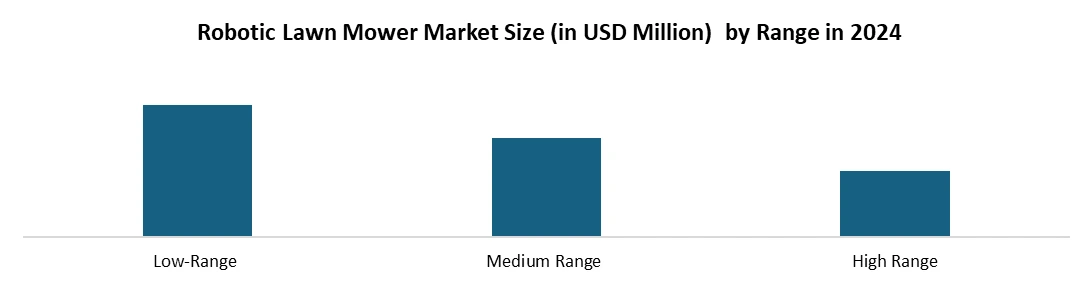
Based on Range, the market is segmented into Low-range Robotic Lawn mowers, Medium-range Robotic Lawn mowers, and High-range Robotic Lawn mowers. The medium-range dominated Robotic Lawn Mower Market in 2024. The growing number of residential properties with medium-sized lawns, which are common in urban and suburban areas across Europe, North America, and the Asia-Pacific. Medium-range robotic mowers offer the ideal balance of performance, efficiency, and affordability, making them suitable for a broad consumer base. They are capable of covering larger areas than low-range models while avoiding the higher costs and advanced features of high-range mowers, which are typically tailored for large estates, commercial properties, or public parks. Consumers are increasingly drawn to medium-range mowers because they provide sufficient battery life, smart navigation, and obstacle detection features at a reasonable price point, making them accessible to most households. The medium-range mowers come equipped with advanced connectivity options such as smartphone apps and integration with smart home systems, adding convenience without the premium pricing associated with high-range models.
Based on End-User, the Robotic Lawn Mower Market is segmented into Commercial Sector, and Residential Sector. Residential Sector segment dominated the Robotic Lawn Mower industry in 2024 and is expected to hold the largest Robotic Lawn Mower Market share over the forecast period. The residential sector represents a significant portion of the robotic lawn mower industry, driven by increasing consumer adoption of automated lawn care solutions. Homeowners are increasingly turning to robotic mowers as a convenient and time-saving alternative to traditional manual mowing methods. Robotic mowers in the residential sector are designed to cater to lawns of varying sizes and complexity, including small, medium, and large-sized lawns with different terrain types, slopes, and landscaping features. Robotic Lawn Mower manufacturers offer a range of robotic mower models with diverse cutting widths, battery capacities, and features to accommodate the unique lawn care needs of residential users.
Robotic Lawn Mower Industry Ecosystem

Robotic Lawn Mower Market Regional Insights
Europe dominated the Robotic Lawn Mower Market in 2024 and is expected to continue its dominance over the forecast period. Robotic lawn mowers, which operate on battery power and produce zero emissions, align with Europe's commitment to reducing carbon footprint and promoting green technologies, which is expected to boost the Robotic Lawn Mower Market growth. European consumers are increasingly embracing smart home technologies and automated solutions for household chores. Robotic lawn mowers offer convenience and automation, allowing users to maintain their lawns effortlessly while freeing up time for other activities. European governments and regulatory bodies support the adoption of eco-friendly technologies through incentives, rebates, and subsidies. Favorable regulations and incentives for energy-efficient and environmentally friendly products encourage consumers to invest in robotic lawn mowers, driving the Robotic Lawn Mower Industry growth in the region.
Germany is one of the largest Robotic lawn mower markets in Europe, driven by a combination of factors such as high disposable income, strong environmental awareness, and a preference for innovative technologies. German consumers value quality, reliability, and performance, leading to a demand for high-end robotic lawn mower models with advanced features and functionalities. Urbanization and the trend towards smaller living spaces in Europe have led to smaller lawn sizes and a higher demand for compact, efficient lawn care solutions. Robotic lawn mowers are well-suited for small to medium-sized lawns, making them an attractive option for urban dwellers and homeowners with limited outdoor space.
Competitive Landscape of the Robotic Lawn Mower Market
The Competition Matrix for the Robotic Lawn Mower Market provides comprehensive coverage focused on the innovative solutions and market approaches of leading companies in the industry. Company profiles detail critical information such as head office location, product offerings, sales performance, market share, geographic footprint, and targeted end users. MMR Competition Matrix for the Robotic Lawn Mower Market includes Key Players Benchmarking in the competitive environment using some key areas, such as innovation, financial performance, brand equity, and global reach. This Competition Matrix of the Robotic Lawn Mower Market examines the competitive strengths of top manufacturers and helps to find growth opportunities. The report assesses how the market's competitive structure, including categorizing players in three categories (market leaders, market followers, work in progress), covers a range of strategic activities, from market leaders in different regions to those with active development pipelines. The report also includes mergers and acquisitions, joint ventures, and R&D investment opportunities that continue to change the competitive landscape.
The Robotic Lawn Mower Key players analyzed are Husqvarna Group (Sweden), Bosch (Germany), Honda Motor Co. (Japan), Toro Company (USA), WORX – Positec (China), and STIHL (Germany). The competitive matrix with diligent analysis comprehensively ensures that stakeholders, thoroughly understand their competitors' positioning, take advantage of differentiating innovation, and rightful way maneuver the Robotic Lawn Mower Market.
Key developments in the Robotic Lawn Mower Market
• In July 2024, Sweden-based Husqvarna Group introduced its next-generation Automower NERA series, marking a significant advancement in robotic lawn care. These models incorporate Husqvarna's EPOS (Exact Positioning Operating System) technology, enabling satellite-based navigation for precise, wire-free installation. This innovation allows users to create virtual cutting zones with high accuracy, providing flexibility in defining mowing areas without the need for physical boundary wires. The Automower NERA series is designed to cater to premium residential users seeking advanced features and efficient lawn maintenance solutions.
• In May 2024, Toro Company expanded its robotic mower lineup with the introduction of new AI-driven models. These mowers are equipped with advanced vision-based navigation systems that allow them to autonomously map and navigate the yard. The integration of smartphone connectivity enables users to control and monitor the mowers remotely, enhancing convenience and user experience. Toro's expansion into AI-driven robotic mowers reflects the company's commitment to providing innovative solutions for smart landscaping and efficient lawn care.
• In April 2024, WORX (Positec Tool Corporation) released an updated version of its Landroid Vision robotic mower. The new model features enhanced capabilities in obstacle detection and edge-cutting, optimized for small to medium-sized lawns. Equipped with a high-definition camera, the Landroid Vision utilizes advanced AI to map and navigate the lawn, avoiding obstacles and ensuring efficient mowing patterns. The "Cut to Edge" functionality produces clean, close cuts near borders, minimizing the need for additional trimming.
• In June 2024, Bosch unveiled new models in its Indego robotic mower series, featuring enhanced integration with smart home ecosystems. These models are capable of being connected to platforms such as Amazon Alexa and Google Home, allowing users to automate and control their lawn care routines through voice commands and smart home interfaces. This development reflects Bosch's commitment to providing users with seamless and intelligent solutions for lawn maintenance, integrating advanced technology into everyday home automation.
• In March 2024, STIHL launched its iMOW EVO range of robotic mowers, specifically designed to handle rougher terrain and larger lawn areas. These models are tailored to meet the unique challenges of the Australian landscape, offering robust performance and adaptability. The iMOW EVO series incorporates advanced features to ensure efficient and precise mowing, catering to users with expansive and uneven lawns.
Key Robotic Lawn Mower Market Trends:
| Trend / Focus Area | Description / Market Impact |
| Integration with Smart Home Ecosystems | Robotic mowers are being connected to platforms such as Amazon Alexa and Google Home, catering to the growing demand for IoT-enabled automation and enhancing consumer convenience. |
| Investment in Navigation and Obstacle Recognition | AI-based object recognition and advanced navigation allow mowers to operate efficiently in complex gardens, reducing manual intervention and improving performance. |
| No-Wire or Satellite-Based Setup | Introduction of EPOS (Exact Positioning Operating System) enables wire-free, satellite-guided mowing, providing users with greater flexibility and easier installation. |
| Specific to Regional Landscapes | Mowers designed for unique environmental conditions, such as rugged Australian terrains, demonstrate adaptation to diverse global landscapes for optimized performance. |
| Investment in Premium/Luxury Consumer Segment | Development of high-end, smart-featured mowers targets residential consumers seeking luxurious, convenient, and technologically advanced landscaping solutions. |
Robotic Lawn Mower Market Scope: Inquire before buying
| Global Robotic Lawn Mower Market | |||
|---|---|---|---|
| Report Coverage | Details | ||
| Base Year: | 2024 | Forecast Period: | 2025-2032 |
| Historical Data: | 2019 to 2024 | Market Size in 2024: | USD 2.60 Bn. |
| Forecast Period 2025 to 2032 CAGR: | 11.2% | Market Size in 2032: | USD 6.08 Bn. |
| Segments Covered: | by Type | Autonomous Semi-Autonomous |
|
| by Range | Low-Range Medium Range High Range |
||
| by Navigation Technology | Boundary-Wire Systems Vision/Cameras-Based Systems GPS/GNSS Navigation Others |
||
| by Battery Capacity | Up to 20V 20V – 30V Above 30V |
||
| by End User | Commercial Residential |
||
| by Distribution Channel | Online Offline |
||
Global Robotic Lawn Mower Market, by Region
Asia Pacific (China, South Korea, Japan, India, Australia, Indonesia, Malaysia, Vietnam, Taiwan, Bangladesh, Pakistan and Rest of APAC)
Europe (UK, France, Germany, Italy, Spain, Sweden, Austria and Rest of Europe)
North America (United States, Canada and Mexico)
Middle East and Africa (South Africa, GCC, Egypt, Nigeria and Rest of ME&A)
South America (Brazil, Argentina Rest of South America)
Robotic Lawn Mower Key Players
North America
1. Honda Power Equipment (United States)
2. MTD Products Inc. (United States)
3. Greenworks Tools (United States)
4. WORX (United States)
5. Echo Robotics (United States)
6. Ecoflow (United States)
7. Gardena (United States)
8. John Deere (United States)
9. Kress Robotics (United States)
10. Mammotion (United States)
Europe
1. Husqvarna Group (Sweden)
2. Bosch Lawn and Garden Ltd. (Germany)
3. AL-KO Geräte GmbH (Germany)
4. Belrobotics (Belgium)
5. Zucchetti Centro Sistemi S.p.A. (Italy)
6. STIGA S.p.A. (Italy)
7. Honda Power Equipment (UK)
8. MTD Products Inc. (UK)
9. Robert Bosch GmbH (Germany)
10. E. ZICOM (France)
11. Yamabiko Europe (Belgium)
12. LG Electronics (South Korea)
13. STIHL (Germany)
Asia-Pacific
1. Yamabiko Corporation (Japan)
2. Zhejiang Tianchen Intelligence & Technology Co., Ltd. (China)
3. Hangzhou Favor Robot Technology Co., Ltd. (China)
4. Ningbo NGP Industry Co., Ltd. (China)
5. Positec Tool Corporation (China)
6. Hitachi, Ltd. (Japan)
7. Milagrow HumanTech (India)
8. The Kobi Company (China)
9. SUMEC Corp. (Yard Force) (China)
10. Mamibot (China)
11. NIKO (China)
12. LG Electronics (South Korea)
Frequently Asked Questions:
1. What is a robotic lawn mower?
Ans: A robotic lawn mower is an autonomous or semi-autonomous device designed to mow lawns without human intervention. It utilizes sensors, navigation systems, and programming to navigate and mow a predefined area of grass.
2. What factors are driving the growth of the robotic lawn mower market?
Ans: Factors driving the Robotic Lawn Mower Market growth include increasing consumer preference for smart and automated lawn care solutions, technological advancements in robotics and AI, and the growing demand for time-saving and environmentally friendly lawn maintenance options.
3. What are the challenges facing the robotic lawn mower market?
Ans: Challenges include the high initial cost of robotic mowers compared to traditional mowers, lack of awareness and understanding among consumers, concerns about effectiveness and reliability, complex installation and setup processes, and potential obstacles in the lawn.
4. Which segment dominates the robotic lawn mower market in terms of end-users?
Ans: The residential sector dominates the market, driven by increasing consumer adoption of automated lawn care solutions and a growing demand for convenience and time-saving alternatives to manual mowing.
5. What are the key regions driving growth in the robotic lawn mower market?
Ans: Europe, particularly countries like Germany, is a key region driving growth due to strong environmental awareness, government incentives for eco-friendly products, and consumer demand for innovative technologies in lawn care.
6. What is the growth rate of the Global robotic lawn mower Market?
Ans: The Global Robotic Lawn Mower Market is expected to grow at a CAGR of 11.2% during the forecast period 2025-2032.