Refrigerant Market Size by Refrigerant Type, Refrigeration Technology, Temperature Range, Application, Distribution Channel, End-Use Industry and Region – Segment-Level Market Assessment, Growth Opportunity Analysis, Competitive Landscape & Forecast to 2034

7.78%
CAGR (2026-2034)
30.34 USD Bn.
Forecast Market Size
329
Report Pages
135
Market Tables

Overview

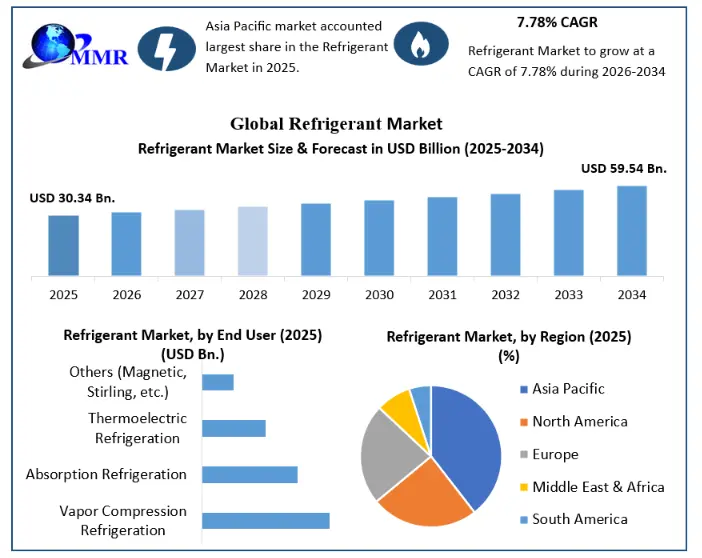
The Global Refrigerant Market was valued at USD 30.34 Billion in 2025 and is projected to reach USD 59.54 Billion by 2034, growing at a CAGR of 7.78% during the forecast period 2026–2034.

Refrigerant Market Overview:

The report explores the Refrigerant market's segments (Type, Application, and Region). Data has been provided by market participants, and regions (North America, Asia Pacific, Europe, Middle East & Africa, and South America). This market report provides a thorough analysis of the rapid advances that are currently taking place across all industry sectors. Facts and figures, illustrations, and presentations are used to provide key data analysis for the historical period from 2020 to 2025. The report investigates the Refrigerant market's drivers, limitations, prospects, and barriers. This MMR report includes investor recommendations based on a thorough examination of the Refrigerant market's contemporary competitive scenario.

Refrigerant Market Growth Outlook
Refrigerant Market Growth Outlook

To know about the Research Methodology :- Request Free Sample Report

Refrigerant Market Dynamics:

The demand for refrigerants is increasing immensely day by day in different sectors like industrial, residential, and others expecting to grow more during the forecasted period. It is used in refrigerators, freezers, air conditioners, fire suppression systems, etc. Probably many industries are dependent upon the artificial cooling system to store and protect the material from damage. Nowadays, artificial cooling is very important in every place like homes, shops, malls, transportation systems, hospitals, etc. because of that, it is expected there will be higher demand in the upcoming years for refrigerants. COVID-19 impacted very seriously of the refrigerants market. There is a high restriction for people and for moving of goods from one place to another. People also start avoiding frozen things because of diseases associated with cold and fever. The only pharmaceutical industry is supporting the refrigerants market at that time.

Rising Industrializations across the Globe:

Rising industrialization and advancement of the standard of living are increasing rapidly, which will drive the refrigerants market during the forecasted period. The refrigerant cooling system has become a vital part of our life. The increasing demand for refrigerant cooling systems because of their usage in the commercial sector, industrial sector, and residential system has increased. Shifting towards new technology and eco-friendly refrigerants will give more growth to this industry in the forecasted period. Several countries are eliminating fluorinated gases from natural gases. Increasing demand in the cold supply chain industry will also drive the market growth of the refrigerants market.

Strict Regulation against Fluorocarbon:

Fluorocarbons refrigerants cause severe harm to the ozone layer because those governments and agencies are regulating strict rules for that and imposing regulations to limit their use. Many countries are agreed to eliminate the usage of HCFCs and HFCs by fixing the limitation of usage through different protocols and regulations. These are the reasons that restrict the fluorocarbon refrigerants market from growing in the market. Under the Montreal protocol, the constant regulations on certain refrigerants are hampering the market growth. The main goal or objective of this protocol is to reduce the damage caused to the ozone layer because of the use of refrigerant gases.

Rising Demand for Natural Refrigerants:

The natural refrigerants which were commonly used are ammonia, carbon dioxide, and HCs such as propane. The Advancement of cooling equipment technology is taking the place of traditional refrigerants with natural refrigerants. This has risen in the market share of natural refrigerants in applications like air conditioners, heating systems, etc.

Illegal Import and Export of Refrigerants:

Illegal import and trade of HFCs have a huge concern for the refrigerants market. These refrigerants are imported and exported illegally to ignore or neglect the government rules and regulations, which is causing harm to our environment as well as in the market. The strict regulation of the government for using of refrigerants is pulling back the potential market growth of refrigerants.
Refrigerant Market Trends:

Uses of HVAC system

The HVAC system is not bad for the environment. The gas used in the HVAC system is freon, which is non-combustible gas that is used in refrigerants in an air conditioner application. These freon gas apply to evaporate process again and again to produce cool air that can go into every AC system throughout the process. This leads to significant demand for low global warming potential that will not harm the environment.

Refrigerant Market Segment Analysis:

Refrigerant Market, by Distribution Channel

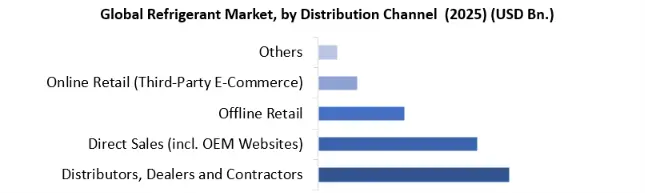
Based on Distribution Channel, the Refrigerant Market is segmented into Direct Sales (including OEM Websites), Distributors, Dealers and Contractors, Offline Retail, Online Retail (Third-Party E-Commerce), and Others. The Distributors, Dealers and Contractors segment holds a significant share of the global Refrigerant Market, supported by strong distribution networks, increasing demand from HVAC systems, commercial refrigeration, industrial cooling, and cold storage applications. Direct Sales support bulk refrigerant procurement, long-term supply agreements, and direct manufacturer relationships with industrial customers. Offline Retail maintains steady demand through authorized refrigerant suppliers and local HVAC service providers, while Online Retail gains traction through digital procurement platforms, competitive pricing, and convenient product availability. Increasing adoption of low-GWP refrigerants, energy-efficient cooling technologies, and sustainable refrigeration solutions strengthens Refrigerant Market growth and distribution channel expansion.
Refrigerant MKT by Dis Channel

Refrigerant Market, by End User

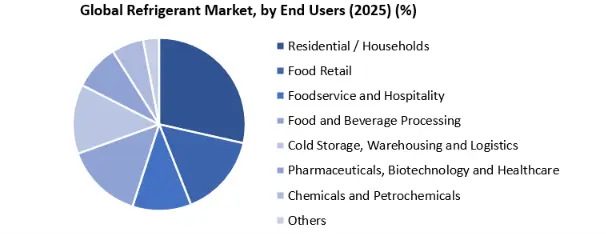
Based on End User, the Refrigerant Market is segmented into Residential / Households, Food Retail, Foodservice and Hospitality, Food and Beverage Processing, Cold Storage, Warehousing and Logistics, Pharmaceuticals, Biotechnology and Healthcare, Chemicals and Petrochemicals, and Others. The Residential / Households segment dominates the Refrigerant Market with an indicative market share of 28.5% in 2025, supported by increasing demand for household refrigerators, air conditioning systems, and energy-efficient cooling solutions. Food Retail and Food and Beverage Processing generate significant refrigerant demand through commercial refrigeration systems, food preservation, and temperature-controlled storage applications. Cold Storage, Warehousing and Logistics benefit from expanding cold-chain infrastructure and refrigerated transportation networks, while the Pharmaceuticals, Biotechnology and Healthcare segment supports demand for precision cooling and temperature-sensitive product storage. Growing adoption of low-GWP refrigerants, natural refrigerants, sustainable cooling technologies, and energy-efficient HVAC systems strengthens global Refrigerant Market growth and creates new opportunities across industrial and commercial refrigeration applications.
Refrigerant Market by End Users

Refrigerant Market Regional Insights:

The Asia Pacific region held the largest market share accounting for 38.1% in 2025. APAC region is dominating the market of refrigerants in the forecasted period because of the high demand, and the number of users is more in this region. Developing countries such as China, India, and Indonesia are contributing more to this market because of the increase in the standard of living of individuals and also the increase in disposable income. In China, packaged food is more in use, especially dairy products and baby foods. Hence, these are the factor APAC is dominating the market of refrigerants.

The objective of the report is to present a comprehensive analysis of the global Refrigerant Market to the stakeholders in the industry. The past and current status of the industry with the forecasted market size and trends are presented in the report with the analysis of complicated data in simple language. The report covers all the aspects of the industry with a dedicated study of key players that include market leaders, followers, and new entrants.

PORTER, PESTEL analysis with the potential impact of micro-economic factors of the market have been presented in the report. External as well as internal factors that are supposed to affect the business positively or negatively have been analyzed, which will give a clear, futuristic view of the industry to the decision-makers.

The reports also help in understanding the Refrigerant Market dynamic and structure by analyzing the market segments and projecting the Refrigerant Market size. Clear representation of competitive analysis of key players by Design, price, financial position, product portfolio, growth strategies, and regional presence in the Refrigerant Market make the report investor’s guide.

Refrigerant Market Scope: Inquiry Before Buying

Refrigerant Market
Report Coverage Details
Base Year: 2025 Forecast Period: 2026-2034
Historical Data: 2020 to 2025 Market Size in 2025: USD 30.34 Bn.
Forecast Period 2026 to 2034 CAGR: 7.78% Market Size in 2034: USD 59.54 Bn.
Segments Covered: by Refrigerant Type Hydrofluorocarbons (HFCs)
Hydrofluoroolefins (HFOs) and HFO-Based Blends
Hydrocarbons (HCs)
Ammonia (R717)
Carbon Dioxide (R744)
Others (incl. HCFCs and Refrigerant-Free Systems)
by Refrigeration Technology Vapor Compression Refrigeration
Absorption Refrigeration
Thermoelectric Refrigeration
Others (Magnetic, Stirling, etc.)
by Temperature Range High-Temperature Refrigeration (Above 0°C)
Medium-Temperature Refrigeration (−18°C to 0°C)
Low-Temperature Refrigeration (−40°C to Below −18°C)
Ultra-Low-Temperature Refrigeration (Below −40°C)
by Application Residential Refrigeration
Refrigerators (incl. Refrigerator-Freezer Combos)
Standalone Freezers
Others
Commercial Refrigeration
Reach-In Refrigerators and Freezers
Walk-In Coolers and Freezers
Refrigerated Display Cases and Merchandisers
Ice-Making Machines
Refrigerated Vending Machines
Others
Industrial Refrigeration
Industrial Chillers
Compressor Racks and Condensing Units
Process Freezers (Blast, Spiral, IQF, Tunnel)
Others
Transport Refrigeration
Truck Refrigeration Units
Trailer Refrigeration Units
Refrigerated Container Units
Rail Refrigeration Units
Others
by Distribution Channel Direct Sales (incl. OEM Websites)
Distributors, Dealers and Contractors
Offline Retail
Online Retail (Third-Party E-Commerce)
Others
by End-Use Industry Residential / Households
Food Retail
Foodservice and Hospitality
Food and Beverage Processing
Cold Storage, Warehousing and Logistics
Pharmaceuticals, Biotechnology and Healthcare
Chemicals and Petrochemicals
Others

Refrigerant Market, by Region

North America (United States, Canada and Mexico)
Europe (UK, France, Germany, Italy, Spain, Sweden, Austria and Rest of Europe)
Asia Pacific (China, South Korea, Japan, India, Australia, Indonesia, Malaysia, Vietnam, Taiwan, Bangladesh, Pakistan and Rest of APAC)
Middle East and Africa (South Africa, GCC, Egypt, Nigeria and Rest of ME&A)
South America (Brazil, Argentina Rest of South America)

Refrigerant Market, Key Players:

1. Carrier Global Corporation
2. Dover Corporation (Hillphoenix, Advansor)
3. Lennox International (Heatcraft)
4. Ali Group (Beverage-Air, Manitowoc Ice)
5. Whirlpool Corporation
6. Johnson Controls International
7. Trane Technologies
8. True Manufacturing
9. Sub-Zero Group
10. EVAPCO, Inc.
11. Tecumseh Products Company
12. Copeland
13. Electrolux AB
14. BSH Hausgeräte GmbH (Bosch, Siemens)
15. Arçelik A.Ş. (Beko, Defy)
16. Liebherr Group
17. GEA Group AG
18. BITZER Group
19. Danfoss A/S
20. Epta S.p.A.
21. LU-VE Group
22. Güntner GmbH & Co. KG
23. Secop GmbH
24. Dometic Group AB
25. Carel Industries S.p.A.
26. Frascold S.p.A.
27. Star Refrigeration Ltd.
28. Haier Smart Home
29. Midea Group
30. Hisense Group
31. Gree Electric Appliances
32. Panasonic Holdings Corporation (Hussmann)
33. Daikin Industries
34. Mitsubishi Electric Corporation
35. Hitachi Global Life Solutions
36. Hoshizaki Corporation
37. Sanden Corporation
38. Mayekawa Mfg. Co., Ltd.
39. LG Electronics
40. Samsung Electronics
41. Godrej Enterprises Group
42. Blue Star Limited
43. Kiriazi Group
44. El Araby Group
45. Siera Electronics
46. Fridgemaster Industries (Pty) Ltd.
47. Metalfrio Solutions
48. Gelopar Refrigeração Paranaense
49. Fricon
50. Indurama

Frequently asked questions:

1)What is the study period of this market?
Ans. The study period of this market is 2025 to 2034.

2)What is the growth rate of the Refrigerants market?
Ans. The CAGR of the refrigerants market is 7.78%.

3)Which region has the highest growth rate in the refrigerants market?
Ans. The APAC region has the highest growth rate in this market.

4)What is the segment covered in this market?
Ans. The segment covered in this market is based on the type and based on applications.

5)What is the estimated market value of this market in 2034?
Ans. The estimated market value of this market is 59.54 bn in 2034.

Table of Contents

1. Executive Market Landscape and Industry Overview 1.1. Global Refrigeration Market Size (USD Billion and Volume in 000' Units), 2025–2034 1.2. Market Definition, Scope, and Key Segmentation Criteria 1.3. Global Refrigeration Market Ecosystem, Brands, Suppliers, Distributors, and Retail Channels 1.4. Competitive Landscape, Major Participants, Regional Specialists, and New Entrants 2. Global Refrigeration Market Dynamics 2.1. Global Refrigeration Market Trends 2.2. Global Refrigeration Market DROC Analysis 2.2.1. Drivers 2.2.2. Restraints 2.2.3. Opportunities 2.2.4. Challenges 2.3. Porter's Five Forces Analysis 2.3.1. Supplier Bargaining Power 2.3.2. Buyer Bargaining Power 2.3.3. Threat of Substitutes 2.3.4. Threat of New Entrants 2.3.5. Competitive Rivalry 2.4. PESTLE Analysis 3. Refrigeration Industry Ecosystem and Value Chain 3.1. Global Refrigeration Industry Ecosystem and Stakeholder Relationships 3.2. Raw Material Suppliers, Component Manufacturers, and Equipment Producers 3.3. Refrigeration System Integrators, Engineering Contractors, and Installation Providers 3.4. Equipment Distributors, Authorized Dealers, and Aftermarket Service Networks 3.5. Refrigeration Equipment Procurement, Installation, Commissioning, and Operational Value Chain 3.6. Value Addition and Revenue Distribution Across Refrigeration Industry Participants 4. Global Refrigeration Manufacturing Landscape 4.1. Global Refrigeration Equipment Manufacturing Facilities and Production Distribution 4.2. Regional Manufacturing Hubs and Country-Wise Production Activities 4.3. Refrigeration Equipment Manufacturing Processes and Production Technologies 4.4. Manufacturing Capacity Utilization and Production Output 4.5. Manufacturing Investments and Production Facility Expansion Plans 4.6. Manufacturing Cost Competitiveness and Regional Production Capabilities Through 2034 5. Refrigeration Raw Materials and Component Supply 5.1. Major Raw Materials Used in Refrigeration Equipment Manufacturing 5.2. Steel, Copper, Aluminum, Plastics, and Insulation Material Procurement 5.3. Compressor, Condenser, Evaporator, and Expansion Valve Supply Landscape 5.4. Electronic Controllers, Sensors, Heat Exchangers, and Component Availability 5.5. Raw Material Price Fluctuations and Manufacturing Cost Impact 5.6. Global Component Supplier Networks and Procurement Dependencies 6. Refrigeration Equipment Production and Capacity 6.1. Global Refrigeration Equipment Production Volume by Equipment Category 6.2. Installed Manufacturing Capacity and Annual Production Output 6.3. Regional Production Capacity Distribution 6.4. Factory Utilization Rates and Production Efficiency Indicators 6.5. Manufacturing Capacity Additions and Planned Investments 6.6. Global Production Capacity and Output Forecast Through 2034 7. Refrigeration Equipment Technology Landscape 7.1. Vapor Compression Refrigeration Systems and Applications 7.2. Absorption Refrigeration Technologies and Alternative Energy Sources 7.3. Thermoelectric Refrigeration Systems and Specialized Applications 7.4. Reciprocating, Scroll, Screw, and Centrifugal Compressor Technologies 7.5. Electronic Expansion Devices, Variable-Speed Drives, and Advanced Controls 7.6. Technology Selection Based on Cooling Capacity and Operating Requirements 8. Refrigeration System Design and Engineering 8.1. Refrigeration System Architecture and Equipment Configuration 8.2. Cooling Load Calculations and Refrigeration Capacity Selection 8.3. Compressor, Condenser, Evaporator, and Expansion Device Integration 8.4. Refrigeration Piping Design, Thermal Insulation, and Heat Transfer Engineering 8.5. Equipment Installation Layouts and System Integration 8.6. Engineering Standards and Refrigeration System Performance Optimization 9. Refrigeration Equipment Performance and Efficiency 9.1. Cooling Capacity and Energy Consumption Indicators 9.2. Coefficient of Performance and Energy Efficiency Ratio 9.3. Equipment Performance Under Different Operating Conditions 9.4. Part-Load Performance and Variable-Speed Operation 9.5. Refrigeration System Energy Losses and Efficiency Improvements 9.6. Equipment Performance Benchmarking and Operating Efficiency 10. Refrigerants and Alternative Cooling Fluids 10.1. Global Refrigerant Consumption Patterns 10.2. Hydrofluorocarbon Refrigerants and Applications 10.3. Hydrofluoroolefin Refrigerants and Low-GWP Formulations 10.4. Natural Refrigerants Including Ammonia, Carbon Dioxide, and Hydrocarbons 10.5. Refrigerant Availability, Supply Constraints, and Equipment Compatibility 10.6. Refrigerant Substitution and Transition Plans 11. Refrigeration Equipment Installed Base and Utilization 11.1. Global Installed Base of Refrigeration Equipment 11.2. Active Equipment Units and Operational Cooling Capacity 11.3. Equipment Utilization Rates and Annual Operating Hours 11.4. Equipment Age Distribution and Remaining Service Life 11.5. Installed Equipment Density Relative to Population and Economic Activity 11.6. Installed Base and Utilization Outlook Through 2034 12. Refrigeration Equipment Replacement and Modernization 12.1. Global Refrigeration Equipment Replacement Requirements 12.2. Replacement Frequency and Major Decision Factors 12.3. Aging Equipment Modernization and Energy-Efficient Upgrades 12.4. Refrigerant Conversion and Equipment Retrofit Requirements 12.5. Equipment Replacement Expenditure and Capital Allocation 12.6. Replacement and Modernization Opportunities Through 2034 13. Refrigeration Equipment Reliability and Durability 13.1. Operational Reliability and Performance Consistency 13.2. Compressor Reliability, Mechanical Wear, and Equipment Failures 13.3. Component Durability Under Different Operating Conditions 13.4. Equipment Failure Frequency and Operational Availability 13.5. Equipment Testing and Long-Term Durability Validation 13.6. Reliability Improvement and Product Quality Requirements 14. Refrigeration Equipment Testing and Certification 14.1. Factory Acceptance Testing and Product Inspection 14.2. Cooling Capacity Testing and Rated Performance Verification 14.3. Pressure Testing, Leak Detection, and Refrigerant Circuit Integrity 14.4. Electrical Safety Testing and Operational Protection 14.5. Third-Party Testing Laboratories and Certification Infrastructure 14.6. Product Testing Documentation and Manufacturer Compliance 15. Refrigeration Equipment Standardization and Product Specifications 15.1. Technical Specification Requirements Across Global Markets 15.2. Standard Cooling Capacity Ratings and Performance Parameters 15.3. Compressor, Condenser, and Evaporator Product Specifications 15.4. Equipment Dimensions, Installation Interfaces, and Compatibility Standards 15.5. Product Standardization and Equipment Interoperability 15.6. Regional Specification Differences and International Harmonization 16. Refrigeration Equipment Supply Chain and Logistics 16.1. Global Refrigeration Equipment Supply Chain Structure 16.2. Manufacturing-to-Distribution Logistics 16.3. Equipment Packaging, Handling, Storage, and Transportation 16.4. Inventory Management and Distribution Center Operations 16.5. Equipment Lead Times, Order Fulfillment, and Delivery Performance 16.6. Supply Chain Localization and Regional Sourcing Strategies 17. Refrigeration Equipment Import Dependency and Localization 17.1. Domestic Production Capabilities and Import Dependency 17.2. Country-Wise Import Dependence on Compressors and Critical Components 17.3. Local Equipment Assembly and Domestic Manufacturing Participation 17.4. Localization Requirements and Domestic Value Addition 17.5. Government Manufacturing Incentives and Production Support Programs 17.6. Localization Investments and Manufacturing Opportunities Through 2034 18. Refrigeration Equipment Pricing and Cost Structure 18.1. Global Refrigeration Equipment Average Selling Prices 18.2. Manufacturing Cost Structure and Major Cost Components 18.3. Compressor, Refrigerant, Heat Exchanger, and Electronic Component Costs 18.4. Regional Equipment Pricing Differences 18.5. Installation, Commissioning, and System Integration Costs 18.6. Equipment Price Trends and Cost Forecast Through 2034 19. Refrigeration Equipment Operating Economics 19.1. Total Cost of Ownership Across Major Refrigeration Applications 19.2. Electricity Consumption and Annual Operating Expenditure 19.3. Preventive Maintenance, Refrigerant Replacement, and Repair Costs 19.4. Equipment Operating Life and Capital Replacement Planning 19.5. Energy-Efficient Equipment Investment Payback and Cost Savings 19.6. Refrigeration System Lifecycle Economics and Ownership Cost Comparisons 20. Refrigeration Equipment Distribution and Sales 20.1. Global Refrigeration Equipment Sales Networks 20.2. Direct Sales and Project-Based Equipment Procurement 20.3. Distributors, Authorized Dealers, and Regional Partnerships 20.4. Organized Retail, Appliance Showrooms, and E-Commerce Sales 20.5. Manufacturer Distribution Agreements and Market Coverage 20.6. Sales Channel Development and Digital Distribution Opportunities Through 2034 21. Refrigeration Equipment Procurement and Purchasing 21.1. Equipment Procurement Procedures Across End-Use Applications 21.2. Equipment Selection Criteria and Purchase Price Considerations 21.3. Commercial Refrigeration Tendering and Vendor Qualification 21.4. Industrial Refrigeration Engineering, Procurement, and Construction Contracts 21.5. Purchase Decision-Making and Capital Expenditure Approval 21.6. Supplier Preferences, Contract Negotiations, and Procurement Relationships 22. Refrigeration Equipment Installation and Services 22.1. Equipment Installation and Commissioning Requirements 22.2. Preventive Maintenance and Service Scheduling 22.3. Compressor Repairs, Refrigerant Leak Detection, and Troubleshooting 22.4. Equipment Retrofit, Modernization, and Replacement Services 22.5. Authorized Service Providers and Technical Support Infrastructure 22.6. Service Contracts, Warranty Coverage, and After-Sales Support 23. Smart Refrigeration and Digital Technologies 23.1. IoT Integration and Connected Refrigeration Monitoring 23.2. AI Applications in Energy Management and Temperature Control 23.3. Predictive Maintenance and Remote Equipment Diagnostics 23.4. Smart Sensors, Digital Controllers, and Real-Time Monitoring 23.5. Cloud-Based Refrigeration Management and Centralized Controls 23.6. Digital Refrigeration Technology Adoption Opportunities Through 2034 24. Sustainable Refrigeration and Environmental Practices 24.1. Refrigeration Equipment Carbon Emissions and Environmental Impact 24.2. Low-GWP Refrigeration Technologies and Sustainable Cooling 24.3. Energy-Efficient Refrigeration and Electricity Consumption Reduction 24.4. Refrigerant Recovery, Recycling, Reclamation, and Equipment Disposal 24.5. Circular Economy Initiatives and Sustainable Manufacturing 24.6. Sustainability Commitments and Industry Decarbonization Through 2034 25. Global Refrigeration International Trade 25.1. Global Refrigeration Equipment Import and Export Trade Flows 25.2. Leading Exporting Countries and International Trade Relationships 25.3. Major Import Markets and Country-Wise Import Dependency 25.4. International Trade of Compressors, Heat Exchangers, and Components 25.5. Import Tariffs, Customs Duties, and Trade Restrictions 25.6. International Trade Opportunities Through 2034 26. Refrigeration Industry Investment and Projects 26.1. Global Refrigeration Industry Capital Investments 26.2. Manufacturing Plant Expansion and New Production Facilities 26.3. Commercial and Industrial Refrigeration Installation Projects 26.4. Cold Storage, Food Processing, and Pharmaceutical Infrastructure Projects 26.5. Manufacturing Joint Ventures, Strategic Investments, and Capacity Expansion 26.6. Country-Wise Investment Opportunities and Planned Projects Through 2034 27. Refrigeration Innovations and Research 27.1. Advanced Compressor Designs and High-Efficiency Cooling Technologies 27.2. Magnetic Refrigeration and Solid-State Cooling Research 27.3. Transcritical CO2 Refrigeration and Natural Refrigerant Applications 27.4. Advanced Heat Exchanger Materials and Thermal Management 27.5. Refrigeration Equipment Research and Development 27.6. Next-Generation Refrigeration Technology Commercialization Through 2034 28. Refrigeration Industry Workforce and Skill Development 28.1. Global Refrigeration Industry Employment Structure 28.2. Engineering, Manufacturing, and Technical Workforce Requirements 28.3. Skilled Technician Availability and Specialized Engineering Professionals 28.4. Technical Training and Professional Skill Development Programs 28.5. Industry Collaboration With Technical and Vocational Institutes 28.6. Workforce Development and Skilled Labor Requirements Through 2034 29. Global Refrigeration Market Demand Indicators and Cold-Chain Infrastructure Analysis 29.1. Country-Wise Household Refrigerator Penetration and Ownership Trends, 2025–2034 29.2. Global and Country-Wise Cold Storage Capacity (Million Cubic Meters), 2025–2034 29.3. Food Retail Infrastructure and Store Counts by Country 29.4. Commercial Refrigeration Equipment Demand Across Food Retail and Cold Storage 29.5. Cold-Chain Infrastructure Expansion and Investment Trends 29.6. Relationship Between Refrigerator Penetration, Cold Storage Capacity, Food Retail Expansion, and Market Demand 30. Impact of US Tariffs and Trade Policy on the Global Refrigeration Market 30.1. US Tariff Measures Affecting Refrigeration Equipment and Components 30.2. Impact of Import Tariffs on Pricing, Manufacturing Costs, and Profit Margins 30.3. Country-Wise Trade Exposure and US Import Supply Chain Dependence 30.4. Tariff Impact on Compressors, Steel, Aluminum, Refrigerants, and Components 30.5. Manufacturing Relocation, Supplier Diversification, and Nearshoring Strategies 30.6. US Trade Policy Scenarios and Market Growth Implications Through 2034 31. Refrigeration Equipment Sales Volume and Inventory Trends 31.1. Global Annual Equipment Sales Volume and Shipment Patterns 31.2. Manufacturer Shipments and Wholesale Inventory Movement 31.3. Distributor Stock Levels and Retail Inventory Availability 31.4. Seasonal Equipment Sales and Inventory Replenishment 31.5. Order Backlogs, Shipment Delays, and Inventory Turnover 31.6. Global Sales Volume and Shipment Forecast Through 2034 32. Refrigeration Equipment Intellectual Property and Patent Landscape 32.1. Global Refrigeration Technology Patent Filing Trends 32.2. Leading Manufacturers and Patent Portfolio Distribution 32.3. Compressor, Heat Exchanger, and Cooling System Patent Activities 32.4. Intellectual Property Ownership and Technology Licensing 32.5. Patent Expiration, Technology Protection, and Commercial Licensing 32.6. Emerging Refrigeration Technology Patent Trends Through 2034 33. Refrigeration Regulations and Compliance Framework 33.1. International Safety Standards and Technical Certification 33.2. Montreal Protocol and Kigali Amendment Requirements 33.3. Regional Refrigerant Restrictions and HFC Phase-Down Regulations 33.4. Energy Efficiency Standards and Mandatory Product Labeling 33.5. Equipment Installation, Refrigerant Handling, and Technician Certification 33.6. Country-Wise Regulatory Compliance and Implementation Timelines Through 2034 34. Refrigeration Industry Risks and Supply Constraints 34.1. Raw Material Price Volatility and Manufacturing Cost Exposure 34.2. Refrigerant Supply Restrictions and Substitution Challenges 34.3. Component Supply Chain Disruptions and Production Dependencies 34.4. Skilled Technician Shortages and Installation Constraints 34.5. Energy Price Exposure and Customer Operating Cost Pressures 34.6. Business Continuity Risks and Supply Chain Resilience Measures 35. Global Refrigeration Market Size and Forecast by Segmentation, 2025–2034 (Value: USD Billion; Volume: 000' Units) 35.1. By Refrigerant Type 35.1.1. Hydrofluorocarbons (HFCs) 35.1.2. Hydrofluoroolefins (HFOs) and HFO-Based Blends 35.1.3. Hydrocarbons (HCs) 35.1.4. Ammonia (R717) 35.1.5. Carbon Dioxide (R744) 35.2. By Refrigeration Technology 35.2.1. Vapor Compression Refrigeration 35.2.2. Absorption Refrigeration 35.2.3. Thermoelectric Refrigeration 35.3. By Temperature Range 35.3.1. High-Temperature Refrigeration (Above 0°C) 35.3.2. Medium-Temperature Refrigeration (−18°C to 0°C) 35.3.3. Low-Temperature Refrigeration (−40°C to Below −18°C) 35.3.4. Ultra-Low-Temperature Refrigeration (Below −40°C) 35.4. By Application 35.4.1. Residential Refrigeration 35.4.1.1. Refrigerators 35.4.1.2. Standalone Freezers 35.4.2. Commercial Refrigeration 35.4.2.1. Reach-In Refrigerators and Freezers 35.4.2.2. Walk-In Coolers and Freezers 35.4.2.3. Refrigerated Display Cases and Merchandisers 35.4.2.4. Ice-Making Machines 35.4.2.5. Refrigerated Vending Machines 35.4.3. Industrial Refrigeration 35.4.3.1. Industrial Chillers 35.4.3.2. Compressor Racks and Condensing Units 35.4.3.3. Process Freezers 35.4.4. Transport Refrigeration 35.4.4.1. Truck Refrigeration Units 35.4.4.2. Trailer Refrigeration Units 35.4.4.3. Refrigerated Container Units 35.4.4.4. Rail Refrigeration Units 35.5. By End-Use Industry 35.5.1. Residential / Households 35.5.2. Food Retail 35.5.3. Foodservice and Hospitality 35.5.4. Food and Beverage Processing 35.5.5. Cold Storage, Warehousing, and Logistics 35.5.6. Pharmaceuticals, Biotechnology, and Healthcare 35.5.7. Chemicals and Petrochemicals 35.6. By Distribution Channel 35.6.1. Direct Sales 35.6.2. Distributors, Dealers, and Contractors 35.6.3. Offline Retail 35.6.4. Online Retail 35.7. By Region 35.7.1. North America 35.7.1.1. United States 35.7.1.2. Canada 35.7.1.3. Mexico 35.7.2. Europe 35.7.2.1. United Kingdom 35.7.2.2. France 35.7.2.3. Germany 35.7.2.4. Italy 35.7.2.5. Netherlands 35.7.2.6. Spain 35.7.2.7. Sweden 35.7.2.8. Russia 35.7.2.9. Belgium 35.7.2.10. Norway 35.7.2.11. Romania 35.7.2.12. Finland 35.7.2.13. Austria 35.7.2.14. Denmark 35.7.3. Asia Pacific 35.7.3.1. China 35.7.3.2. South Korea 35.7.3.3. India 35.7.3.4. Japan 35.7.3.5. Australia 35.7.3.6. Indonesia 35.7.3.7. Philippines 35.7.3.8. Malaysia 35.7.3.9. Vietnam 35.7.3.10. Thailand 35.7.4. Middle East and Africa 35.7.4.1. South Africa 35.7.4.2. Saudi Arabia 35.7.4.3. United Arab Emirates 35.7.4.4. Oman 35.7.4.5. Kuwait 35.7.4.6. Turkey 35.7.4.7. Egypt 35.7.4.8. Nigeria 35.7.4.9. Kenya 35.7.4.10. Mozambique 35.7.4.11. Morocco 35.7.5. South America 35.7.5.1. Brazil 35.7.5.2. Argentina 35.7.5.3. Chile 35.7.5.4. Colombia 35.7.5.5. Peru 35.7.5.6. Bolivia 36. Competitive Landscape 36.1. MMR Competition Matrix 36.2. Competitive Positioning of Leading Key Players by Revenue and Market Share 36.3. Key Player Benchmarking 36.3.1. Company Name 36.3.2. Headquarters 36.3.3. Product Portfolio 36.3.4. Global Distribution Network 36.3.5. Revenue (2025) 36.3.6. Market Share (%) 36.3.7. Price Competitiveness 36.3.8. Profit Margin (%) 36.3.9. Year-on-Year Growth Rate (%) 36.3.10. R&D Investment 36.3.11. Patent Portfolio 36.3.12. Certifications and Regulatory Compliance 36.3.13. Manufacturing Capacity 36.3.14. Production Volume 36.3.15. Energy Efficiency 36.3.16. Cooling Performance 36.3.17. Product Reliability 36.3.18. Customer Base 36.3.19. After-Sales Service Network 36.3.20. Geographic Presence 36.4. Market Structure 36.4.1. Market Leaders 36.4.2. Market Followers 36.4.3. Emerging Players 36.5. Mergers and Acquisitions 36.6. Recent Key Developments 37. Leading Refrigeration Companies and Competitive Market Share Positioning 37.1. Market Share of Leading Global and Regional Refrigeration Equipment Manufacturers 37.2. Competitive Positioning Across Major Geographic Markets 37.3. Revenue Contribution by Refrigeration Equipment, Integrated Systems, Components, and Services 37.4. Manufacturing Capacity, Production Volume, Equipment Sales, and Geographic Coverage 37.5. Competitive Presence Across Major Refrigeration Equipment Categories 38. Refrigeration Product Portfolio and Customer Service Capabilities 38.1. Product Portfolio Comparison Across Major Refrigeration Equipment Categories 38.2. Equipment Benchmarking by Cooling Capacity, Energy Efficiency, and Reliability 38.3. Manufacturing and Technical Capabilities Across Major Refrigeration Components 38.4. Customized Refrigeration Solutions Across Major End-Use Industries 38.5. Customer Service, Installation, Maintenance, Warranty, and Repair Capabilities 39. Refrigeration Go-to-Market Strategy and Distribution Channel Structure 39.1. Direct Sales, Authorized Distributors, Dealers, Retail Networks, and E-Commerce 39.2. Role of Manufacturers, System Integrators, Contractors, and Service Providers 39.3. Commercial Strategies Across Residential, Commercial, and Industrial Customers 39.4. Project-Based Supply Agreements, Procurement Contracts, and OEM Partnerships 39.5. Customer Acquisition Through Pricing, Energy Efficiency, Reliability, and After-Sales Support 40. Refrigeration Strategic Alliances and Partnership Landscape 40.1. Strategic Partnerships Among Manufacturers, Component Suppliers, and Technology Providers 40.2. Collaborations With System Integrators, Engineering Contractors, and Distributors 40.3. Commercial Agreements Across Food Retail, Processing, Cold Storage, and Logistics 40.4. Technology Partnerships in Natural Refrigerants, IoT, AI, and Energy-Efficient Cooling 40.5. Partnership Impact on Product Development, Manufacturing, Distribution, and Market Expansion 41. Refrigeration Mergers, Acquisitions, Investments, and Business Expansion Landscape 41.1. Recent Mergers and Acquisitions Across Refrigeration Equipment Manufacturing 41.2. Acquisition Strategies of Leading Manufacturers and Component Suppliers 41.3. Strategic Investments in Manufacturing, Sustainable Refrigerants, and Digital Cooling 41.4. Business Expansion Through New Facilities, Distribution Networks, and Market Entry 41.5. Impact of Mergers, Acquisitions, and Investments on Revenue, Capacity, and Market Share 42. Refrigeration Key Player Benchmarking Matrix 42.1. Product Portfolio Benchmarking 42.2. Manufacturing Capacity and Production Benchmarking 42.3. Technical Performance and Energy Efficiency Comparison 42.4. Financial Benchmarking by Revenue, Market Share, Pricing, and Profitability 42.5. Geographic Presence, Distribution Networks, and Customer Service Benchmarking 43. Existing Refrigeration Equipment Users, Potential Customer Identification, and Commercial Opportunities 43.1. Existing Refrigeration Equipment Buyers Across Major End-Use Industries 43.2. Country-Wise Customer Mapping, Installed Capacity, and Procurement Patterns 43.3. Equipment Replacement Requirements, Facility Expansion, and Procurement Opportunities 43.4. Potential Customer Mapping Across Retail, Hospitality, Manufacturing, Healthcare, and Logistics 43.5. Customer Challenges Related to Energy Consumption, Downtime, Compliance, and Maintenance 43.6. Potential Customer Prioritization and Underserved Market Opportunities 44. Alternative Refrigeration Technologies, Cost Competitiveness, and Commercial Feasibility 44.1. Conventional and Advanced Refrigeration Technology Benchmarking 44.2. Capital Expenditure Comparison Across Refrigeration Technologies 44.3. Operating Expenditure Comparison Across Equipment Configurations 44.4. Commercial Applications of Modular Refrigeration, Variable-Speed Compressors, and Hybrid Cooling 44.5. Energy Efficiency and Refrigerant Transition Cost Reduction Opportunities 44.6. Commercial Feasibility, Payback Period, Return on Investment, and Adoption Potential 45. Company Profiles – 50 Key Players 45.1. Carrier Global Corporation 45.2. Dover Corporation (Hillphoenix, Advansor) 45.3. Lennox International (Heatcraft) 45.4. Ali Group (Beverage-Air, Manitowoc Ice) 45.5. Whirlpool Corporation 45.6. Johnson Controls International 45.7. Trane Technologies 45.8. True Manufacturing 45.9. Sub-Zero Group 45.10. EVAPCO, Inc. 45.11. Tecumseh Products Company 45.12. Copeland 45.13. Electrolux AB 45.14. BSH Hausgeräte GmbH (Bosch, Siemens) 45.15. Arçelik A.Ş. (Beko, Defy) 45.16. Liebherr Group 45.17. GEA Group AG 45.18. BITZER Group 45.19. Danfoss A/S 45.20. Epta S.p.A. 45.21. LU-VE Group 45.22. Güntner GmbH & Co. KG 45.23. Secop GmbH 45.24. Dometic Group AB 45.25. Carel Industries S.p.A. 45.26. Frascold S.p.A. 45.27. Star Refrigeration Ltd. 45.28. Haier Smart Home 45.29. Midea Group 45.30. Hisense Group 45.31. Gree Electric Appliances 45.32. Panasonic Holdings Corporation (Hussmann) 45.33. Daikin Industries 45.34. Mitsubishi Electric Corporation 45.35. Hitachi Global Life Solutions 45.36. Hoshizaki Corporation 45.37. Sanden Corporation 45.38. Mayekawa Mfg. Co., Ltd. 45.39. LG Electronics 45.40. Samsung Electronics 45.41. Godrej Enterprises Group 45.42. Blue Star Limited 45.43. Kiriazi Group 45.44. El Araby Group 45.45. Siera Electronics 45.46. Fridgemaster Industries (Pty) Ltd. 45.47. Metalfrio Solutions 45.48. Gelopar Refrigeração Paranaense 45.49. Fricon 45.50. Indurama 45.50.1 Each company profile covers Company Overview, Business Portfolio, Financial Overview, SWOT Analysis, Strategic Analysis, and Recent Developments. 46. Key Findings 47. Strategic Moves and Industry Outlook 48. Research Methodology

Custom Market Research Services

We Will Customise The Research For You, In Case The Report Listed Above Does Not Meet With Your Requirements