Refractive Surgery Devices Market – Global Market Size, Strategic Growth Drivers, Risk Assessment Framework, Regulatory Landscape Review, Competitive Intensity Mapping & Long-Term Industry Outlook to 2032

4.65%
CAGR (2026-2032)
226.69 USD Mn.
Forecast Market Size
313
Report Pages
161
Market Tables

Overview

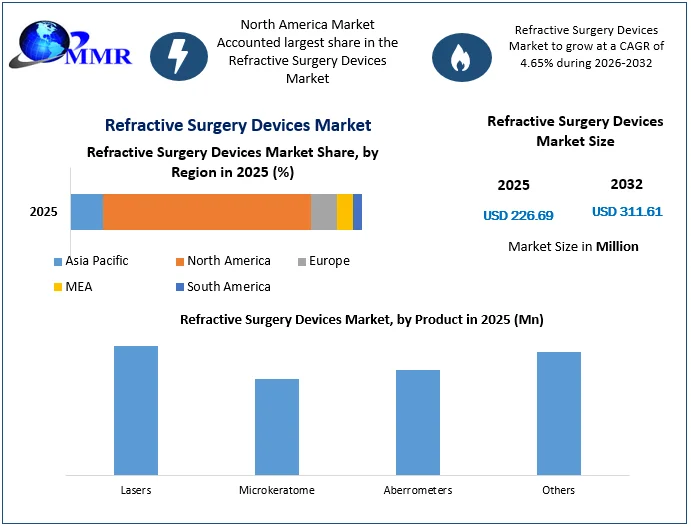
The refractive surgery devices market size was valued at USD 226.69 Million in 2025 and the Refractive Surgery Devices Market revenue is expected to reach USD 311.61 Million by 2032, at a CAGR of 4.65 % over the forecast period.

Refractive Surgery Devices Market Overview:

The refractive surgery devices market is defined by all the advanced ophthalmic equipment used to correct refractive errors such as myopia, hyperopia, and astigmatism through procedures including LASIK, PRK, and SMILE.  The Market growth of refractive surgery devices is primarily driven by the rising global prevalence of refractive errors, increasing demand for spectacle-free vision, growing awareness of elective vision-correction procedures, and continuous advancements in laser technology. At least 2.2 billion people globally have near or distance vision impairment, creating a substantial underlying need for vision-care solutions.

Technological innovation in the refractive surgery devices market is a major market trend as  manufacturers are  developing femtosecond lasers, excimer lasers, wavefront-guided systems, and topography-guided platforms that enable more personalized and precise treatments.  The adoption of minimally invasive and flapless procedures , particularly SMILE, expanding opportunities for device manufacturers. Increasing healthcare expenditure, improvements in ophthalmic surgical infrastructure, and rising disposable incomes in emerging economies are also supporting market expansion. North America remains a dominant market due to advanced healthcare infrastructure, high technology adoption, and established refractive surgery centers, while Asia-Pacific is expected to register the fastest growth, supported by its large patient population, rising prevalence of myopia, improving healthcare access, and increasing adoption of advanced ophthalmic technologies.

Refractive Surgery Devices Market size

To know about the Research Methodology:- Request Free Sample Report

Refractive Surgery Devices Market Dynamics:

Rising Prevalence of Refractive Errors is Driving Demand for Refractive Surgery Devices

The global burden of refractive errors increasing and contributing to a major factor supporting the growth of refractive surgery devices. Myopia, hyperopia, astigmatism, and presbyopia are becoming increasingly prevalent, creating a larger pool of patients seeking long-term vision correction. Minimally, 2.2 billion people globally have a vision impairment, with refractive errors representing a significant proportion of cases. The growing demand for effective alternatives to spectacles and contact lenses is encouraging the adoption of laser-based and other advanced refractive procedures.

Increasing Adoption of Minimally Invasive Laser Procedures is Supporting Market Growth

The growing preference for minimally invasive and outpatient vision-correction procedures is supporting demand for advanced refractive surgery devices. Technologies such as LASIK, PRK, SMILE, and femtosecond laser-assisted procedures offer shorter recovery periods, improved precision, and reduced dependence on corrective eyewear. Continuous improvements in laser systems, surgical planning software, and diagnostic technologies are enhancing procedure accuracy and patient outcomes.

Technological Advancements in Laser and Diagnostic Systems are Creating Market Opportunities

Advancements in femtosecond lasers, excimer lasers, wavefront-guided technology, topography-guided treatments, and artificial intelligence-assisted surgical planning are creating new opportunities for market expansion. These technologies enable surgeons to customize procedures according to individual corneal characteristics and refractive profiles. Integration of high-resolution imaging and automated treatment planning is further improving surgical precision and expanding the range of patients who can be considered for refractive procedures.

High Procedure Costs and Limited Reimbursement are Restraining Market Expansion

The relatively high cost of refractive surgery procedures and devices remains a key market restraint, particularly in emerging economies. Since refractive surgery is often considered an elective procedure and is not consistently covered by health insurance, patients may need to pay the full treatment cost themselves. This limits adoption among price-sensitive populations and creates disparities in access to advanced vision-correction procedures.

Growing Demand for Presbyopia-Correction Solutions is Creating New Growth Opportunities

The rising prevalence of presbyopia among aging populations is creating opportunities for refractive surgery device manufacturers. Increasing demand for solutions that address age-related loss of near vision is encouraging the development of presbyopia-correcting laser procedures, corneal inlays, and advanced lens-based surgical approaches. As the global population ages, the demand for technologies capable of treating multiple refractive conditions is expected to increase.

Increasing Competition from Non-Surgical Vision Correction is Challenging Market Growth

Refractive surgery devices face competition from advanced contact lenses, premium intraocular lenses, phakic IOLs, and other vision-correction technologies. Improvements in these alternatives provide patients with additional options and may influence decisions regarding permanent surgical correction. In addition, concerns about surgical complications, dry eye, recovery time, and long-term outcomes can discourage some patients from undergoing refractive procedures, creating a challenge for market expansion.

Growing Medical Tourism for Refractive Procedures is Supporting Market Development

The availability of lower-cost refractive surgery procedures in countries with established ophthalmic centers is encouraging medical tourism. Patients from developed markets may travel to destinations offering advanced LASIK, SMILE, and other laser procedures at comparatively lower costs. This trend is supporting the growth of specialized ophthalmology clinics and increasing demand for advanced refractive surgery equipment in emerging healthcare markets.

Refractive Surgery Devices Market Trends:

  • Growing Adoption of SMILE and Femtosecond Laser Technologies is Transforming the Market - The refractive surgery market is increasingly shifting toward advanced laser-based procedures such as Small Incision Lenticule Extraction (SMILE) and femtosecond laser-assisted techniques. These procedures are gaining attention due to their minimally invasive approach, smaller corneal incisions, faster recovery, and reduced disruption to corneal biomechanics. Increasing physician familiarity and growing patient preference for less invasive vision-correction procedures are supporting the adoption of next-generation laser platforms.
  • Increasing Demand for Personalized and Topography-Guided Treatments is Reshaping Refractive Surgery - A major trend is the growing use of wavefront-guided, wavefront-optimized, and topography-guided procedures that allow treatment plans to be customized according to individual corneal shape and visual characteristics. Advanced diagnostic imaging and corneal mapping are enabling ophthalmologists to identify subtle irregularities and develop more precise treatment strategies, improving the personalization of refractive surgery.
  • Integration of Artificial Intelligence and Digital Technologies is Enhancing Surgical Precision - The integration of artificial intelligence, machine learning, automated diagnostics, and digital surgical planning is emerging as an important trend. AI-supported systems can assist in patient screening, treatment planning, risk assessment, and postoperative monitoring. The increasing integration of diagnostic devices with laser platforms is also helping streamline clinical workflows and improve consistency in surgical decision-making.

Refractive Surgery Devices Market Supporting Indicators

     Value
Global People with Vision Impairment 2.2 Billion
People with Refractive Error-Related Distance Vision Impairment 88.4 Million
Projected People with Myopia by 2030 3.36 Billion
Projected People with Presbyopia by 2030 2.1 Billion
People with Near Vision Impairment 800 Million+
Global Effective Refractive Error Coverage Target by 2030 40 Percentage-Point Increase
People with Refractive Error in Low-Income Countries Without Access to Eyeglasses 2 in 3

Refractive Surgery Devices Market Segment Analysis:

The By Product segment is divided into Lasers, Microkeratome, Aberrometers, and Others. Lasers dominated the Refractive Surgery Devices Market in 2025, supported by the widespread adoption of laser-assisted procedures such as LASIK, PRK, and SMILE. Excimer and femtosecond laser systems enable precise corneal reshaping and are increasingly supported by advanced treatment-planning and diagnostic technologies. The growing preference for minimally invasive vision correction, shorter recovery periods, and improved procedural accuracy is sustaining demand for advanced laser platforms.

Aberrometers are also gaining importance as wavefront-guided and customized refractive procedures become more widely adopted. These systems help measure higher-order aberrations and support personalized treatment planning. Microkeratomes remain important for flap creation in conventional LASIK procedures, although their relative growth is being influenced by the increasing adoption of femtosecond laser technology. The Others segment includes emerging and supporting technologies that contribute to diagnostic assessment, surgical planning, and postoperative monitoring. Overall, Lasers held the dominant position in 2025, while advanced diagnostic and customized treatment technologies are expected to create further opportunities across the segment.

The By Application segment includes Myopia, Hyperopia, Astigmatism, Presbyopia, and Dry Eyes. Myopia dominated the Refractive Surgery Devices Market in 2025, driven by the high and growing global prevalence of nearsightedness and increasing demand for surgical vision correction. The rising prevalence of myopia among younger populations, particularly in urbanized and digitally intensive environments, is expanding the potential patient pool for LASIK, PRK, and SMILE procedures.

Refractive Surgery Devices Market Share by Application in 2025

Astigmatism represents another significant application because it can often be treated alongside myopia or hyperopia using customized laser procedures. Hyperopia is also contributing to market demand, although its addressable patient population is comparatively smaller. Presbyopia is expected to offer significant future growth opportunities as the global population ages and demand increases for solutions addressing age-related near-vision loss. Meanwhile, Dry Eyes represents an important consideration in refractive surgery, particularly in preoperative screening and postoperative patient management. Overall, Myopia dominated the market in 2025, while Presbyopia is expected to witness strong growth as manufacturers and ophthalmic specialists develop improved solutions for age-related vision correction.

Refractive Surgery Devices Market Regional Insights:

North America dominated the Refractive Surgery Devices Market in 2025, supported by advanced ophthalmic infrastructure, high adoption of LASIK and other laser-based procedures, strong presence of leading device manufacturers, and high patient awareness of elective vision correction. The United States remains the major contributor, supported by widespread availability of specialized ophthalmology centers, advanced diagnostic systems, and continuous adoption of femtosecond and excimer laser technologies.

Europe represents a significant market, driven by established healthcare infrastructure, increasing demand for refractive correction procedures, and growing adoption of advanced laser-assisted technologies. Countries such as Germany, the United Kingdom, France, Italy, and Spain have well-developed ophthalmic care systems and specialized refractive surgery centers. Increasing demand for personalized treatments and improvements in wavefront-guided and topography-guided procedures are supporting regional market development.

Asia Pacific is expected to be the fastest-growing region, supported by the high prevalence of myopia, particularly in East and Southeast Asia, rising healthcare expenditure, improving ophthalmic infrastructure, and increasing awareness of surgical vision correction. China, Japan, South Korea, and India represent important growth markets, while the expansion of specialized eye-care centers and medical tourism is further supporting the adoption of refractive surgery devices.

Latin America is witnessing steady market growth due to improving access to ophthalmic services, increasing disposable incomes, and growing demand for elective vision correction. Brazil and Mexico are key markets, supported by expanding private healthcare networks and specialized ophthalmology clinics. However, procedure affordability and variations in healthcare access remain challenges.

Middle East & Africa is expected to experience gradual growth as healthcare infrastructure improves and investments in specialized eye-care facilities increase. The UAE, Saudi Arabia, and South Africa are among the more developed markets for advanced ophthalmic procedures, while rising awareness of refractive surgery and medical tourism is creating additional opportunities

Refractive Surgery Devices Market Recent Developments:

Date Recent Development
13 January 2025 Carl Zeiss Meditec announced that the ZEISS MEL 90 excimer laser received U.S. FDA approval for treatment of myopia, hyperopia, and mixed astigmatism, completing its U.S. corneal refractive workflow alongside the VISUMAX 800 with SMILE pro.
26 February 2025 Carl Zeiss Meditec announced that China's National Medical Products Administration (NMPA) approved the ZEISS VISUMAX 800 with SMILE pro software for treating nearsightedness, with or without astigmatism, expanding the company's advanced femtosecond laser offering in China.
17 April 2025 ZEISS announced the U.S. availability of both the VISUMAX 800 with SMILE pro and MEL 90, strengthening its corneal refractive surgery portfolio and expanding treatment options for myopia, hyperopia, and mixed astigmatism.
2 September 2025 Carl Zeiss Meditec announced that more than 12 million eyes had been treated with ZEISS SMILE and SMILE pro globally and highlighted the expansion of SMILE pro for hyperopia, which was available in 56 countries.
12 September 2025 At the 2025 ESCRS Congress in Copenhagen, ZEISS showcased enhancements to its digitally connected corneal refractive workflow, including an updated VISULYZE 1.2 software solution integrated with ZEISS FORUM to support personalized treatment planning and workflow efficiency.
18 October 2025 ZEISS showcased its latest refractive innovations at the American Academy of Ophthalmology (AAO) 2025 meeting, highlighting continued global adoption of SMILE and SMILE pro and advancements in minimally invasive lenticule extraction.
12 June 2026 Carl Zeiss Meditec and Aier Eye Hospital Group signed a strategic agreement covering the purchase and installation of 25 ZEISS VISUMAX 800 femtosecond laser systems across Aier's domestic and international hospital network, with deployment planned to begin later in 2026.
17 June 2026 ZEISS formally announced the strategic agreement with Aier Eye Hospital Group for 25 VISUMAX 800 units, further strengthening the global expansion of its femtosecond laser platform and highlighting future collaboration in digital workflows and AI-assisted diagnosis.

Refractive Surgery Devices Market Competitive Landscape:

The Refractive Surgery Devices Market is highly competitive, with established ophthalmic technology companies and specialized laser manufacturers competing through technological innovation, product launches, clinical research, and strategic partnerships. Competition is primarily centered on excimer lasers, femtosecond lasers, SMILE platforms, wavefront-guided systems, corneal topography, and integrated diagnostic technologies. Leading companies are focusing on improving surgical precision, reducing procedure times, enhancing patient outcomes, and developing personalized treatment capabilities. The market is also witnessing increasing competition from advanced lens-based vision correction technologies and emerging minimally invasive procedures. Companies with broad ophthalmology portfolios and strong global distribution networks maintain an advantage, while specialized players are differentiating themselves through next-generation laser platforms and advanced diagnostic solutions.

Key players include Johnson & Johnson Vision, Alcon Inc., Carl Zeiss Meditec AG, Bausch + Lomb Corporation, SCHWIND eye-tech-solutions GmbH, Ziemer Ophthalmic Systems AG, NIDEK CO., LTD., Topcon Corporation, STAAR Surgical Company, and Johnson & Johnson Surgical Vision. Alcon continues to strengthen its position through its EX500 excimer laser and FS200 femtosecond laser platforms, while Carl Zeiss Meditec is expanding its refractive surgery portfolio through advanced SMILE and laser-based technologies. SCHWIND is focusing on customized laser treatments and advanced corneal correction solutions, while Ziemer is developing compact femtosecond laser platforms. Meanwhile, NIDEK and Topcon continue to strengthen their ophthalmic technology portfolios through diagnostic and surgical innovations. The competitive landscape is expected to remain dynamic as companies increasingly focus on AI-assisted planning, personalized treatment, integrated diagnostics, and minimally invasive procedures.

Refractive Surgery Devices Market Scope:Inquire before buying

Global Refractive Surgery Devices Market
Report Coverage Details
Base Year: 2025 Forecast Period: 2026-2032
Historical Data: 2020 to 2025 Market Size in 2025: US $ 226.69 Mn.
Forecast Period 2026 to 2032 CAGR: 4.65% Market Size in 2032: US $ 311.61 Mn.
Segments Covered: By Product Lasers
Microkeratome
Aberrometers
Others
By Application Myopia
Hyperopia
Astigmatism
Presbyopia
Dry Eyes
By End User Hospitals
Ambulatory Surgery Centers
Ophthalmology Clinics

Refractive Surgery Devices Market, by Region

North America (United States, Canada and Mexico)
Europe (UK, France, Germany, Italy, Spain, Sweden, Russia and Rest of Europe)
Asia Pacific (China, South Korea, Japan, India, Australia, ASEAN, and Rest of APAC)
Middle East and Africa (South Africa, GCC, and Rest of ME&A)
South America (Brazil, Argentina Rest of South America)

Leading Refractive Surgery Devices Key Players:

North America

  1. Visx (United States)
  2. Refractec LLC (United States)
  3. Avedro, Inc. (United States)
  4. LENSAR, Inc. (United States)
  5. STAAR Surgical Company (United States)
  6. Aaren-Scientific Inc. (United States)
  7. Alcon Inc. (United States)
  8. Johnson & Johnson Vision (United States)
  9. Bausch + Lomb Corporation (United States)
  10. Glaukos Corporation (United States)
  11. IRIDEX Corporation (United States)
  12. Lenstec, Inc. (United States)
  13. Tracey Technologies (United States)
  14. VisionCare Ophthalmic Technologies, Inc. (United States)
  15. Visioneering Technologies, Inc. (United States)

Europe

  1. Essilor International (France)
  2. OPHTEC B.V. (Netherlands)
  3. The HumanOptics AG (Germany)
  4. Carl Zeiss Meditec AG (Germany)
  5. iVIS Technologies S.r.l. (Italy)
  6. SCHWIND eye-tech-solutions GmbH (Germany)
  7. Rayner Intraocular Lenses Limited (United Kingdom)
  8. Ziemer Ophthalmic Systems AG (Switzerland)
  9. Oculentis B.V. (Netherlands)
  10. PhysIOL (Belgium)
  11. Oertli Instrumente AG (Switzerland)
  12. Z-LASER Optoelektronik GmbH (Germany)

Asia Pacific

  1. Topcon Corporation (Japan)
  2. HOYA Corporation (Japan)
  3. NIDEK CO., LTD. (Japan)
  4. Santen Pharmaceutical Co., Ltd. (Japan)

Middle East & Africa

  1. Lumenis Ltd. (Israel)
  2. Quantel Medical SAS (France)

Others

Frequently Asked Questions:

1. How big is the Refractive Surgery Devices market?
Ans: The global market size was estimated at USD 226.69 Million in 2025.

2. What is the Refractive Surgery Devices market growth?
Ans: The global Refractive Surgery Devices market is expected to grow at a compound annual growth rate of 4.65 % from 2026 to 2032 to reach USD 311.61 Million by 2032.

3. Which segment accounted for the largest market share?
Ans: In 2025, North America held the market's largest revenue share. The region's advanced healthcare infrastructure, increasing awareness about overall health, and a growing aging population contribute to the market's dominance.

4. Who are the key players in the Refractive Surgery Devices market?
Ans: Some key market players are Visx, Topcon corporation, Essilor, Refractec and Others.

5. What are the factors driving the market?
Ans: The Refractive Surgery Devices market is experiencing robust growth, driven by the Demand for technological advancement is rapidly increasing.

Table of Contents

1. Refractive Surgery Devices Market Introduction 1.1. Study Assumption and Market Definition 1.2. Scope of the Study 1.3. Executive Summary 2. Global Refractive Surgery Devices Market: Competitive Landscape 2.1. MMR Competition Matrix 2.2. Competitive Landscape 2.3. Key Players Benchmarking 2.3.1. Company Name 2.3.2. Business Segment 2.3.3. End-user Segment 2.3.4. Revenue (2025) 2.3.5. Company Locations 2.4. Leading Refractive Surgery Devices Market Companies, by market capitalization 2.5. Market Structure 2.5.1. Market Leaders 2.5.2. Market Followers 2.5.3. Emerging Players 2.6. Mergers and Acquisitions Details 3. Refractive Surgery Devices Market: Dynamics 3.1. Refractive Surgery Devices Market Trends by Region 3.1.1. North America Refractive Surgery Devices Market Trends 3.1.2. Europe Refractive Surgery Devices Market Trends 3.1.3. Asia Pacific Refractive Surgery Devices Market Trends 3.1.4. Middle East and Africa Refractive Surgery Devices Market Trends 3.1.5. South America Refractive Surgery Devices Market Trends 3.2. Refractive Surgery Devices Market Dynamics by Region 3.2.1. North America 3.2.1.1. North America Refractive Surgery Devices Market Drivers 3.2.1.2. North America Refractive Surgery Devices Market Restraints 3.2.1.3. North America Refractive Surgery Devices Market Opportunities 3.2.1.4. North America Refractive Surgery Devices Market Challenges 3.2.2. Europe 3.2.2.1. Europe Refractive Surgery Devices Market Drivers 3.2.2.2. Europe Refractive Surgery Devices Market Restraints 3.2.2.3. Europe Refractive Surgery Devices Market Opportunities 3.2.2.4. Europe Refractive Surgery Devices Market Challenges 3.2.3. Asia Pacific 3.2.3.1. Asia Pacific Refractive Surgery Devices Market Drivers 3.2.3.2. Asia Pacific Refractive Surgery Devices Market Restraints 3.2.3.3. Asia Pacific Refractive Surgery Devices Market Opportunities 3.2.3.4. Asia Pacific Refractive Surgery Devices Market Challenges 3.2.4. Middle East and Africa 3.2.4.1. Middle East and Africa Refractive Surgery Devices Market Drivers 3.2.4.2. Middle East and Africa Refractive Surgery Devices Market Restraints 3.2.4.3. Middle East and Africa Refractive Surgery Devices Market Opportunities 3.2.4.4. Middle East and Africa Refractive Surgery Devices Market Challenges 3.2.5. South America 3.2.5.1. South America Refractive Surgery Devices Market Drivers 3.2.5.2. South America Refractive Surgery Devices Market Restraints 3.2.5.3. South America Refractive Surgery Devices Market Opportunities 3.2.5.4. South America Refractive Surgery Devices Market Challenges 3.3. PORTER's Five Forces Analysis 3.4. PESTLE Analysis 3.5. Technology Roadmap 3.6. Regulatory Landscape by Region 3.6.1. North America 3.6.2. Europe 3.6.3. Asia Pacific 3.6.4. Middle East and Africa 3.6.5. South America 3.7. Key Opinion Leader Analysis For Refractive Surgery Devices Industry 3.8. Analysis of Government Schemes and Initiatives For Refractive Surgery Devices Industry 3.9. Refractive Surgery Devices Market Trade Analysis 3.10. The Global Pandemic Impact on Refractive Surgery Devices Market 4. Refractive Surgery Devices Market: Global Market Size and Forecast by Segmentation (in USD Billion) 2025-2032 4.1. Refractive Surgery Devices Market Size and Forecast, by Product (2025-2032) 4.1.1. Lasers 4.1.2. Microkeratome 4.1.3. Aberrometers 4.1.4. Others 4.2. Refractive Surgery Devices Market Size and Forecast, by Application (2025-2032) 4.2.1. Myopia 4.2.2. Hyperopia 4.2.3. Astigmatism 4.2.4. Presbyopia 4.2.5. Dry Eyes 4.3. Refractive Surgery Devices Market Size and Forecast, by End User (2025-2032) 4.3.1. Hospitals 4.3.2. Ambulatory Surgery Centers 4.3.3. Ophthalmology Clinics 4.4. Refractive Surgery Devices Market Size and Forecast, by Region (2025-2032) 4.4.1. North America 4.4.2. Europe 4.4.3. Asia Pacific 4.4.4. Middle East and Africa 4.4.5. South America 5. North America Refractive Surgery Devices Market Size and Forecast by Segmentation (in USD Billion) 2025-2032 5.1. North America Refractive Surgery Devices Market Size and Forecast, by Product (2025-2032) 5.1.1. Lasers 5.1.2. Microkeratome 5.1.3. Aberrometers 5.1.4. Others 5.2. North America Refractive Surgery Devices Market Size and Forecast, by Application (2025-2032) 5.2.1. Myopia 5.2.2. Hyperopia 5.2.3. Astigmatism 5.2.4. Presbyopia 5.2.5. Dry Eyes 5.3. North America Refractive Surgery Devices Market Size and Forecast, by End User (2025-2032) 5.3.1. Hospitals 5.3.2. Ambulatory Surgery Centers 5.3.3. Ophthalmology Clinics 5.4. North America Refractive Surgery Devices Market Size and Forecast, by Country (2025-2032) 5.4.1. United States 5.4.1.1. United States Refractive Surgery Devices Market Size and Forecast, by Product (2025-2032) 5.4.1.1.1. Lasers 5.4.1.1.2. Microkeratome 5.4.1.1.3. Aberrometers 5.4.1.1.4. Others 5.4.1.2. United States Refractive Surgery Devices Market Size and Forecast, by Application (2025-2032) 5.4.1.2.1. Myopia 5.4.1.2.2. Hyperopia 5.4.1.2.3. Astigmatism 5.4.1.2.4. Presbyopia 5.4.1.2.5. Dry Eyes 5.4.1.3. United States Refractive Surgery Devices Market Size and Forecast, by End User (2025-2032) 5.4.1.3.1. Hospitals 5.4.1.3.2. Ambulatory Surgery Centers 5.4.1.3.3. Ophthalmology Clinics 5.4.2. Canada 5.4.2.1. Canada Refractive Surgery Devices Market Size and Forecast, by Product (2025-2032) 5.4.2.1.1. Lasers 5.4.2.1.2. Microkeratome 5.4.2.1.3. Aberrometers 5.4.2.1.4. Others 5.4.2.2. Canada Refractive Surgery Devices Market Size and Forecast, by Application (2025-2032) 5.4.2.2.1. Myopia 5.4.2.2.2. Hyperopia 5.4.2.2.3. Astigmatism 5.4.2.2.4. Presbyopia 5.4.2.2.5. Dry Eyes 5.4.2.3. Canada Refractive Surgery Devices Market Size and Forecast, by End User (2025-2032) 5.4.2.3.1. Hospitals 5.4.2.3.2. Ambulatory Surgery Centers 5.4.2.3.3. Ophthalmology Clinics 5.4.3. Mexico 5.4.3.1. Mexico Refractive Surgery Devices Market Size and Forecast, by Product (2025-2032) 5.4.3.1.1. Lasers 5.4.3.1.2. Microkeratome 5.4.3.1.3. Aberrometers 5.4.3.1.4. Others 5.4.3.2. Mexico Refractive Surgery Devices Market Size and Forecast, by Application (2025-2032) 5.4.3.2.1. Myopia 5.4.3.2.2. Hyperopia 5.4.3.2.3. Astigmatism 5.4.3.2.4. Presbyopia 5.4.3.2.5. Dry Eyes 5.4.3.3. Mexico Refractive Surgery Devices Market Size and Forecast, by End User (2025-2032) 5.4.3.3.1. Hospitals 5.4.3.3.2. Ambulatory Surgery Centers 5.4.3.3.3. Ophthalmology Clinics 6. Europe Refractive Surgery Devices Market Size and Forecast by Segmentation (in USD Billion) 2025-2032 6.1. Europe Refractive Surgery Devices Market Size and Forecast, by Product (2025-2032) 6.2. Europe Refractive Surgery Devices Market Size and Forecast, by Application (2025-2032) 6.3. Europe Refractive Surgery Devices Market Size and Forecast, by End User (2025-2032) 6.4. Europe Refractive Surgery Devices Market Size and Forecast, by Country (2025-2032) 6.4.1. United Kingdom 6.4.1.1. United Kingdom Refractive Surgery Devices Market Size and Forecast, by Product (2025-2032) 6.4.1.2. United Kingdom Refractive Surgery Devices Market Size and Forecast, by Application (2025-2032) 6.4.1.3. United Kingdom Refractive Surgery Devices Market Size and Forecast, by End User (2025-2032) 6.4.2. France 6.4.2.1. France Refractive Surgery Devices Market Size and Forecast, by Product (2025-2032) 6.4.2.2. France Refractive Surgery Devices Market Size and Forecast, by Application (2025-2032) 6.4.2.3. France Refractive Surgery Devices Market Size and Forecast, by End User (2025-2032) 6.4.3. Germany 6.4.3.1. Germany Refractive Surgery Devices Market Size and Forecast, by Product (2025-2032) 6.4.3.2. Germany Refractive Surgery Devices Market Size and Forecast, by Application (2025-2032) 6.4.3.3. Germany Refractive Surgery Devices Market Size and Forecast, by End User (2025-2032) 6.4.4. Italy 6.4.4.1. Italy Refractive Surgery Devices Market Size and Forecast, by Product (2025-2032) 6.4.4.2. Italy Refractive Surgery Devices Market Size and Forecast, by Application (2025-2032) 6.4.4.3. Italy Refractive Surgery Devices Market Size and Forecast, by End User (2025-2032) 6.4.5. Spain 6.4.5.1. Spain Refractive Surgery Devices Market Size and Forecast, by Product (2025-2032) 6.4.5.2. Spain Refractive Surgery Devices Market Size and Forecast, by Application (2025-2032) 6.4.5.3. Spain Refractive Surgery Devices Market Size and Forecast, by End User (2025-2032) 6.4.6. Sweden 6.4.6.1. Sweden Refractive Surgery Devices Market Size and Forecast, by Product (2025-2032) 6.4.6.2. Sweden Refractive Surgery Devices Market Size and Forecast, by Application (2025-2032) 6.4.6.3. Sweden Refractive Surgery Devices Market Size and Forecast, by End User (2025-2032) 6.4.7. Austria 6.4.7.1. Austria Refractive Surgery Devices Market Size and Forecast, by Product (2025-2032) 6.4.7.2. Austria Refractive Surgery Devices Market Size and Forecast, by Application (2025-2032) 6.4.7.3. Austria Refractive Surgery Devices Market Size and Forecast, by End User (2025-2032) 6.4.8. Rest of Europe 6.4.8.1. Rest of Europe Refractive Surgery Devices Market Size and Forecast, by Product (2025-2032) 6.4.8.2. Rest of Europe Refractive Surgery Devices Market Size and Forecast, by Application (2025-2032) 6.4.8.3. Rest of Europe Refractive Surgery Devices Market Size and Forecast, by End User (2025-2032) 7. Asia Pacific Refractive Surgery Devices Market Size and Forecast by Segmentation (in USD Billion) 2025-2032 7.1. Asia Pacific Refractive Surgery Devices Market Size and Forecast, by Product (2025-2032) 7.2. Asia Pacific Refractive Surgery Devices Market Size and Forecast, by Application (2025-2032) 7.3. Asia Pacific Refractive Surgery Devices Market Size and Forecast, by End User (2025-2032) 7.4. Asia Pacific Refractive Surgery Devices Market Size and Forecast, by Country (2025-2032) 7.4.1. China 7.4.1.1. China Refractive Surgery Devices Market Size and Forecast, by Product (2025-2032) 7.4.1.2. China Refractive Surgery Devices Market Size and Forecast, by Application (2025-2032) 7.4.1.3. China Refractive Surgery Devices Market Size and Forecast, by End User (2025-2032) 7.4.2. S Korea 7.4.2.1. S Korea Refractive Surgery Devices Market Size and Forecast, by Product (2025-2032) 7.4.2.2. S Korea Refractive Surgery Devices Market Size and Forecast, by Application (2025-2032) 7.4.2.3. S Korea Refractive Surgery Devices Market Size and Forecast, by End User (2025-2032) 7.4.3. Japan 7.4.3.1. Japan Refractive Surgery Devices Market Size and Forecast, by Product (2025-2032) 7.4.3.2. Japan Refractive Surgery Devices Market Size and Forecast, by Application (2025-2032) 7.4.3.3. Japan Refractive Surgery Devices Market Size and Forecast, by End User (2025-2032) 7.4.4. India 7.4.4.1. India Refractive Surgery Devices Market Size and Forecast, by Product (2025-2032) 7.4.4.2. India Refractive Surgery Devices Market Size and Forecast, by Application (2025-2032) 7.4.4.3. India Refractive Surgery Devices Market Size and Forecast, by End User (2025-2032) 7.4.5. Australia 7.4.5.1. Australia Refractive Surgery Devices Market Size and Forecast, by Product (2025-2032) 7.4.5.2. Australia Refractive Surgery Devices Market Size and Forecast, by Application (2025-2032) 7.4.5.3. Australia Refractive Surgery Devices Market Size and Forecast, by End User (2025-2032) 7.4.6. Indonesia 7.4.6.1. Indonesia Refractive Surgery Devices Market Size and Forecast, by Product (2025-2032) 7.4.6.2. Indonesia Refractive Surgery Devices Market Size and Forecast, by Application (2025-2032) 7.4.6.3. Indonesia Refractive Surgery Devices Market Size and Forecast, by End User (2025-2032) 7.4.7. Malaysia 7.4.7.1. Malaysia Refractive Surgery Devices Market Size and Forecast, by Product (2025-2032) 7.4.7.2. Malaysia Refractive Surgery Devices Market Size and Forecast, by Application (2025-2032) 7.4.7.3. Malaysia Refractive Surgery Devices Market Size and Forecast, by End User (2025-2032) 7.4.8. Vietnam 7.4.8.1. Vietnam Refractive Surgery Devices Market Size and Forecast, by Product (2025-2032) 7.4.8.2. Vietnam Refractive Surgery Devices Market Size and Forecast, by Application (2025-2032) 7.4.8.3. Vietnam Refractive Surgery Devices Market Size and Forecast, by End User (2025-2032) 7.4.9. Taiwan 7.4.9.1. Taiwan Refractive Surgery Devices Market Size and Forecast, by Product (2025-2032) 7.4.9.2. Taiwan Refractive Surgery Devices Market Size and Forecast, by Application (2025-2032) 7.4.9.3. Taiwan Refractive Surgery Devices Market Size and Forecast, by End User (2025-2032) 7.4.10. Rest of Asia Pacific 7.4.10.1. Rest of Asia Pacific Refractive Surgery Devices Market Size and Forecast, by Product (2025-2032) 7.4.10.2. Rest of Asia Pacific Refractive Surgery Devices Market Size and Forecast, by Application (2025-2032) 7.4.10.3. Rest of Asia Pacific Refractive Surgery Devices Market Size and Forecast, by End User (2025-2032) 8. Middle East and Africa Refractive Surgery Devices Market Size and Forecast by Segmentation (in USD Billion) 2025-2032 8.1. Middle East and Africa Refractive Surgery Devices Market Size and Forecast, by Product (2025-2032) 8.2. Middle East and Africa Refractive Surgery Devices Market Size and Forecast, by Application (2025-2032) 8.3. Middle East and Africa Refractive Surgery Devices Market Size and Forecast, by End User (2025-2032) 8.4. Middle East and Africa Refractive Surgery Devices Market Size and Forecast, by Country (2025-2032) 8.4.1. South Africa 8.4.1.1. South Africa Refractive Surgery Devices Market Size and Forecast, by Product (2025-2032) 8.4.1.2. South Africa Refractive Surgery Devices Market Size and Forecast, by Application (2025-2032) 8.4.1.3. South Africa Refractive Surgery Devices Market Size and Forecast, by End User (2025-2032) 8.4.2. GCC 8.4.2.1. GCC Refractive Surgery Devices Market Size and Forecast, by Product (2025-2032) 8.4.2.2. GCC Refractive Surgery Devices Market Size and Forecast, by Application (2025-2032) 8.4.2.3. GCC Refractive Surgery Devices Market Size and Forecast, by End User (2025-2032) 8.4.3. Nigeria 8.4.3.1. Nigeria Refractive Surgery Devices Market Size and Forecast, by Product (2025-2032) 8.4.3.2. Nigeria Refractive Surgery Devices Market Size and Forecast, by Application (2025-2032) 8.4.3.3. Nigeria Refractive Surgery Devices Market Size and Forecast, by End User (2025-2032) 8.4.4. Rest of ME&A 8.4.4.1. Rest of ME&A Refractive Surgery Devices Market Size and Forecast, by Product (2025-2032) 8.4.4.2. Rest of ME&A Refractive Surgery Devices Market Size and Forecast, by Application (2025-2032) 8.4.4.3. Rest of ME&A Refractive Surgery Devices Market Size and Forecast, by End User (2025-2032) 9. South America Refractive Surgery Devices Market Size and Forecast by Segmentation (in USD Billion) 2025-2032 9.1. South America Refractive Surgery Devices Market Size and Forecast, by Product (2025-2032) 9.2. South America Refractive Surgery Devices Market Size and Forecast, by Application (2025-2032) 9.3. South America Refractive Surgery Devices Market Size and Forecast, by End User (2025-2032) 9.4. South America Refractive Surgery Devices Market Size and Forecast, by Country (2025-2032) 9.4.1. Brazil 9.4.1.1. Brazil Refractive Surgery Devices Market Size and Forecast, by Product (2025-2032) 9.4.1.2. Brazil Refractive Surgery Devices Market Size and Forecast, by Application (2025-2032) 9.4.1.3. Brazil Refractive Surgery Devices Market Size and Forecast, by End User (2025-2032) 9.4.2. Argentina 9.4.2.1. Argentina Refractive Surgery Devices Market Size and Forecast, by Product (2025-2032) 9.4.2.2. Argentina Refractive Surgery Devices Market Size and Forecast, by Application (2025-2032) 9.4.2.3. Argentina Refractive Surgery Devices Market Size and Forecast, by End User (2025-2032) 9.4.3. Rest Of South America 9.4.3.1. Rest Of South America Refractive Surgery Devices Market Size and Forecast, by Product (2025-2032) 9.4.3.2. Rest Of South America Refractive Surgery Devices Market Size and Forecast, by Application (2025-2032) 9.4.3.3. Rest Of South America Refractive Surgery Devices Market Size and Forecast, by End User (2025-2032) 10. Company Profile: Key Players 10.1. 1. Visx 10.1.1. Company Overview 10.1.2. Business Portfolio 10.1.3. Financial Overview 10.1.4. SWOT Analysis 10.1.5. Strategic Analysis 10.1.6. Scale of Operation (small, medium, and large) 10.1.7. Details on Partnership 10.1.8. Regulatory Accreditations and Certifications Received by Them 10.1.9. Awards Received by the Firm 10.1.10. Recent Developments 10.2. 2. Topcon corporation 10.3. 3. Essilor 10.4. 4. Refractec 10.5. 5. HOYA Corporation 10.6. 6. Aaren-Scientific Inc 10.7. 7. OPHTEC BV 10.8. 8. The HumanOptics AG 10.9. 9. STAAR 10.10. 10. Avedro 10.11. 11. Nidek 10.12. 12. Lensar 10.13. 13. iVIS Technologies 10.14. 14. Carl Zeiss AG 10.15. 15. Refractec 10.16. 16. Lumenis Ltd 11. Key Findings 12. Industry Recommendations 13. Refractive Surgery Devices Market: Research Methodology 14. Terms and Glossary

Custom Market Research Services

We Will Customise The Research For You, In Case The Report Listed Above Does Not Meet With Your Requirements