
Rapid Microbiology Testing Market Size by Product, End-User, Application and Region – Segment-Level Market Assessment, Growth Opportunity Analysis, Competitive Mapping & Forecast to 2032
Overview
Rapid Microbiology Testing Market size was valued at USD 5.49 Billion in 2025 and the total revenue is expected to grow at a CAGR of 9.4% from 2025 to 2032, reaching nearly USD 10.3 Billion.
Rapid Microbiology Testing Market Overview:
The Rapid Microbiology Testing Market analyzes and forecasts the market size in terms of value for the market (Billion). Further, the Rapid Microbiology Testing Market is segmented by Product, Application, End-User, and Region. Based on Product, the market is segmented into Instruments, Reagents and Kits, and Consumables. Based on Application, the market has been segmented into Clinical Disease Diagnosis, Food and Beverage Testing, Pharmaceutical and Biological Drug Testing, Environmental Testing, Cosmetics and Personal Care Products Testing, Research Applications, and Others. By End-User, the market is divided into Laboratories & Hospitals, Pharmaceuticals and Biotechnology Companies, Contract Research Organizations, and Others. North America is the dominant player in the market. The report thoroughly analyzes market drivers, limitations, and opportunities.
Microbiology is the division of medical science that contracts with the handling, diagnosis, and stoppage of infectious diseases. Rapid microbiology testing helps to increase product safety profiles, track crucial control points in real-time, identify microbial hazards more quickly, enhance production processes, and reduce overall costs of quality programs. Rapid microbiology testing Application is also termed microbiological Applications and these are the type of technologies that are beneficial to get microbiology test outcomes faster as compared to outdated culture-plate Applications.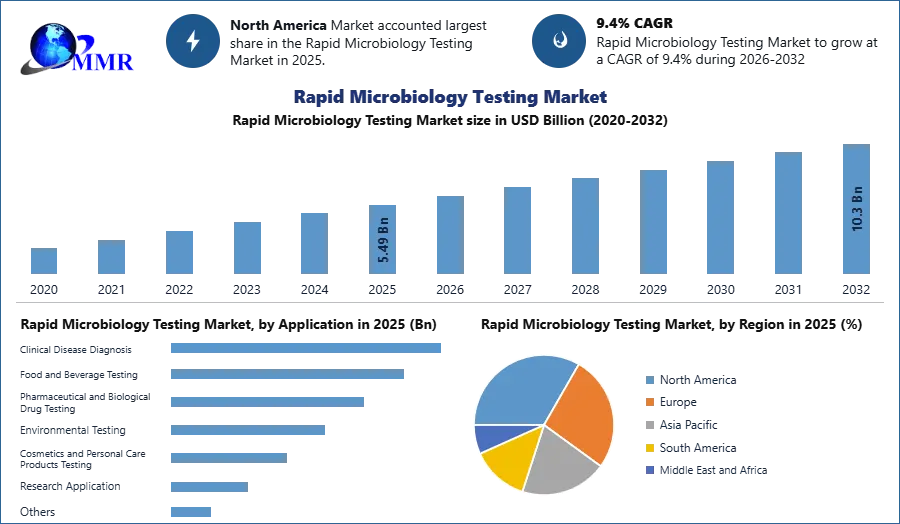 To Know About The Research Methodology :- Request Free Sample Report
Global Rapid Microbiology Testing Market Dynamics:
Quick technologies in microbial detection are used to differentiate microbes from many samples in clinical diagnostics, food and beverage testing, and environmental End-Users. This Application is extensively used in medication, drug production, and other biotechnology grounds. By dropping the per-procedure consumable rate, these tests offer a profitable alternate for microbial identification. Growing food safety worries is the dynamic factor rising the market growth, rising fund, investigating allowances, and public-private funds, rising acceptance of microbiology testing for the analysis of infectious diseases in humans, increasing importance of effective and early disease diagnosis, an increasing number of research activities, rise in the number of infectious diseases and surge in the technological advancements are the major factors among others driving the rapid microbiology testing market.
Also, growing management initiatives for the discovery of antimicrobial resistance, increasing emerging countries, and rising bioterrorism investigation are expected to create new opportunities for the rapid microbiology testing market during the forecasted period. The rising unfavorable compensation rules and the increasing cost of the rapid microbiology testing market are the major factors anticipated to obstruct the market growth during the forecast period.
Rising Rates of Cancer and Infectious Diseases
Numerous infectious diseases, including HIV, tuberculosis, malaria, and pneumonia, are now very common. The demand for rapid microbiology techniques for quicker and more accurate microbial screening, identification, and vulnerability testing against pathogens is anticipated to experience important growth during the forecast period because of the increase in the global burden of these diseases.
Emerging Nations Offer Potential for Growth
Players in the market for rapid microbiology testing have numerous chances to grow in emerging economies like India, South Korea, Brazil, and Mexico. This can be linked to a lack of regulatory obstacles, advancements in healthcare infrastructure, an increase in the number of patients, an increase in the prevalence of infectious diseases, and rising healthcare costs. The regulatory frameworks in some of these nations are more flexible and business-friendly than those in developed nations, which has driven major participants in the market for quick microbiological testing to focus on emerging nations.
High capital Expenditure and Poor Cost-Benefit Ratio
Due to the high drug erosion in clinical trials (with almost 30% of medicines failing in Phase III), diagnostic manufacturers are exposed to substantial monetary tasks. Important capital investments are required for the discovery, development, and validation of efficient rapid tests. Manufacturers require completed phase III clinical trials to receive regulatory approval for in vitro diagnostic (IVD). Huge investments are essential to run clinical trials and address strict regulatory requirements, which not only affect the potential of small companies to develop tests but also strictly affect innovation. Therefore, in addition to the high amount of capital savings, the low cost-benefit share is hampering the growth of the fast microbiology testing market.
Operative Barriers
Clinical laboratories across main markets are still developing; experts face operational tests in confirming active sample finding, storage, and carriage, especially while approving novel skills such as NGS and lab-on-a-chip PCR devices. Laboratory space also needs to be reconfigured to meet the necessities of directing specific diagnostic tests used for pathogen recognition as a means of avoiding cross-contamination and confirming efficient time management. This outcomes in significant cost appreciation to maintain and operate innovative rapid microbiology tests, particularly those capable of handling a single trial. Also, due to the quick transformation of microbes and the growing outburst of epidemics, clinical laboratories need to implement innovative technologies skilled in rapid sample diagnosis.
Rapid Microbiology Testing Market Segment Analysis
Based on Type, the instruments segment accounted for the largest share of the rapid microbiology testing market because of the increased money for R&D, growing incidence of infectious disease and cancer, and technological developments.
Based on End-User, the clinical disease diagnostics segment accounted for the largest share of the rapid microbiology testing market. The rising incidence of infectious diseases and cancer is fuelling the growth of this segment.
Rapid Microbiology Testing Market Competitive Landscape
The quick microbiology testing market also provides a detailed market analysis of every nation’s growing healthcare expenditure for capital equipment, the fixed base of different kinds of goods for the rapid microbiology testing market, the effect of technology using support curves, and variations in healthcare governing situations and their influence on the speedy microbiology testing market. The fast microbiology testing market competitive landscape provides details by a competitor.
The major players in the market are Abbott, BD, BioMerieux SA, Bruker, Neogen Corporation, Quidel Corporation, Rapid Micro Biosystem Inc., TSI, Vivione Biosciences Inc., ERBA Diagnostics, Vedalab, Rtalabs, Shimadzu Corporation., Pall Corporation. and Mocon, Sartorius Group, Thermo Fisher Scientific, Charles River, Danaher, Don Whitley Scientific Limited, Merck KGaA.
Rapid Microbiology Testing Market Regional Insights:
The North American region held the largest market share and is expected to witness significant growth during the forecast period. The factors attributed to the growth are the occurrence of infectious diseases, R & D funding, and increased attention to early disease detection. The government of Canada and the United States supports in the form of compensation programs and health insurance, support the development of the regional market. Europe is anticipated to show the highest growth rate during the forecast period because of the introduction of advanced microbiological testing in the region and technological advances.
The objective of the report is to present a comprehensive analysis of the global Rapid Microbiology Testing Market to the stakeholders in the industry. The past and current status of the industry with the forecasted market size and trends are presented in the report with the analysis of complicated data in simple language. The report covers all the aspects of the industry with a dedicated study of key players that include market leaders, followers, and new entrants
PORTER, PESTEL analysis with the potential impact of micro-economic factors of the market have been presented in the report. External as well as internal factors that are supposed to affect the business positively or negatively have been analyzed, which will give a clear futuristic view of the industry to the decision-makers.
The reports also help in understanding the Rapid Microbiology Testing Market dynamic, and structure by analyzing the market segments and projecting the Rapid Microbiology Testing Market size. Clear representation of competitive analysis of key players by Design, price, financial position, product portfolio, growth strategies, and regional presence in the Rapid Microbiology Testing Market make the report investor’s guide.
Rapid Microbiology Testing Market Scope: Inquire before buying
| Rapid Microbiology Testing Market | |||
|---|---|---|---|
| Report Coverage | Details | ||
| Base Year: | 2025 | Forecast Period: | 2026-2032 |
| Historical Data: | 2020 to 2025 | Market Size in 2025: | 5.49 USD Billion |
| Forecast Period 2026-2032 CAGR: | 9.4% | Market Size in 2032: | 10.3 USD Billion |
| Segments Covered: | by Product | Instruments Reagents and Kits Consumables |
|
| by Testing Method | Growth-Based Rapid Microbiology Testing Cellular Component-Based Testing Nucleic Acid-Based Testing Viability-Based Rapid Testing Culture-Independent Diagnostic Testing |
||
| by Application | Clinical Disease Diagnosis Food and Beverage Testing Pharmaceutical and Biological Drug Testing Environmental Testing Cosmetics and Personal Care Products Testing Research Application Others |
||
| by End-User | Laboratories & Hospitals Pharmaceuticals and Biotechnology Companies Contract Research Organizations Others |
||
Rapid Microbiology Testing Market, by Region
North America (United States, Canada and Mexico)
Europe (UK, France, Germany, Italy, Spain, Sweden, Austria and Rest of Europe)
Asia Pacific (China, South Korea, Japan, India, Australia, Indonesia, Malaysia, Vietnam, Taiwan, Bangladesh, Pakistan and Rest of APAC)
Middle East and Africa (South Africa, GCC, Egypt, Nigeria and Rest of ME&A)
South America (Brazil, Argentina Rest of South America
Global Rapid Microbiology Testing Market key players
- Abbott Laboratories, Inc.
- Becton, Dickinson and Company
- bioMérieux SA
- Bruker Corporation
- Charles River Laboratories International, Inc.
- Danaher Corporation
- Don Whitley Scientific Limited
- Merck KGaA
- Neogen Corporation
- Quidel Corporation (US)
- Rapid Micro Biosystems, Inc.
- Sartorius AG
- Thermo Fisher Scientific (US)
- TSI Incorporated
- Vivione Biosciences LLC
- ERBA Diagnostics, Inc.
- VedaLab
- Rtalabs
- Shimadzu Corporation
- Pall Corporation
- Hygiena, LLC
- R-Biopharm AG
- Gradientech AB
- rqmicro AG
- Colifast AS