
Raman Spectroscopy Market - Industry Structure Evaluation, Demand Drivers Analysis, Regional Growth Analysis and Identification, Competitive Positioning / Landscape Review & Global Market Size Forecast to 2034
Overview
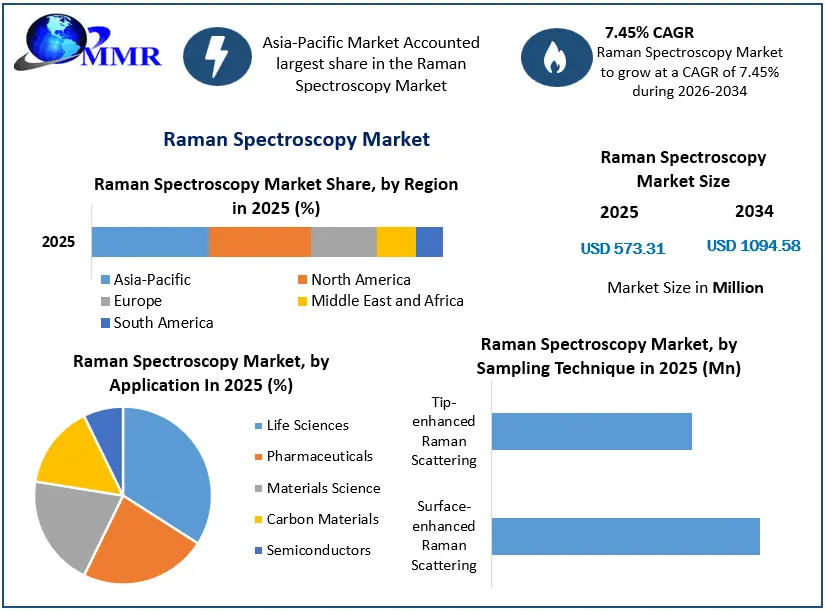
The Raman Spectroscopy Market size was valued at USD 573.31 Million in 2025 and the total Raman Spectroscopy Market size is expected to grow at a CAGR of 7.45% from 2026 to 2034, reaching nearly USD 1094.58 Million by 2034.
Raman Spectroscopy Market Overview:
The Raman spectroscopy (named after Indian physicist C. V. Raman) is a spectroscopic technique that is most commonly used to determine the vibrational modes of molecules, however, it may also detect rotational and other low-frequency modes of systems. In chemistry, Raman spectroscopy is often used to provide a structural fingerprint that may be used to identify compounds. Raman spectroscopy relies on Raman scattering, which is the inelastic scattering of photons.
A monochromatic light source is used, which is commonly a laser in the visible, near-infrared, or near-ultraviolet spectrum, though X-rays can also be used. The energy of the laser photons is pushed up or down as the laser light interacts with molecular vibrations, phonons, or other excitations in the system. The energy shift reveals information about the system's vibrational modes.
Raman Spectroscopy Market Growth Analysis
To know about the Research Methodology :- Request Free Sample Report
Raman Spectroscopy Market Dynamics:
The key factors that drive the Global Raman spectroscopy market are the increased focus on drug development in healthcare, as well as the rising acceptance of Raman spectroscopy in clinical applications.
Raman spectroscopy's analytical techniques are increasingly being used at different stages of drug discovery and development. Chemical identification, molecular biology research, and diagnostics, preformulation, solid form screening, bioanalysis, formulation analytics in late-phase drug development, process analytics, quality control, raw material certification, and counterfeit detection is one of the areas covered. Preformulation studies are an important part of the drug development process, and they are used to learn about the physicochemical properties of potential medications in order to help with formulation creation for preclinical and clinical studies.
Solid-form screening is an important step in drug development, with the goal of identifying the best solid form of a prospective therapeutic molecule as early as possible. This decreases the number of issues that arise later in the medication development process. The lattice vibrations of various solid forms produce unique and distinctive Raman spectra for each of them. Raman spectroscopy is thus a significant occurrence in the pharmaceutical industry. Furthermore, Raman spectroscopy has been widely used to better understand phase transformations such as polymorphic alterations, anhydrate hydrate transitions, and the mechanics of co-crystal formation.
The demand for Raman spectroscopy is expected to rise during the forecast period as the healthcare industry places a stronger focus on drug development. Market growth is also expected to be driven by increased pharmaceutical R&D investments.
Despite the various advantages, Raman spectroscopy is not preferred for usage in a variety of applications. The main reason for this is the high cost of Raman analyser systems. When compared to its counterparts, Raman analysers are significantly more expensive. This is due to the excitation laser and detector are quite expensive. Due to laser lifetimes and associated replacement costs, Raman systems can be more expensive to maintain over time. Almost all analytical Raman systems are laser-safe Class I products. Raman spectrometers, on the other hand, are non-destructive and non-contact, thus they don't require consumables or sample preparation, lowering the cost.
A high-resolution and high signal-to-noise ratio Raman analyser costs around USD 40,000 and up right now. Low-cost Raman analyser systems, on the other hand, are in demand as general laboratory tools. Those systems, on the other hand, are typically equipped with poor-resolution, low-power visible lasers, and low signal-to-noise ratios, making them insufficient for performing any high-performance chemical analysis. As a result, higher-resolution and lower-cost Raman systems are critical for boosting and enabling Raman spectroscopy acceptability and usage. As a result, market growth is restrained by high ownership costs. These are the major factors that restrict the growth of the global market in the forecast period.
Raman Spectroscopy Market Segment Analysis:
Based on By Instrument, in 2025, Microscopy Raman is expected to dominate the Raman Spectroscopy market because of its advanced capabilities in providing high spatial resolution, which is crucial for analyzing microstructures in materials science, biology, and pharmaceuticals. These instruments enable detailed imaging and chemical analysis at the microscopic level, which is vital for precise diagnostics and research. Technological advancements in Raman microscopy have improved sensitivity, specificity, and data quality, making them essential in fields like drug development and quality control.
Additionally, the growing demand for non-destructive analysis in various industries, such as healthcare, materials science, and environmental monitoring, contributes to the increasing preference for Microscopy Raman instruments. The versatility and integration of these tools in both research and industrial applications are key factors driving their market dominance in 2025.
Based on the Sampling Technique, the market is segmented into Surface-Enhanced Raman Scattering (SERS), Tip Enhanced Raman Scattering (TERS), and Others. Surface Enhanced Raman Scattering (SERS) segment is expected to grow rapidly at a CAGR of xx% during the forecast period 2026-2034.
The continuous technological development of nanotechnology, as well as extensive theoretical and experimental research, have significantly broadened the scope of surface-enhanced Raman scattering and increased its demand in pharmaceutical, life science, and material science research, contributing to the segment's growth. Compared to other Raman spectroscopic sampling techniques, SERS has significant advantages. Due to the considerable increase in signal intensity, a far larger concentration range can be examined, with detection limits that are much lower than those of conventional Raman scattering. These are the factors that drive the growth of the Surface Enhanced Raman Scattering (SERS) segment in the global market in the forecast period.
Based on the Application, the market is segmented into Pharmaceutical, Life Science, Materials Science, Carbon Material, Semiconductor, and Others. The pharmaceutical application segment is expected to grow rapidly at a CAGR of xx% during the forecast period 2026-2034.
The surge in the use of solid-state pharmaceutical products in both industry and academia can be attributed to the pharmaceutical segment's growth. Raman spectroscopy is in high demand in the pharmaceutical industry due to its capacity to visualize drug and excipient distribution in pharmaceutical formulations such as tablets, creams, and ointments. Furthermore, Raman spectroscopy-based spectral characterization of pharmaceuticals has some additional advantages, such as the selection and optimization of active medicinal components (APIs). Raman spectroscopy does not require a reference light channel as it is a scattering technique. As a result, it is fiber optics compatible and enables remote sampling.
Raman spectroscopy can also achieve higher lateral spatial and depth resolution. These are the key factors of the pharmaceutical application segment that drives the growth in the global market in the forecast period.
Raman Spectroscopy Market Regional Insights:
Asia Pacific dominates the Global Market during the forecast period 2026-2034. Asia Pacific is expected to hold the largest market shares of xx% by 2034. The factors that drives the growth in Asia Pacific region in the global market are the increased demand for pharmaceutical, life science, and materials science applications in nations like China, Japan, South Korea, and India. Furthermore, the presence of a high number of pharmaceutical and life science companies as well as contract manufacturing organizations (CMOs) in the Asia Pacific region is driving the global Raman spectroscopy market in the forecast period.
The objective of the report is to present a comprehensive analysis of the Global Raman Spectroscopy Market to the stakeholders in the industry. The past and current status of the industry with the forecasted market size and trends are presented in the report with the analysis of complicated data in simple language. The report covers all the aspects of the industry with a dedicated study of key players that include market leaders, followers, and new entrants.
PORTER, PESTEL analysis with the potential impact of micro-economic factors of the market have been presented in the report. External as well as internal factors that are supposed to affect the business positively or negatively have been analyzed, which will give a clear futuristic view of the industry to the decision-makers.
The reports also helps in understanding the Global Raman Spectroscopy Market dynamic, structure by analyzing the market segments and project the Global Raman Spectroscopy Market size. Clear representation of competitive analysis of key players by product, price, financial position, product portfolio, growth strategies, and regional presence in the Global Raman Spectroscopy Market make the report investor’s guide.
Raman Spectroscopy Market Recent Industry Developments
| Date | Company | Development | Impact |
|---|---|---|---|
| 15 January 2026 | Renishaw plc | Renishaw announced the commercial integration of Time-resolved Raman Spectroscopy (TRRS) into its flagship inVia confocal Raman microscopes. | This upgrade significantly suppresses background fluorescence noise to enable precise molecular characterization of complex biological and photoluminescent samples. |
| 13 May 2025 | DialAct Corporation / ELODIZ Ltd. | DialAct Corporation partnered with ELODIZ Ltd. to launch a series of FDA-registered multi-laser Raman spectrometers across North American research and industrial QA markets. | The collaboration expands localized technical support and regulatory-compliant research instrumentation for U.S. pharmaceutical and manufacturing facilities. |
| 14 October 2025 | Metrohm AG | Metrohm AG introduced the i-Raman NxG, a next-generation dual-laser Raman spectrometer integrated with SpecSuite software. | The system accelerates quality control measurements for liquids and solids while maintaining full compliance with FDA 21 CFR Part 11 regulations. |
| 01 July 2026 | Leibniz Institute of Photonic Technology | Researchers integrated machine learning pipelines with clinical Raman spectroscopy to perform rapid, label-free single-cell leukocyte fingerprinting. | The milestone accelerates the deployment of point-of-care biophotonics for early, real-time sepsis and pathogen diagnostics at bedside settings. |
Raman Spectroscopy Market Scope: Inquire before buying
| Raman Spectroscopy Market | |||
|---|---|---|---|
| Report Coverage | Details | ||
| Base Year: | 2025 | Forecast Period: | 2026-2034 |
| Historical Data: | 2020 to 2025 | Market Size in 2025: | USD 573.31 Mn. |
| Forecast Period 2026 to 2034 CAGR: | 7.45% | Market Size in 2034: | USD 1094.58 Mn. |
| Segments Covered: | by Instrument | Microscopy Raman FT Raman Handheld & Portable Raman Others |
|
| by Sampling Technique | Surface-enhanced Raman Scattering Tip-enhanced Raman Scattering |
||
| by Application | Life Sciences Pharmaceuticals Materials Science Carbon Materials Semiconductors |
||
Raman Spectroscopy Market, by Region
North America (United States, Canada and Mexico)
Europe (UK, France, Germany, Italy, Spain, Sweden, Austria and Rest of Europe)
Asia Pacific (China, South Korea, Japan, India, Australia, Indonesia, Malaysia, Vietnam, Taiwan, Bangladesh, Pakistan and Rest of APAC)
Middle East and Africa (South Africa, GCC, Egypt, Nigeria and Rest of ME&A)
South America (Brazil, Argentina Rest of South America)
Raman Spectroscopy Market, Key Players are
1. Thermo Fisher Scientific Inc.
2. Agilent Technologies, Inc.
3. HORIBA, Ltd.
4. Bruker Corporation
5. Renishaw plc
6. Mettler-Toledo International Inc.
7. PerkinElmer, Inc.
8. Shimadzu Corporation
9. JASCO Corporation
10. Metrohm AG
11. Ocean Insight (Ocean Optics)
12. Wasatch Photonics
13. B&W Tek (a Metrohm Company)
14. Kaiser Optical Systems, Inc. (an Endress+Hauser Company)
15. WITec GmbH (an Oxford Instruments Company)
16. Oxford Instruments plc
17. BaySpec, Inc.
18. Tornado Spectral Systems Inc.
19. TimeGate Instruments Ltd.
20. Raman Diagnostics
21. LIGHTALLYS
22. StellarNet, Inc.
23. Cobolt AB (part of HÜBNER Photonics)
24. Zolix Instruments Co., Ltd.
25. Gangway Optical Technology Co., Ltd.
26. ELODIZ Ltd.
27. DialAct Corporation
28. Cubert GmbH
29. Spectral Sciences, Inc.
30. ABB Ltd.
Frequently Asked Questions:
1] Which segments are covered in Raman Spectroscopy Market report?
Ans. The segments covered in Raman Spectroscopy Market report are based on Instrument, Sampling Technique, and Application.
2] Which region is expected to hold the highest share in the global Raman Spectroscopy Market?
Ans. Asia Pacific is expected to hold the highest share in the global Raman Spectroscopy Market.
3] Who are the top key players in the global Raman Spectroscopy Market?
Ans. Agilent Technologies, Inc., Horiba, Ltd., Metrohm AG, Rigaku Corporation, and PerkinElmer, Inc. are the top key players in the global Raman Spectroscopy Market.
4] Which segment holds the largest market share in the global Raman Spectroscopy market by 2034?
Ans. The handheld & portable Raman segment hold the largest market share in the global Raman Spectroscopy market by 2034.
5] What is the market size of the global Raman Spectroscopy market by 2034?
Ans. The market size of the global Raman Spectroscopy market is USD 1094.58 Mn. by 2034.
6] What was the market size of the Global Raman Spectroscopy market in 2025?
Ans. The market size of the Global Raman Spectroscopy market was worth USD 573.31 Mn. in 2025.