
Process Simulation Software in Oil and Gas Market Size by Component, Operation Type, Deployment Model, Application, Region, Industry-Wide Analysis, Competitive Landscape Assessment & Long-Term Forecast to 2032
Overview
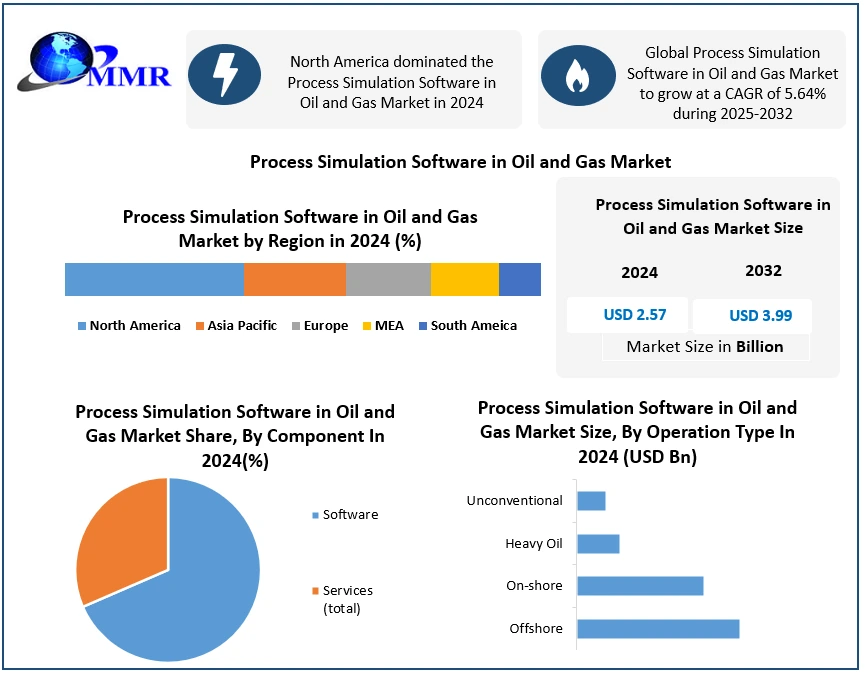
Process Simulation Software in Oil and Gas Market was valued at USD 2.57 Billion in 2024, and total global Process Simulation Software in Oil and Gas Market revenue is expected to grow at a CAGR of 5.64% from 2025 to 2032, reaching nearly USD 3.99 Billion. Adoption of Cloud-Based Solutions.
The Process simulation software delivers designing and modeling capabilities to oil & gas plants, pipelines, and other major equipment. The process simulation software assistances helps oil and gas companies in minimalize the risk of error and enhance the total cost of production.
An increase in the drilling activity across the globe and overall expenditure by oil and gas companies are expected to drive the growth of the global process simulation software in the oil and gas market. Additionally, a rise in penetration of the cloud-based solution is one of the key drivers in the global process simulation software in the oil and gas market.
On the other hand, the high initial investment is expected to limit the market growth. Furthermore, oil and gas key players are investing in numerous technologies like simulation and 3D technology, which is expected to form opportunities for the market during the forecast period.
The software segment is expected to contribute US$ xx Mn share in the global process simulation software in the oil and gas market. The demand for the implementation of process simulation software at oil and gas facilities is increasing because it can efficiently design and analyze each process during exploration and enhance the production of oil and gas. Market key players are investing in the latest technologies to enhance operational efficiency. The Oil and gas industry is experiencing tremendous transformation because of the adoption of the industry 4.0 standard.
 To know about the Research Methodology - Request Free Sample Report
Many of the oil and gas resources are lie offshore and in water depths of more than 2,000 meters across the globe. Extreme subsea conditions are expected to require a very high level of reliability for all components. The process simulation software is used to meet the reliability in the oil and gas sector. Virtual simulation of the machinery, which is used in subsea conditions benefits to achieving system reliability and shelter investment and the environment.
Based on Component, software, especially cloud-based solutions, dominated the oil and gas process simulation market in 2024. Companies are increasingly moving away from heavy on-premise systems due to the high upfront capital costs and limited scalability. Cloud-based deployment allows oil and gas firms to use flexible, pay-as-you-go models, reducing operational expenditure while still accessing advanced simulation tools. Another advantage is the ability to collaborate remotely across multiple geographies, which is vital in oil and gas where operations often span offshore rigs, refineries, and distant research hubs. Furthermore, cloud platforms integrate emerging technologies such as AI, real-time analytics, and digital twins more seamlessly than legacy on-premise setups. The speed of updates and lower maintenance needs make cloud software attractive, while services like training and consultancy remain supportive but secondary. For this reason, software continues to dominate overall, with cloud-based deployment being the leading sub-segment.
Based on Operation Type, offshore projects emerged as the dominant segment in 2024. Offshore fields, particularly deepwater and ultra-deepwater projects, involve higher complexity in exploration, production, and facility management compared to onshore operations. This complexity requires advanced simulation tools to optimize processes, ensure safety, and reduce costly mistakes. Offshore platforms also operate under stricter environmental regulations and safety standards, making simulation software essential to meet compliance while improving efficiency. Since offshore operations are logistically challenging and highly capital-intensive, the cost of error is enormous, driving the adoption of simulation to test processes before implementation. Additionally, oil companies are investing heavily in digital transformation initiatives, where offshore fields often serve as testbeds for automation and simulation technologies. These factors collectively position offshore operations as the leading segment within the market.
Region-wise, the North America region is expected to hold the dominant position in the global process simulation software in the oil and gas market. The dominant position in the market is attributed to the rise in the adoption rate of the simulation software in the region. Growth in the digitization, rapid technology adoption and presence of the prominent key players in the region are some of the driving factors of the market growth.
Key players in the global process simulation software in the oil and gas market are focusing on the production of the easy-to-use models with the capability to create, tune, and visualize analytics. Oil & gas key players are adopting oil and gas simulation widely and demonstrating software to form the realistic representations of reservoirs, equipment usage, and resistivity and environmental effects.
The global process simulation software in the oil and gas market key players are adopting various strategies to expand their global presence. Some of the key strategies implemented by the key players contain expansions & investments, new product launch, acquisitions, new technology developments, and agreements. In 2018, ESI Group has announced the partnership with the Model on. The companies are holding the join forces to upkeep industrial key players in delivering innovations at a more rapid pace and reduced cost.
The objective of the report is to present a comprehensive analysis of Global Process Simulation Software in Oil and Gas Market including all the stakeholders of the industry. The past and current status of the industry with forecasted market size and trends are presented in the report with the analysis of complicated data in simple language. The report covers all aspects of the industry with a dedicated study of key players that includes market leaders, followers and new entrants by region.
PORTER, SVOR, PESTEL analysis with the potential impact of micro-economic factors by region on the market are presented in the report. External as well as internal factors that are supposed to affect the business positively or negatively have been analysed, which will give a clear futuristic view of the industry to the decision-makers. The report also helps in understanding Global Process Simulation Software in Oil and Gas Market dynamics, structure by analysing the market segments and project the Global Process Simulation Software in Oil and Gas Market size.
Clear representation of competitive analysis of key players by Thyroid Gland Disorders Treatment Type, price, financial position, product portfolio, growth strategies, and regional presence in the Global Process Simulation Software in Oil and Gas Market make the report investor’s guide.
The report study has analyzed revenue impact of covid-19 pandemic on the sales revenue of market leaders, market followers and disrupters in the report and same is reflected in our analysis.
Process Simulation Software in Oil and Gas Market Scope: Inquire before buying
| Global Process Simulation Software in Oil and Gas Market | |||
|---|---|---|---|
| Report Coverage | Details | ||
| Base Year: | 2024 | Forecast Period: | 2025-2032 |
| Historical Data: | 2019 to 2024 | Market Size in 2024: | USD 2.57 Bn. |
| Forecast Period 2025 to 2032 CAGR: | 5.64% | Market Size in 2032: | USD 3.99 Bn. |
| Segments Covered: | by Component | Software Cloud-Based On-Premise Services Consultancy Training Support / Maintenance |
|
| by Operation Type | On-shore Off-shore Heavy Oil Unconventional |
||
| by Deployment Model | Cloud / SaaS On-Premises |
||
| by Application | Upstream Midstream Oil & Gas Processing / Downstream Others |
||
Process Simulation Software in Oil and Gas Market, by Region
North America (United States, Canada and Mexico)
Europe (UK, France, Germany, Italy, Spain, Sweden, Austria and Rest of Europe)
Asia Pacific (China, South Korea, Japan, India, Australia, Indonesia, Malaysia, Vietnam, Taiwan, Bangladesh, Pakistan and Rest of APAC)
Middle East and Africa (South Africa, GCC, Egypt, Nigeria and Rest of ME&A)
South America (Brazil, Argentina Rest of South America)
Process Simulation Software in Oil and Gas Market Key players:
1. MOSIMTEC, LLC
2. ESI Group
3. The Anylogic Company
4. Chemstations Inc.
5. Eq-comp
6. KBC (Yokogawa)
7. Bryan Research & Engineering, LLC.
8. Schneider Electric
9. ProSim
10. Aspen Technology, Inc.
11. Honeywell Process Solution
12. AVEVA Group Plc
13. Virtual Materials Group Inc. (Schlumberger)
14. Kongsberg Group
15. Chemstations Inc.
16. GSE Systems
17. Process System Enterprise Ltd.
18. CULGI B.V.
19. Schlumberger Limited.
20. Simul8 Corporation
21. ANSYS, Inc.
22. MOSIMTEC, LLC
23. Hexagon AB
24. TietoEVRY
Frequently Asked Questions:
1. Which region has the largest share in the Global Process Simulation Software in Oil and Gas Market?
Ans: The North America region held the highest share in 2024.
2. What is the growth rate of the Global Process Simulation Software in Oil and Gas Market?
Ans: The global market is growing at a CAGR of 5.64% during the forecasting period 2025-2032.
3. What is the scope of the Global market report?
Ans: Global market report helps with the PESTEL, PORTER, COVID-19 Impact analysis, Recommendations for Investors & Leaders, and market estimation of the forecast period.
4. What was the Global Market size in 2024?
Ans: The Global Market was valued at USD 2.57Bn. In 2024.
5. What is the study period of this Market?
Ans: The Global market is studied from 2024 to 2032.