
Predictive Maintenance Market – Industry Structure Evaluation, Demand Drivers Analysis, Regional Growth Analysis and Identification, Competitive Positioning Review & Global Market Size Forecast to 2032
Overview
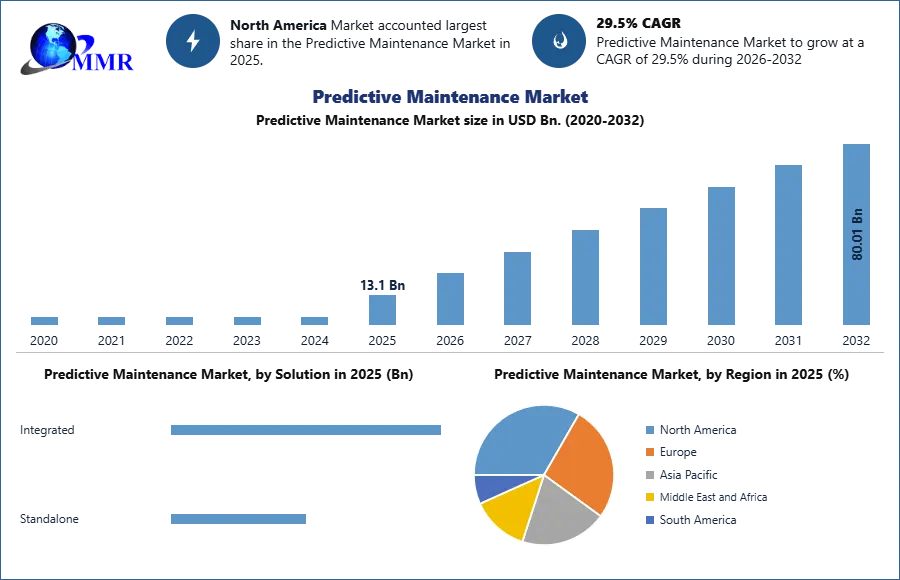
Predictive Maintenance Market size was valued at USD 13.1 Bn.in 2025 and the total Predictive Maintenance revenue is expected to grow at 29.5% from 2026 to 2032, reaching nearly USD 80.01 Bn.
Predictive Maintenance Market Overview:
The recorded data allows an engineer to estimate the eventual failure point of the observed asset, enabling it to be repaired or replaced shortly before it fails. Predictive maintenance reduces the occurrence of repair while still eliminating unexpected reactive maintenance and reducing equipment downtime and expenses associated with preventative maintenance. Predictive maintenance increases the lifespan of the equipment being observed.
The report explores the Predictive Maintenance market's segments (Solution, Service, Deployment, Enterprise Size, End-Use, and Region). Data has been provided by market participants, and regions (North America, Asia Pacific, Europe, Middle East & Africa, and South America). It provides a thorough analysis of the rapid advances that are currently taking place across all industry sectors. Facts and figures, illustrations, and presentations are used to provide key data analysis for the historical period from 2018 to 2023. The report investigates the Predictive Maintenance market's drivers, limitations, prospects, and barriers. This MMR report includes investor recommendations based on a thorough examination of the Predictive Maintenance market's contemporary competitive scenario.
To know about the Research Methodology :- Request Free Sample Report
Predictive Maintenance Market Dynamics:
The growing use of advanced technologies to gather important insights is a major driver of market growth.
Continuous advancements in big data, M2M connectivity, and cloud technology have opened up new avenues for investigating data obtained from industrial assets. Sensors, cameras, and other smart devices create a massive quantity of data for IoT devices. The data, on the other hand, has little value until it is converted into actionable, relevant information. Detailed analysis, big data and data visualization approaches allow companies to obtain fresh perspectives. Real-time data analysis and decision-making are frequently done manually, however, it is preferable to be done electronically to make it scalable.
The primary function of AI technology is to examine massive amounts of data generated by various elements of the IoT infrastructure and translate the data into relevant insights. AI is being integrated into established modeling techniques by enterprises to automate the data analysis and interpretation and acquire real-time knowledge from big data provided by these IoT devices. AI provides tools and mechanisms for organizations to evaluate real-time data and extract different IoT use cases.
A scarcity of skilled workers is a major restraint in the market growth.
To install AI-based IoT technologies required for predictive analytics, skillsets, and trained personnel are necessary to manage the most recent software systems. As a result, regular personnel must be trained on how to use new and enhanced systems. Furthermore, enterprises are quick to adopt new technology; nevertheless, they face a scarcity of highly educated and capable people. As the majority of global suppliers organize predictive maintenance initiatives, the requirement for highly qualified personnel grows. Companies must develop competence in areas e.g. cybersecurity, networking, and application development. Additionally, they hope to leverage IoT data to forecast outcomes, avoid errors, optimize operations, create new products, and provide advanced analytics expertise, including AI and Machine learning.
A major challenge in the market growth is that frequent maintenance and upgrades are required to keep the systems operational.
AI-based IoT solutions are being adopted by businesses for predictive maintenance and improved customer service. Market providers must build predictive maintenance solutions that take into account two critical factors: maintenance and upgrades. To adopt technical updates, AI-based IoT platforms must be upgraded and sustained in line with the evolving business requirements. As additional features are introduced, the software must also be updated. The new systems must be incorporated with both the old and the new ones. The cost of repairs rises as the number of systems grows. Maintaining and updating AI-based IoT systems will be a difficult undertaking for organizations that provide solutions without disruptions.
Predictive Maintenance Market Segment Analysis:
By Solution, the integrated solution segment is expected to dominate the market at the end of the forecast period. The increased need for customized solutions might be ascribed to the high demand for integrated systems. Additionally, as these solutions have gone mainstream, the need for application-specific services from numerous industrial sectors has grown substantially. Integrated solutions are custom-made, whilst isolated or standalone solutions are benchmarked or ready-made solutions provided by market participants. Standalone methods do not allow for customization. However, because of their low cost, standalone alternatives are often used by small and medium-sized businesses. The growing need for a single solution with many features is driving the popularity of integrated solutions over standalone alternatives.
By Service, the installation segment is expected to dominate the market at the end of the forecast period. Over the forecast period, the demand for cloud-based implementation of services from multiple sectors e.g. aerospace and military, automobile and transportation, and power and utilities is anticipated to grow. This is anticipated to contribute much more to segment growth. Because heavy machinery and equipment require frequent and timely maintenance to work properly, service and maintenance solutions are gaining popularity. Once these solutions are deployed, support and repair services are critical throughout the solution's lifespan. These services assist firms in increasing overall efficiency and income creation. The greater rate of implementation of preventative and reactive maintenance solutions, as well as the anticipated continuance of the trend, are also driving the segment growth.
By End-Use, the manufacturing segment is expected to grow at a CAGR of 4.9% during the forecast period. The increased requirement for maintenance of production machinery e.g. robotic systems, apparatus, forklifts, compressors, etc. to reduce total downtime is increasing the manufacturing segment's use of preventive maintenance services and solutions. Additionally, increased production automation, along with Industry 4.0, is estimated to drive the demand for these technologies to secure high-quality and expensive apparatus from damage.
The energy and utility sector is also a significant contributor to the growing market. The segment's growth can be ascribed to the growing demand to improve system reliability by identifying possible difficulties before they arise. Additionally, the growing necessity to estimate the possibility of a breakdown of aging components in power and utility infrastructure is driving the market growth. Moreover, the prevalence of energy consumption analytics apps is helping to drive the energy and utility segment to the forefront of the industry.
Predictive Maintenance Market Regional Insights:
During the forecast period, the Asia Pacific market is expected to grow at a CAGR of 5.8%. The increased growth of the market in the continent is mostly due to substantial expenditures offered by the state and private sectors to improve maintenance solutions. As a result, the need for preventative or predictive maintenance solutions installed for optimizing a facility's maintenance process is increasing. Furthermore, the region's increased supply of inexpensive labor has resulted in the construction of a large number of industrial facilities. Moreover, increased concerns about lowering total downtime and operating costs in manufacturing facilities are compelling facility owners to use these approaches.
At the end of the forecast period, North America is expected to dominate the market. The continent is at the forefront of the research and implementation of advanced predictive maintenance technologies. This is due to the existence of a significant number of top solution and service suppliers. Also, increased investments in new technologies e.g. artificial intelligence, Internet of Things, and machine learning are expected to help the region maintain its leading role during the forecast period. Moreover, increased awareness of the necessity of predictive maintenance procedures in factories and production units is driving increasing demand for these services in the region.
Recent Industry Developments (2025–2026):
| Exact Date | Company | Development | Impact |
|---|---|---|---|
| 21 January 2025 | Astute Analytica | Confirmed the transition of four major oil and gas corporations, including Shell and BP, to advanced predictive platforms. | Accelerates the replacement of reactive maintenance in high-stakes energy infrastructure. |
| 01 January 2025 | Technavio | Launched a 2025-2029 forecast identifying SME adoption of cloud computing as the dominant market accelerator. | Lowers entry barriers for smaller industrial players, diversifying the competitive landscape. |
The objective of the report is to present a comprehensive analysis of the Predictive Maintenance market to the stakeholders in the industry. The past and current status of the industry with the forecasted market size and trends are presented in the report with the analysis of complicated data in simple language. The report covers all the aspects of the industry with a dedicated study of key players that include market leaders, followers, and new entrants.
PORTER, PESTEL analysis with the potential impact of micro-economic factors of the market have been presented in the report. External as well as internal factors that are supposed to affect the business positively or negatively have been analyzed, which will give a clear futuristic view of the industry to the decision-makers.
The report also helps in understanding the market dynamics, and structure by analyzing the market segments and projecting the Predictive Maintenance market size. Clear representation of competitive analysis of key players by product, price, financial position, product portfolio, growth strategies, and regional presence in the Predictive Maintenance market make the report investor’s guide.
Predictive Maintenance Market Scope: Inquire before buying
| Predictive Maintenance Market | |||
|---|---|---|---|
| Report Coverage | Details | ||
| Base Year: | 2025 | Forecast Period: | 2026-2032 |
| Historical Data: | 2020 to 2025 | Market Size in 2025: | 13.1 USD Bn. |
| Forecast Period 2026-2032 CAGR: | 29.5% | Market Size in 2032: | 80.01 USD Bn. |
| Segments Covered: | by Solution | Integrated Standalone |
|
| by Service | Installation Support & Maintenance Training & Consulting |
||
| by Deployment | Cloud On-premise |
||
| by Enterprise Size | Small & Medium Enterprises Large Enterprises |
||
| by End User | Aerospace & Defense Automotive & Transportation Energy & Utilities Healthcare IT & Telecommunication Manufacturing Oil & Gas Others |
||
Predictive Maintenance Market, by Region:
North America (United States, Canada and Mexico)
Europe (UK, France, Germany, Italy, Spain, Sweden, Austria and Rest of Europe)
Asia Pacific (China, South Korea, Japan, India, Australia, Indonesia, Malaysia, Vietnam, Taiwan, Bangladesh, Pakistan and Rest of APAC)
Middle East and Africa (South Africa, GCC, Egypt, Nigeria and Rest of ME&A)
South America (Brazil, Argentina Rest of South America)
Key Players / Competitors Profiles Covered in Brief in Global Predictive Maintenance Market Report in Strategic Perspective:
- IBM Corporation
- Microsoft Corporation
- SAP SE
- Hitachi
- PTC
- General Electric
- Schneider Electric
- Software AG
- SAS Institute
- TIBCO Software
- C3.ai
- Uptake Technologies
- Softweb Solutions
- Asystom
- Ecolibrium Energy
- ABB
- Rockwell Automation
- Honeywell International
- Emerson Electric
- Siemens AG
- Oracle Corporation
- Splunk
- Altair Engineering
- Robert Bosch GmbH
- Amazon Web Services (AWS)