
PreEngineered Buildings Market - Industry Structure Evaluation, Demand Drivers Analysis, Regional Growth Analysis and Identification, Competitive Positioning / Landscape Review & Global Market Size Forecast to 2032
Overview
The Pre-Engineered Buildings Market size was valued at USD 25038.85 Million in 2024 and the total Pre-Engineered Buildings revenue is expected to grow at a CAGR of 11.5% from 2025 to 2032, reaching nearly USD 59815.44 Million.
Pre-Engineered Buildings Market Overview:
Pre-Engineered buildings are steel frames, which are manufactured at a factory and then shipped to the job site to be assembled. These structures are constructed up of a solid frame formed of steel plates, including beams and columns that may span huge distances without the use of columns, along with roof and wall coverings. Warehouses, distribution facilities, retail stores, shopping centers, office complexes, airplane hangars, and hospitals are among the many industrial applications for pre-engineered buildings. They are generally more cost-effective and efficient than traditional structure framing solutions like light gauge aluminum.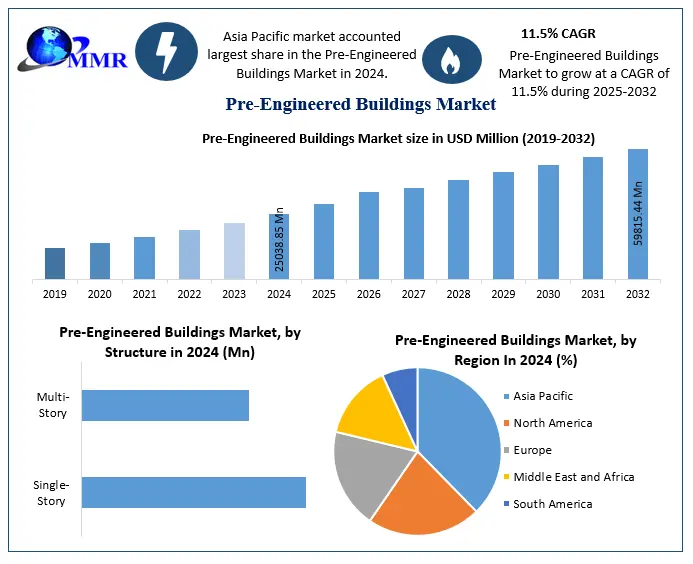 To know about the Research Methodology :- Request Free Sample Report
Pre-Engineered Buildings Market Dynamics:
The growing awareness of sophisticated off-site construction technologies and practices, along with rising industrialization across the globe is driving the pre-engineered buildings market growth. The demand for industrial storage facilities and warehouses has increased as e-commerce and logistics stores have become more prevalent in the retail industry. This has increased the need for pre-engineered buildings, which are more cost-effective and long-lasting than conventionally constructed structures. Pre-engineered building systems also provide major performance benefits, such as a longer building material life cycle, infinite design flexibility, and lower material and labor costs. In addition, the introduction of pre-engineered green buildings has boosted the market growth. These green structures are low-carbon, environmentally friendly solutions that use less energy during and after construction.
Pre-engineered buildings along with technological advances have greatly contributed to the development of quality of life over time. PEB construction takes 30 to 40% less time than masonry. PEB structures have a good insulating effect and would be ideal for a tropical country such as India. PEB is an excellent choice for construction in isolated and steep places. According to a recent survey by the Metal Building Associations (MBA), pre-engineered buildings account for over 60% of non-residential low-rise buildings in the United States.
Pre-engineered building systems are predominantly used in the construction of warehouses, industrial sheds, and buildings across the globe. Rural and urban areas, individual and mass housing projects, farmhouses, slum re-organization, and rehabilitation projects, along with amenity structures such as health centers, kiosks, primary schools, and colleges, are now being constructed by pre-engineered building technology. PEB has also attracted pharmaceutical companies and exposition centers along with functional requirements such as offices, conference halls, call centers, supermarkets, and showrooms. Earthquake-resistant structures are a relatively new application of PEB that has received widespread and quick acceptance across the globe.
Increased corrosion risk and reduced thermal and fire resistance, are expected to hamper the pre-engineered building market growth throughout the forecast period. In addition, one of the most significant obstacles to the adoption of PEBs in the countries like India, continued faith in traditional construction methods. Nonetheless, as people become more aware of the benefits of PEBs, demand for these products is expected to rise significantly over the forecast period.
Pre-Engineered Buildings Market Segment Analysis:
Based on the Structure, the Pre-Engineered Buildings Market is segmented into Single-Story and Multi-Story. The ingle-Story segment held the largest market share, accounting for 73.1% in 2024. Infrastructure, logistical, and industrial construction investments are driving demand for single-story pre-engineered buildings. The need for single-story pre-engineered buildings is also being fueled by the growth of new forms of non-residential construction, such as healthcare, education, recreational and social infrastructure, and retail. In addition, the reduced cost of single-story buildings and the advantages of generating big open areas that are efficient, easy to maintain, and architecturally flexible, are boosting the pre-engineered buildings market growth for this segment.
Based on the Application, the Pre-Engineered Buildings Market is segmented into Warehouses & Industrial, Infrastructure, Commercial, and Others. The Warehouses & Industrial segment held the largest market share, accounting for 64% in 2024. The segment growth is attributed to the growth of the manufacturing, shipping, and e-commerce industries across the globe. The growth in these areas fuels demands for factories, manufacturing plants, research and development centers, warehouses, and distribution centers, boosting the pre-engineered building market growth.
The Infrastructure segment is expected to witness significant growth at a CAGR of 10.9% during the forecast period. The increasing infrastructural, demand for metro station sheds, airport hangers, airport terminal buildings, shipyards, roads and footbridges, and railway platform shelters are driving the segment growth across the globe.
Pre-Engineered Buildings Market Regional Insights:
Asia Pacific region held the largest market share accounted for 38.71% in 2024. The growing demand for pre-engineered structures in the Asia Pacific region is attributed to the region's growing non-residential construction and infrastructure development. India and China account for the majority of pre-engineered building demand in the area, owing to the rising population, economic growth, government investments, and demand for low-cost green structures. In addition, with low labor costs, trade liberalization, and favourable government regulations, foreign investors are establishing factories and distribution centers in Asia Pacific developing countries, fueling the growth of the pre-engineered buildings market growth.
In India, the steel structures (SS) market is in excess of 4.5 million metric tonnes, and it has been rising at a rate of more than 10% per year over the past several years. In comparison to both the Indian steel industry and the Indian construction GDP, this market has grown faster. India has a steel capacity of 35 to 40 million tons installed, with an apparent steel consumption of 27 to 30 million tons. The current capacity for pre-engineered steel buildings is 0.35 million tons per year. The industry is expanding at a compound annual rate of 25 to 30%. These factors are expected to boost the pre-engineered buildings market growth over the forecast period.
The objective of the report is to present a comprehensive analysis of the global Pre-Engineered Buildings Market to the stakeholders in the industry. The past and current status of the industry with the forecasted market size and trends are presented in the report with the analysis of complicated data in simple language. The report covers all the aspects of the industry with a dedicated study of key players that include market leaders, followers, and new entrants.
PORTER, PESTEL analysis with the potential impact of micro-economic factors of the market have been presented in the report. External as well as internal factors that are supposed to affect the business positively or negatively have been analyzed, which will give a clear futuristic view of the industry to the decision-makers.
The reports also help in understanding the Pre-Engineered Buildings Market dynamic, structure by analyzing the market segments and projecting the Pre-Engineered Buildings Market size. Clear representation of competitive analysis of key players by Vehicle type, price, financial position, product portfolio, growth strategies, and regional presence in the Pre-Engineered Buildings Market make the report investor’s guide.
Pre-Engineered Buildings Market Scope: Inquiry Before Buying
| Pre-Engineered Buildings Market | |||
|---|---|---|---|
| Report Coverage | Details | ||
| Base Year: | 2024 | Forecast Period: | 2025-2032 |
| Historical Data: | 2019 to 2024 | Market Size in 2024: | USD 25038.85 Mn. |
| Forecast Period 2025 to 2032 CAGR: | 11.5% | Market Size in 2032: | USD 59815.44 Mn. |
| Segments Covered: | by Structure | Single-Story Multi-Story |
|
| by Application | Warehouses & Industrial Infrastructure Commercial Others |
||
Pre-Engineered Buildings Market, by Region
North America (United States, Canada and Mexico)
Europe (UK, France, Germany, Italy, Spain, Sweden, Austria and Rest of Europe)
Asia Pacific (China, South Korea, Japan, India, Australia, Indonesia, Malaysia, Vietnam, Taiwan, Bangladesh, Pakistan and Rest of APAC)
Middle East and Africa (South Africa, GCC, Egypt, Nigeria and Rest of ME&A)
South America (Brazil, Argentina Rest of South America)
Pre-Engineered Buildings Market Key Players:
1. Bluescope
2. Zamil Steel Holding Company
3. Kirby Building Systems
4. Nucor Corporation
5. NCI Building Systems
6. Lindab Group
7. Everest Industries
8. PEB Steel
9. PEBS Pennar
10. ATCO
11. Atad Steel Structure Corporation
12. Memaar Building Systems
13. Norsteel Buildings
14. John Reid & Sons (Strucsteel)
15. Rigid Global Buildings
16. Metal Building Manufacturers Inc.
17. Mabani Steel
18. Steelway Building Systems
19. Tiger Steel Engineering India (Tseil)
20. Emirates Building Systems
Frequently Asked Questions:
1. Which region has the largest share in Global Re-Engineered Buildings Market?
Ans: Asia Pacific region held the highest share in 2024.
2. What is the growth rate of Global Re-Engineered Buildings Market?
Ans: The Global Re-Engineered Buildings Market is growing at a CAGR of 11.5% during forecasting period 2025-2032.
3. What is scope of the Global Re-Engineered Buildings Market report?
Ans: Global Re-Engineered Buildings Market report helps with the PESTEL, PORTER, COVID-19 Impact analysis, Recommendations for Investors & Leaders, and market estimation of the forecast period.
4. Who are the key players in Global Re-Engineered Buildings Market?
Ans: The important key players in the Global Re-Engineered Buildings Market are – Bluescope, Zamil Steel Holding Company, Kirby Building Systems, Nucor Corporation, NCI Building Systems, Lindab Group, Everest Industries, PEB Steel, PEBS Pennar, ATCO, Atad Steel Structure Corporation, Memaar Building Systems, Norsteel Buildings, John Reid & Sons (Strucsteel), Rigid Global Buildings, Metal Building Manufacturers Inc., Mabani Steel, Steelway Building Systems, Tiger Steel Engineering India (Tseil), Emirates Building Systems, Phenix Construction Technologies, Allied Steel Buildings, SML Group, Octamec Group, and Jindal Buildsys
5. What was the Global Pre-Engineered Buildings Market size in 2024?
Ans: The Global Pre-Engineered Buildings Market size was USD 25038.85 Million in 2024.