
Colorants Market by Product Type, Source, End Use and Region – Global Market Size Estimation, Industry-Wide Analysis, Competitive Landscape Assessment & Long-Term Forecast to 2032
Overview
Global Colorants Market size was valued at USD 66.80 Bn in 2025, and the total Colorants Market revenue is expected to grow at a CAGR of 4.81% from 2026 to 2032, reaching nearly USD 97.27 Bn
Colorants Market Overview
Colorants are vibrant substances that impart visual appeal to materials, available as dyes (soluble for textiles/food) or pigments (insoluble for paints/plastics). From nature-derived hues to synthetic brilliance, they transform everyday productsclothing, packaging, cosmetics—into visually captivating experiences. As sustainability surges, innovations like bio-based dyes and smart pigments are redefining color science for a greener, more dynamic future.
Demand for colorants is surging, driven by booming industries like textiles, packaging, and automotive coatings, alongside rising consumer preference for eco-friendly and smart pigments. Meanwhile, supply is expanding through innovations in bio-based dyes and scaled synthetic production, though raw material volatility and regional disruptions (e.g., Asia’s dominance) create dynamic market balances.
Asia-Pacific dominated the global colorants market with over 45% share in 2024, led by China's textile dyes and India's pigment manufacturing, while BASF SE (Germany) emerges as the top global player with USD 4.8 billion in colorant revenue, pioneering sustainable innovations like bio-based pigments and circular economy solutions, followed closely by DIC Corporation (Japan) in printing inks and Clariant (Switzerland) in high-performance pigments.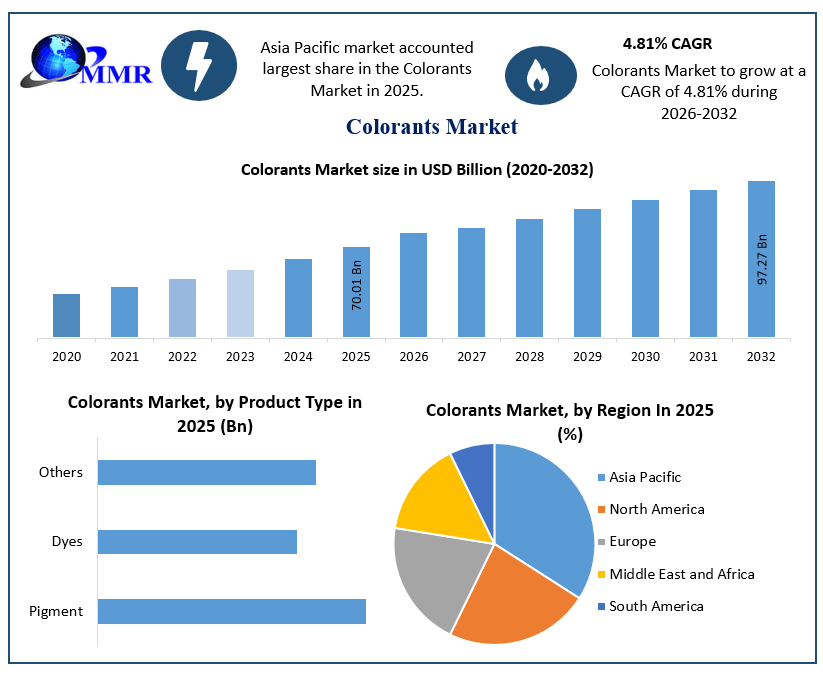 To know about the Research Methodology :- Request Free Sample Report
Colorant Market Recent Trend
1. Shift to Sustainable & Bio-Based Colorants
• Rising demand for plant-based, microbial, and algae-derived dyes/pigments (e.g., beetroot red, spirulina blue).
• Brands like Unilever, L’Oreal adopting natural colorants for cosmetics and food.
2. Stringent Regulations Driving Innovation
• EU bans on synthetic dyes (e.g., titanium dioxide in food) pushing R&D in safer alternatives.
• FDA & REACH compliance forcing reformulations in pigments and dyes.
3. Digital Printing Boom
• High growth in digital textile printing inks (eco-solvent, UV-curable).
• Packaging industry adopting digital colorants for short-run, customized labels.
4. Smart & Functional Colorants
• Thermochromic & photochromic pigments for packaging, automotive, and security inks.
• Self-healing coatings with color-changing properties (automotive sector).
Colorant Market Dynamics
Bio-Based Colorants Boom the Colorants Market
The increasing demand for sustainable and eco-friendly alternatives to synthetic dyes and pigments. Derived from renewable biological sources such as plants, algae, fungi, and microorganisms, bio-based colorants offer a low-carbon footprint, reduced toxicity, and biodegradability, aligning with stringent environmental regulations and consumer preference for green products. Industries such as textiles, food & beverages, cosmetics, and packaging are adopting these natural solutions to meet regulatory compliance and brand sustainability goals.
In textiles, bio-based dyes are gaining traction as a replacement for petrochemical-based colorants, while in food and cosmetics, plant-derived pigments such as anthocyanins, carotenoids, and chlorophyll are valued for their clean-label appeal. Technological advancements in fermentation and extraction processes are improving yield, stability, and color intensity, making bio-based options more competitive. Furthermore, collaborations between biotech firms and major FMCG brands are accelerating commercialization. Although challenges remain such as scalability, cost competitiveness, and limited color range rising investments, supportive policies, and consumer awareness are expected to boost market growth. This “green shift” is positioning bio-based colorants not just as an alternative, but as a key driver of innovation in the broader colorants market.
Regulations Over the Colorant Products Restrain the Colorants Market Growth
Stringent environmental regulations are increasingly hindering the growth of the synthetic colorants market, as governments tighten controls on harmful chemicals. In major economies such as the EU and the US, bans on substances like titanium dioxide and certain azo dyes have been implemented due to health and environmental concerns. These measures have driven compliance costs up by more than 30%, pushing manufacturers to reformulate their product lines or, in some cases, withdraw entirely from affected markets.
Smaller and mid-sized producers are particularly vulnerable, as limited resources make it challenging to meet costly compliance and certification requirements. Many face the risk of liquidation, further consolidating the market among larger, well-capitalized players. At the same time, low-cost, less-regulated alternatives from Asia are gaining traction, intensifying competitive pressures on Western manufacturers.
This combination of regulatory stringency and competitive disadvantage threatens over $12 billion in legacy dye and pigment revenues globally. While these developments are pushing the industry toward greener, bio-based alternatives, the transition involves significant investment and higher production costs. Nevertheless, with sustainability becoming a critical market driver, adapting to these regulations is increasingly viewed as essential for long-term competitiveness and survival in the evolving colorants industry.
Expanding Applications in Emerging Industries Create Growth Opportunities to the Colorants Market Growth
The global colorants market is growth through expanding applications in emerging industries such as 3D printing, advanced coatings, and high-performance plastics. In 3D printing, colorants are used to create vibrant, durable finishes for prototypes, customized consumer products, and industrial components, new revenue streams for pigment and dye manufacturers. In advanced coatings, the demand for functional colorants offering UV resistance, anti-microbial properties, or heat reflection is on the rise, driven by sectors like automotive, aerospace, and construction seeking both aesthetics and performance enhancement.
In packaging, innovations in smart and active packaging are fueling the use of colorants that respond to environmental stimuli, such as temperature or light, providing interactive consumer experiences and improved product safety. Additionally, the shift toward premiumization in consumer goods is creating opportunities for specialized, high-value colorants that deliver unique shades, effects, and branding differentiation Drives the colorants market.
Global Colorants Market Segment Analysis
Based on Source Type, Colorant Market is segmented into Natural and Synthetic. Synthetic segment dominated the Colorant Market in 2024 and is expected to maintained the largest market share over the forecast period. Manufactured primarily from petrochemical sources, synthetic colorants provide a broad spectrum of vibrant and consistent shades, along with excellent stability against light, heat, and chemicals. These attributes make them the preferred choice across high-demand industries such as textiles, plastics, paints & coatings, printing inks, and packaging. Their ability to deliver uniform results at scale has solidified their position as the industry standard for mass production.
The growing environmental concerns and strict regulatory frameworks in regions like the EU and the US have created challenges, synthetic colorants continue to maintain strong market traction. This resilience is largely supported by advancements in safer, compliant formulations and ongoing investments in technologies that reduce harmful emissions during production. Furthermore, the presence of well-established supply chains, competitive pricing, and the ability to meet large-volume orders make synthetic colorants difficult to replace in several sectors, especially in cost-sensitive markets.
However, natural colorants are the fastest-growing segment (CAGR ~8%), fueled by stringent regulations (EU bans on synthetics in food/cosmetics) and consumer demand for clean-label products. Plant-based (turmeric, beetroot), microbial (algae blue), and mineral-derived pigments are gaining traction in food, beauty, and premium textiles. While synthetic production scales keep prices low, brands like Beyond Meat and Lush are accelerating the shift to natural alternativeshinting at a future USD 15B+ bio-based colorants market by 2030.
Colorants Market Recent Development
| Date | Company | Development | Impact |
|---|---|---|---|
| 03 March 2025 | Sudarshan Chemical Industries Limited | The company completed its cash acquisition of Germany-based Heubach Group for approximately EUR 127.5 million. | This strategic transaction establishes a combined entity with 19 international sites, creating a global pigment industry leader with a highly diversified colorant asset footprint. |
| 06 August 2025 | Cabot Corporation | The company entered into a definitive agreement to acquire Mexico Carbon Manufacturing S.A. de C.V. from Bridgestone Corporation for $70 million. | The integration of the plant expands the firm's global reinforcing carbon network and boosts production capacity to secure consistent supply for key industrial colorant and carbon black markets. |
| 03 November 2025 | Sun Chemical | The company unveiled multiple world product premieres at CHINACOAT 2025, including the highly intense bluish-red aluminum effect pigment Paliocrom Brilliant Ruby L 3558. | The new grade introduces extraordinary hiding power and lightness optimized for both solventborne and waterborne high-performance automotive coatings. |
| 18 February 2026 | hubergroup Chemicals | The company launched ELARA, a new brand of high-performance additives including non-aqueous dispersing agents engineered for organic and inorganic pigments. | These tailored additives enable higher pigment loading and superior process stability across solvent-free and UV-curable industrial ink and coating formulations. |
| 15 May 2026 | Sun Chemical | The company announced the launch of ACI-5000 SunPURO Natural V. Charcoal Powder alongside an expanded line of synthetic mica-based effect pigments. | The 100% natural-origin upcycled ingredient offers alternative opacifying color properties tailored to satisfy surging consumer demands in the clean beauty and cosmetic colorants sectors. |
Global Colorants Market Regional Analysis
The Asia-Pacific (APAC) region dominated the global colorants market, accounting for over XX % of revenue in 2024, driven with massive textile, packaging, and paint demand in China, India, and Southeast Asia. This leadership is fueled by the region’s robust industrial base, rapidly expanding consumer markets, and strong demand from key sectors such as textiles, packaging, and paints & coatings. China, India, and Southeast Asian nations are at the forefront, driven by large-scale manufacturing, competitive labor costs, and rising domestic consumption.
In textiles, APAC countries benefit from their position as global manufacturing hubs, supplying both domestic and export markets with dyed fabrics and finished apparel. The packaging industry, buoyed by booming e-commerce and processed food sectors, is also a major driver, with high demand for printing inks, pigments, and masterbatches. In paints and coatings, rapid urbanization and infrastructure development are boosting decorative and industrial applications in Colorants Market.
Global Colorants Market Competitive Landscape
The global colorants market is dominated by chemical giants, with BASF SE (USD 4.8B colorant revenue in 2024) leading through sustainable innovation, including bio-based automotive pigments and a USD 2.3B R&D budget. Clariant AG (USD 3.1B) specializes in high-performance pigments for plastics and eco-friendly coatings, with its Earth-Friendly series driving 18% of sales. DIC Corporation (USD 3.9B) rules printing inks and textile dyes, boosted by its Sun Chemical acquisition and Asia's manufacturing boom. Together they command 38% market share, but face disruption from bio-tech startups like Pili Bio's microbial dyes (growing at 200% YoY). BASF leads in circular solutions, Clariant in regulatory-compliant pigments, while DIC expands through strategic acquisitions - making this a USD 25B battleground of technology versus sustainability.
Colorants Market Recent Development
In March 2022, with Colorants International AG, a joint venture between Heubach Group and SK Capital Partners, acquiring a 3.36525% stake in the company. This acquisition was part of a broader strategy that led to Colorants International AG increasing its holding to 54.37%.
Colorants Market Scope: Inquire before buying
| Global Market | |||
|---|---|---|---|
| Report Coverage | Details | ||
| Base Year: | 2025 | Forecast Period: | 2026-2032 |
| Historical Data: | 2020 to 2025 | Market Size in 2025: | USD 70.01 Bn. |
| Forecast Period 2026 to 2032 CAGR: | 4.81% | Market Size in 2032: | USD 97.27 Bn. |
| Segments Covered: | by Product Type | Pigment Dyes Others |
|
| by Source | Synthetic Natural |
||
| by End Use | Paint and coatings Packaging Food & Beverages Textiles Paper & Printing Others |
||
Colorant Market, by Region
North America (United States, Canada, Mexico)
Europe (United Kingdom, France, Germany, Italy, Spain, Sweden, Russia, Rest of Europe)
Asia Pacific (China, South Korea, Japan, India, Australia, Indonesia, Malaysia, Philippines, Thailand, Vietnam, Rest of Asia Pacific)
Middle East and Africa (MEA) (South Africa, GCC, Nigeria, Rest of MEA)
South America (Brazil, Argentina, Colombia, Chile, Rest of South America)
Colorant Market Key Players
North America Colorant Market Key Players
1. BASF SE (Ludwigshafen, Germany) –
2. Huntsman Corporation (Texas, USA)
3. Sensient Technologies (Wisconsin, USA)
4. Sun Chemical (New Jersey, USA)
5. PPG Industries (Pennsylvania, USA)
6. Sherwin-Williams (Ohio, USA)
7. Dow Chemical Company (Michigan, USA)
Europe Colorant Market Key Players
1. Lanxess AG (Cologne, Germany)
2. Archroma (Reinach, Switzerland)
3. AkzoNobel N.V. (Amsterdam, Netherlands)
4. DSM-Firmenich (Kaiseraugst, Switzerland)
5. Heubach GmbH (Langelsheim, Germany)
Asia Pacific Colorant Market Key Players
1. DIC Corporation (Tokyo, Japan)
2. Sudarshan Chemical Industries (Pune, India)
3. Kiri Industries (Gujarat, India)
4. Atul Ltd (Gujarat, India)
Middle East and Africa Colorant Market Key Players
1. National Paints Factories (Jordan)
2. Hempel Middle East (UAE)
3. Jotun (UAE operations)
4. Saudi Basic Industries Corp (SABIC)
South America Colorant Market Key Players
1. Oxiteno (Brazil)
2. Unigel (Brazil)
3. Elekeiroz (Brazil)
Frequently Asked Questions:
1. Which region has the largest share in Global Colorant Market?
Ans: Asia Pacific region held the highest share in 2025.
2. What is the growth rate of Global Colorant Market?
Ans: The Global Colorant Market is growing at a CAGR of 4.81% during forecasting period 2026-2032.
3. What is scope of the Global Colorant market report?
Ans: Global Colorant Market report helps with the PESTEL, PORTER, Recommendations for Investors & Leaders, and market estimation of the forecast period.
4. Who are the key players in Global Colorant market?
Ans: The important key players in the Global Colorant Market are BASF SE, Sun Chemical Corporation, Huntsman Corporation and DIC Corporation.