Polyanionic Cellulose (PAC) Market – Industry Structure Evaluation, Demand Drivers Analysis, Regional Growth Analysis and Identification, Competitive Positioning Review & Global Market Size Forecast to 2034

1.3%
CAGR (2026-2034)
840.27 USD Mn.
Forecast Market Size
318
Report Pages
161
Market Tables

Overview

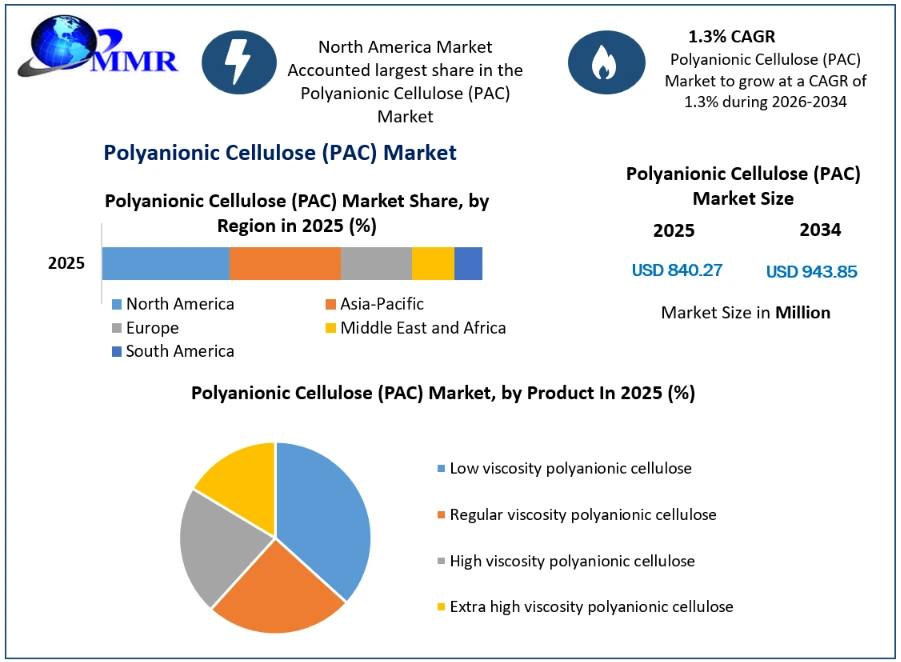
Global Polyanionic Cellulose (PAC) Market is expected to grow at a CAGR of 1.3% during the forecast period and is expected to reach USD 943.85 Mn. by 2034.

Global Polyanionic Cellulose (PAC) Market Introduction and Market Scenario:

Polyanionic cellulose (PAC) is a water-soluble cellulose ether derivative manufactured by the chemical modification of natural cellulose. Polyanionic cellulose finds significant applications in offshore exploration & production, drilling & salt well operations in the upstream oil & gas industry. Also, polyanionic cellulose finds applications across various industries for a wide range of uses excepting the oil & gas industry, such as food & beverage, pharmaceutical, chemical, plastic, and polymer are some of the end-use industries.

Polyanionic Cellulose (PAC) Market Growth and Share AnalysisPolyanionic Cellulose (PAC) Market Growth
To know about the Research Methodology :- Request Free Sample Report

Polyanionic cellulose delivers superior filtration control and supplementary viscosity in most water-based drilling fluids, regarding other oilfield chemicals. This has been an important factor driving the growth of the polyanionic cellulose market in the future.

Currently, there has been an increase in the demand for polyanionic cellulose from the fast-growing food & beverage industry. This is because polyanionic cellulose has demonstrated to be safer regarding other chemicals, as a food additive, thereby gaining special use. Polyanionic cellulose has also been finding an increased usage in water purification processes in the food & beverage industry. It is also being broadly used as a stabilizer & thickener in food production. For example, jelly products & ice creams are stabilized & thickened to a large extent with the use of polyanionic cellulose (PAC). Hence, the fast growth of the food & beverages industry has also been contributing to the market growth of polyanionic cellulose. In the pharmaceutical sector, polyanionic cellulose has been gaining importance as an emulsifier & a stabilizer in the manufacture of injectable medicines & tablets because of its effective bonding properties.

A brief analysis of drivers, restraints, opportunities, and challenges in the market is covered with examples by region in the report. To make the most of the opportunities, market vendors should focus more on the growth prospects in the fast-growing segments, while maintaining their positions in the slow-growing segments. It also has covered the analysis of key player’s growth strategies, micro and macro analysis of markets, key developments, and key trends in the market.

Global Polyanionic Cellulose (PAC) Market Segment Analysis:

The global Polyanionic Cellulose (PAC) market is segmented into product type, and end-use. In terms of product type, the market is further segmented into Low viscosity polyanionic cellulose, Regular viscosity polyanionic cellulose, High viscosity polyanionic cellulose, and extra high viscosity polyanionic cellulose. Among these, High viscosity polyanionic cellulose (PAC-HV) is expected to hold the largest market share of xx% in the global market by 2034. This is used to reduce the filtration rate in water-based oils & gas drilling fluids. It also supports improve hole cleaning and suspension properties in drilling fluids by stabilizing and increasing the viscosity of a wide-ranging of fluids. Further detailed analysis of each segment is explained in the MMR report.

Global Polyanionic Cellulose (PAC) Market Regional Insights:

The global polyanionic cellulose market is categorized into North America, Europe, Asia Pacific, Latin America, and the Middle East & Africa. Among these, North America & Europe are leading consumers of polyanionic cellulose. Rising R&D activities in drilling and salt well operations in the upstream oil & gas industry and offshore exploration & production, particularly in the U.S. is boosting the demand for polyanionic cellulose in the U.S. Also, the increasing usage of polyanionic cellulose in drilling fluid applications because of its properties like high stability in high-temperature applications and high resistance to salty environments drive its demand in North America.

European countries such as France, the U.K., Germany, and Russia are major consumers of polyanionic cellulose. Increasing demand for polyanionic cellulose in the food & beverage industry and the pharmaceutical industry is boosting the market in Europe. Demand for polyanionic cellulose is expected to rise considerably in the Asia Pacific during the forecast period, thanks to its effective bonding properties.

The report focuses on the Polyanionic Cellulose (PAC) market value at the top regions and countries of the world, which shows a regional development, including market size, share, revenue, and much more across the globe. The report has covered, capacity, production value, cost/profit, and supply/demand by statistical analysis. A brief analysis of drivers, restraints, opportunities, and challenges in the market is also covered with examples by region. To make the most of the opportunities, market vendors should focus more on the growth prospects in the fast-growing segments, while maintaining their positions in the slow-growing segments. It also has covered the analysis of key player’s growth strategies, micro and macro analysis of markets, key developments, and key trends in the market.

Polyanionic Cellulose (PAC) Market Recent Industry Development

Date Company Development Impact
18 June 2025 Nouryon Nouryon officially launched its new Innovation Center for oilfield applications in Houston, Texas, expanding its specialized R&D for drilling chemical polymers. The facility accelerates local testing and customer co-development of high-performance polyanionic cellulose (PAC) and drilling fluid additives tailored for North American oil exploration.
10 November 2025 Nouryon Nouryon opened an expanded specialty chemical innovation facility in Shanghai, focusing on advanced water-soluble polymer applications. The center enhances local formulation capabilities for cellulose ethers and polyanionic polymers in Asia-Pacific industrial and energy sectors.
21 January 2026 Ashland Global Holdings, Inc. Ashland reinforced its commercial supply of AquaFLO high-viscosity polyanionic cellulose (PAC) for high-pressure, high-temperature (HPHT) drilling projects. The upgraded polymer grade improves fluid loss control and rheology modification in extreme oilfield environments.

Global Polyanionic Cellulose (PAC) Market Scope: Inquire before buying

Global Polyanionic Cellulose (PAC) Market
Report Coverage Details
Base Year: 2025 Forecast Period: 2026-2034
Historical Data: 2020 to 2025 Market Size in 2025: USD 840.27 Mn.
Forecast Period 2026 to 2034 CAGR: 1.3% Market Size in 2034: USD 943.85 Mn.
Segments Covered: by Product Low viscosity polyanionic cellulose
Regular viscosity polyanionic cellulose
High viscosity polyanionic cellulose
Extra high viscosity polyanionic cellulose
by End Use Oil & gas
Food & beverage
Pharmaceutical
Agrochemical
Electronics
Leather processing
Chemical
Printing
Plastic & polymer
Ceramic
Others

Global Polyanionic Cellulose (PAC) Market, by Region

North America (United States, Canada and Mexico)
Europe (UK, France, Germany, Italy, Spain, Sweden, Austria and the Rest of Europe)
Asia Pacific (China, South Korea, Japan, India, Australia, Indonesia, Malaysia, Vietnam, Taiwan, Bangladesh, Pakistan and the Rest of APAC)
South America (Brazil, Argentina Rest of South America)
Middle East & Africa (South Africa, GCC, Egypt, Nigeria and the Rest of ME&A)

Global Polyanionic Cellulose (PAC) Market, Key Players are

1. The Dow Chemical Company
2. Ashland
3. Sidley Chemical Co., Ltd.
4. IRO Group Inc.
5. Global Drilling Fluids & Chemicals Ltd.
6. Shanghai Bichain Industrial Chemical Co., Ltd.
7. Deva Drill Tech India Limited
8. Albattal Chemical industries
9. Silver Fern Chemical, Inc.
10. Zhengzhou Sino Chemical Co., Ltd.
11. Chemstar Products Company
Others

Frequently Asked Questions:

1. Which region has the largest share in Global Polyanionic Cellulose (PAC) Market?
Ans: North America region held the highest share in 2025.

2. What is the growth rate of Global Polyanionic Cellulose (PAC) Market?
Ans: The Global Polyanionic Cellulose (PAC) Market is growing at a CAGR of 1.3% during forecasting period 2026-2034.

3. What is scope of the Global Polyanionic Cellulose (PAC) Market report?
Ans: Global Polyanionic Cellulose (PAC) Market report helps with the PESTEL, PORTER, COVID-19 Impact analysis, Recommendations for Investors & Leaders, and market estimation of the forecast period.

4. Who are the key players in Global Polyanionic Cellulose (PAC) Market?
Ans: The important key players in the Global Polyanionic Cellulose (PAC) Market are –   The Dow Chemical Company, Ashland, Sidley Chemical Co., Ltd., IRO Group Inc., Global Drilling Fluids & Chemicals Ltd., Shanghai Bichain Industrial Chemical Co., Ltd., Deva Drill Tech India Limited, Albattal Chemical industries, Silver Fern Chemical, Inc., Zhengzhou Sino Chemical Co., Ltd., Chemstar Products Company, Others .

5. What is the study period of this Market?
Ans: The Global Polyanionic Cellulose (PAC) Market is studied from 2025 to 2034.

Table of Contents

1. Polyanionic Cellulose (PAC) Market Introduction 1.1. Study Assumption and Market Definition 1.2. Scope of the Study 1.3. Executive Summary 2. Global Polyanionic Cellulose (PAC) Market: Competitive Landscape 2.1. MMR Competition Matrix 2.2. Competitive Landscape 2.3. Key Players Benchmarking 2.3.1. Company Name 2.3.2. Business Segment 2.3.3. End-user Segment 2.3.4. Revenue (2025) 2.3.5. Company Locations 2.4. Leading Polyanionic Cellulose (PAC) Market Companies, by market capitalization 2.5. Market Structure 2.5.1. Market Leaders 2.5.2. Market Followers 2.5.3. Emerging Players 2.6. Mergers and Acquisitions Details 3. Polyanionic Cellulose (PAC) Market: Dynamics 3.1. Polyanionic Cellulose (PAC) Market Trends by Region 3.1.1. North America Polyanionic Cellulose (PAC) Market Trends 3.1.2. Europe Polyanionic Cellulose (PAC) Market Trends 3.1.3. Asia Pacific Polyanionic Cellulose (PAC) Market Trends 3.1.4. Middle East and Africa Polyanionic Cellulose (PAC) Market Trends 3.1.5. South America Polyanionic Cellulose (PAC) Market Trends 3.2. Polyanionic Cellulose (PAC) Market Dynamics by Region 3.2.1. North America 3.2.1.1. North America Polyanionic Cellulose (PAC) Market Drivers 3.2.1.2. North America Polyanionic Cellulose (PAC) Market Restraints 3.2.1.3. North America Polyanionic Cellulose (PAC) Market Opportunities 3.2.1.4. North America Polyanionic Cellulose (PAC) Market Challenges 3.2.2. Europe 3.2.2.1. Europe Polyanionic Cellulose (PAC) Market Drivers 3.2.2.2. Europe Polyanionic Cellulose (PAC) Market Restraints 3.2.2.3. Europe Polyanionic Cellulose (PAC) Market Opportunities 3.2.2.4. Europe Polyanionic Cellulose (PAC) Market Challenges 3.2.3. Asia Pacific 3.2.3.1. Asia Pacific Polyanionic Cellulose (PAC) Market Drivers 3.2.3.2. Asia Pacific Polyanionic Cellulose (PAC) Market Restraints 3.2.3.3. Asia Pacific Polyanionic Cellulose (PAC) Market Opportunities 3.2.3.4. Asia Pacific Polyanionic Cellulose (PAC) Market Challenges 3.2.4. Middle East and Africa 3.2.4.1. Middle East and Africa Polyanionic Cellulose (PAC) Market Drivers 3.2.4.2. Middle East and Africa Polyanionic Cellulose (PAC) Market Restraints 3.2.4.3. Middle East and Africa Polyanionic Cellulose (PAC) Market Opportunities 3.2.4.4. Middle East and Africa Polyanionic Cellulose (PAC) Market Challenges 3.2.5. South America 3.2.5.1. South America Polyanionic Cellulose (PAC) Market Drivers 3.2.5.2. South America Polyanionic Cellulose (PAC) Market Restraints 3.2.5.3. South America Polyanionic Cellulose (PAC) Market Opportunities 3.2.5.4. South America Polyanionic Cellulose (PAC) Market Challenges 3.3. PORTER's Five Forces Analysis 3.4. PESTLE Analysis 3.5. Technology Roadmap 3.6. Regulatory Landscape by Region 3.6.1. North America 3.6.2. Europe 3.6.3. Asia Pacific 3.6.4. Middle East and Africa 3.6.5. South America 3.7. Key Opinion Leader Analysis For Polyanionic Cellulose (PAC) Industry 3.8. Analysis of Government Schemes and Initiatives For Polyanionic Cellulose (PAC) Industry 3.9. Polyanionic Cellulose (PAC) Market Trade Analysis 3.10. The Global Pandemic Impact on Polyanionic Cellulose (PAC) Market 4. Polyanionic Cellulose (PAC) Market: Global Market Size and Forecast by Segmentation (in USD Million) 2025-2034 4.1. Polyanionic Cellulose (PAC) Market Size and Forecast, by Product (2025-2034) 4.1.1. Low viscosity polyanionic cellulose 4.1.2. Regular viscosity polyanionic cellulose 4.1.3. High viscosity polyanionic cellulose 4.1.4. Extra high viscosity polyanionic cellulose 4.2. Polyanionic Cellulose (PAC) Market Size and Forecast, by End Use (2025-2034) 4.2.1. Oil & gas 4.2.2. Food & beverage 4.2.3. Pharmaceutical 4.2.4. Agrochemical 4.2.5. Electronics 4.2.6. Leather processing 4.2.7. Chemical 4.2.8. Printing 4.2.9. Plastic & polymer 4.2.10. Ceramic 4.2.11. Others 4.3. Polyanionic Cellulose (PAC) Market Size and Forecast, by Region (2025-2034) 4.3.1. North America 4.3.2. Europe 4.3.3. Asia Pacific 4.3.4. Middle East and Africa 4.3.5. South America 5. North America Polyanionic Cellulose (PAC) Market Size and Forecast by Segmentation (in USD Million) 2025-2034 5.1. North America Polyanionic Cellulose (PAC) Market Size and Forecast, by Product (2025-2034) 5.1.1. Low viscosity polyanionic cellulose 5.1.2. Regular viscosity polyanionic cellulose 5.1.3. High viscosity polyanionic cellulose 5.1.4. Extra high viscosity polyanionic cellulose 5.2. North America Polyanionic Cellulose (PAC) Market Size and Forecast, by End Use (2025-2034) 5.2.1. Oil & gas 5.2.2. Food & beverage 5.2.3. Pharmaceutical 5.2.4. Agrochemical 5.2.5. Electronics 5.2.6. Leather processing 5.2.7. Chemical 5.2.8. Printing 5.2.9. Plastic & polymer 5.2.10. Ceramic 5.2.11. Others 5.3. North America Polyanionic Cellulose (PAC) Market Size and Forecast, by Country (2025-2034) 5.3.1. United States 5.3.1.1. United States Polyanionic Cellulose (PAC) Market Size and Forecast, by Product (2025-2034) 5.3.1.1.1. Low viscosity polyanionic cellulose 5.3.1.1.2. Regular viscosity polyanionic cellulose 5.3.1.1.3. High viscosity polyanionic cellulose 5.3.1.1.4. Extra high viscosity polyanionic cellulose 5.3.1.2. United States Polyanionic Cellulose (PAC) Market Size and Forecast, by End Use (2025-2034) 5.3.1.2.1. Oil & gas 5.3.1.2.2. Food & beverage 5.3.1.2.3. Pharmaceutical 5.3.1.2.4. Agrochemical 5.3.1.2.5. Electronics 5.3.1.2.6. Leather processing 5.3.1.2.7. Chemical 5.3.1.2.8. Printing 5.3.1.2.9. Plastic & polymer 5.3.1.2.10. Ceramic 5.3.1.2.11. Others 5.3.2. Canada 5.3.2.1. Canada Polyanionic Cellulose (PAC) Market Size and Forecast, by Product (2025-2034) 5.3.2.1.1. Low viscosity polyanionic cellulose 5.3.2.1.2. Regular viscosity polyanionic cellulose 5.3.2.1.3. High viscosity polyanionic cellulose 5.3.2.1.4. Extra high viscosity polyanionic cellulose 5.3.2.2. Canada Polyanionic Cellulose (PAC) Market Size and Forecast, by End Use (2025-2034) 5.3.2.2.1. Oil & gas 5.3.2.2.2. Food & beverage 5.3.2.2.3. Pharmaceutical 5.3.2.2.4. Agrochemical 5.3.2.2.5. Electronics 5.3.2.2.6. Leather processing 5.3.2.2.7. Chemical 5.3.2.2.8. Printing 5.3.2.2.9. Plastic & polymer 5.3.2.2.10. Ceramic 5.3.2.2.11. Others 5.3.3. Mexico 5.3.3.1. Mexico Polyanionic Cellulose (PAC) Market Size and Forecast, by Product (2025-2034) 5.3.3.1.1. Low viscosity polyanionic cellulose 5.3.3.1.2. Regular viscosity polyanionic cellulose 5.3.3.1.3. High viscosity polyanionic cellulose 5.3.3.1.4. Extra high viscosity polyanionic cellulose 5.3.3.2. Mexico Polyanionic Cellulose (PAC) Market Size and Forecast, by End Use (2025-2034) 5.3.3.2.1. Oil & gas 5.3.3.2.2. Food & beverage 5.3.3.2.3. Pharmaceutical 5.3.3.2.4. Agrochemical 5.3.3.2.5. Electronics 5.3.3.2.6. Leather processing 5.3.3.2.7. Chemical 5.3.3.2.8. Printing 5.3.3.2.9. Plastic & polymer 5.3.3.2.10. Ceramic 5.3.3.2.11. Others 6. Europe Polyanionic Cellulose (PAC) Market Size and Forecast by Segmentation (in USD Million) 2025-2034 6.1. Europe Polyanionic Cellulose (PAC) Market Size and Forecast, by Product (2025-2034) 6.2. Europe Polyanionic Cellulose (PAC) Market Size and Forecast, by End Use (2025-2034) 6.3. Europe Polyanionic Cellulose (PAC) Market Size and Forecast, by Country (2025-2034) 6.3.1. United Kingdom 6.3.1.1. United Kingdom Polyanionic Cellulose (PAC) Market Size and Forecast, by Product (2025-2034) 6.3.1.2. United Kingdom Polyanionic Cellulose (PAC) Market Size and Forecast, by End Use (2025-2034) 6.3.2. France 6.3.2.1. France Polyanionic Cellulose (PAC) Market Size and Forecast, by Product (2025-2034) 6.3.2.2. France Polyanionic Cellulose (PAC) Market Size and Forecast, by End Use (2025-2034) 6.3.3. Germany 6.3.3.1. Germany Polyanionic Cellulose (PAC) Market Size and Forecast, by Product (2025-2034) 6.3.3.2. Germany Polyanionic Cellulose (PAC) Market Size and Forecast, by End Use (2025-2034) 6.3.4. Italy 6.3.4.1. Italy Polyanionic Cellulose (PAC) Market Size and Forecast, by Product (2025-2034) 6.3.4.2. Italy Polyanionic Cellulose (PAC) Market Size and Forecast, by End Use (2025-2034) 6.3.5. Spain 6.3.5.1. Spain Polyanionic Cellulose (PAC) Market Size and Forecast, by Product (2025-2034) 6.3.5.2. Spain Polyanionic Cellulose (PAC) Market Size and Forecast, by End Use (2025-2034) 6.3.6. Sweden 6.3.6.1. Sweden Polyanionic Cellulose (PAC) Market Size and Forecast, by Product (2025-2034) 6.3.6.2. Sweden Polyanionic Cellulose (PAC) Market Size and Forecast, by End Use (2025-2034) 6.3.7. Austria 6.3.7.1. Austria Polyanionic Cellulose (PAC) Market Size and Forecast, by Product (2025-2034) 6.3.7.2. Austria Polyanionic Cellulose (PAC) Market Size and Forecast, by End Use (2025-2034) 6.3.8. Rest of Europe 6.3.8.1. Rest of Europe Polyanionic Cellulose (PAC) Market Size and Forecast, by Product (2025-2034) 6.3.8.2. Rest of Europe Polyanionic Cellulose (PAC) Market Size and Forecast, by End Use (2025-2034) 7. Asia Pacific Polyanionic Cellulose (PAC) Market Size and Forecast by Segmentation (in USD Million) 2025-2034 7.1. Asia Pacific Polyanionic Cellulose (PAC) Market Size and Forecast, by Product (2025-2034) 7.2. Asia Pacific Polyanionic Cellulose (PAC) Market Size and Forecast, by End Use (2025-2034) 7.3. Asia Pacific Polyanionic Cellulose (PAC) Market Size and Forecast, by Country (2025-2034) 7.3.1. China 7.3.1.1. China Polyanionic Cellulose (PAC) Market Size and Forecast, by Product (2025-2034) 7.3.1.2. China Polyanionic Cellulose (PAC) Market Size and Forecast, by End Use (2025-2034) 7.3.2. S Korea 7.3.2.1. S Korea Polyanionic Cellulose (PAC) Market Size and Forecast, by Product (2025-2034) 7.3.2.2. S Korea Polyanionic Cellulose (PAC) Market Size and Forecast, by End Use (2025-2034) 7.3.3. Japan 7.3.3.1. Japan Polyanionic Cellulose (PAC) Market Size and Forecast, by Product (2025-2034) 7.3.3.2. Japan Polyanionic Cellulose (PAC) Market Size and Forecast, by End Use (2025-2034) 7.3.4. India 7.3.4.1. India Polyanionic Cellulose (PAC) Market Size and Forecast, by Product (2025-2034) 7.3.4.2. India Polyanionic Cellulose (PAC) Market Size and Forecast, by End Use (2025-2034) 7.3.5. Australia 7.3.5.1. Australia Polyanionic Cellulose (PAC) Market Size and Forecast, by Product (2025-2034) 7.3.5.2. Australia Polyanionic Cellulose (PAC) Market Size and Forecast, by End Use (2025-2034) 7.3.6. Indonesia 7.3.6.1. Indonesia Polyanionic Cellulose (PAC) Market Size and Forecast, by Product (2025-2034) 7.3.6.2. Indonesia Polyanionic Cellulose (PAC) Market Size and Forecast, by End Use (2025-2034) 7.3.7. Malaysia 7.3.7.1. Malaysia Polyanionic Cellulose (PAC) Market Size and Forecast, by Product (2025-2034) 7.3.7.2. Malaysia Polyanionic Cellulose (PAC) Market Size and Forecast, by End Use (2025-2034) 7.3.8. Vietnam 7.3.8.1. Vietnam Polyanionic Cellulose (PAC) Market Size and Forecast, by Product (2025-2034) 7.3.8.2. Vietnam Polyanionic Cellulose (PAC) Market Size and Forecast, by End Use (2025-2034) 7.3.9. Taiwan 7.3.9.1. Taiwan Polyanionic Cellulose (PAC) Market Size and Forecast, by Product (2025-2034) 7.3.9.2. Taiwan Polyanionic Cellulose (PAC) Market Size and Forecast, by End Use (2025-2034) 7.3.10. Rest of Asia Pacific 7.3.10.1. Rest of Asia Pacific Polyanionic Cellulose (PAC) Market Size and Forecast, by Product (2025-2034) 7.3.10.2. Rest of Asia Pacific Polyanionic Cellulose (PAC) Market Size and Forecast, by End Use (2025-2034) 8. Middle East and Africa Polyanionic Cellulose (PAC) Market Size and Forecast by Segmentation (in USD Million) 2025-2034 8.1. Middle East and Africa Polyanionic Cellulose (PAC) Market Size and Forecast, by Product (2025-2034) 8.2. Middle East and Africa Polyanionic Cellulose (PAC) Market Size and Forecast, by End Use (2025-2034) 8.3. Middle East and Africa Polyanionic Cellulose (PAC) Market Size and Forecast, by Country (2025-2034) 8.3.1. South Africa 8.3.1.1. South Africa Polyanionic Cellulose (PAC) Market Size and Forecast, by Product (2025-2034) 8.3.1.2. South Africa Polyanionic Cellulose (PAC) Market Size and Forecast, by End Use (2025-2034) 8.3.2. GCC 8.3.2.1. GCC Polyanionic Cellulose (PAC) Market Size and Forecast, by Product (2025-2034) 8.3.2.2. GCC Polyanionic Cellulose (PAC) Market Size and Forecast, by End Use (2025-2034) 8.3.3. Nigeria 8.3.3.1. Nigeria Polyanionic Cellulose (PAC) Market Size and Forecast, by Product (2025-2034) 8.3.3.2. Nigeria Polyanionic Cellulose (PAC) Market Size and Forecast, by End Use (2025-2034) 8.3.4. Rest of ME&A 8.3.4.1. Rest of ME&A Polyanionic Cellulose (PAC) Market Size and Forecast, by Product (2025-2034) 8.3.4.2. Rest of ME&A Polyanionic Cellulose (PAC) Market Size and Forecast, by End Use (2025-2034) 9. South America Polyanionic Cellulose (PAC) Market Size and Forecast by Segmentation (in USD Million) 2025-2034 9.1. South America Polyanionic Cellulose (PAC) Market Size and Forecast, by Product (2025-2034) 9.2. South America Polyanionic Cellulose (PAC) Market Size and Forecast, by End Use (2025-2034) 9.3. South America Polyanionic Cellulose (PAC) Market Size and Forecast, by Country (2025-2034) 9.3.1. Brazil 9.3.1.1. Brazil Polyanionic Cellulose (PAC) Market Size and Forecast, by Product (2025-2034) 9.3.1.2. Brazil Polyanionic Cellulose (PAC) Market Size and Forecast, by End Use (2025-2034) 9.3.2. Argentina 9.3.2.1. Argentina Polyanionic Cellulose (PAC) Market Size and Forecast, by Product (2025-2034) 9.3.2.2. Argentina Polyanionic Cellulose (PAC) Market Size and Forecast, by End Use (2025-2034) 9.3.3. Rest Of South America 9.3.3.1. Rest Of South America Polyanionic Cellulose (PAC) Market Size and Forecast, by Product (2025-2034) 9.3.3.2. Rest Of South America Polyanionic Cellulose (PAC) Market Size and Forecast, by End Use (2025-2034) 10. Company Profile: Key Players 10.1. The Dow Chemical Company 10.1.1. Company Overview 10.1.2. Business Portfolio 10.1.3. Financial Overview 10.1.4. SWOT Analysis 10.1.5. Strategic Analysis 10.1.6. Scale of Operation (small, medium, and large) 10.1.7. Details on Partnership 10.1.8. Regulatory Accreditations and Certifications Received by Them 10.1.9. Awards Received by the Firm 10.1.10. Recent Developments 10.2. Ashland 10.3. Sidley Chemical Co., Ltd. 10.4. IRO Group Inc. 10.5. Global Drilling Fluids & Chemicals Ltd. 10.6. Shanghai Bichain Industrial Chemical Co., Ltd. 10.7. Deva Drill Tech India Limited 10.8. Albattal Chemical industries 10.9. Silver Fern Chemical, Inc. 10.10. Zhengzhou Sino Chemical Co., Ltd. 10.11. Chemstar Products Company 11. Key Findings 12. Industry Recommendations 13. Polyanionic Cellulose (PAC) Market: Research Methodology 14. Terms and Glossary

Custom Market Research Services

We Will Customise The Research For You, In Case The Report Listed Above Does Not Meet With Your Requirements