
Global Pizza Market Size and Forecast By Product Form , By Topping Preference, By Size, By Crust Type, By Pizza Style, By Price Tier, By Distribution Channel, by Region and Forecast 2034
Overview
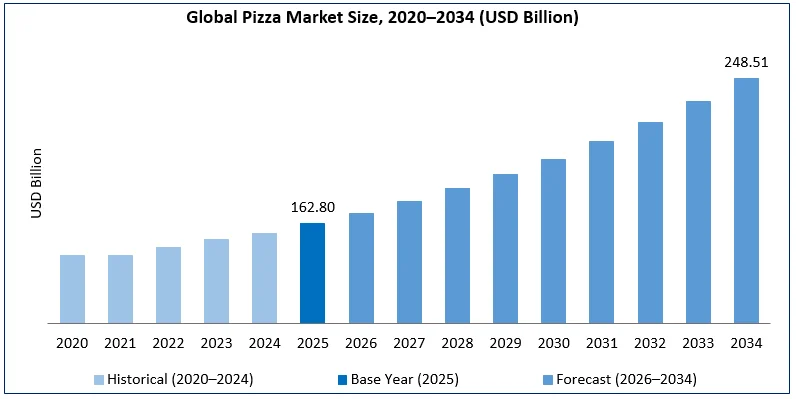
The Global Pizza Market size was valued at USD 162.80 Billion in 2025 and is projected to reach USD 248.51 Billion by 2034, growing at a CAGR of 4.80% during 2025–2034.
In terms of volume, the market is estimated at XX Metric Tons in 2025 and is expected to reach XX Metric Tons by 2034.
Global Pizza Market Overview
The Global Pizza Market encompasses the production, preparation, distribution, and sale of pizza products through foodservice establishments, quick-service restaurant chains, independent pizzerias, supermarkets, convenience stores, and online retail platforms. The market includes freshly prepared, frozen, chilled, refrigerated, and other ready-to-cook pizza products offered across different crust types, toppings, sizes, pizza styles, and price categories. Pizza has become an established food category across international markets, supported by its convenience, affordability, product customization, and availability through dine-in, takeaway, delivery, and retail channels.
The market is witnessing increasing demand for customized pizzas, premium toppings, innovative crust formulations, and internationally inspired flavours. Traditional varieties continue to maintain consumer interest, while gourmet, artisanal, vegetarian, vegan, and plant-based options are expanding product choices. Furthermore, the growing popularity of frozen and ready-to-bake pizzas is supporting demand across supermarkets, hypermarkets, convenience stores, and online grocery platforms.
The expansion of quick-service restaurant chains, franchise-based business models, cloud kitchens, and digital ordering platforms is transforming the global pizza industry. Restaurant operators are increasingly investing in online ordering systems, delivery infrastructure, customer loyalty programmes, automated kitchen equipment, and advanced inventory management solutions to improve operational efficiency and customer experience. In addition, product innovation, promotional pricing, sustainable packaging, and efficient ingredient procurement are becoming important competitive factors across the industry.
Global Pizza Market Size, Growth and Share Analysis
To know about the Research Methodology :- Request Free Sample Report
| Parameter | Value |
|---|---|
| Market Size (2025) | USD 162.80 Billion |
| Market Size (2034) | USD 248.51 Billion |
| CAGR | 4.80% |
| Historical Period | 2020 to 2025 |
| Forecast Period | 2026 to 2034 |
Global Pizza Market Key Highlights
Global Pizza Market Dynamics:
Increasing Demand for Convenient and Ready-to-Eat Food Products to Drive Market Growth
Changing lifestyles, urbanization, busy work schedules, and increasing demand for convenient meal options are supporting the growth of the global pizza industry. Pizza offers flexibility in portion sizes, toppings, crust types, and serving formats, making it suitable for individual consumption, family meals, social gatherings, and group occasions. The availability of dine-in, takeaway, home delivery, and ready-to-bake options further increases its accessibility across consumer groups.
The expansion of quick-service restaurants, independent pizzerias, and food delivery services is strengthening the availability of pizza across urban and semi-urban markets. Consumers are increasingly using digital platforms to compare menus, customize orders, access promotional offers, and receive home deliveries. Furthermore, restaurant chains are expanding their geographic presence through franchise-based models and standardized operating systems to serve growing consumer demand.
Frozen and chilled pizza products are also benefiting from convenience-driven purchasing behaviour. Improvements in freezing technologies, packaging formats, and storage practices are supporting product availability through supermarkets, hypermarkets, convenience stores, and online grocery channels.
Increasing Product Innovation and Customization to Create Market Opportunities
Product innovation is becoming an important growth opportunity in the global pizza industry as consumers increasingly seek differentiated flavours, premium ingredients, and personalized food experiences. Pizza manufacturers and restaurant operators are introducing specialty toppings, innovative crust formulations, regional recipes, and limited-time menu offerings to attract different consumer segments.
Demand for vegetarian, vegan, and plant-based pizzas is encouraging the use of alternative cheese products, plant-based meat substitutes, and vegetable-based toppings. Similarly, gluten-free crusts, whole-grain formulations, and alternative flour ingredients are expanding product choices for consumers seeking specific dietary options.
Premium and gourmet pizzas featuring specialty cheeses, seafood, imported ingredients, artisanal dough, and unique flavour combinations are also supporting product differentiation. Regional variations, including Neapolitan, New York, Chicago-style, Sicilian, and Roman-style pizzas, are helping brands develop localized menus and attract consumers interested in authentic and distinctive food experiences.
Expansion of Online Ordering and Food Delivery Platforms
The growing adoption of digital ordering platforms and food delivery applications is transforming pizza purchasing behaviour worldwide. Consumers increasingly prefer ordering through restaurant websites, mobile applications, and third-party food delivery marketplaces because of their convenience, menu accessibility, order customization, and promotional benefits.
Pizza restaurant chains are investing in digital infrastructure, customer relationship management systems, loyalty programmes, and personalized marketing campaigns to improve customer retention. Online ordering data also helps businesses understand purchasing preferences, identify popular menu combinations, and improve demand forecasting.
Furthermore, cloud kitchens and delivery-focused restaurant formats are expanding the availability of pizza without requiring conventional dine-in infrastructure. These business models can support market entry and expansion in locations where restaurant space and operating costs are major considerations.
Global Pizza Market Segment Analysis
The Global Pizza Market is segmented by product form, topping preference, size, crust type, pizza style, price tier, distribution channel, and region. Each segment represents different consumer preferences, product characteristics, purchasing occasions, and distribution requirements.
By Product Form
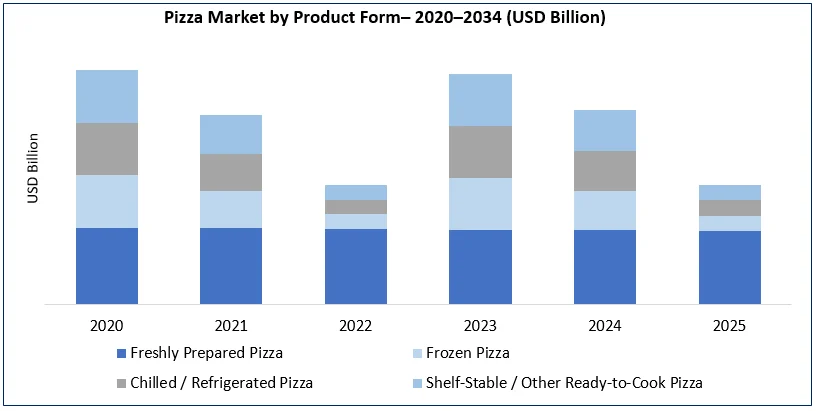
Based on product form, the market is segmented into freshly prepared pizza, frozen pizza, chilled/refrigerated pizza, and shelf-stable/other ready-to-cook pizza.
The freshly prepared pizza segment includes restaurant-prepared pizza, takeaway and delivery pizza, and other freshly prepared formats. This category benefits from consumer preference for freshly baked products, customizable toppings, and immediate consumption. Quick-service restaurants, full-service restaurants, and independent pizzerias support demand through dine-in, takeaway, and delivery services.
The frozen pizza segment is supported by convenience-driven purchasing behaviour and increasing retail availability. Improvements in freezing technology, packaging, and product formulations are helping manufacturers offer a wider range of flavours, crust types, and premium options. Chilled and refrigerated pizza products provide additional convenience for consumers seeking shorter preparation times, while shelf-stable and other ready-to-cook formats serve specific retail and storage requirements.
By Topping Preference
Based on topping preference, the market is segmented into vegetarian pizza and non-vegetarian pizza.
The non-vegetarian pizza segment includes products featuring chicken, beef, pork, seafood, and other meat-based toppings. Demand is supported by consumer preference for protein-rich toppings, familiar recipes, and customized flavour combinations. Restaurant chains and independent pizzerias offer multiple non-vegetarian varieties to serve different regional preferences.
The vegetarian pizza segment includes pizzas prepared with vegetables, cheese, herbs, and other plant-based ingredients. Increasing interest in vegetarian diets, vegetable-rich meals, and alternative ingredients is supporting product development in this category. Restaurants and manufacturers are also introducing vegan pizzas using dairy-free cheese and plant-based toppings to address evolving consumer preferences.
Global Pizza Market Regional Insights:
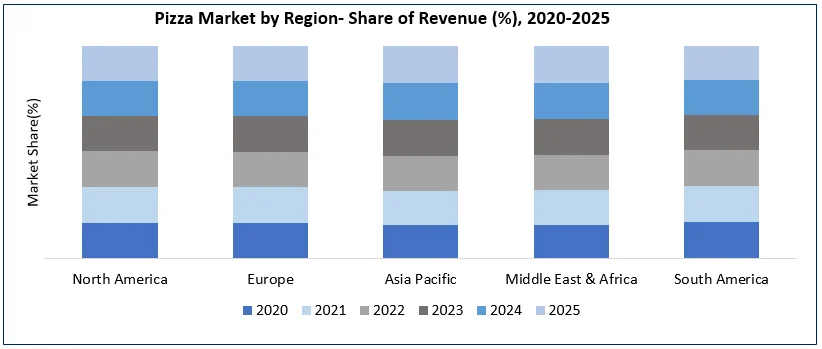
The Global Pizza Market is geographically segmented into North America, Europe, Asia Pacific, Middle East & Africa, and South America. North America represents an established pizza market, supported by widespread restaurant chains, strong consumer familiarity, extensive delivery networks, and high availability of frozen and packaged pizza products. The United States and Canada are important contributors, with demand supported by quick-service restaurants, independent pizzerias, digital ordering, and product customization. Europe benefits from established pizza consumption traditions, a strong foodservice industry, and demand for regional and specialty varieties. Italy remains an important market for traditional pizza styles, while the United Kingdom, Germany, France, and other European countries support demand through restaurant chains, independent outlets, and retail frozen pizza categories. Product innovation, premium ingredients, artisanal recipes, and sustainable packaging are influencing regional competition.
Asia Pacific is expected to offer growth opportunities through urbanization, expanding foodservice infrastructure, increasing disposable incomes, and growing exposure to international food categories. China, India, Japan, Australia, and other regional markets are witnessing expansion of quick-service restaurant networks, online food delivery, and localized pizza menus. Consumer preferences for vegetarian toppings, regional flavours, affordable meal options, and customized products are influencing product development. Middle East & Africa is supported by urban population growth, expanding shopping and restaurant infrastructure, international foodservice brands, and demand for convenient dining options. The UAE, Saudi Arabia, South Africa, and other developing markets offer opportunities for restaurant expansion, franchise development, and delivery-focused formats. South America is supported by established pizza consumption in countries such as Brazil and Argentina, alongside the development of restaurant chains, independent pizzerias, and digital food delivery services. Regional ingredient preferences, value-oriented menus, and localized flavours continue to influence product offerings and market competition.
Global Pizza Market – Industry Analysis
The objective of the report is to present a comprehensive analysis of the Global Pizza Market, covering the major participants across pizza manufacturing, foodservice, restaurant operations, retail distribution, and packaged food industries. The study evaluates historical and current market conditions, industry developments, market size, consumption volume, and future growth opportunities through 2034.
The report provides an in-depth assessment of market dynamics, including major growth drivers, restraints, opportunities, and challenges influencing pizza consumption and sales. It examines consumer preferences, product innovation, pizza styles, crust types, topping trends, pricing strategies, manufacturing processes, ingredient procurement, packaging, and distribution networks.
The study further evaluates the competitive positioning of leading pizza restaurant chains, independent pizzerias, frozen pizza manufacturers, and packaged food companies. Company-level analysis includes product portfolios, restaurant networks, geographic presence, franchise operations, pizza-specific revenue, financial performance, profitability, marketing strategies, product launches, and business expansion initiatives.
PORTER's Five Forces, PESTLE, DROC, and SWOT analyses are incorporated to evaluate the competitive environment and the influence of economic, social, technological, regulatory, and consumer-related factors on the industry. The report also provides regional market assessments and segmentation-based forecasts to identify emerging opportunities and future investment areas.
Global Pizza Market Scope: Inquire before buying
| Global Pizza Market | |||
|---|---|---|---|
| Report Coverage | Details | ||
| Base Year: | 2025 | Forecast Period: | 2026-2034 |
| Historical Data: | 2020 to 2025 | Market Size in 2025: | 162.8 USD Billion |
| Forecast Period 2026-2034 CAGR: | 4.8% | Market Size in 2034: | 248.51 USD Billion |
| Segments Covered: | by Product Form | Freshly Prepared Pizza Restaurant-Prepared Pizza Takeaway and Delivery Pizza Other Freshly Prepared Pizza Frozen Pizza Chilled / Refrigerated Pizza Shelf-Stable / Other Ready-to-Cook Pizza |
|
| by Topping Preference | Vegetarian Pizza Non-Vegetarian Pizza |
||
| by Size | Personal / Small — Below 9 Inches Medium — 9 to Below 13 Inches Large — 13 to Below 17 Inches Extra Large — 17 Inches and Above Non-Circular / Other Pizza Formats |
||
| by Crust Type | Thin Crust Regular / Traditional Crust Thick / Deep-Dish Crust Stuffed Crust Other Specialty Crusts |
||
| by Pizza Style | Neapolitan-Style Pizza New York-Style Pizza Chicago-Style / Deep-Dish Pizza Sicilian / Pan Pizza Roman-Style Pizza Other Regional and Specialty Pizza Styles |
||
| by Price Tier | Economy Mid-Range Premium Luxury / Gourmet |
||
| by Distribution Channel | Foodservice Quick Service Restaurants / Pizza Chains Full Service Restaurants Independent Pizzerias and Other Foodservice Outlets Retail Supermarkets and Hypermarkets Convenience Stores Specialty Food Stores Online Grocery Retail Other Retail Channels |
||
Global Pizza Market by Region
North America (United States, Canada and Mexico)
Europe (UK, France, Germany, Italy, Spain, Sweden, Austria and Rest of Europe)
Asia Pacific (China, South Korea, Japan, India, Australia, Indonesia, Malaysia, Vietnam, Taiwan, Bangladesh, Pakistan and Rest of APAC)
Middle East and Africa (South Africa, GCC, Egypt, Nigeria and Rest of ME&A)
South America (Brazil, Argentina, Rest of South America)
Global Pizza Market, Major Key Players
• North America
1. Domino’s Pizza, Inc.
2. Pizza Hut, LLC (Yum! Brands, Inc.)
3. Papa John’s International, Inc.
4. Little Caesar Enterprises, Inc. (Ilitch Holdings)
5. Marco’s Pizza (Marco’s Franchising, LLC)
6. Sbarro, LLC
7. California Pizza Kitchen
8. Round Table Pizza
9. Papa Murphy’s (MTY Food Group Inc.)
10. MTY Food Group Inc.
11. Hungry Howie’s Pizza, Inc.
12. Jet’s Pizza
13. Godfather’s Pizza, Inc.
14. CiCi’s Pizza
15. Blaze Pizza, LLC
16. Pieology Pizzeria
17. Uno Pizzeria & Grill (Uno Restaurant Holdings)
18. Donatos Pizza
19. Rave Restaurant Group, Inc. (Pizza Inn, Pie Five)
20. Casey’s General Stores, Inc.
21. Lou Malnati’s Pizzeria
22. Giordano’s
23. Hunt Brothers Pizza
24. Pizza Ranch
25. Pizza Pizza Limited
26. Pizza Nova
27. Boston Pizza International Inc.
28. Panago Pizza Inc.
29. Alsea, S.A.B. de C.V. (Domino’s Mexico)
30. General Mills, Inc. (Totino’s)
31. The Schwan’s Company (CJ CheilJedang Corp.; Red Baron, Freschetta, Tony’s)
32. Conagra Brands, Inc.
33. McCain Foods Limited
34. Amy’s Kitchen, Inc.
35. Tyson Foods, Inc.
36. Palermo Villa, Inc.
37. Home Run Inn
38. Rich Products Corporation
39. The Campbell’s Company (Rao’s, via Sovos Brands)
40. Bellisio Foods, Inc.
• Europe
41. Nestlé S.A. (DiGiorno, Wagner, Buitoni)
42. Dr. August Oetker KG
43. Roncadin GmbH
44. Italpizza S.p.A.
45. Domino’s Pizza Group plc
46. PizzaExpress Limited
47. Telepizza (Food Delivery Brands Group, S.A.; Apollo Global Management)
48. Vapiano SE
• Asia Pacific
49. Domino’s Pizza Enterprises Limited
50. Jubilant FoodWorks Limited (Jubilant Bhartia Group)
51. Devyani International Limited
52. Sapphire Foods India Limited
53. Yum China Holdings, Inc. (Pizza Hut China)
54. Pizza-La Corporation
55. Shakey’s Pizza Asia Ventures, Inc.
56. Yellow Cab Pizza Co.
57. Greenwich Pizza (Jollibee Foods Corporation)
58. Mr. Pizza (MP Group)
59. Ajinomoto Co., Inc.
60. Hell Pizza
• Middle East & Africa
61. Americana Restaurants International PLC
62. Famous Brands Limited (Debonairs Pizza)
63. Roman’s Pizza
64. Spur Corporation Ltd. (Panarottis)
Others
Frequently Asked Questions:
1. What is the Global Pizza Market?
The Global Pizza Market includes the production, sale, and distribution of pizza products through restaurants, quick-service outlets, independent operators, takeaway and delivery services, supermarkets, hypermarkets, convenience stores, and online retail platforms. The market covers freshly prepared, frozen, chilled, ready-to-bake, and ready-to-eat pizza products.
2. What is the Global Pizza Market size in 2025?
The Global Pizza Market was valued at approximately USD 162.80 Billion in 2025. The market estimate considers demand across different product forms, topping preferences, pizza sizes, crust types, price tiers, and distribution channels.
3. What is the expected Global Pizza Market size by 2034?
The Global Pizza Market is projected to reach approximately USD 248.51 Billion by 2034, supported by growing demand for convenient food products, expansion of restaurant chains, digital food delivery, and increasing product innovation.
4. What is the expected CAGR of the Global Pizza Market during the forecast period?
The Global Pizza Market is expected to grow at a CAGR of 4.80% during 2026–2034. Growth is influenced by changing consumer lifestyles, increasing urbanization, expanding foodservice infrastructure, and rising demand for frozen and ready-to-eat products.
5. Which region is expected to witness significant growth in the Global Pizza Market?
Asia Pacific is expected to offer significant growth opportunities due to increasing disposable incomes, urbanization, changing food preferences, expanding international restaurant chains, and growing adoption of online food delivery services.