Global Pigmentation Disorders Treatment Market Size by Type of Disorder, Distribution Channel, Region & Forecast to 2034

7.2%
CAGR (2026-2034)
7.95 USD Bn.
Forecast Market Size
300
Report Pages
144
Market Tables

Overview

The Global Pigmentation Disorders Treatment Market was valued at USD 7.95 Billion in 2025 and is projected to reach USD 14.86 Billion by 2034, growing at a CAGR of 7.2% during the forecast period 2026–2034.

Pigmentation Disorders Treatment Market Overview:

Pigmentation Disorders Treatment is a type of medicine or topical cream, lasers, and light-based procedure to treat aesthetic issues, including melasma, vitiligo, post-inflammatory hyperpigmentation, and other pigmentation problems. The Pigmentation Disorders Treatment Market growth is primarily driven by the appearance and quality of life concerns associated with these conditions. Dermatology practices, medical facilities, aesthetic surgeon groups, and skincare clinics commonly offer such procedures to patients, drawing attention to the importance of the global market. The market value is determined by the increasing number of affected people, a higher proportion of patients seeking dermatological advice, and the overall demand for aesthetic treatments. Moreover, the market has to consider topical creams, laser surgeries, and other methods. Thus, the global industry seems highly relevant and attractive in the context of ongoing innovation and research.

The most significant market challenges are associated with the segmented market landscape for topical treatments and other therapies, as well as the need for comprehensive patient-centric care solutions. In line with that, the key market opportunities are represented by emerging indications, including melasma or vitiligo treatment, introduction of novel laser technologies, and a growing number of home skincare treatments. Moreover, the market growth dynamics are aligned with a rising number of patients and the increasing impact of dermatology in healthcare settings. Finally, the market drivers are supported by the overall attractiveness of the aesthetics industry, a rising number of treatments, and the potential for innovation to address the Pigmentation Disorders Treatment gap. Topical creams, laser surgeries, and other methods are included in the forecast for the global market value up to 2034.

North America is the biggest region in the Pigmentation Disorders Treatment Market report, followed by Europe and the Asia-Pacific region. The market concentration is found in dermatology practices, medical institutions, and aesthetic surgery groups, representing the distribution network of industry participants. Thus, the most influential companies include AbbVie, Incyte, L’Oréal, Galderma, Pierre Fabre, Beiersdorf, and Dr. Reddy’s Laboratories. MMR research emphasizes the potential of the Pigmentation Disorders Treatment Market, as it is projected to experience consistent growth up to 2034. Innovation and investment potential, as well as the relevance of emerging indications, are the primary factors behind this trend.

Pigmentation Disorders Treatment Market Growth Outlook
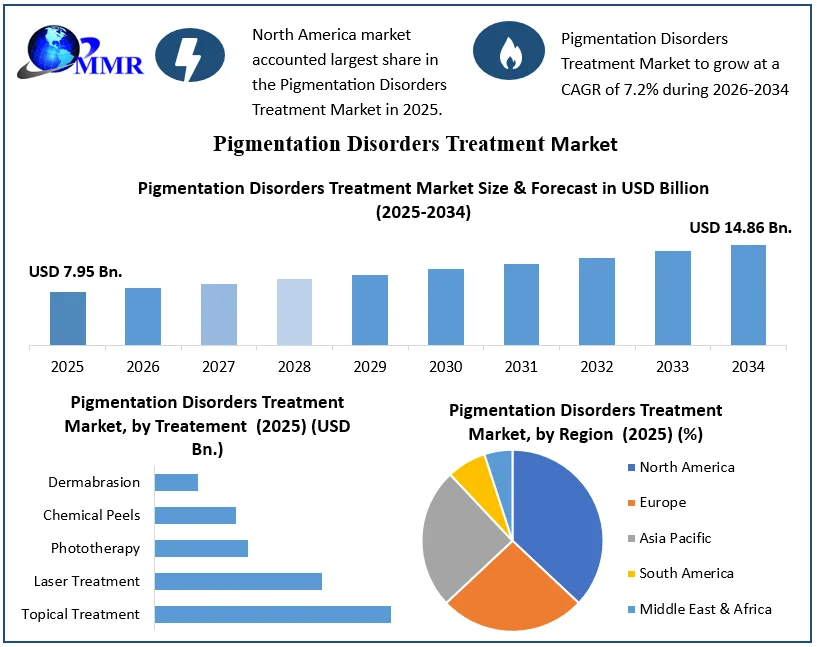
Pigmentation Disorders Treatment Market Growth

To know about the Research Methodology :- Request Free Sample Report

Pigmentation Disorders Treatment Market Dynamics:

Increasing demand for skin lightening procedure is the major factor driving the market growth.

Rising up-gradation of lifestyle along with an increase in demand for skin lightening is a major factor expected to drive the global pigmentation problem treatment market. Melanin, a skin component produced by some specific cells in the body, regulates skin colour. Pigmentation is caused by damaged or diseased melanin-producing cells that produce too little or too much melanin. Melasma (hyper pigmentary disorder), vitiligo (hypopigmentary disorder), albinism (inherited uncommon disorder), and post-inflammatory hyperpigmentation are the most frequent pigmentation diseases.

Environmental changes, such as global warming, have a substantial impact on the skin and are expected to aid the industry's growth in the next years. Furthermore, advancements in tissue engineering, as well as a spike in fresh methods for boosting aesthetics and skincare products, will aid the industry in achieving maximum revenue in the near future. Other factors driving the global pigmentation problem treatment market include an ageing population, an increase in the frequency of skin problems, and rising disposable income. Growing consumer knowledge of cosmeceutical and cosmetics goods, such as anti-aging, sun care, and hair care, and beauty, is predicted to improve the industry's growth potential in the future. The introduction of natural and plant-based components has been critical in meeting the global demand for cosmeceutical products. The exorbitant expenses of cosmetic treatments and surgery, on the other hand, are limiting the market growth.

The report has profiled nineteen key players in the market from different regions. However, report has considered all market leaders, followers and new entrants with investors while analyzing the market and estimation the size of the same. Increasing R&D activities in each region are different and focus is given on the regional impact on the cost, availability of advanced technology are analyzed and report has come up with recommendations for future hot spot in APAC region.

Pigmentation Disorders Treatment Market Segment Analysis:

Global Pigmentation Disorders Treatment Market, by Type of Disorders

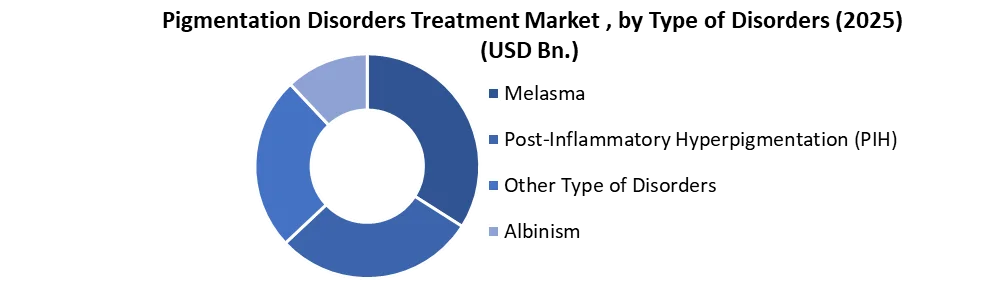
The Pigmentation Disorders Treatment Market is segmented into Albinism, Melasma, Post-Inflammatory Hyperpigmentation (PIH), and others. The high incidence of Melasma and PIH and the large demand for their resolution methods, in particular, account for the main share of the market. The growing awareness of the issue and the need for dermatological treatment impel the market growth. Although Albinism is a rare occurrence, it still represents a considerable share of the Pigmentation Disorders Treatment Market. The key market opportunities are driven by the risk of exacerbation, the irregularity of the disease, the need for expensive procedures, and the unavailability of treatment. The market drivers for the Pigmentation Disorders treatment market include the increasing prevalence of the disorders and the rising awareness of the consumers and the availability of dermatological procedures.Pigmentation Disorders Treatment Market by type of disorders
Global Pigmentation Disorders Treatment Market, by Distribution Channel

The Pigmentation Disorders Treatment market is classified into E-commerce, Dermatology Clinics, Drugstores and Cosmetic Stores, and Others. Dermatology clinics dominate the market due to the high demand for dermatological procedures and patient confidence in obtaining an accurate diagnosis, receiving a prescription, and undergoing treatment. E-commerce is a fast-growing channel as more people order various topical preparations for treating pigmentation disorders. Drugstores and Cosmetic Stores provide an alternative sales channel for dermatological treatments, where patients can receive qualified assistance and advice. The market forecast for these four distribution channels is a positive one due to a rising number of people suffering from pigmentation disorders and people’s growing willingness to spend on their appearance. Altogether, the market opportunities for the distribution of pigmentation treatments are still ahead as there is a growing demand for safe and effective treatments, which can be distributed through multiple channels. The market gap is the lack of trust in purchasing topical treatments for pigmentation disorders, which are available at various price ranges.
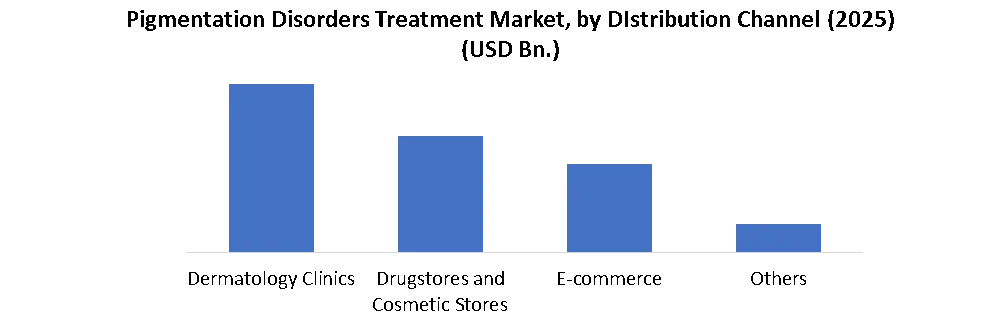
Pigmentation Disorders Treatment Market by Distribution Channel

Pigmentation Disorders Treatment Market Regional Insights:

North America is expected to hold the dominant market share during forecast period.

Because of the increased prevalence of pigmentation disorders, North America dominates the global pigmentation disorders treatment market. In North America, there is a well-established healthcare infrastructure and large market companies that provide efficient treatment choices for patients with post-inflammatory hyperpigmentation. Due to increased beauty concern among Asians, rapid entry of new competitors into the market, and growth by major companies into emerging economies, the Asia Pacific region is witnessing a quick pace in the global pigmentation disorders treatment market.

The report also helps in understanding Global Pigmentation Disorders Treatment Market dynamics, structure by analyzing the market segments and project the Global Pigmentation Disorders Treatment Market size. Clear representation of competitive analysis of key players by product, price, financial position, product portfolio, growth strategies, and regional presence in the Global Pigmentation Disorders Treatment Market make the report investor’s guide.

Global Pigmentation Disorders Treatment Market Competitive Landscape

The Pigmentation Disorders Treatment Market competitive landscape is moderately fragmented, with several pharmaceutical, dermatology, skincare, and medical-aesthetic device companies vying for dominance through new product development, clinical studies, regulatory approvals, and expansive distribution networks. AbbVie, Incyte, Galderma, Novartis, Sanofi, L’Oréal, Pierre Fabre, Obagi, Lumenis, and Candela lead the pack, targeting melasma, vitiligo, post-inflammatory hyperpigmentation, and other pigmentation irregularities. Topical ingredients, emerging therapies, laser equipment, and combination treatment options enhance the manufacturers’ presence and competitive advantage.

The firms are forming strategic alliances, engaging in mergers and acquisitions, and launching innovative products and treatment programs. Personalized dermatology, laser technology, prescription drugs, and digital skincare solutions dominate the market’s growth potential, driven by increased medical interventions for pigmentation irregularities. Yet, the market size remains vulnerable to high recurrence rates, treatment costs, inconsistent efficacy, and difficult access to dermatologists. Hence, manufacturers invest significantly in developing safe, sustainable, and economical treatment regimens to gain a bigger market share.

Global Pigmentation Disorders Treatment Market Recent Development

Published Date Company Recent Development
May-2026 UPM UPM announced the deal to buy Avantium’s Ray Technology® know-how. This includes the production of bio-based mono-propylene glycol and mono-ethylene glycol made from plant-based sugar. The acquisition helps UPM build its standing in renewable glycol technology as well as future production of bio-based PG.
May-2026 DOW Dow announced the launch of its Coolant Care Network for data-center liquid cooling. It helps widen its footprint in coolant management as heat-transfer fluids that are based on PG are used in numerous cooling processes.
February-2026 Balaji Amines Limited Balaji Amines announced the commissioning of its own propylene glycol technology to create pharma-grade material. Its expansion into higher purity PG products will strengthen its portfolio of high-value-added products and applications for the pharma and other industries.
September-2026 Manali Petrochemicals Limited Manali Petrochemicals announced the expansion of its Propylene Glycol plant and the addition of approximately 50,000 tonnes per year of capacity to its existing production. It will be able to boost its output and cater to a higher share of the domestic demand for PG.
January-2026 BASF SE BASF began operating the steam cracker at its new Verbund site in Zhanjiang, China. It will start to supply the propylene as well as other basic chemicals to downstream plants in the new complex and ramp up activity in downstream glycol and specialty chemical production in Asia.

Pigmentation Disorders Treatment Market Scope: Inquire before buying

Pigmentation Disorders Treatment Market
Report Coverage Details
Base Year: 2025 Forecast Period: 2026-2034
Historical Data: 2020 to 2025 Market Size in 2025: US $ 7.95 Bn.
Forecast Period 2026 to 2034 CAGR: 7.2% Market Size in 2034: US $ 14.86 Bn.
Segments Covered: by Type of Disorders Albinism
Melasma
Post-Inflammatory Hyperpigmentation (PIH)
Other Type of Disorders
by Treatment Topical Treatment
Dermabrasion
Chemical peels
Laser Treatment
Phototherapy
by Distribution Channel E-commerce
Dermatology Clinics
Drugstores and Cosmetic Stores
Others

Pigmentation Disorders Treatment Market , by Region

North America (United States, Canada and Mexico)
Europe (UK, France, Germany, Italy, Spain, Sweden, Austria and Rest of Europe)
Asia Pacific (China, South Korea, Japan, India, Australia, Indonesia, Malaysia, Vietnam, Taiwan, Bangladesh, Pakistan and Rest of APAC)
Middle East and Africa (South Africa, GCC, Egypt, Nigeria and Rest of ME&A)
South America (Brazil, Argentina Rest of South America)

Global Pigmentation Disorders Treatment Market, Key players:

1. AbbVie Inc.
2. Incyte Corporation
3. Galderma Group AG
4. Novartis AG
5. Pfizer Inc.
6. Sanofi S.A.
7. Bristol Myers Squibb Company
8. Bausch Health Companies Inc.
9. Bayer AG
10. Pierre Fabre S.A.
11. Dr. Reddy’s Laboratories Ltd.
12. Glenmark Pharmaceuticals Ltd.
13. Sun Pharmaceutical Industries Ltd.
14. Viatris Inc.
15. Strides Pharma Science Limited
16. Accord Healthcare Ltd.
17. LEO Pharma A/S
18. Astellas Pharma Inc.
19. Amgen Inc.
20. Clinuvel Pharmaceuticals Ltd.
21. Organon & Co.
22. Arcutis Biotherapeutics, Inc.
23. Scientis SA
24. Obagi Cosmeceuticals LLC
25. L’Oréal S.A.
26. Shiseido Company, Limited
27. Beiersdorf AG
28. Estée Lauder Companies Inc.
29. Kenvue Inc.
30. Cantabria Labs
31. mesoestetic Pharma Group
32. Sesderma S.L.
33. ISDIN S.A.
34. Vivier Pharma Inc.
35. Colorescience, Inc.
36. STRATA Skin Sciences, Inc.
37. Zerigo Health, Inc.
38. Candela Corporation
39. Fotona d.o.o.
40. Lumenis Be Ltd.
41. Aerolase Corporation
42. InMode Ltd.
43. Alma Lasers Ltd.
44. Cutera, Inc.
45. Sciton, Inc.
46. Cynosure Lutronic
47. BTL Industries Inc.
48. Quanta System S.p.A.
49. WONTECH Co., Ltd.
50. Laseroptek Co., Ltd.

Frequently Asked Questions:

1. Which region has the largest share in Global Pigmentation Disorders Treatment Market?
Ans: North America region held the highest share in 2025.

2. What is the growth rate of Global Pigmentation Disorders Treatment Market?
Ans: The Global Pigmentation Disorders Treatment Market is growing at a CAGR of 7.2% during forecasting period 2026-2034.

3. What is scope of the Global Pigmentation Disorders Treatment Market report?
Ans: Global Pigmentation Disorders Treatment Market report helps with the PESTEL, PORTER, COVID-19 Impact analysis, Recommendations for Investors & Leaders, and market estimation of the forecast period.

4. Who are the key players in Global Pigmentation Disorders Treatment Market?
Ans: The important key players in the Global Pigmentation Disorders Treatment Market are – AbbVie Inc., Incyte Corporation, Galderma Group AG, Novartis AG, Pfizer Inc., Sanofi S.A.and Others.

5. What is the study period of this Market?
Ans: The Global Pigmentation Disorders Treatment Market is studied from 2020 to 2034.

Table of Contents

1. Pigmentation Disorders Treatment Market Introduction 1.1. Study Assumption and Market Definition 1.2. Scope of the Study 1.3. Executive Summary 2. Global Pigmentation Disorders Treatment Market: Competitive Landscape 2.1. MMR Competition Matrix 2.2. Competitive Landscape 2.3. Key Players Benchmarking 2.3.1. Company Name 2.3.2. Business Segment 2.3.3. End-user Segment 2.3.4. Revenue (2025) 2.3.5. Company Locations 2.4. Leading Pigmentation Disorders Treatment Market Companies, by market capitalization 2.5. Market Structure 2.5.1. Market Leaders 2.5.2. Market Followers 2.5.3. Emerging Players 2.6. Mergers and Acquisitions Details 3. Pigmentation Disorders Treatment Market: Dynamics 3.1. Pigmentation Disorders Treatment Market Trends by Region 3.1.1. North America Pigmentation Disorders Treatment Market Trends 3.1.2. Europe Pigmentation Disorders Treatment Market Trends 3.1.3. Asia Pacific Pigmentation Disorders Treatment Market Trends 3.1.4. Middle East and Africa Pigmentation Disorders Treatment Market Trends 3.1.5. South America Pigmentation Disorders Treatment Market Trends 3.2. Pigmentation Disorders Treatment Market Dynamics by Region 3.2.1. North America 3.2.1.1. North America Pigmentation Disorders Treatment Market Drivers 3.2.1.2. North America Pigmentation Disorders Treatment Market Restraints 3.2.1.3. North America Pigmentation Disorders Treatment Market Opportunities 3.2.1.4. North America Pigmentation Disorders Treatment Market Challenges 3.2.2. Europe 3.2.2.1. Europe Pigmentation Disorders Treatment Market Drivers 3.2.2.2. Europe Pigmentation Disorders Treatment Market Restraints 3.2.2.3. Europe Pigmentation Disorders Treatment Market Opportunities 3.2.2.4. Europe Pigmentation Disorders Treatment Market Challenges 3.2.3. Asia Pacific 3.2.3.1. Asia Pacific Pigmentation Disorders Treatment Market Drivers 3.2.3.2. Asia Pacific Pigmentation Disorders Treatment Market Restraints 3.2.3.3. Asia Pacific Pigmentation Disorders Treatment Market Opportunities 3.2.3.4. Asia Pacific Pigmentation Disorders Treatment Market Challenges 3.2.4. Middle East and Africa 3.2.4.1. Middle East and Africa Pigmentation Disorders Treatment Market Drivers 3.2.4.2. Middle East and Africa Pigmentation Disorders Treatment Market Restraints 3.2.4.3. Middle East and Africa Pigmentation Disorders Treatment Market Opportunities 3.2.4.4. Middle East and Africa Pigmentation Disorders Treatment Market Challenges 3.2.5. South America 3.2.5.1. South America Pigmentation Disorders Treatment Market Drivers 3.2.5.2. South America Pigmentation Disorders Treatment Market Restraints 3.2.5.3. South America Pigmentation Disorders Treatment Market Opportunities 3.2.5.4. South America Pigmentation Disorders Treatment Market Challenges 3.3. PORTER's Five Forces Analysis 3.4. PESTLE Analysis 3.5. Technology Roadmap 3.6. Regulatory Landscape by Region 3.6.1. North America 3.6.2. Europe 3.6.3. Asia Pacific 3.6.4. Middle East and Africa 3.6.5. South America 3.7. Key Opinion Leader Analysis in the Pigmentation Disorders Treatment Market 3.8. Analysis of Government Schemes and Initiatives For Global Industry 3.9. Pigmentation Disorders Treatment Market Trade Analysis 3.10. The Global Pandemic Impact on Pigmentation Disorders Treatment Market 4. Pigmentation Disorders Treatment Market: Global Market Size and Forecast by Segmentation (in Bn.) 2025-2034 4.1. Pigmentation Disorders Treatment Market Size and Forecast, by Type of Disorders (2025-2034) 4.1.1. Albinism 4.1.2. Melasma 4.1.3. Post-Inflammatory Hyperpigmentation (PIH) 4.1.4. Other Type of Disorders 4.2. Pigmentation Disorders Treatment Market Size and Forecast, by Treatment (2025-2034) 4.2.1. Topical Treatment 4.2.2. Dermabrasion 4.2.3. Chemical peels 4.2.4. Laser Treatment 4.2.5. Phototherapy 4.3. Pigmentation Disorders Treatment Market Size and Forecast, by Distribution Channel (2025-2034) 4.3.1. E-commerce 4.3.2. Dermatology Clinics 4.3.3. Drugstores and Cosmetic Stores 4.3.4. Others 4.4. Pigmentation Disorders Treatment Market Size and Forecast, by Region (2025-2034) 4.4.1. North America 4.4.2. Europe 4.4.3. Asia Pacific 4.4.4. Middle East and Africa 4.4.5. South America 5. North America Pigmentation Disorders Treatment Market Size and Forecast by Segmentation (in Bn.) 2025-2034 5.1. North America Pigmentation Disorders Treatment Market Size and Forecast, by Type of Disorders (2025-2034) 5.1.1. Albinism 5.1.2. Melasma 5.1.3. Post-Inflammatory Hyperpigmentation (PIH) 5.1.4. Other Type of Disorders 5.2. North America Pigmentation Disorders Treatment Market Size and Forecast, by Treatment (2025-2034) 5.2.1. Topical Treatment 5.2.2. Dermabrasion 5.2.3. Chemical peels 5.2.4. Laser Treatment 5.2.5. Phototherapy 5.3. North America Pigmentation Disorders Treatment Market Size and Forecast, by Distribution Channel (2025-2034) 5.3.1. E-commerce 5.3.2. Dermatology Clinics 5.3.3. Drugstores and Cosmetic Stores 5.3.4. Others 5.4. North America Pigmentation Disorders Treatment Market Size and Forecast, by Country (2025-2034) 5.4.1. United States 5.4.1.1. United States Pigmentation Disorders Treatment Market Size and Forecast, by Type of Disorders (2025-2034) 5.4.1.1.1. Albinism 5.4.1.1.2. Melasma 5.4.1.1.3. Post-Inflammatory Hyperpigmentation (PIH) 5.4.1.1.4. Other Type of Disorders 5.4.1.2. United States Pigmentation Disorders Treatment Market Size and Forecast, by Treatment (2025-2034) 5.4.1.2.1. Topical Treatment 5.4.1.2.2. Dermabrasion 5.4.1.2.3. Chemical peels 5.4.1.2.4. Laser Treatment 5.4.1.2.5. Phototherapy 5.4.1.3. United States Pigmentation Disorders Treatment Market Size and Forecast, by Distribution Channel (2025-2034) 5.4.1.3.1. E-commerce 5.4.1.3.2. Dermatology Clinics 5.4.1.3.3. Drugstores and Cosmetic Stores 5.4.1.3.4. Others 5.4.2. Canada 5.4.2.1. Canada Pigmentation Disorders Treatment Market Size and Forecast, by Type of Disorders (2025-2034) 5.4.2.1.1. Albinism 5.4.2.1.2. Melasma 5.4.2.1.3. Post-Inflammatory Hyperpigmentation (PIH) 5.4.2.1.4. Other Type of Disorders 5.4.2.2. Canada Pigmentation Disorders Treatment Market Size and Forecast, by Treatment (2025-2034) 5.4.2.2.1. Topical Treatment 5.4.2.2.2. Dermabrasion 5.4.2.2.3. Chemical peels 5.4.2.2.4. Laser Treatment 5.4.2.2.5. Phototherapy 5.4.2.3. Canada Pigmentation Disorders Treatment Market Size and Forecast, by Distribution Channel (2025-2034) 5.4.2.3.1. E-commerce 5.4.2.3.2. Dermatology Clinics 5.4.2.3.3. Drugstores and Cosmetic Stores 5.4.2.3.4. Others 5.4.3. Mexico 5.4.3.1. Mexico Pigmentation Disorders Treatment Market Size and Forecast, by Type of Disorders (2025-2034) 5.4.3.1.1. Albinism 5.4.3.1.2. Melasma 5.4.3.1.3. Post-Inflammatory Hyperpigmentation (PIH) 5.4.3.1.4. Other Type of Disorders 5.4.3.2. Mexico Pigmentation Disorders Treatment Market Size and Forecast, by Treatment (2025-2034) 5.4.3.2.1. Topical Treatment 5.4.3.2.2. Dermabrasion 5.4.3.2.3. Chemical peels 5.4.3.2.4. Laser Treatment 5.4.3.2.5. Phototherapy 5.4.3.3. Mexico Pigmentation Disorders Treatment Market Size and Forecast, by Distribution Channel (2025-2034) 5.4.3.3.1. E-commerce 5.4.3.3.2. Dermatology Clinics 5.4.3.3.3. Drugstores and Cosmetic Stores 5.4.3.3.4. Others 6. Europe Pigmentation Disorders Treatment Market Size and Forecast by Segmentation (in Bn.) 2025-2034 6.1. Europe Pigmentation Disorders Treatment Market Size and Forecast, by Type of Disorders (2025-2034) 6.1.1. Albinism 6.1.2. Melasma 6.1.3. Post-Inflammatory Hyperpigmentation (PIH) 6.1.4. Other Type of Disorders 6.2. Europe Pigmentation Disorders Treatment Market Size and Forecast, by Treatment (2025-2034) 6.2.1. Topical Treatment 6.2.2. Dermabrasion 6.2.3. Chemical peels 6.2.4. Laser Treatment 6.2.5. Phototherapy 6.3. Europe Pigmentation Disorders Treatment Market Size and Forecast, by Distribution Channel (2025-2034) 6.3.1. E-commerce 6.3.2. Dermatology Clinics 6.3.3. Drugstores and Cosmetic Stores 6.3.4. Others 6.4. Europe Pigmentation Disorders Treatment Market Size and Forecast, by Country (2025-2034) 6.4.1. United Kingdom 6.4.1.1. United Kingdom Pigmentation Disorders Treatment Market Size and Forecast, by Type of Disorders (2025-2034) 6.4.1.1.1. Albinism 6.4.1.1.2. Melasma 6.4.1.1.3. Post-Inflammatory Hyperpigmentation (PIH) 6.4.1.1.4. Other Type of Disorders 6.4.1.2. United Kingdom Pigmentation Disorders Treatment Market Size and Forecast, by Treatment (2025-2034) 6.4.1.2.1. Topical Treatment 6.4.1.2.2. Dermabrasion 6.4.1.2.3. Chemical peels 6.4.1.2.4. Laser Treatment 6.4.1.2.5. Phototherapy 6.4.1.3. United Kingdom Pigmentation Disorders Treatment Market Size and Forecast, by Distribution Channel (2025-2034) 6.4.1.3.1. E-commerce 6.4.1.3.2. Dermatology Clinics 6.4.1.3.3. Drugstores and Cosmetic Stores 6.4.1.3.4. Others 6.4.2. France 6.4.2.1. France Pigmentation Disorders Treatment Market Size and Forecast, by Type of Disorders (2025-2034) 6.4.2.1.1. Albinism 6.4.2.1.2. Melasma 6.4.2.1.3. Post-Inflammatory Hyperpigmentation (PIH) 6.4.2.1.4. Other Type of Disorders 6.4.2.2. France Pigmentation Disorders Treatment Market Size and Forecast, by Treatment (2025-2034) 6.4.2.2.1. Topical Treatment 6.4.2.2.2. Dermabrasion 6.4.2.2.3. Chemical peels 6.4.2.2.4. Laser Treatment 6.4.2.2.5. Phototherapy 6.4.2.3. France Pigmentation Disorders Treatment Market Size and Forecast, by Distribution Channel (2025-2034) 6.4.2.3.1. E-commerce 6.4.2.3.2. Dermatology Clinics 6.4.2.3.3. Drugstores and Cosmetic Stores 6.4.2.3.4. Others 6.4.3. Germany 6.4.3.1. Germany Pigmentation Disorders Treatment Market Size and Forecast, by Type of Disorders (2025-2034) 6.4.3.1.1. Albinism 6.4.3.1.2. Melasma 6.4.3.1.3. Post-Inflammatory Hyperpigmentation (PIH) 6.4.3.1.4. Other Type of Disorders 6.4.3.2. Germany Pigmentation Disorders Treatment Market Size and Forecast, by Treatment (2025-2034) 6.4.3.2.1. Topical Treatment 6.4.3.2.2. Dermabrasion 6.4.3.2.3. Chemical peels 6.4.3.2.4. Laser Treatment 6.4.3.2.5. Phototherapy 6.4.3.3. Germany Pigmentation Disorders Treatment Market Size and Forecast, by Distribution Channel (2025-2034) 6.4.3.3.1. E-commerce 6.4.3.3.2. Dermatology Clinics 6.4.3.3.3. Drugstores and Cosmetic Stores 6.4.3.3.4. Others 6.4.4. Italy 6.4.4.1. Italy Pigmentation Disorders Treatment Market Size and Forecast, by Type of Disorders (2025-2034) 6.4.4.1.1. Albinism 6.4.4.1.2. Melasma 6.4.4.1.3. Post-Inflammatory Hyperpigmentation (PIH) 6.4.4.1.4. Other Type of Disorders 6.4.4.2. Italy Pigmentation Disorders Treatment Market Size and Forecast, by Treatment (2025-2034) 6.4.4.2.1. Topical Treatment 6.4.4.2.2. Dermabrasion 6.4.4.2.3. Chemical peels 6.4.4.2.4. Laser Treatment 6.4.4.2.5. Phototherapy 6.4.4.3. Italy Pigmentation Disorders Treatment Market Size and Forecast, by Distribution Channel (2025-2034) 6.4.4.3.1. E-commerce 6.4.4.3.2. Dermatology Clinics 6.4.4.3.3. Drugstores and Cosmetic Stores 6.4.4.3.4. Others 6.4.5. Spain 6.4.5.1. Spain Pigmentation Disorders Treatment Market Size and Forecast, by Type of Disorders (2025-2034) 6.4.5.1.1. Albinism 6.4.5.1.2. Melasma 6.4.5.1.3. Post-Inflammatory Hyperpigmentation (PIH) 6.4.5.1.4. Other Type of Disorders 6.4.5.2. Spain Pigmentation Disorders Treatment Market Size and Forecast, by Treatment (2025-2034) 6.4.5.2.1. Topical Treatment 6.4.5.2.2. Dermabrasion 6.4.5.2.3. Chemical peels 6.4.5.2.4. Laser Treatment 6.4.5.2.5. Phototherapy 6.4.5.3. Spain Pigmentation Disorders Treatment Market Size and Forecast, by Distribution Channel (2025-2034) 6.4.5.3.1. E-commerce 6.4.5.3.2. Dermatology Clinics 6.4.5.3.3. Drugstores and Cosmetic Stores 6.4.5.3.4. Others 6.4.6. Sweden 6.4.6.1. Sweden Pigmentation Disorders Treatment Market Size and Forecast, by Type of Disorders (2025-2034) 6.4.6.1.1. Albinism 6.4.6.1.2. Melasma 6.4.6.1.3. Post-Inflammatory Hyperpigmentation (PIH) 6.4.6.1.4. Other Type of Disorders 6.4.6.2. Sweden Pigmentation Disorders Treatment Market Size and Forecast, by Treatment (2025-2034) 6.4.6.2.1. Topical Treatment 6.4.6.2.2. Dermabrasion 6.4.6.2.3. Chemical peels 6.4.6.2.4. Laser Treatment 6.4.6.2.5. Phototherapy 6.4.6.3. Sweden Pigmentation Disorders Treatment Market Size and Forecast, by Distribution Channel (2025-2034) 6.4.6.3.1. E-commerce 6.4.6.3.2. Dermatology Clinics 6.4.6.3.3. Drugstores and Cosmetic Stores 6.4.6.3.4. Others 6.4.7. Austria 6.4.7.1. Austria Pigmentation Disorders Treatment Market Size and Forecast, by Type of Disorders (2025-2034) 6.4.7.1.1. Albinism 6.4.7.1.2. Melasma 6.4.7.1.3. Post-Inflammatory Hyperpigmentation (PIH) 6.4.7.1.4. Other Type of Disorders 6.4.7.2. Austria Pigmentation Disorders Treatment Market Size and Forecast, by Treatment (2025-2034) 6.4.7.2.1. Topical Treatment 6.4.7.2.2. Dermabrasion 6.4.7.2.3. Chemical peels 6.4.7.2.4. Laser Treatment 6.4.7.2.5. Phototherapy 6.4.7.3. Austria Pigmentation Disorders Treatment Market Size and Forecast, by Distribution Channel (2025-2034) 6.4.7.3.1. E-commerce 6.4.7.3.2. Dermatology Clinics 6.4.7.3.3. Drugstores and Cosmetic Stores 6.4.7.3.4. Others 6.4.8. Rest of Europe 6.4.8.1. Rest of Europe Pigmentation Disorders Treatment Market Size and Forecast, by Type of Disorders (2025-2034) 6.4.8.1.1. Albinism 6.4.8.1.2. Melasma 6.4.8.1.3. Post-Inflammatory Hyperpigmentation (PIH) 6.4.8.1.4. Other Type of Disorders 6.4.8.2. Rest of Europe Pigmentation Disorders Treatment Market Size and Forecast, by Treatment (2025-2034) 6.4.8.2.1. Topical Treatment 6.4.8.2.2. Dermabrasion 6.4.8.2.3. Chemical peels 6.4.8.2.4. Laser Treatment 6.4.8.2.5. Phototherapy 6.4.8.3. Rest of Europe Pigmentation Disorders Treatment Market Size and Forecast, by Distribution Channel (2025-2034) 6.4.8.3.1. E-commerce 6.4.8.3.2. Dermatology Clinics 6.4.8.3.3. Drugstores and Cosmetic Stores 6.4.8.3.4. Others 7. Asia Pacific Pigmentation Disorders Treatment Market Size and Forecast by Segmentation (in Bn.) 2025-2034 7.1. Asia Pacific Pigmentation Disorders Treatment Market Size and Forecast, by Type of Disorders (2025-2034) 7.1.1. Albinism 7.1.2. Melasma 7.1.3. Post-Inflammatory Hyperpigmentation (PIH) 7.1.4. Other Type of Disorders 7.2. Asia Pacific Pigmentation Disorders Treatment Market Size and Forecast, by Treatment (2025-2034) 7.2.1. Topical Treatment 7.2.2. Dermabrasion 7.2.3. Chemical peels 7.2.4. Laser Treatment 7.2.5. Phototherapy 7.3. Asia Pacific Pigmentation Disorders Treatment Market Size and Forecast, by Distribution Channel (2025-2034) 7.3.1. E-commerce 7.3.2. Dermatology Clinics 7.3.3. Drugstores and Cosmetic Stores 7.3.4. Others 7.4. Asia Pacific Pigmentation Disorders Treatment Market Size and Forecast, by Country (2025-2034) 7.4.1. China 7.4.1.1. China Pigmentation Disorders Treatment Market Size and Forecast, by Type of Disorders (2025-2034) 7.4.1.1.1. Albinism 7.4.1.1.2. Melasma 7.4.1.1.3. Post-Inflammatory Hyperpigmentation (PIH) 7.4.1.1.4. Other Type of Disorders 7.4.1.2. China Pigmentation Disorders Treatment Market Size and Forecast, by Treatment (2025-2034) 7.4.1.2.1. Topical Treatment 7.4.1.2.2. Dermabrasion 7.4.1.2.3. Chemical peels 7.4.1.2.4. Laser Treatment 7.4.1.2.5. Phototherapy 7.4.1.3. China Pigmentation Disorders Treatment Market Size and Forecast, by Distribution Channel (2025-2034) 7.4.1.3.1. E-commerce 7.4.1.3.2. Dermatology Clinics 7.4.1.3.3. Drugstores and Cosmetic Stores 7.4.1.3.4. Others 7.4.2. S Korea 7.4.2.1. S Korea Pigmentation Disorders Treatment Market Size and Forecast, by Type of Disorders (2025-2034) 7.4.2.1.1. Albinism 7.4.2.1.2. Melasma 7.4.2.1.3. Post-Inflammatory Hyperpigmentation (PIH) 7.4.2.1.4. Other Type of Disorders 7.4.2.2. S Korea Pigmentation Disorders Treatment Market Size and Forecast, by Treatment (2025-2034) 7.4.2.2.1. Topical Treatment 7.4.2.2.2. Dermabrasion 7.4.2.2.3. Chemical peels 7.4.2.2.4. Laser Treatment 7.4.2.2.5. Phototherapy 7.4.2.3. S Korea Pigmentation Disorders Treatment Market Size and Forecast, by Distribution Channel (2025-2034) 7.4.2.3.1. E-commerce 7.4.2.3.2. Dermatology Clinics 7.4.2.3.3. Drugstores and Cosmetic Stores 7.4.2.3.4. Others 7.4.3. Japan 7.4.3.1. Japan Pigmentation Disorders Treatment Market Size and Forecast, by Type of Disorders (2025-2034) 7.4.3.1.1. Albinism 7.4.3.1.2. Melasma 7.4.3.1.3. Post-Inflammatory Hyperpigmentation (PIH) 7.4.3.1.4. Other Type of Disorders 7.4.3.2. Japan Pigmentation Disorders Treatment Market Size and Forecast, by Treatment (2025-2034) 7.4.3.2.1. Topical Treatment 7.4.3.2.2. Dermabrasion 7.4.3.2.3. Chemical peels 7.4.3.2.4. Laser Treatment 7.4.3.2.5. Phototherapy 7.4.3.3. Japan Pigmentation Disorders Treatment Market Size and Forecast, by Distribution Channel (2025-2034) 7.4.3.3.1. E-commerce 7.4.3.3.2. Dermatology Clinics 7.4.3.3.3. Drugstores and Cosmetic Stores 7.4.3.3.4. Others 7.4.4. India 7.4.4.1. India Pigmentation Disorders Treatment Market Size and Forecast, by Type of Disorders (2025-2034) 7.4.4.1.1. Albinism 7.4.4.1.2. Melasma 7.4.4.1.3. Post-Inflammatory Hyperpigmentation (PIH) 7.4.4.1.4. Other Type of Disorders 7.4.4.2. India Pigmentation Disorders Treatment Market Size and Forecast, by Treatment (2025-2034) 7.4.4.2.1. Topical Treatment 7.4.4.2.2. Dermabrasion 7.4.4.2.3. Chemical peels 7.4.4.2.4. Laser Treatment 7.4.4.2.5. Phototherapy 7.4.4.3. India Pigmentation Disorders Treatment Market Size and Forecast, by Distribution Channel (2025-2034) 7.4.4.3.1. E-commerce 7.4.4.3.2. Dermatology Clinics 7.4.4.3.3. Drugstores and Cosmetic Stores 7.4.4.3.4. Others 7.4.5. Australia 7.4.5.1. Australia Pigmentation Disorders Treatment Market Size and Forecast, by Type of Disorders (2025-2034) 7.4.5.1.1. Albinism 7.4.5.1.2. Melasma 7.4.5.1.3. Post-Inflammatory Hyperpigmentation (PIH) 7.4.5.1.4. Other Type of Disorders 7.4.5.2. Australia Pigmentation Disorders Treatment Market Size and Forecast, by Treatment (2025-2034) 7.4.5.2.1. Topical Treatment 7.4.5.2.2. Dermabrasion 7.4.5.2.3. Chemical peels 7.4.5.2.4. Laser Treatment 7.4.5.2.5. Phototherapy 7.4.5.3. Australia Pigmentation Disorders Treatment Market Size and Forecast, by Distribution Channel (2025-2034) 7.4.5.3.1. E-commerce 7.4.5.3.2. Dermatology Clinics 7.4.5.3.3. Drugstores and Cosmetic Stores 7.4.5.3.4. Others 7.4.6. Indonesia 7.4.6.1. Indonesia Pigmentation Disorders Treatment Market Size and Forecast, by Type of Disorders (2025-2034) 7.4.6.1.1. Albinism 7.4.6.1.2. Melasma 7.4.6.1.3. Post-Inflammatory Hyperpigmentation (PIH) 7.4.6.1.4. Other Type of Disorders 7.4.6.2. Indonesia Pigmentation Disorders Treatment Market Size and Forecast, by Treatment (2025-2034) 7.4.6.2.1. Topical Treatment 7.4.6.2.2. Dermabrasion 7.4.6.2.3. Chemical peels 7.4.6.2.4. Laser Treatment 7.4.6.2.5. Phototherapy 7.4.6.3. Indonesia Pigmentation Disorders Treatment Market Size and Forecast, by Distribution Channel (2025-2034) 7.4.6.3.1. E-commerce 7.4.6.3.2. Dermatology Clinics 7.4.6.3.3. Drugstores and Cosmetic Stores 7.4.6.3.4. Others 7.4.7. Malaysia 7.4.7.1. Malaysia Pigmentation Disorders Treatment Market Size and Forecast, by Type of Disorders (2025-2034) 7.4.7.1.1. Albinism 7.4.7.1.2. Melasma 7.4.7.1.3. Post-Inflammatory Hyperpigmentation (PIH) 7.4.7.1.4. Other Type of Disorders 7.4.7.2. Malaysia Pigmentation Disorders Treatment Market Size and Forecast, by Treatment (2025-2034) 7.4.7.2.1. Topical Treatment 7.4.7.2.2. Dermabrasion 7.4.7.2.3. Chemical peels 7.4.7.2.4. Laser Treatment 7.4.7.2.5. Phototherapy 7.4.7.3. Malaysia Pigmentation Disorders Treatment Market Size and Forecast, by Distribution Channel (2025-2034) 7.4.7.3.1. E-commerce 7.4.7.3.2. Dermatology Clinics 7.4.7.3.3. Drugstores and Cosmetic Stores 7.4.7.3.4. Others 7.4.8. Vietnam 7.4.8.1. Vietnam Pigmentation Disorders Treatment Market Size and Forecast, by Type of Disorders (2025-2034) 7.4.8.1.1. Albinism 7.4.8.1.2. Melasma 7.4.8.1.3. Post-Inflammatory Hyperpigmentation (PIH) 7.4.8.1.4. Other Type of Disorders 7.4.8.2. Vietnam Pigmentation Disorders Treatment Market Size and Forecast, by Treatment (2025-2034) 7.4.8.2.1. Topical Treatment 7.4.8.2.2. Dermabrasion 7.4.8.2.3. Chemical peels 7.4.8.2.4. Laser Treatment 7.4.8.2.5. Phototherapy 7.4.8.3. Vietnam Pigmentation Disorders Treatment Market Size and Forecast, by Distribution Channel (2025-2034) 7.4.8.3.1. E-commerce 7.4.8.3.2. Dermatology Clinics 7.4.8.3.3. Drugstores and Cosmetic Stores 7.4.8.3.4. Others 7.4.9. Taiwan 7.4.9.1. Taiwan Pigmentation Disorders Treatment Market Size and Forecast, by Type of Disorders (2025-2034) 7.4.9.1.1. Albinism 7.4.9.1.2. Melasma 7.4.9.1.3. Post-Inflammatory Hyperpigmentation (PIH) 7.4.9.1.4. Other Type of Disorders 7.4.9.2. Taiwan Pigmentation Disorders Treatment Market Size and Forecast, by Treatment (2025-2034) 7.4.9.2.1. Topical Treatment 7.4.9.2.2. Dermabrasion 7.4.9.2.3. Chemical peels 7.4.9.2.4. Laser Treatment 7.4.9.2.5. Phototherapy 7.4.9.3. Taiwan Pigmentation Disorders Treatment Market Size and Forecast, by Distribution Channel (2025-2034) 7.4.9.3.1. E-commerce 7.4.9.3.2. Dermatology Clinics 7.4.9.3.3. Drugstores and Cosmetic Stores 7.4.9.3.4. Others 7.4.10. Rest of Asia Pacific 7.4.10.1. Rest of Asia Pacific Pigmentation Disorders Treatment Market Size and Forecast, by Type of Disorders (2025-2034) 7.4.10.1.1. Albinism 7.4.10.1.2. Melasma 7.4.10.1.3. Post-Inflammatory Hyperpigmentation (PIH) 7.4.10.1.4. Other Type of Disorders 7.4.10.2. Rest of Asia Pacific Pigmentation Disorders Treatment Market Size and Forecast, by Treatment (2025-2034) 7.4.10.2.1. Topical Treatment 7.4.10.2.2. Dermabrasion 7.4.10.2.3. Chemical peels 7.4.10.2.4. Laser Treatment 7.4.10.2.5. Phototherapy 7.4.10.3. Rest of Asia Pacific Pigmentation Disorders Treatment Market Size and Forecast, by Distribution Channel (2025-2034) 7.4.10.3.1. E-commerce 7.4.10.3.2. Dermatology Clinics 7.4.10.3.3. Drugstores and Cosmetic Stores 7.4.10.3.4. Others 8. Middle East and Africa Pigmentation Disorders Treatment Market Size and Forecast by Segmentation (in Bn.) 2025-2034 8.1. Middle East and Africa Pigmentation Disorders Treatment Market Size and Forecast, by Type of Disorders (2025-2034) 8.1.1. Albinism 8.1.2. Melasma 8.1.3. Post-Inflammatory Hyperpigmentation (PIH) 8.1.4. Other Type of Disorders 8.2. Middle East and Africa Pigmentation Disorders Treatment Market Size and Forecast, by Treatment (2025-2034) 8.2.1. Topical Treatment 8.2.2. Dermabrasion 8.2.3. Chemical peels 8.2.4. Laser Treatment 8.2.5. Phototherapy 8.3. Middle East and Africa Pigmentation Disorders Treatment Market Size and Forecast, by Distribution Channel (2025-2034) 8.3.1. E-commerce 8.3.2. Dermatology Clinics 8.3.3. Drugstores and Cosmetic Stores 8.3.4. Others 8.4. Middle East and Africa Pigmentation Disorders Treatment Market Size and Forecast, by Country (2025-2034) 8.4.1. South Africa 8.4.1.1. South Africa Pigmentation Disorders Treatment Market Size and Forecast, by Type of Disorders (2025-2034) 8.4.1.1.1. Albinism 8.4.1.1.2. Melasma 8.4.1.1.3. Post-Inflammatory Hyperpigmentation (PIH) 8.4.1.1.4. Other Type of Disorders 8.4.1.2. South Africa Pigmentation Disorders Treatment Market Size and Forecast, by Treatment (2025-2034) 8.4.1.2.1. Topical Treatment 8.4.1.2.2. Dermabrasion 8.4.1.2.3. Chemical peels 8.4.1.2.4. Laser Treatment 8.4.1.2.5. Phototherapy 8.4.1.3. South Africa Pigmentation Disorders Treatment Market Size and Forecast, by Distribution Channel (2025-2034) 8.4.1.3.1. E-commerce 8.4.1.3.2. Dermatology Clinics 8.4.1.3.3. Drugstores and Cosmetic Stores 8.4.1.3.4. Others 8.4.2. GCC 8.4.2.1. GCC Pigmentation Disorders Treatment Market Size and Forecast, by Type of Disorders (2025-2034) 8.4.2.1.1. Albinism 8.4.2.1.2. Melasma 8.4.2.1.3. Post-Inflammatory Hyperpigmentation (PIH) 8.4.2.1.4. Other Type of Disorders 8.4.2.2. GCC Pigmentation Disorders Treatment Market Size and Forecast, by Treatment (2025-2034) 8.4.2.2.1. Topical Treatment 8.4.2.2.2. Dermabrasion 8.4.2.2.3. Chemical peels 8.4.2.2.4. Laser Treatment 8.4.2.2.5. Phototherapy 8.4.2.3. GCC Pigmentation Disorders Treatment Market Size and Forecast, by Distribution Channel (2025-2034) 8.4.2.3.1. E-commerce 8.4.2.3.2. Dermatology Clinics 8.4.2.3.3. Drugstores and Cosmetic Stores 8.4.2.3.4. Others 8.4.3. Nigeria 8.4.3.1. Nigeria Pigmentation Disorders Treatment Market Size and Forecast, by Type of Disorders (2025-2034) 8.4.3.1.1. Albinism 8.4.3.1.2. Melasma 8.4.3.1.3. Post-Inflammatory Hyperpigmentation (PIH) 8.4.3.1.4. Other Type of Disorders 8.4.3.2. Nigeria Pigmentation Disorders Treatment Market Size and Forecast, by Treatment (2025-2034) 8.4.3.2.1. Topical Treatment 8.4.3.2.2. Dermabrasion 8.4.3.2.3. Chemical peels 8.4.3.2.4. Laser Treatment 8.4.3.2.5. Phototherapy 8.4.3.3. Nigeria Pigmentation Disorders Treatment Market Size and Forecast, by Distribution Channel (2025-2034) 8.4.3.3.1. E-commerce 8.4.3.3.2. Dermatology Clinics 8.4.3.3.3. Drugstores and Cosmetic Stores 8.4.3.3.4. Others 8.4.4. Rest of ME&A 8.4.4.1. Rest of ME&A Pigmentation Disorders Treatment Market Size and Forecast, by Type of Disorders (2025-2034) 8.4.4.1.1. Albinism 8.4.4.1.2. Melasma 8.4.4.1.3. Post-Inflammatory Hyperpigmentation (PIH) 8.4.4.1.4. Other Type of Disorders 8.4.4.2. Rest of ME&A Pigmentation Disorders Treatment Market Size and Forecast, by Treatment (2025-2034) 8.4.4.2.1. Topical Treatment 8.4.4.2.2. Dermabrasion 8.4.4.2.3. Chemical peels 8.4.4.2.4. Laser Treatment 8.4.4.2.5. Phototherapy 8.4.4.3. Rest of ME&A Pigmentation Disorders Treatment Market Size and Forecast, by Distribution Channel (2025-2034) 8.4.4.3.1. E-commerce 8.4.4.3.2. Dermatology Clinics 8.4.4.3.3. Drugstores and Cosmetic Stores 8.4.4.3.4. Others 9. South America Pigmentation Disorders Treatment Market Size and Forecast by Segmentation (in Bn.) 2025-2034 9.1. South America Pigmentation Disorders Treatment Market Size and Forecast, by Type of Disorders (2025-2034) 9.1.1. Albinism 9.1.2. Melasma 9.1.3. Post-Inflammatory Hyperpigmentation (PIH) 9.1.4. Other Type of Disorders 9.2. South America Pigmentation Disorders Treatment Market Size and Forecast, by Treatment (2025-2034) 9.2.1. Topical Treatment 9.2.2. Dermabrasion 9.2.3. Chemical peels 9.2.4. Laser Treatment 9.2.5. Phototherapy 9.3. South America Pigmentation Disorders Treatment Market Size and Forecast, by Distribution Channel (2025-2034) 9.3.1. E-commerce 9.3.2. Dermatology Clinics 9.3.3. Drugstores and Cosmetic Stores 9.3.4. Others 9.4. South America Pigmentation Disorders Treatment Market Size and Forecast, by Country (2025-2034) 9.4.1. Brazil 9.4.1.1. Brazil Pigmentation Disorders Treatment Market Size and Forecast, by Type of Disorders (2025-2034) 9.4.1.1.1. Albinism 9.4.1.1.2. Melasma 9.4.1.1.3. Post-Inflammatory Hyperpigmentation (PIH) 9.4.1.1.4. Other Type of Disorders 9.4.1.2. Brazil Pigmentation Disorders Treatment Market Size and Forecast, by Treatment (2025-2034) 9.4.1.2.1. Topical Treatment 9.4.1.2.2. Dermabrasion 9.4.1.2.3. Chemical peels 9.4.1.2.4. Laser Treatment 9.4.1.2.5. Phototherapy 9.4.1.3. Brazil Pigmentation Disorders Treatment Market Size and Forecast, by Distribution Channel (2025-2034) 9.4.1.3.1. E-commerce 9.4.1.3.2. Dermatology Clinics 9.4.1.3.3. Drugstores and Cosmetic Stores 9.4.1.3.4. Others 9.4.2. Argentina 9.4.2.1. Argentina Pigmentation Disorders Treatment Market Size and Forecast, by Type of Disorders (2025-2034) 9.4.2.1.1. Albinism 9.4.2.1.2. Melasma 9.4.2.1.3. Post-Inflammatory Hyperpigmentation (PIH) 9.4.2.1.4. Other Type of Disorders 9.4.2.2. Argentina Pigmentation Disorders Treatment Market Size and Forecast, by Treatment (2025-2034) 9.4.2.2.1. Topical Treatment 9.4.2.2.2. Dermabrasion 9.4.2.2.3. Chemical peels 9.4.2.2.4. Laser Treatment 9.4.2.2.5. Phototherapy 9.4.2.3. Argentina Pigmentation Disorders Treatment Market Size and Forecast, by Distribution Channel (2025-2034) 9.4.2.3.1. E-commerce 9.4.2.3.2. Dermatology Clinics 9.4.2.3.3. Drugstores and Cosmetic Stores 9.4.2.3.4. Others 9.4.3. Rest Of South America 9.4.3.1. Rest Of South America Pigmentation Disorders Treatment Market Size and Forecast, by Type of Disorders (2025-2034) 9.4.3.1.1. Albinism 9.4.3.1.2. Melasma 9.4.3.1.3. Post-Inflammatory Hyperpigmentation (PIH) 9.4.3.1.4. Other Type of Disorders 9.4.3.2. Rest Of South America Pigmentation Disorders Treatment Market Size and Forecast, by Treatment (2025-2034) 9.4.3.2.1. Topical Treatment 9.4.3.2.2. Dermabrasion 9.4.3.2.3. Chemical peels 9.4.3.2.4. Laser Treatment 9.4.3.2.5. Phototherapy 9.4.3.3. Rest Of South America Pigmentation Disorders Treatment Market Size and Forecast, by Distribution Channel (2025-2034) 9.4.3.3.1. E-commerce 9.4.3.3.2. Dermatology Clinics 9.4.3.3.3. Drugstores and Cosmetic Stores 9.4.3.3.4. Others 10. Company Profile: Key Players 10.1. AbbVie Inc. 10.1.1. Company Overview 10.1.2. Business Portfolio 10.1.3. Financial Overview 10.1.4. SWOT Analysis 10.1.5. Strategic Analysis 10.1.6. Scale of Operation (small, medium, and large) 10.1.7. Details on Partnership 10.1.8. Regulatory Accreditations and Certifications Received by Them 10.1.9. Awards Received by the Firm 10.1.10. Recent Developments 10.2. Incyte Corporation 10.3. Galderma Group AG 10.4. Novartis AG 10.5. Pfizer Inc. 10.6. Sanofi S.A. 10.7. Bristol Myers Squibb Company 10.8. Bausch Health Companies Inc. 10.9. Bayer AG 10.10. Pierre Fabre S.A. 10.11. Dr. Reddy’s Laboratories Ltd. 10.12. Glenmark Pharmaceuticals Ltd. 10.13. Sun Pharmaceutical Industries Ltd. 10.14. Viatris Inc. 10.15. Strides Pharma Science Limited 10.16. Accord Healthcare Ltd. 10.17. LEO Pharma A/S 10.18. Astellas Pharma Inc. 10.19. Amgen Inc. 10.20. Clinuvel Pharmaceuticals Ltd. 10.21. Organon & Co. 10.22. Arcutis Biotherapeutics, Inc. 10.23. Scientis SA 10.24. Obagi Cosmeceuticals LLC 10.25. L’Oréal S.A. 10.26. Shiseido Company, Limited 10.27. Beiersdorf AG 10.28. Estée Lauder Companies Inc. 10.29. Kenvue Inc. 10.30. Cantabria Labs 10.31. mesoestetic Pharma Group 10.32. Sesderma S.L. 10.33. ISDIN S.A. 10.34. Vivier Pharma Inc. 10.35. Colorescience, Inc. 10.36. STRATA Skin Sciences, Inc. 10.37. Zerigo Health, Inc. 10.38. Candela Corporation 10.39. Fotona d.o.o. 10.40. Lumenis Be Ltd. 10.41. Aerolase Corporation 10.42. InMode Ltd. 10.43. Alma Lasers Ltd. 10.44. Cutera, Inc. 10.45. Sciton, Inc. 10.46. Cynosure Lutronic 10.47. BTL Industries Inc. 10.48. Quanta System S.p.A. 10.49. WONTECH Co., Ltd. 10.50. Laseroptek Co., Ltd. 11. Key Findings 12. Industry Recommendations 13. Pigmentation Disorders Treatment Market: Research Methodology 14. Terms and Glossary

Custom Market Research Services

We Will Customise The Research For You, In Case The Report Listed Above Does Not Meet With Your Requirements