Pharmaceutical Robots Market Size by Product, Application, End-use, Region – Segment-Level Market Assessment, Growth Opportunity Analysis, Competitive Mapping & Forecast to 2032

12.3%
CAGR (2026-2032)
229.82 USD Bn.
Market Size
311
Report Pages
123
Market Tables

Overview

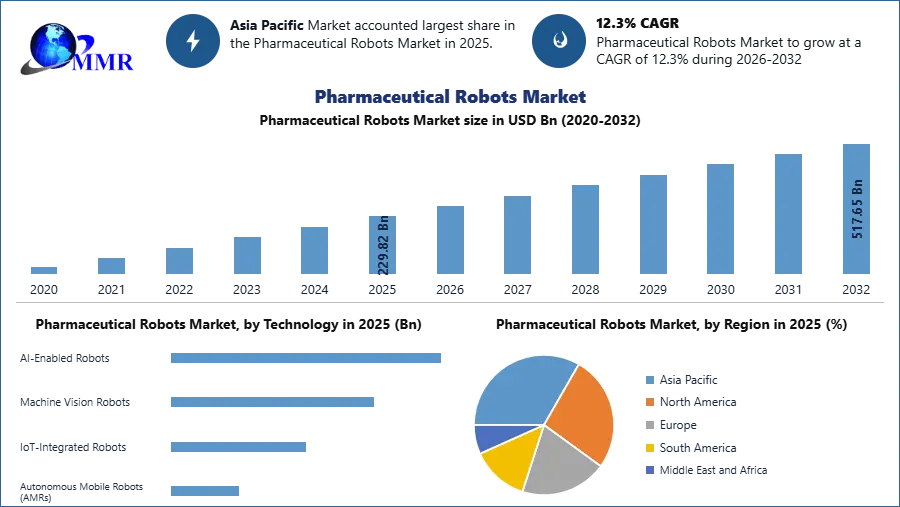
The Pharmaceutical Robots Market size was valued at USD 229.82 Bn. in 2025 and the total Pharmaceutical Robots Market revenue is expected to grow at a CAGR of 12.3% from 2025 to 2032, reaching nearly USD 517.65 Bn.

Pharmaceutical Robots Market Overview

Pharmaceutical robots are specialized automated machines designed to perform various tasks in pharmaceutical manufacturing processes, including dispensing, packaging, labeling, inspection, and laboratory automation. These robots are equipped with advanced features such as precision control, high-speed operation, and integration with data management systems to enhance efficiency, accuracy, and safety in pharmaceutical production environments. The global pharmaceutical robots market is witnessing significant growth, driven by factors such as increasing demand for high-quality pharmaceuticals, rising adoption of automation in healthcare, and advancements in robotics technology.

The current scenario indicates a surge in the deployment of robotic solutions across pharmaceutical manufacturing facilities worldwide, aiming to improve productivity, ensure regulatory compliance, and reduce operational costs. Key drivers of market growth include the need for enhanced efficiency and quality in pharmaceutical production, the shift towards personalized medicine, and the increasing focus on maintaining sterile manufacturing environments. Growth factors such as advancements in artificial intelligence (AI), machine learning (ML), and Internet of Things (IoT) technologies are enabling the development of smarter and more adaptable robotic systems tailored to meet the evolving needs of the pharmaceutical industry.

Recent trends in the pharmaceutical robots market include the integration of collaborative robotics (cobots) designed to work alongside human operators, enabling safer and more efficient production processes. Cobots offer benefits such as easy programming, flexibility, and space-saving designs, making them ideal for tasks requiring human-robot collaboration, such as assembly, pick-and-place operations, and small-batch manufacturing. There is a growing emphasis on the development of robotic systems capable of handling a wide range of pharmaceutical applications, including drug synthesis, formulation, and laboratory automation. These advancements are driven by the need for increased production flexibility, faster time-to-market, and reduced reliance on manual labor.

Opportunities in the pharmaceutical robots market abound, particularly in emerging economies with expanding pharmaceutical industries and a growing focus on healthcare modernization. Market players are actively pursuing collaborations, partnerships, and strategic acquisitions to strengthen their product portfolios and expand their market presence. Investments in research and development (R&D) aimed at enhancing robotic capabilities, such as vision systems, artificial intelligence, and robotic arms, are poised to drive innovation and differentiation in the market.

Recent developments by key Pharmaceutical Robots Market players include the introduction of advanced robotic solutions tailored to meet specific pharmaceutical manufacturing requirements, such as improved accuracy in dispensing, faster inspection speeds, and enhanced flexibility in production workflows. These developments underscore the industry's commitment to addressing evolving customer needs and driving technological advancements in pharmaceutical automation.Pharmaceutical Robots MarketTo know about the Research Methodology :- Request Free Sample Report
Pharmaceutical Robots Market Dynamics:

Improving Product Quality and Consistency with Pharmaceutical Robots:

The need for expediting the identification of potential drug candidates drives the demand for pharmaceutical robots market in high-throughput screening. For instance, the utilization of robotic systems like Hamilton Microlab STAR in drug discovery laboratories accelerates compound screening processes, enabling researchers to identify promising candidates faster. Pharmaceutical robots ensure reproducibility and consistency in compound synthesis, leading to improved product quality. Robots like the ABB FlexPicker are adept at precisely handling delicate materials, minimizing variations in formulations, and ensuring batch-to-batch consistency, thereby elevating the overall quality of pharmaceutical products.

Automation streamlines various manufacturing processes, leading to increased efficiency. Robots such as the FANUC M-20iA/35M facilitate tasks like labeling and packaging with speed and accuracy, reducing production cycle times and operational costs while boosting throughput in pharmaceutical manufacturing facilities. Automation reduces the potential for human error in critical procedures, enhancing manufacturing safety and reliability. For example, robotic systems like the Kawasaki duAro2 are employed in pharmaceutical packaging to minimize manual handling errors, ensuring precise placement of labels, and reducing the risk of product defects or contamination.

The incorporation of robotics and automation technologies results in long-term cost savings for pharmaceutical manufacturers. By automating labor-intensive tasks such as quality control inspections, robots like the Universal Robots UR5e reduce the need for manual intervention, leading to lower operational costs and improved profit margins over time. Continuous advancements in robotics technology, including artificial intelligence and machine learning, drive Pharmaceutical Robots Market growth.

For instance, the integration of AI-powered robotic systems like the ABB IRB 910SC enables real-time data analysis and adaptive manufacturing processes, fostering innovation and expanding Pharmaceutical Robots Market opportunities for pharmaceutical robots. Pharmaceutical robots help companies meet stringent regulatory standards by ensuring process adherence and data integrity. Robots such as the Yaskawa Motoman MH5L are equipped with advanced safety features and compliance protocols, enabling pharmaceutical manufacturers to adhere to regulatory guidelines while maintaining operational efficiency and product quality.

The evolution towards personalized medicine necessitates flexible manufacturing systems, driving demand for adaptable robotic solutions. For example, collaborative robots (cobots) like the Rethink Robotics Sawyer enable pharmaceutical companies to customize production processes quickly, accommodating variations in dosage forms and formulations to meet individual patient needs. The adoption of Industry 4.0 principles in pharmaceutical manufacturing, characterized by connectivity and data-driven decision-making, fuels demand for robotics. Robots integrated with IoT sensors and analytics platforms, such as the KUKA KR AGILUS, enable real-time monitoring of manufacturing processes, optimizing efficiency, and facilitating predictive maintenance, thus driving Pharmaceutical Robots Market growth.
Pharmaceutical Robots Market1The need to address cybersecurity risks associated with increased automation stimulates innovation in robotic technologies. For instance, companies like FANUC invest in developing secure communication protocols and encryption methods for their robots, ensuring the protection of sensitive manufacturing data, and mitigating cyber threats, thereby fostering trust, and driving market adoption.

Enhancing Health and Safety Through Robotic Automation in Pharmaceutical Manufacturing:

Robotics play a crucial role in maintaining product quality by reducing the risk of contamination in pharmaceutical manufacturing environments. With operators being a significant source of contamination, replacing manual operations with robotic solutions enhances production cleanliness. For instance, robots used within barrier systems like RABS minimize human interaction, ensuring aseptic conditions and improving overall product quality. Automation and robotics streamline production processes and enable efficient data management in pharmaceutical manufacturing. Robots record detailed operation logs, environmental parameters, and equipment statuses, facilitating comprehensive batch recordkeeping.

By leveraging smart data analytics and machine learning, the company identifies process trends, implements preventive measures, and optimizes production efficiency to meet growing Pharmaceutical Robots Market demands. The integration of robotics aligns with Industry 4.0 principles, emphasizing connectivity, data-driven decision-making, and predictive maintenance. Robots equipped with IoT sensors and analytics platforms enable real-time monitoring of manufacturing processes, ensuring optimal performance, and minimizing downtime. For example, robots like the KUKA KR AGILUS enable seamless integration into smart manufacturing ecosystems, supporting agile and responsive production operations.

Advanced robotic systems, such as Stevanato Group's Vision Robot Unit (VRU), leverage artificial intelligence to enhance visual inspection processes in pharmaceutical manufacturing. By automatically detecting cosmetic and particulate defects in drug containers, these robotic solutions improve production efficiency and product quality. For example, the VRU module enhances inspection accuracy and repeatability, ensuring compliance with regulatory standards and minimizing defects in pharmaceutical products.

The demand for automation in clean room environments, particularly in medical and pharmaceutical molding plants, is driving the adoption of specialized robotic solutions. Sepro Group's MED Series robots, designed for ISO 7 and 8 clean room applications, enhance productivity and precision in sensitive manufacturing environments. These robots offer ready-to-use solutions tailored to the unique requirements of medical and pharmaceutical production, supporting continuous productivity and compliance with stringent cleanliness standards for the Pharmaceutical Robots Market.

The Pharmaceutical Robots Market is witnessing rapid growth in the adoption of robotic solutions for inspection and packaging processes. Companies like Stevanato Group are introducing innovative robotic units, such as the VRU, to automate visual inspection tasks and enhance production efficiency. These robotic systems leverage artificial intelligence to improve defect detection and ensure the quality and integrity of pharmaceutical products, meeting the increasing demand for high-quality and safe medications. The expanding role of robots in pharmaceutical manufacturing extends beyond traditional tasks to include complex operations like drug synthesis and formulation. With advancements in robotics technology, companies are exploring new applications for robots in drug manufacturing processes. For example, robots equipped with precise handling capabilities, like the ABB FlexPicker, enable accurate dispensing of materials and formulations, enhancing product consistency and quality in pharmaceutical production.

High upfront investment hinders robotic adoption in pharmaceutical manufacturing:

The high upfront costs associated with implementing robotic solutions in pharmaceutical manufacturing is a significant barrier for companies, particularly smaller ones. For example, the purchase and installation of robotic systems like the ABB FlexPicker or the KUKA KR AGILUS require substantial capital investment, which deters some companies from adopting these technologies, leading to slower Pharmaceutical Robots Market penetration and adoption rates. Integrating robotic systems into existing pharmaceutical manufacturing workflows is complex and time-consuming. For instance, companies face challenges retrofitting their facilities to accommodate robotic equipment like the Sawyer by Rethink Robotics, requiring modifications to infrastructure and production layouts.

These integration complexities prolong implementation timelines, delay production efficiency improvements, and incur additional costs for companies. Stringent regulatory standards governing pharmaceutical manufacturing impose strict requirements for the validation and qualification of robotic systems. For example, companies must ensure that robotic solutions such as the Stevanato Group's Vision Robot Unit (VRU) comply with Good Manufacturing Practice (GMP) guidelines and other regulatory frameworks. Meeting these compliance requirements adds complexity and cost to the deployment of robotic technologies, slowing down the adoption rate in the pharmaceutical industry.

The shift towards robotic automation in pharmaceutical manufacturing necessitates a skilled workforce capable of operating and maintaining these advanced technologies. For instance, companies investing in robots like Sepro Group's MED Series must train personnel to effectively utilize and troubleshoot these systems. The need for specialized training and expertise in robotics poses challenges for companies in recruiting and retaining skilled personnel, hindering the widespread adoption of robotic solutions. The rapid pace of technological advancement in the field of robotics poses a risk of technological obsolescence for pharmaceutical companies investing in these solutions. For example, companies hesitate to invest in robotic systems like the ABB IRB 910SC if they anticipate newer, more advanced technologies emerging shortly after deployment. Concerns about the longevity and relevance of robotic investments lead to cautious adoption strategies and slower Pharmaceutical Robots Market growth for pharmaceutical robots.

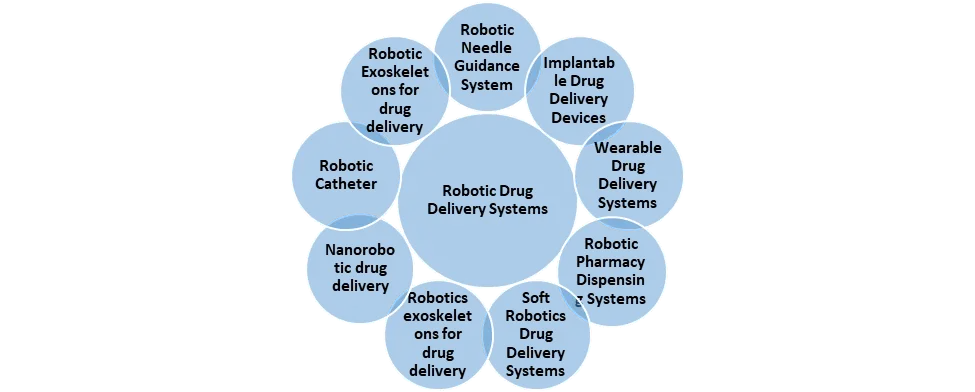
Chart: Applications of Innovative Robotic Drug Delivery Systems in Medicine:Pharmaceutical Robots Market3
Pharmaceutical Robots Market Segment Analysis:

Based on product, traditional robots have dominated the Pharmaceutical Robots Market in 2025 and expected to grow in the forecast period, due to their early adoption and established presence in manufacturing processes. These robots typically exhibit high precision and efficiency, making them suitable for a wide range of applications, such as packaging, labelling, and material handling. Articulated robots have emerged as a prominent competitor, offering increased flexibility and maneuverability in complex pharmaceutical production environments. Their ability to perform intricate tasks with multiple axes of motion makes them well-suited to tasks like assembly and inspection.

Collaborative pharmaceutical robots have gained traction due to their ability to work alongside human operators safely. These robots are equipped with advanced safety features, such as force and proximity sensors, enabling close collaboration with humans without the need for physical barriers. Their application to tasks requiring human-robot interaction, such as assembly and small-batch production, has contributed to their growing dominance.

Collaborative pharmaceutical robots are expected to continue dominating the Pharmaceutical Robots Market, driven by the increasing emphasis on safety, efficiency, and flexibility in pharmaceutical manufacturing. Their adoption is projected to expand further as companies prioritize human-robot collaboration to optimize production processes and adapt to evolving market demands. Traditional and articulated robots will maintain significant Pharmaceutical Robots Market shares, particularly in applications requiring high-speed and precision operations.

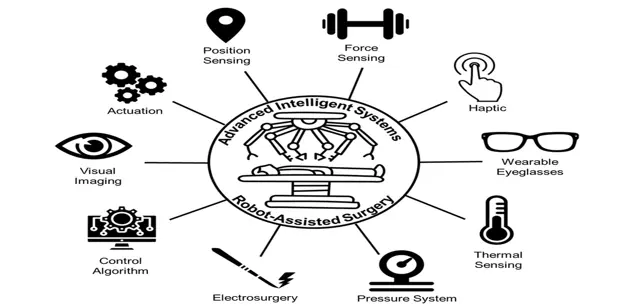
Chart: The technological development for the surgeryPharmaceutical Robots Market4

Pharmaceutical Robots Market Regional Insights:

The pharmaceutical robots market exhibits varied dominance across regions, with North America emerging as a dominant force in the global landscape. North America currently leads the Pharmaceutical Robots Market due to its advanced healthcare infrastructure, strong emphasis on technological innovation, and significant investments in pharmaceutical automation. For example, the United States accounts for a substantial portion of the market share, driven by the presence of major pharmaceutical companies and a conducive regulatory environment.

Asia-Pacific showcases considerable growth potential, fueled by increasing pharmaceutical manufacturing activities, rising healthcare expenditures, and government initiatives to enhance healthcare infrastructure. Countries like China and India are witnessing the rapid adoption of pharmaceutical robots, supported by expanding pharmaceutical production capacities and a growing focus on quality and efficiency. Europe also holds a significant Pharmaceutical Robots Market share, leveraging advanced robotics technology to streamline pharmaceutical manufacturing processes and comply with stringent regulatory standards.

The Middle East, Africa, and South America regions lag in terms of Pharmaceutical Robots Market dominance, primarily due to factors such as limited access to advanced healthcare infrastructure and lower adoption rates of pharmaceutical automation technologies. Nevertheless, these regions present untapped opportunities for Pharmaceutical Robots Market growth, driven by increasing healthcare investments and a growing demand for pharmaceutical products. North America currently dominates the pharmaceutical robot’s market, while Asia-Pacific is expected to witness the fastest growth in the coming years, fueled by robust pharmaceutical industry growth and rising adoption of automation technologies in the region.
Pharmaceutical Robots Market5

Pharmaceutical Robots Market Competitive Landscape

The recent developments in robotic technology by Johnson & Johnson MedTech, FANUC CORPORATION, and Datalogic S.p.A. signify a significant shift towards enhanced automation in various industries. These advancements will drive Pharmaceutical Robots Market growth by revolutionizing surgical procedures, optimizing industrial automation, and pioneering cognitive computing systems for robotics. With a focus on efficiency, precision, and safety, these innovations create opportunities for improved patient care, streamlined manufacturing processes, and increased productivity. As companies invest in cutting-edge technology to meet evolving demands, the market for robotic solutions is poised for substantial expansion, offering transformative benefits across healthcare, manufacturing, and beyond.

On November 7, 2023, Johnson & Johnson MedTech unveiled plans to introduce the OTTAVA robotic surgical system, slated for submission to the FDA for an investigational device exemption by late 2024. Leveraging over 135 years of surgical expertise, the OTTAVA system aims to revolutionize surgical procedures by enhancing OR efficiency, simplifying workflows, and integrating Ethicon instrumentation. Hani Abouhalka, Company Group Chairman of Robotics & Digital at Johnson & Johnson MedTech, emphasized a commitment to personalized surgery, highlighting the system's potential to elevate patient care, surgeon performance, and OR staff satisfaction worldwide.

On October 19, 2023, FANUC CORPORATION, a pioneer in factory automation, announced the milestone production of its one-millionth industrial robot. With a legacy spanning over five decades, FANUC's robots are integral to global production, serving the diverse automotive and aerospace industries. President and CEO Mike Cicco highlighted the growing demand for automated solutions amidst a labor shortage, emphasizing FANUC's ability to deliver quick returns on investment. Leveraging its expertise, FANUC employs its robots to manufacture robots, controllers, and machine tools, renowned for reliability and precision. The company's expansion, including the upcoming West Campus, underscores its commitment to meeting customer needs with innovative automation solutions.

on December 21, 2023, Datalogic S.p.A. announced the acquisition of a minority stake in Oversonic Robotics Srl Benefit Corporation, reinforcing its commitment to AI. Oversonic Robotics pioneers cognitive computing systems, notably RoBee, the first humanoid robot certified for Industry 5.0 manufacturing. Datalogic aims to revolutionize industrial automation, collaborating with Oversonic on sales, R&D, and marketing. The investment aligns with Datalogic's ethos of innovation, prioritizing productivity and worker safety. RoBee integrates Datalogic's Safety Laser Scanners and vision systems, enhancing tasks in manufacturing and healthcare by ensuring safe interaction with operators and obstacle-free navigation. This strategic move underscores Datalogic's dedication to advancing AI-driven robotics for industrial applications.

Pharmaceutical Robots Market Recent Industry Developments (2025–2026)

Exact Date Company Development Impact
25 February 2026 Quantum Surgical Acquired the NeuWave ablation business from Johnson & Johnson to integrate advanced microwave technology with its Epione robotic platform. The acquisition strengthens the portfolio for robot-assisted tumor ablation, expanding surgical robotic applications in oncology.
15 January 2026 Boston Scientific Entered a definitive agreement to acquire Penumbra for $14.5 billion, gaining a leading suite of neurovascular and peripheral robotic thrombectomy devices. This move significantly expands Boston Scientific’s presence in the vascular surgery robotics market through market-leading clot-removal technology.
06 January 2026 Siemens AG Unveiled new industrial AI copilots and digital twin technologies at CES 2026 designed specifically to accelerate autonomous drug discovery and lab efficiency. The development enables pharmaceutical researchers to virtually scale production and test molecules up to 50% faster using AI-driven robotics.
28 October 2025 Johnson & Johnson MedTech Announced a strategic partnership with NVIDIA to integrate NVIDIA Isaac for Healthcare AI into the development of the MONARCH robotic platform. The collaboration uses high-fidelity digital twins to optimize robotic-assisted urology and bronchoscopy procedures before 2026 commercialization.
03 September 2025 Beckman Coulter Life Sciences Collaborated with Hombrechtikon Systems Engineering (HSE•AG) to launch automated nucleic acid workflows for research laboratories. The integration of real-time fluorescence into robotic workstations streamlines genomic quantification and reduces manual intervention in drug development.
15 April 2025 Douglas Pharmaceuticals Completed the installation of a new fleet of AI-powered articulated robots to automate its primary manufacturing and packaging lines. This facility upgrade was designed to boost production efficiency and mitigate the impact of international supply chain tariffs on manufacturing costs.

Global Pharmaceutical Robots Market Scope:Inquire Before Buying

Pharmaceutical Robots Market
Report Coverage Details
Base Year: 2025 Forecast Period: 2026-2032
Historical Data: 2020 to 2025 Market Size in 2025: 229.82 USD Bn
Forecast Period 2026-2032 CAGR: 12.3% Market Size in 2032: 517.65 USD Bn
Segments Covered: by Product Traditional Robots
Articulated Robots
SCARA Robots
Delta/Parallel Robots
Cartesian Robots
Dual-arm Robots
Collaborative Pharmaceutical Robots
by Payload Capacity UpTo2Kg
2KgTo10Kg
10KgTo20Kg
Above20Kg
by Component Hardware
Software
Services
Sensors
Controllers
VisionSystems
EndEffectors
by Technology AI-Enabled Robots
Machine Vision Robots
IoT-Integrated Robots
Autonomous Mobile Robots (AMRs)
by Degree Of Automation Semi Automated
Fully Automated
by Application Picking and Packaging
Inspection of Pharmaceutical Drugs
Laboratory Applications
by End-use Pharmaceutical Companies
Research Laboratories
by Production Scale Small-Scale Production
Medium-Scale Production
Large-Scale Production

Pharmaceutical Robots Market, by Region

North America (United States, Canada and Mexico)
Europe (UK, France, Germany, Italy, Spain, Sweden, Austria and Rest of Europe)
Asia Pacific (China, South Korea, Japan, India, Australia, Indonesia, Malaysia, Vietnam, Taiwan, Bangladesh, Pakistan and Rest of APAC)
South America (Brazil, Argentina Rest of South America)
Middle East & Africa (South Africa, GCC, Egypt, Nigeria and Rest of ME&A)

Pharmaceutical Robots Market key players

  1. ABB Ltd.
  2. Kawasaki Heavy Industries Ltd. (Japan)
  3. FANUC Corporation
  4. KUKA AG
  5. Yaskawa Electric Corporation
  6. Mitsubishi Electric Corporation
  7. Stäubli International AG
  8. Denso Corporation
  9. Seiko Epson Corporation
  10. Marchesini Group S.p.A.
  11. Universal Robots A/S
  12. Shibuya Corporation
  13. Omron Corporation
  14. Panasonic Corporation
  15. Nachi-Fujikoshi Corp.
  16. Becton Dickinson Rowa
  17. Omnicell, Inc.
  18. Kiro Grifols
  19. Thermo Fisher Scientific Inc.
  20. Talyst, LLC
  21. Arxium Inc.
  22. Steriline S.r.l.
  23. Toshiba Machine Co., Ltd.
  24. Yamaha Motor Co., Ltd.
  25. Comau S.p.A.

Table of Contents

1. Pharmaceutical Robots Market Introduction
1.1. Study Assumption and Market Definition
1.2. Scope of the Study
1.3. Executive Summary
2. Global Pharmaceutical Robots Market: Competitive Landscape
2.1. MMR Competition Matrix
2.2. Competitive Landscape
2.3. Key Players Benchmarking
2.3.1. Company Name
2.3.2. Business Segment
2.3.3. End-user Segment
2.3.4. Revenue (2025)
2.3.5. Company Locations
2.4. Leading Pharmaceutical Robots Market Companies, by market capitalization
2.5. Market Structure
2.5.1. Market Leaders
2.5.2. Market Followers
2.5.3. Emerging Players
2.6. Mergers and Acquisitions Details
3. Pharmaceutical Robots Market: Dynamics
3.1. Pharmaceutical Robots Market Trends by Region
3.1.1. North America Pharmaceutical Robots Market Trends
3.1.2. Europe Pharmaceutical Robots Market Trends
3.1.3. Asia Pacific Pharmaceutical Robots Market Trends
3.1.4. Middle East and Africa Pharmaceutical Robots Market Trends
3.1.5. South America Pharmaceutical Robots Market Trends
3.2. Pharmaceutical Robots Market Dynamics by Region
3.2.1. North America
3.2.1.1. North America Pharmaceutical Robots Market Drivers
3.2.1.2. North America Pharmaceutical Robots Market Restraints
3.2.1.3. North America Pharmaceutical Robots Market Opportunities
3.2.1.4. North America Pharmaceutical Robots Market Challenges
3.2.2. Europe
3.2.2.1. Europe Pharmaceutical Robots Market Drivers
3.2.2.2. Europe Pharmaceutical Robots Market Restraints
3.2.2.3. Europe Pharmaceutical Robots Market Opportunities
3.2.2.4. Europe Pharmaceutical Robots Market Challenges
3.2.3. Asia Pacific
3.2.3.1. Asia Pacific Pharmaceutical Robots Market Drivers
3.2.3.2. Asia Pacific Pharmaceutical Robots Market Restraints
3.2.3.3. Asia Pacific Pharmaceutical Robots Market Opportunities
3.2.3.4. Asia Pacific Pharmaceutical Robots Market Challenges
3.2.4. Middle East and Africa
3.2.4.1. Middle East and Africa Pharmaceutical Robots Market Drivers
3.2.4.2. Middle East and Africa Pharmaceutical Robots Market Restraints
3.2.4.3. Middle East and Africa Pharmaceutical Robots Market Opportunities
3.2.4.4. Middle East and Africa Pharmaceutical Robots Market Challenges
3.2.5. South America
3.2.5.1. South America Pharmaceutical Robots Market Drivers
3.2.5.2. South America Pharmaceutical Robots Market Restraints
3.2.5.3. South America Pharmaceutical Robots Market Opportunities
3.2.5.4. South America Pharmaceutical Robots Market Challenges
3.3. PORTER's Five Forces Analysis
3.4. PESTLE Analysis
3.5. Technology Roadmap
3.6. Regulatory Landscape by Region
3.6.1. North America
3.6.2. Europe
3.6.3. Asia Pacific
3.6.4. Middle East and Africa
3.6.5. South America
3.7. Key Opinion Leader Analysis For Pharmaceutical Robots Industry
3.8. Analysis of Government Schemes and Initiatives For Pharmaceutical Robots Industry
3.9. Pharmaceutical Robots Market Trade Analysis
3.10. The Global Pandemic Impact on Pharmaceutical Robots Market
4. Pharmaceutical Robots Market: Global Market Size and Forecast by Segmentation (in USD Bn) 2025-2032
4.1. Pharmaceutical Robots Market Size and Forecast, by Product (2025-2032)
4.1.1. Traditional Robots
4.1.2. Articulated Robots
4.1.3. SCARA Robots
4.1.4. Delta/Parallel Robots
4.1.5. Cartesian Robots
4.1.6. Dual-arm Robots
4.1.7. Collaborative Pharmaceutical Robots
4.2. Pharmaceutical Robots Market Size and Forecast, by Payload Capacity (2025-2032)
4.2.1. UpTo2Kg
4.2.2. 2KgTo10Kg
4.2.3. 10KgTo20Kg
4.2.4. Above20Kg
4.3. Pharmaceutical Robots Market Size and Forecast, by Component (2025-2032)
4.3.1. Hardware
4.3.2. Software
4.3.3. Services
4.3.4. Sensors
4.3.5. Controllers
4.3.6. VisionSystems
4.3.7. EndEffectors
4.4. Pharmaceutical Robots Market Size and Forecast, by Technology (2025-2032)
4.4.1. AI-Enabled Robots
4.4.2. Machine Vision Robots
4.4.3. IoT-Integrated Robots
4.4.4. Autonomous Mobile Robots (AMRs)
4.5. Pharmaceutical Robots Market Size and Forecast, by Degree Of Automation (2025-2032)
4.5.1. Semi Automated
4.5.2. Fully Automated
4.6. Pharmaceutical Robots Market Size and Forecast, by Application (2025-2032)
4.6.1. Picking and Packaging
4.6.2. Inspection of Pharmaceutical Drugs
4.6.3. Laboratory Applications
4.7. Pharmaceutical Robots Market Size and Forecast, by End-use (2025-2032)
4.7.1. Pharmaceutical Companies
4.7.2. Research Laboratories
4.8. Pharmaceutical Robots Market Size and Forecast, by Region (2025-2032)
4.8.1. North America
4.8.2. Europe
4.8.3. Asia Pacific
4.8.4. Middle East and Africa
4.8.5. South America
5. North America Pharmaceutical Robots Market Size and Forecast by Segmentation (in USD Bn) 2025-2032
5.1. North America Pharmaceutical Robots Market Size and Forecast, by Product (2025-2032)
5.1.1. Traditional Robots
5.1.2. Articulated Robots
5.1.3. SCARA Robots
5.1.4. Delta/Parallel Robots
5.1.5. Cartesian Robots
5.1.6. Dual-arm Robots
5.1.7. Collaborative Pharmaceutical Robots
5.2. North America Pharmaceutical Robots Market Size and Forecast, by Payload Capacity (2025-2032)
5.2.1. UpTo2Kg
5.2.2. 2KgTo10Kg
5.2.3. 10KgTo20Kg
5.2.4. Above20Kg
5.3. North America Pharmaceutical Robots Market Size and Forecast, by Component (2025-2032)
5.3.1. Hardware
5.3.2. Software
5.3.3. Services
5.3.4. Sensors
5.3.5. Controllers
5.3.6. VisionSystems
5.3.7. EndEffectors
5.4. North America Pharmaceutical Robots Market Size and Forecast, by Technology (2025-2032)
5.4.1. AI-Enabled Robots
5.4.2. Machine Vision Robots
5.4.3. IoT-Integrated Robots
5.4.4. Autonomous Mobile Robots (AMRs)
5.5. North America Pharmaceutical Robots Market Size and Forecast, by Degree Of Automation (2025-2032)
5.5.1. Semi Automated
5.5.2. Fully Automated
5.6. North America Pharmaceutical Robots Market Size and Forecast, by Application (2025-2032)
5.6.1. Picking and Packaging
5.6.2. Inspection of Pharmaceutical Drugs
5.6.3. Laboratory Applications
5.7. North America Pharmaceutical Robots Market Size and Forecast, by End-use (2025-2032)
5.7.1. Pharmaceutical Companies
5.7.2. Research Laboratories
5.8. North America Pharmaceutical Robots Market Size and Forecast, by Country (2025-2032)
5.8.1. United States
5.8.1.1. United States Pharmaceutical Robots Market Size and Forecast, by Product (2025-2032)
5.8.1.1.1. Traditional Robots
5.8.1.1.2. Articulated Robots
5.8.1.1.3. SCARA Robots
5.8.1.1.4. Delta/Parallel Robots
5.8.1.1.5. Cartesian Robots
5.8.1.1.6. Dual-arm Robots
5.8.1.1.7. Collaborative Pharmaceutical Robots
5.8.1.2. United States Pharmaceutical Robots Market Size and Forecast, by Payload Capacity (2025-2032)
5.8.1.2.1. UpTo2Kg
5.8.1.2.2. 2KgTo10Kg
5.8.1.2.3. 10KgTo20Kg
5.8.1.2.4. Above20Kg
5.8.1.3. United States Pharmaceutical Robots Market Size and Forecast, by Component (2025-2032)
5.8.1.3.1. Hardware
5.8.1.3.2. Software
5.8.1.3.3. Services
5.8.1.3.4. Sensors
5.8.1.3.5. Controllers
5.8.1.3.6. VisionSystems
5.8.1.3.7. EndEffectors
5.8.1.4. United States Pharmaceutical Robots Market Size and Forecast, by Technology (2025-2032)
5.8.1.4.1. AI-Enabled Robots
5.8.1.4.2. Machine Vision Robots
5.8.1.4.3. IoT-Integrated Robots
5.8.1.4.4. Autonomous Mobile Robots (AMRs)
5.8.1.5. United States Pharmaceutical Robots Market Size and Forecast, by Degree Of Automation (2025-2032)
5.8.1.5.1. Semi Automated
5.8.1.5.2. Fully Automated
5.8.1.6. United States Pharmaceutical Robots Market Size and Forecast, by Application (2025-2032)
5.8.1.6.1. Picking and Packaging
5.8.1.6.2. Inspection of Pharmaceutical Drugs
5.8.1.6.3. Laboratory Applications
5.8.1.7. United States Pharmaceutical Robots Market Size and Forecast, by End-use (2025-2032)
5.8.1.7.1. Pharmaceutical Companies
5.8.1.7.2. Research Laboratories
5.8.2. Canada
5.8.2.1. Canada Pharmaceutical Robots Market Size and Forecast, by Product (2025-2032)
5.8.2.1.1. Traditional Robots
5.8.2.1.2. Articulated Robots
5.8.2.1.3. SCARA Robots
5.8.2.1.4. Delta/Parallel Robots
5.8.2.1.5. Cartesian Robots
5.8.2.1.6. Dual-arm Robots
5.8.2.1.7. Collaborative Pharmaceutical Robots
5.8.2.2. Canada Pharmaceutical Robots Market Size and Forecast, by Payload Capacity (2025-2032)
5.8.2.2.1. UpTo2Kg
5.8.2.2.2. 2KgTo10Kg
5.8.2.2.3. 10KgTo20Kg
5.8.2.2.4. Above20Kg
5.8.2.3. Canada Pharmaceutical Robots Market Size and Forecast, by Component (2025-2032)
5.8.2.3.1. Hardware
5.8.2.3.2. Software
5.8.2.3.3. Services
5.8.2.3.4. Sensors
5.8.2.3.5. Controllers
5.8.2.3.6. VisionSystems
5.8.2.3.7. EndEffectors
5.8.2.4. Canada Pharmaceutical Robots Market Size and Forecast, by Technology (2025-2032)
5.8.2.4.1. AI-Enabled Robots
5.8.2.4.2. Machine Vision Robots
5.8.2.4.3. IoT-Integrated Robots
5.8.2.4.4. Autonomous Mobile Robots (AMRs)
5.8.2.5. Canada Pharmaceutical Robots Market Size and Forecast, by Degree Of Automation (2025-2032)
5.8.2.5.1. Semi Automated
5.8.2.5.2. Fully Automated
5.8.2.6. Canada Pharmaceutical Robots Market Size and Forecast, by Application (2025-2032)
5.8.2.6.1. Picking and Packaging
5.8.2.6.2. Inspection of Pharmaceutical Drugs
5.8.2.6.3. Laboratory Applications
5.8.2.7. Canada Pharmaceutical Robots Market Size and Forecast, by End-use (2025-2032)
5.8.2.7.1. Pharmaceutical Companies
5.8.2.7.2. Research Laboratories
5.8.3. Mexico
5.8.3.1. Mexico Pharmaceutical Robots Market Size and Forecast, by Product (2025-2032)
5.8.3.1.1. Traditional Robots
5.8.3.1.2. Articulated Robots
5.8.3.1.3. SCARA Robots
5.8.3.1.4. Delta/Parallel Robots
5.8.3.1.5. Cartesian Robots
5.8.3.1.6. Dual-arm Robots
5.8.3.1.7. Collaborative Pharmaceutical Robots
5.8.3.2. Mexico Pharmaceutical Robots Market Size and Forecast, by Payload Capacity (2025-2032)
5.8.3.2.1. UpTo2Kg
5.8.3.2.2. 2KgTo10Kg
5.8.3.2.3. 10KgTo20Kg
5.8.3.2.4. Above20Kg
5.8.3.3. Mexico Pharmaceutical Robots Market Size and Forecast, by Component (2025-2032)
5.8.3.3.1. Hardware
5.8.3.3.2. Software
5.8.3.3.3. Services
5.8.3.3.4. Sensors
5.8.3.3.5. Controllers
5.8.3.3.6. VisionSystems
5.8.3.3.7. EndEffectors
5.8.3.4. Mexico Pharmaceutical Robots Market Size and Forecast, by Technology (2025-2032)
5.8.3.4.1. AI-Enabled Robots
5.8.3.4.2. Machine Vision Robots
5.8.3.4.3. IoT-Integrated Robots
5.8.3.4.4. Autonomous Mobile Robots (AMRs)
5.8.3.5. Mexico Pharmaceutical Robots Market Size and Forecast, by Degree Of Automation (2025-2032)
5.8.3.5.1. Semi Automated
5.8.3.5.2. Fully Automated
5.8.3.6. Mexico Pharmaceutical Robots Market Size and Forecast, by Application (2025-2032)
5.8.3.6.1. Picking and Packaging
5.8.3.6.2. Inspection of Pharmaceutical Drugs
5.8.3.6.3. Laboratory Applications
5.8.3.7. Mexico Pharmaceutical Robots Market Size and Forecast, by End-use (2025-2032)
5.8.3.7.1. Pharmaceutical Companies
5.8.3.7.2. Research Laboratories
6. Europe Pharmaceutical Robots Market Size and Forecast by Segmentation (in USD Bn) 2025-2032
6.1. Europe Pharmaceutical Robots Market Size and Forecast, by Product (2025-2032)
6.2. Europe Pharmaceutical Robots Market Size and Forecast, by Payload Capacity (2025-2032)
6.3. Europe Pharmaceutical Robots Market Size and Forecast, by Component (2025-2032)
6.4. Europe Pharmaceutical Robots Market Size and Forecast, by Technology (2025-2032)
6.5. Europe Pharmaceutical Robots Market Size and Forecast, by Degree Of Automation (2025-2032)
6.6. Europe Pharmaceutical Robots Market Size and Forecast, by Application (2025-2032)
6.7. Europe Pharmaceutical Robots Market Size and Forecast, by End-use (2025-2032)
6.8. Europe Pharmaceutical Robots Market Size and Forecast, by Country (2025-2032)
6.8.1. United Kingdom
6.8.1.1. United Kingdom Pharmaceutical Robots Market Size and Forecast, by Product (2025-2032)
6.8.1.2. United Kingdom Pharmaceutical Robots Market Size and Forecast, by Payload Capacity (2025-2032)
6.8.1.3. United Kingdom Pharmaceutical Robots Market Size and Forecast, by Component (2025-2032)
6.8.1.4. United Kingdom Pharmaceutical Robots Market Size and Forecast, by Technology (2025-2032)
6.8.1.5. United Kingdom Pharmaceutical Robots Market Size and Forecast, by Degree Of Automation (2025-2032)
6.8.1.6. United Kingdom Pharmaceutical Robots Market Size and Forecast, by Application (2025-2032)
6.8.1.7. United Kingdom Pharmaceutical Robots Market Size and Forecast, by End-use (2025-2032)
6.8.2. France
6.8.2.1. France Pharmaceutical Robots Market Size and Forecast, by Product (2025-2032)
6.8.2.2. France Pharmaceutical Robots Market Size and Forecast, by Payload Capacity (2025-2032)
6.8.2.3. France Pharmaceutical Robots Market Size and Forecast, by Component (2025-2032)
6.8.2.4. France Pharmaceutical Robots Market Size and Forecast, by Technology (2025-2032)
6.8.2.5. France Pharmaceutical Robots Market Size and Forecast, by Degree Of Automation (2025-2032)
6.8.2.6. France Pharmaceutical Robots Market Size and Forecast, by Application (2025-2032)
6.8.2.7. France Pharmaceutical Robots Market Size and Forecast, by End-use (2025-2032)
6.8.3. Germany
6.8.3.1. Germany Pharmaceutical Robots Market Size and Forecast, by Product (2025-2032)
6.8.3.2. Germany Pharmaceutical Robots Market Size and Forecast, by Payload Capacity (2025-2032)
6.8.3.3. Germany Pharmaceutical Robots Market Size and Forecast, by Component (2025-2032)
6.8.3.4. Germany Pharmaceutical Robots Market Size and Forecast, by Technology (2025-2032)
6.8.3.5. Germany Pharmaceutical Robots Market Size and Forecast, by Degree Of Automation (2025-2032)
6.8.3.6. Germany Pharmaceutical Robots Market Size and Forecast, by Application (2025-2032)
6.8.3.7. Germany Pharmaceutical Robots Market Size and Forecast, by End-use (2025-2032)
6.8.4. Italy
6.8.4.1. Italy Pharmaceutical Robots Market Size and Forecast, by Product (2025-2032)
6.8.4.2. Italy Pharmaceutical Robots Market Size and Forecast, by Payload Capacity (2025-2032)
6.8.4.3. Italy Pharmaceutical Robots Market Size and Forecast, by Component (2025-2032)
6.8.4.4. Italy Pharmaceutical Robots Market Size and Forecast, by Technology (2025-2032)
6.8.4.5. Italy Pharmaceutical Robots Market Size and Forecast, by Degree Of Automation (2025-2032)
6.8.4.6. Italy Pharmaceutical Robots Market Size and Forecast, by Application (2025-2032)
6.8.4.7. Italy Pharmaceutical Robots Market Size and Forecast, by End-use (2025-2032)
6.8.5. Spain
6.8.5.1. Spain Pharmaceutical Robots Market Size and Forecast, by Product (2025-2032)
6.8.5.2. Spain Pharmaceutical Robots Market Size and Forecast, by Payload Capacity (2025-2032)
6.8.5.3. Spain Pharmaceutical Robots Market Size and Forecast, by Component (2025-2032)
6.8.5.4. Spain Pharmaceutical Robots Market Size and Forecast, by Technology (2025-2032)
6.8.5.5. Spain Pharmaceutical Robots Market Size and Forecast, by Degree Of Automation (2025-2032)
6.8.5.6. Spain Pharmaceutical Robots Market Size and Forecast, by Application (2025-2032)
6.8.5.7. Spain Pharmaceutical Robots Market Size and Forecast, by End-use (2025-2032)
6.8.6. Sweden
6.8.6.1. Sweden Pharmaceutical Robots Market Size and Forecast, by Product (2025-2032)
6.8.6.2. Sweden Pharmaceutical Robots Market Size and Forecast, by Payload Capacity (2025-2032)
6.8.6.3. Sweden Pharmaceutical Robots Market Size and Forecast, by Component (2025-2032)
6.8.6.4. Sweden Pharmaceutical Robots Market Size and Forecast, by Technology (2025-2032)
6.8.6.5. Sweden Pharmaceutical Robots Market Size and Forecast, by Degree Of Automation (2025-2032)
6.8.6.6. Sweden Pharmaceutical Robots Market Size and Forecast, by Application (2025-2032)
6.8.6.7. Sweden Pharmaceutical Robots Market Size and Forecast, by End-use (2025-2032)
6.8.7. Austria
6.8.7.1. Austria Pharmaceutical Robots Market Size and Forecast, by Product (2025-2032)
6.8.7.2. Austria Pharmaceutical Robots Market Size and Forecast, by Payload Capacity (2025-2032)
6.8.7.3. Austria Pharmaceutical Robots Market Size and Forecast, by Component (2025-2032)
6.8.7.4. Austria Pharmaceutical Robots Market Size and Forecast, by Technology (2025-2032)
6.8.7.5. Austria Pharmaceutical Robots Market Size and Forecast, by Degree Of Automation (2025-2032)
6.8.7.6. Austria Pharmaceutical Robots Market Size and Forecast, by Application (2025-2032)
6.8.7.7. Austria Pharmaceutical Robots Market Size and Forecast, by End-use (2025-2032)
6.8.8. Rest of Europe
6.8.8.1. Rest of Europe Pharmaceutical Robots Market Size and Forecast, by Product (2025-2032)
6.8.8.2. Rest of Europe Pharmaceutical Robots Market Size and Forecast, by Payload Capacity (2025-2032)
6.8.8.3. Rest of Europe Pharmaceutical Robots Market Size and Forecast, by Component (2025-2032)
6.8.8.4. Rest of Europe Pharmaceutical Robots Market Size and Forecast, by Technology (2025-2032)
6.8.8.5. Rest of Europe Pharmaceutical Robots Market Size and Forecast, by Degree Of Automation (2025-2032)
6.8.8.6. Rest of Europe Pharmaceutical Robots Market Size and Forecast, by Application (2025-2032)
6.8.8.7. Rest of Europe Pharmaceutical Robots Market Size and Forecast, by End-use (2025-2032)
7. Asia Pacific Pharmaceutical Robots Market Size and Forecast by Segmentation (in USD Bn) 2025-2032
7.1. Asia Pacific Pharmaceutical Robots Market Size and Forecast, by Product (2025-2032)
7.2. Asia Pacific Pharmaceutical Robots Market Size and Forecast, by Payload Capacity (2025-2032)
7.3. Asia Pacific Pharmaceutical Robots Market Size and Forecast, by Component (2025-2032)
7.4. Asia Pacific Pharmaceutical Robots Market Size and Forecast, by Technology (2025-2032)
7.5. Asia Pacific Pharmaceutical Robots Market Size and Forecast, by Degree Of Automation (2025-2032)
7.6. Asia Pacific Pharmaceutical Robots Market Size and Forecast, by Application (2025-2032)
7.7. Asia Pacific Pharmaceutical Robots Market Size and Forecast, by End-use (2025-2032)
7.8. Asia Pacific Pharmaceutical Robots Market Size and Forecast, by Country (2025-2032)
7.8.1. China
7.8.1.1. China Pharmaceutical Robots Market Size and Forecast, by Product (2025-2032)
7.8.1.2. China Pharmaceutical Robots Market Size and Forecast, by Payload Capacity (2025-2032)
7.8.1.3. China Pharmaceutical Robots Market Size and Forecast, by Component (2025-2032)
7.8.1.4. China Pharmaceutical Robots Market Size and Forecast, by Technology (2025-2032)
7.8.1.5. China Pharmaceutical Robots Market Size and Forecast, by Degree Of Automation (2025-2032)
7.8.1.6. China Pharmaceutical Robots Market Size and Forecast, by Application (2025-2032)
7.8.1.7. China Pharmaceutical Robots Market Size and Forecast, by End-use (2025-2032)
7.8.2. S Korea
7.8.2.1. S Korea Pharmaceutical Robots Market Size and Forecast, by Product (2025-2032)
7.8.2.2. S Korea Pharmaceutical Robots Market Size and Forecast, by Payload Capacity (2025-2032)
7.8.2.3. S Korea Pharmaceutical Robots Market Size and Forecast, by Component (2025-2032)
7.8.2.4. S Korea Pharmaceutical Robots Market Size and Forecast, by Technology (2025-2032)
7.8.2.5. S Korea Pharmaceutical Robots Market Size and Forecast, by Degree Of Automation (2025-2032)
7.8.2.6. S Korea Pharmaceutical Robots Market Size and Forecast, by Application (2025-2032)
7.8.2.7. S Korea Pharmaceutical Robots Market Size and Forecast, by End-use (2025-2032)
7.8.3. Japan
7.8.3.1. Japan Pharmaceutical Robots Market Size and Forecast, by Product (2025-2032)
7.8.3.2. Japan Pharmaceutical Robots Market Size and Forecast, by Payload Capacity (2025-2032)
7.8.3.3. Japan Pharmaceutical Robots Market Size and Forecast, by Component (2025-2032)
7.8.3.4. Japan Pharmaceutical Robots Market Size and Forecast, by Technology (2025-2032)
7.8.3.5. Japan Pharmaceutical Robots Market Size and Forecast, by Degree Of Automation (2025-2032)
7.8.3.6. Japan Pharmaceutical Robots Market Size and Forecast, by Application (2025-2032)
7.8.3.7. Japan Pharmaceutical Robots Market Size and Forecast, by End-use (2025-2032)
7.8.4. India
7.8.4.1. India Pharmaceutical Robots Market Size and Forecast, by Product (2025-2032)
7.8.4.2. India Pharmaceutical Robots Market Size and Forecast, by Payload Capacity (2025-2032)
7.8.4.3. India Pharmaceutical Robots Market Size and Forecast, by Component (2025-2032)
7.8.4.4. India Pharmaceutical Robots Market Size and Forecast, by Technology (2025-2032)
7.8.4.5. India Pharmaceutical Robots Market Size and Forecast, by Degree Of Automation (2025-2032)
7.8.4.6. India Pharmaceutical Robots Market Size and Forecast, by Application (2025-2032)
7.8.4.7. India Pharmaceutical Robots Market Size and Forecast, by End-use (2025-2032)
7.8.5. Australia
7.8.5.1. Australia Pharmaceutical Robots Market Size and Forecast, by Product (2025-2032)
7.8.5.2. Australia Pharmaceutical Robots Market Size and Forecast, by Payload Capacity (2025-2032)
7.8.5.3. Australia Pharmaceutical Robots Market Size and Forecast, by Component (2025-2032)
7.8.5.4. Australia Pharmaceutical Robots Market Size and Forecast, by Technology (2025-2032)
7.8.5.5. Australia Pharmaceutical Robots Market Size and Forecast, by Degree Of Automation (2025-2032)
7.8.5.6. Australia Pharmaceutical Robots Market Size and Forecast, by Application (2025-2032)
7.8.5.7. Australia Pharmaceutical Robots Market Size and Forecast, by End-use (2025-2032)
7.8.6. Indonesia
7.8.6.1. Indonesia Pharmaceutical Robots Market Size and Forecast, by Product (2025-2032)
7.8.6.2. Indonesia Pharmaceutical Robots Market Size and Forecast, by Payload Capacity (2025-2032)
7.8.6.3. Indonesia Pharmaceutical Robots Market Size and Forecast, by Component (2025-2032)
7.8.6.4. Indonesia Pharmaceutical Robots Market Size and Forecast, by Technology (2025-2032)
7.8.6.5. Indonesia Pharmaceutical Robots Market Size and Forecast, by Degree Of Automation (2025-2032)
7.8.6.6. Indonesia Pharmaceutical Robots Market Size and Forecast, by Application (2025-2032)
7.8.6.7. Indonesia Pharmaceutical Robots Market Size and Forecast, by End-use (2025-2032)
7.8.7. Malaysia
7.8.7.1. Malaysia Pharmaceutical Robots Market Size and Forecast, by Product (2025-2032)
7.8.7.2. Malaysia Pharmaceutical Robots Market Size and Forecast, by Payload Capacity (2025-2032)
7.8.7.3. Malaysia Pharmaceutical Robots Market Size and Forecast, by Component (2025-2032)
7.8.7.4. Malaysia Pharmaceutical Robots Market Size and Forecast, by Technology (2025-2032)
7.8.7.5. Malaysia Pharmaceutical Robots Market Size and Forecast, by Degree Of Automation (2025-2032)
7.8.7.6. Malaysia Pharmaceutical Robots Market Size and Forecast, by Application (2025-2032)
7.8.7.7. Malaysia Pharmaceutical Robots Market Size and Forecast, by End-use (2025-2032)
7.8.8. Vietnam
7.8.8.1. Vietnam Pharmaceutical Robots Market Size and Forecast, by Product (2025-2032)
7.8.8.2. Vietnam Pharmaceutical Robots Market Size and Forecast, by Payload Capacity (2025-2032)
7.8.8.3. Vietnam Pharmaceutical Robots Market Size and Forecast, by Component (2025-2032)
7.8.8.4. Vietnam Pharmaceutical Robots Market Size and Forecast, by Technology (2025-2032)
7.8.8.5. Vietnam Pharmaceutical Robots Market Size and Forecast, by Degree Of Automation (2025-2032)
7.8.8.6. Vietnam Pharmaceutical Robots Market Size and Forecast, by Application (2025-2032)
7.8.8.7. Vietnam Pharmaceutical Robots Market Size and Forecast, by End-use (2025-2032)
7.8.9. Taiwan
7.8.9.1. Taiwan Pharmaceutical Robots Market Size and Forecast, by Product (2025-2032)
7.8.9.2. Taiwan Pharmaceutical Robots Market Size and Forecast, by Payload Capacity (2025-2032)
7.8.9.3. Taiwan Pharmaceutical Robots Market Size and Forecast, by Component (2025-2032)
7.8.9.4. Taiwan Pharmaceutical Robots Market Size and Forecast, by Technology (2025-2032)
7.8.9.5. Taiwan Pharmaceutical Robots Market Size and Forecast, by Degree Of Automation (2025-2032)
7.8.9.6. Taiwan Pharmaceutical Robots Market Size and Forecast, by Application (2025-2032)
7.8.9.7. Taiwan Pharmaceutical Robots Market Size and Forecast, by End-use (2025-2032)
7.8.10. Rest of Asia Pacific
7.8.10.1. Rest of Asia Pacific Pharmaceutical Robots Market Size and Forecast, by Product (2025-2032)
7.8.10.2. Rest of Asia Pacific Pharmaceutical Robots Market Size and Forecast, by Payload Capacity (2025-2032)
7.8.10.3. Rest of Asia Pacific Pharmaceutical Robots Market Size and Forecast, by Component (2025-2032)
7.8.10.4. Rest of Asia Pacific Pharmaceutical Robots Market Size and Forecast, by Technology (2025-2032)
7.8.10.5. Rest of Asia Pacific Pharmaceutical Robots Market Size and Forecast, by Degree Of Automation (2025-2032)
7.8.10.6. Rest of Asia Pacific Pharmaceutical Robots Market Size and Forecast, by Application (2025-2032)
7.8.10.7. Rest of Asia Pacific Pharmaceutical Robots Market Size and Forecast, by End-use (2025-2032)
8. Middle East and Africa Pharmaceutical Robots Market Size and Forecast by Segmentation (in USD Bn) 2025-2032
8.1. Middle East and Africa Pharmaceutical Robots Market Size and Forecast, by Product (2025-2032)
8.2. Middle East and Africa Pharmaceutical Robots Market Size and Forecast, by Payload Capacity (2025-2032)
8.3. Middle East and Africa Pharmaceutical Robots Market Size and Forecast, by Component (2025-2032)
8.4. Middle East and Africa Pharmaceutical Robots Market Size and Forecast, by Technology (2025-2032)
8.5. Middle East and Africa Pharmaceutical Robots Market Size and Forecast, by Degree Of Automation (2025-2032)
8.6. Middle East and Africa Pharmaceutical Robots Market Size and Forecast, by Application (2025-2032)
8.7. Middle East and Africa Pharmaceutical Robots Market Size and Forecast, by End-use (2025-2032)
8.8. Middle East and Africa Pharmaceutical Robots Market Size and Forecast, by Country (2025-2032)
8.8.1. South Africa
8.8.1.1. South Africa Pharmaceutical Robots Market Size and Forecast, by Product (2025-2032)
8.8.1.2. South Africa Pharmaceutical Robots Market Size and Forecast, by Payload Capacity (2025-2032)
8.8.1.3. South Africa Pharmaceutical Robots Market Size and Forecast, by Component (2025-2032)
8.8.1.4. South Africa Pharmaceutical Robots Market Size and Forecast, by Technology (2025-2032)
8.8.1.5. South Africa Pharmaceutical Robots Market Size and Forecast, by Degree Of Automation (2025-2032)
8.8.1.6. South Africa Pharmaceutical Robots Market Size and Forecast, by Application (2025-2032)
8.8.1.7. South Africa Pharmaceutical Robots Market Size and Forecast, by End-use (2025-2032)
8.8.2. GCC
8.8.2.1. GCC Pharmaceutical Robots Market Size and Forecast, by Product (2025-2032)
8.8.2.2. GCC Pharmaceutical Robots Market Size and Forecast, by Payload Capacity (2025-2032)
8.8.2.3. GCC Pharmaceutical Robots Market Size and Forecast, by Component (2025-2032)
8.8.2.4. GCC Pharmaceutical Robots Market Size and Forecast, by Technology (2025-2032)
8.8.2.5. GCC Pharmaceutical Robots Market Size and Forecast, by Degree Of Automation (2025-2032)
8.8.2.6. GCC Pharmaceutical Robots Market Size and Forecast, by Application (2025-2032)
8.8.2.7. GCC Pharmaceutical Robots Market Size and Forecast, by End-use (2025-2032)
8.8.3. Nigeria
8.8.3.1. Nigeria Pharmaceutical Robots Market Size and Forecast, by Product (2025-2032)
8.8.3.2. Nigeria Pharmaceutical Robots Market Size and Forecast, by Payload Capacity (2025-2032)
8.8.3.3. Nigeria Pharmaceutical Robots Market Size and Forecast, by Component (2025-2032)
8.8.3.4. Nigeria Pharmaceutical Robots Market Size and Forecast, by Technology (2025-2032)
8.8.3.5. Nigeria Pharmaceutical Robots Market Size and Forecast, by Degree Of Automation (2025-2032)
8.8.3.6. Nigeria Pharmaceutical Robots Market Size and Forecast, by Application (2025-2032)
8.8.3.7. Nigeria Pharmaceutical Robots Market Size and Forecast, by End-use (2025-2032)
8.8.4. Rest of ME&A
8.8.4.1. Rest of ME&A Pharmaceutical Robots Market Size and Forecast, by Product (2025-2032)
8.8.4.2. Rest of ME&A Pharmaceutical Robots Market Size and Forecast, by Payload Capacity (2025-2032)
8.8.4.3. Rest of ME&A Pharmaceutical Robots Market Size and Forecast, by Component (2025-2032)
8.8.4.4. Rest of ME&A Pharmaceutical Robots Market Size and Forecast, by Technology (2025-2032)
8.8.4.5. Rest of ME&A Pharmaceutical Robots Market Size and Forecast, by Degree Of Automation (2025-2032)
8.8.4.6. Rest of ME&A Pharmaceutical Robots Market Size and Forecast, by Application (2025-2032)
8.8.4.7. Rest of ME&A Pharmaceutical Robots Market Size and Forecast, by End-use (2025-2032)
9. South America Pharmaceutical Robots Market Size and Forecast by Segmentation (in USD Bn) 2025-2032
9.1. South America Pharmaceutical Robots Market Size and Forecast, by Product (2025-2032)
9.2. South America Pharmaceutical Robots Market Size and Forecast, by Payload Capacity (2025-2032)
9.3. South America Pharmaceutical Robots Market Size and Forecast, by Component (2025-2032)
9.4. South America Pharmaceutical Robots Market Size and Forecast, by Technology (2025-2032)
9.5. South America Pharmaceutical Robots Market Size and Forecast, by Degree Of Automation (2025-2032)
9.6. South America Pharmaceutical Robots Market Size and Forecast, by Application (2025-2032)
9.7. South America Pharmaceutical Robots Market Size and Forecast, by End-use (2025-2032)
9.8. South America Pharmaceutical Robots Market Size and Forecast, by Country (2025-2032)
9.8.1. Brazil
9.8.1.1. Brazil Pharmaceutical Robots Market Size and Forecast, by Product (2025-2032)
9.8.1.2. Brazil Pharmaceutical Robots Market Size and Forecast, by Payload Capacity (2025-2032)
9.8.1.3. Brazil Pharmaceutical Robots Market Size and Forecast, by Component (2025-2032)
9.8.1.4. Brazil Pharmaceutical Robots Market Size and Forecast, by Technology (2025-2032)
9.8.1.5. Brazil Pharmaceutical Robots Market Size and Forecast, by Degree Of Automation (2025-2032)
9.8.1.6. Brazil Pharmaceutical Robots Market Size and Forecast, by Application (2025-2032)
9.8.1.7. Brazil Pharmaceutical Robots Market Size and Forecast, by End-use (2025-2032)
9.8.2. Argentina
9.8.2.1. Argentina Pharmaceutical Robots Market Size and Forecast, by Product (2025-2032)
9.8.2.2. Argentina Pharmaceutical Robots Market Size and Forecast, by Payload Capacity (2025-2032)
9.8.2.3. Argentina Pharmaceutical Robots Market Size and Forecast, by Component (2025-2032)
9.8.2.4. Argentina Pharmaceutical Robots Market Size and Forecast, by Technology (2025-2032)
9.8.2.5. Argentina Pharmaceutical Robots Market Size and Forecast, by Degree Of Automation (2025-2032)
9.8.2.6. Argentina Pharmaceutical Robots Market Size and Forecast, by Application (2025-2032)
9.8.2.7. Argentina Pharmaceutical Robots Market Size and Forecast, by End-use (2025-2032)
9.8.3. Rest Of South America
9.8.3.1. Rest Of South America Pharmaceutical Robots Market Size and Forecast, by Product (2025-2032)
9.8.3.2. Rest Of South America Pharmaceutical Robots Market Size and Forecast, by Payload Capacity (2025-2032)
9.8.3.3. Rest Of South America Pharmaceutical Robots Market Size and Forecast, by Component (2025-2032)
9.8.3.4. Rest Of South America Pharmaceutical Robots Market Size and Forecast, by Technology (2025-2032)
9.8.3.5. Rest Of South America Pharmaceutical Robots Market Size and Forecast, by Degree Of Automation (2025-2032)
9.8.3.6. Rest Of South America Pharmaceutical Robots Market Size and Forecast, by Application (2025-2032)
9.8.3.7. Rest Of South America Pharmaceutical Robots Market Size and Forecast, by End-use (2025-2032)
10. Company Profile: Key Players
10.1. ABB Ltd.
10.1.1. Company Overview
10.1.2. Business Portfolio
10.1.3. Financial Overview
10.1.4. SWOT Analysis
10.1.5. Strategic Analysis
10.1.6. Scale of Operation (small, medium, and large)
10.1.7. Details on Partnership
10.1.8. Regulatory Accreditations and Certifications Received by Them
10.1.9. Awards Received by the Firm
10.1.10. Recent Developments
10.2. Kawasaki Heavy Industries Ltd. (Japan)
10.3. FANUC Corporation
10.4. KUKA AG
10.5. Yaskawa Electric Corporation
10.6. Mitsubishi Electric Corporation
10.7. Stäubli International AG
10.8. Denso Corporation
10.9. Seiko Epson Corporation
10.10. Marchesini Group S.p.A.
10.11. Universal Robots A/S
10.12. Shibuya Corporation
10.13. Omron Corporation
10.14. Panasonic Corporation
10.15. Nachi-Fujikoshi Corp.
10.16. Becton Dickinson Rowa
10.17. Omnicell Inc.
10.18. Kiro Grifols
10.19. Thermo Fisher Scientific Inc.
10.20. Talyst LLC
10.21. Arxium Inc.
10.22. Steriline S.r.l.
10.23. Toshiba Machine Co. Ltd.
10.24. Yamaha Motor Co. Ltd.
10.25. Comau S.p.A.
11. Key Findings
12. Industry Recommendations
13. Pharmaceutical Robots Market: Research Methodology
14. Terms and Glossary

Custom Market Research Services

We Will Customise The Research For You, In Case The Report Listed Above Does Not Meet With Your Requirements