
Global Immunotherapy Drugs Market Size by Type, Route of Administration, Indication, Application, Region and Forecast 2034
Overview
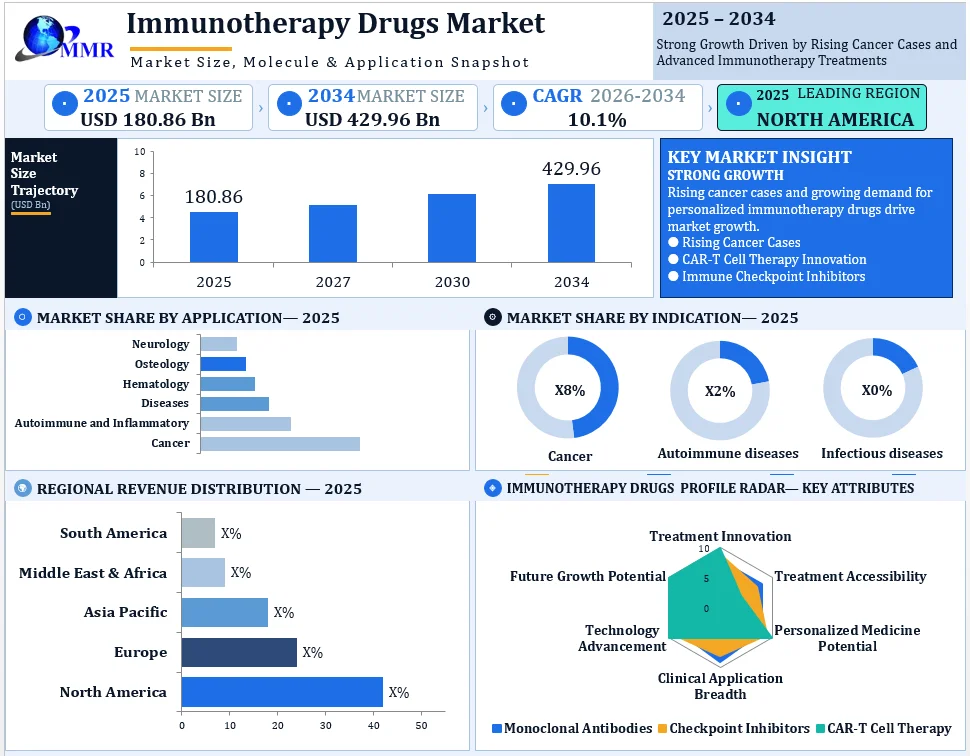
The Global Immunotherapy Drugs Market was valued at USD 180.86 Billion in 2025 and is projected to reach USD 429.96 Billion by 2034, growing at a CAGR of 10.1% during the forecast period 2026–2034.
Immunotherapy Drugs Market Overview:
The Immunotherapy Drugs Market encompasses treatments designed to enhance or restore the immune system's ability to combat diseases. Immunotherapy leverages various mechanisms, such as checkpoint inhibitors, monoclonal antibodies, CAR-T cell therapy, and vaccines, to target and destroy cancer cells or modulate immune responses. Key applications of immunotherapy Drugs include the treatment of various cancers, including melanoma, lung cancer, and leukaemia, as well as chronic diseases like autoimmune disorders. Market growth is influenced by rising cancer incidence and high investments in research and development. The combination therapies and growth into emerging markets are creating new opportunities for immunotherapy drug adoption.
In 2025, North America dominated the Immunotherapy Drugs Market due to advanced healthcare infrastructure and high cancer incidence in the region. Companies like DC Therapeutics and Ablynx further increase the market demand through innovation and strong industry presence. Trends like CAR T, ADCs, and mRNA-based therapies is reshaping the immunotherapy market with both strong current value and high future potential. Additionally, the approval of novel therapies and expanding indications for existing treatments contribute to market expansion. Increased awareness and the shift towards precision medicine further fuel demand for immunotherapy drugs, making them a critical area of focus in the evolving landscape of medical treatments.
Global Immunotherapy Drugs Market Key Highlights
| Market Size | Valued at USD 180.86 billion in 2025, the market is projected to reach USD 429.96 billion by 2034, growing at a CAGR of 10.1%. |
| Market Growth | Rising cancer cases, personalized medicine, and increasing demand for advanced immunotherapy treatments drive global market expansion. |
| Market Trends | Monoclonal antibodies, immune checkpoint inhibitors, CAR-T cell therapy, and cancer vaccines accelerate immuno-oncology innovation. |
| Market Regional Insights | North America dominates the global market, while Asia Pacific offers strong growth opportunities through expanding healthcare access and pharmaceutical investment. |
| Market Competitive Landscape | Merck & Co., Roche, Bristol Myers Squibb, AstraZeneca, and Johnson & Johnson focus on innovative immunotherapy drugs, clinical trials, and strategic collaborations. |
Global Immunotherapy Drugs Market Growth Outlook
To know about the Research Methodology :- Request Free Sample Report
Immunotherapy Drugs Market Dynamics
Advancements in Personalised Medicine to drive the Immunotherapy Drugs Market Growth
The rising global incidence of cancer is a primary driver for the immunotherapy drugs market. As the number of cancer cases grows due to factors like ageing populations and lifestyle changes, there is a heightened demand for effective treatment options. Immunotherapy offers targeted treatments that can address various cancer types, including those that are resistant to traditional therapies. Progress in personalised medicine, which tailors treatments based on individual genetic and molecular profiles, has significantly impacted the immunotherapy market. Innovations such as personalised cancer vaccines and CAR-T cell therapies demonstrate how tailored approaches can enhance treatment efficacy and minimize side effects. This driver creates a robust market for new and existing immunotherapy drugs, leading to increased research, development, and investment in novel therapies.
Growth of Combination Therapies to create opportunity for the Immunotherapy Drugs Market
Combining immunotherapy with other treatments like chemotherapy, targeted therapies, or radiation offers an opportunity to improve patient outcomes. These combination therapies can enhance efficacy, overcome resistance, and provide a broader range of treatment options. This approach opens new avenues for drug development and market expansion, as it allows companies to offer comprehensive treatment solutions and potentially access new patient demographics. Emerging markets, such as those in Asia-Pacific, Latin America, and the Middle East, are experiencing improvements in healthcare infrastructure and increased healthcare spending. These regions represent opportunities for the introduction and growth of immunotherapy drugs. Expanding into these markets can lead to significant revenue growth and increased market presence, provided companies adapt to local needs and regulatory requirements.
High Treatment Costs and Managing Adverse Effects to create Challenges for the Immunotherapy Drugs Market
Immunotherapy drugs are often expensive due to complex development and manufacturing processes. High costs can restrict access, particularly in lower-income regions or for patients without comprehensive insurance coverage. High costs can limit market penetration and create disparities in treatment access, necessitating strategies to address affordability and improve patient access. Immunotherapy can cause adverse effects, such as immune-related adverse events (irAEs), which may affect various organs and systems. Effective management of these side effects is crucial to ensure patient safety and adherence to treatment.
High Immunotherapy Treatment Costs and Limited Patient Access Restrict Market Growth
High treatment costs, limited insurance coverage, and expensive cancer immunotherapy drugs restrain the Global Immunotherapy Drugs Market growth. Advanced treatments, including immune checkpoint inhibitors, monoclonal antibodies, and CAR-T cell therapies, require significant healthcare expenditure. Limited affordability, immune-related side effects, and strict regulatory approvals further restrict patient access, affecting Immunotherapy Drugs Market size, market share, and revenue growth.
Immunotherapy Drugs Market Trends
Growing Adoption of Precision Immunotherapy and Combination Cancer Treatments Drives Market Innovation
Increasing demand for personalized cancer immunotherapy, immune checkpoint inhibitors, and targeted immunotherapy drugs drives the Global Immunotherapy Drugs Market trends. Pharmaceutical companies focus on combination immunotherapy, bispecific antibodies, CAR-T cell therapies, and biomarker-based treatments to improve outcomes in selected patients. Rising investment in oncology drug development, AI-driven drug discovery, and advanced immuno-oncology therapies supports the Immunotherapy Drugs Market forecast, competitive landscape, and future growth opportunities.
Global Immunotherapy Drugs Market Dynamics – Drivers, Restraints, Opportunities, Challenges and Trends
| Market Dynamics | Key Factors | Market Impact |
|---|---|---|
| Drivers | Rising cancer incidence Growing adoption of personalized medicine Increasing demand for CAR-T cell therapy |
Drives Immunotherapy Drugs Market growth Increases demand for advanced cancer treatments |
| Restraints | High immunotherapy drug prices Limited insurance coverage Low treatment affordability |
Restricts market expansion Limits patient access to immunotherapy |
| Opportunities | Growing adoption of combination immunotherapy Expansion into emerging healthcare markets Increasing oncology drug development |
Creates new revenue opportunities Strengthens global market potential |
| Challenges | Immune-related adverse effects Complex drug manufacturing High treatment and development expenditure |
Increases healthcare costs Creates treatment safety and accessibility challenges |
| Trends | Precision immunotherapy and personalized cancer vaccines Bispecific antibodies and CAR-T cell therapies AI-driven drug discovery and biomarker-based treatments |
Accelerates immunotherapy innovation Supports future market growth and competition |
Immunotherapy Drugs Market Segment Analysis
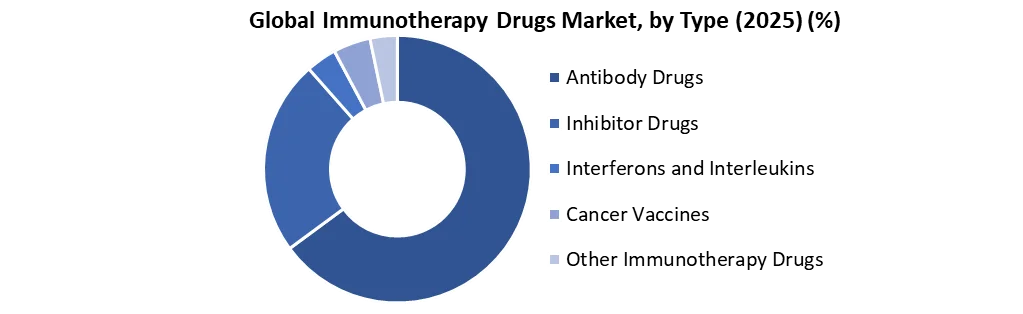
Based on Type, the Immunotherapy Drugs Market is segmented into Antibody Drugs, Inhibitor Drugs, Interferons and Interleukins, Cancer Vaccines and Others. In this Antibody Drugs dominant market in 2025 and is expected to dominate in the forecasted period due to High clinical efficacy and specificity of monoclonal antibodies (mAbs), including checkpoint inhibitors like PD-1/PD-L1 and CTLA-4 inhibitors and Increasing approvals of biosimilars and next-gen antibodies.
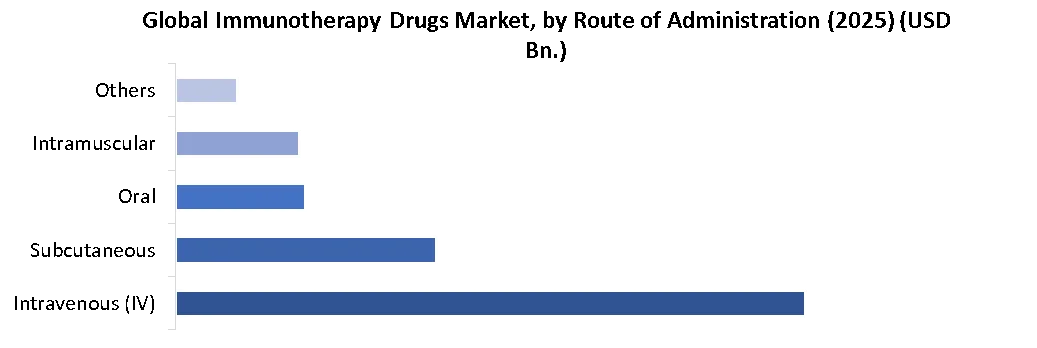
Based on the Route of Administration, the Immunotherapy Drugs Market is segmented into intravenous (IV), oral, intramuscular, subcutaneous, and others. The oral segment dominated the market in 2025 and is expected to hold the market in the forecasted period. Patients generally prefer oral drugs over other forms of administration as they are less invasive and can be self-administered without any medical assistance. This makes the treatment process far more convenient for patients as there is no need for hospital visits or medical supervision every time it is simpler to take pills along with their regular diet rather than regular and painful injections.
Based on the Indication, the Immunotherapy Drugs Market is segmented into Cancer, Autoimmune diseases, Infectious diseases and Others. Cancer dominated the market in 2025 and is expected to dominate in the forecasted period and High prevalence of cancer globally, with increasing incidence driving demand for innovative treatments and widespread adoption of immune checkpoint inhibitors, CAR-T cell therapies, and cancer vaccines.
Immunotherapy Drugs Market Regional Analysis
North America dominates the Immunotherapy Drugs Market, driven by advanced healthcare infrastructure, high oncology R&D expenditure, and increasing adoption of cancer immunotherapy. The United States leads regional demand through innovative drug approvals and growing use of immune checkpoint inhibitors.
Europe holds a significant Immunotherapy Drugs Market share, supported by pharmaceutical innovation, rising cancer treatment demand, and increasing adoption of monoclonal antibodies and personalized immunotherapy. Germany, France, and the UK contribute to regional market growth.
Asia Pacific offers strong Immunotherapy Drugs Market growth opportunities, driven by increasing cancer cases, improving healthcare infrastructure, and expanding access to advanced oncology treatments. China, India, and Japan support market expansion through pharmaceutical investments and immunotherapy drug development.
Middle East & Africa experiences growing demand for immunotherapy drugs due to rising healthcare expenditure, expanding oncology treatment facilities, and improving access to cancer medicines. Saudi Arabia, the UAE, and South Africa contribute to regional market development.
South America presents emerging Immunotherapy Drugs Market opportunities, supported by increasing cancer treatment demand, improving healthcare access, and growing availability of immuno-oncology medicines. Brazil and Argentina remain important regional markets.
Immunotherapy Drugs Market Competitive Analysis
Top companies like DC Therapeutics, Ablynx, BeiGene, Hikma Pharmaceuticals and Instituto Butantan hold the largest share in the Immunotherapy Drugs Market, whereas companies like DC Therapeutics and Ablynx standout as DC Therapeutics also called DC3 Therapeutics helps other biotech and pharmaceutical companies with early-stage research for cancer immunotherapy. It offers services like drug screening, biomarker testing, and support for getting FDA approval whereas Ablynx is a creates special small antibodies called Nanobodies to treat autoimmune, inflammatory, and cancer-related diseases. Its main product, caplacizumab, is used for a rare blood clotting disorder (aTTP) also Ablynx has over 45 nanobody drug programs and works with big pharma companies like Merck and Boehringer Ingelheim.
Global Immunotherapy Drugs Market Recent Industry Developments
| Date | Company | Development | Impact |
|---|---|---|---|
| 10 February 2026 |
Merck & Co., Inc. |
The U.S. FDA approved Keytruda (pembrolizumab) in combination with paclitaxel, with or without bevacizumab, for eligible patients with platinum-resistant ovarian, fallopian tube, or primary peritoneal cancer. |
This approval expands cancer immunotherapy treatment options and supports the growth of immune checkpoint inhibitors and combination immunotherapy therapies. |
| 15 January 2026 |
Bristol Myers Squibb |
The National Institute for Health and Care Excellence (NICE) recommended Nivolumab (Opdivo) as a perioperative treatment in combination with chemotherapy for adult patients. |
The recommendation enhances market accessibility in Europe and solidifies its role as a cornerstone immunotherapy agent that reduces long-term cancer recurrence rates. |
| 01 March 2026 |
Johnson & Johnson |
The U.S. FDA granted approval to Darzalex Fassero (daratumumab and hyaluronidase-fihj) in combination with bortezomib, lenalidomide, and dexamethasone for newly diagnosed multiple myeloma patient’s ineligible for autologous stem cell transplant. |
This approval introduces a highly effective subcutaneous monoclonal antibody combination therapy that substantially improves patient outcomes while decreasing overall clinic administration time. |
| 15 March 2026 |
Bristol Myers Squibb |
The U.S. FDA approved the immune checkpoint inhibitor Nivolumab (Opdivo) in combination with doxorubicin, vinblastine, and dacarbazine for adult and pediatric patients with previously untreated, advanced classical Hodgkin lymphoma. |
This landmark decision changes the global standard of care by shifting first-line therapeutic regimens toward targeted immunotherapy-chemotherapy combinations. |
| 22 May 2026 |
AstraZeneca | The U.S. FDA approved Datroway (datopotamab deruxtecan) as the first TROP2-directed antibody-drug conjugate for the first-line treatment of patients with metastatic triple-negative breast cancer who are not candidates for PD-1/PD-L1 inhibitors. |
This targeted drug launch provides a critical therapeutic alternative, demonstrating a significant overall survival advantage over conventional chemotherapy in a highly difficult-to-treat patient population. |
Immunotherapy Drugs Market Scope:Inquire Before Buying
| Global Immunotherapy Drugs Market | |||
|---|---|---|---|
| Report Coverage | Details | ||
| Base Year: | 2025 | Forecast Period: | 2026-2034 |
| Historical Data: | 2020 to 2025 | Market Size in 2025: | USD 180.86 Bn. |
| Forecast Period 2026 to 2034 CAGR: | 10.1% | Market Size in 2034: | USD 429.96 Bn. |
| Segments Covered: | by Type | Hospital Clinics Public Services Others Antibody Drugs Inhibitor Drugs Interferons and Interleukins Cancer Vaccines Others |
|
| by Route of Administration | Intravenous (IV) Oral Intramuscular Subcutaneous Others |
||
| by Indication | Cancer Autoimmune diseases Infectious diseases Others |
||
| by Application | Cancer Autoimmune and Inflammatory Diseases Hematology Osteology Neurology Others |
||
Immunotherapy Drugs Market, by Region
North America (United States, Canada, and Mexico)
Europe (UK, France, Germany, Italy, Spain, Sweden, Austria, and the Rest of Europe)
Asia Pacific (China, South Korea, Japan, India, Australia, ASEAN, Indonesia, Philippines, Malaysia, Vietnam, Thailand, ASEAN, Rest of Asia Pacific)
Middle East & Africa (South Africa, GCC, Nigeria, Rest of ME&A)
South America (Brazil, Argentina, Rest of South America)
Immunotherapy Drugs Market, Key Players:
1. Merck & Co., Inc. (United States)
2. F. Hoffmann-La Roche Ltd. (Switzerland)
3. Bristol Myers Squibb (United States)
4. AstraZeneca PLC (United Kingdom)
5. Johnson & Johnson (United States)
6. Novartis AG (Switzerland)
7. Pfizer Inc. (United States)
8. Amgen Inc. (United States)
9. Sanofi S.A. (France)
10. GSK plc (United Kingdom)
11. Regeneron Pharmaceuticals, Inc. (United States)
12. Gilead Sciences, Inc. (United States)
13. AbbVie Inc. (United States)
14. Eli Lilly and Company (United States)
15. Merck KGaA (Germany)
16. Takeda Pharmaceutical Company Limited (Japan)
17. Astellas Pharma Inc. (Japan)
18. BeiGene / BeOne Medicines Ltd. (Switzerland)
19. Genmab A/S (Denmark)
20. BioNTech SE (Germany)
21. Moderna, Inc. (United States)
22. Incyte Corporation (United States)
23. Seagen Inc. (United States)
24. Daiichi Sankyo Company, Limited (Japan)
25. Eisai Co., Ltd. (Japan)
26. Legend Biotech Corporation (United States)
27. Iovance Biotherapeutics, Inc. (United States)
28. ImmunityBio, Inc. (United States)
29. Autolus Therapeutics plc (United Kingdom)
30. Allogene Therapeutics, Inc. (United States)
31. Cellectis S.A. (France)
32. Caribou Biosciences, Inc. (United States)
33. Xencor, Inc. (United States)
34. Agenus Inc. (United States)
35. MacroGenics, Inc. (United States)
36. Celldex Therapeutics, Inc. (United States)
37. Innovent Biologics, Inc. (China)
38. Akeso, Inc. (China)
39. Shanghai Junshi Biosciences Co., Ltd. (China)
40. Hengrui Pharmaceuticals (China)
Frequently Asked Questions:
1. What is the Global Immunotherapy Drugs Market size and forecasts for 2034?
The Global Immunotherapy Drugs Market is projected to reach USD 429.96 billion by 2034, from USD 180.86 billion in 2025, at a CAGR of 10.1% during 2026–2034.
2. What are the major growth drivers of the Immunotherapy Drugs Market?
Rising cancer incidence, personalized cancer treatment, growing healthcare expenditure, and advancements in monoclonal antibody drugs and CAR-T cell therapy drive market growth.
3. Which drug type dominates the Global Immunotherapy Drugs Market?
Antibody drugs lead the Immunotherapy Drugs Market by type in the supplied MMR report, supported by the adoption of monoclonal antibodies, immune checkpoint inhibitors, and targeted immunotherapy treatments.
4. Which region holds the largest Immunotherapy Drugs Market share?
North America holds the leading Immunotherapy Drugs Market position, supported by advanced oncology infrastructure, pharmaceutical R&D, and increasing adoption of cancer immunotherapy. Asia Pacific offers significant growth potential.
5. Who are the leading companies in the Global Immunotherapy Drugs Market?
Major immunotherapy drug companies include Merck & Co., Roche, Bristol Myers Squibb, AstraZeneca, Johnson & Johnson, Novartis, and Pfizer, focusing on innovative cancer treatments and immuno-oncology drug development.