
Pervasive Computing Market Size by Type, Applications, Region, Industry-Wide Analysis, Competitive Landscape Assessment & Long-Term Forecast to 2032
Overview
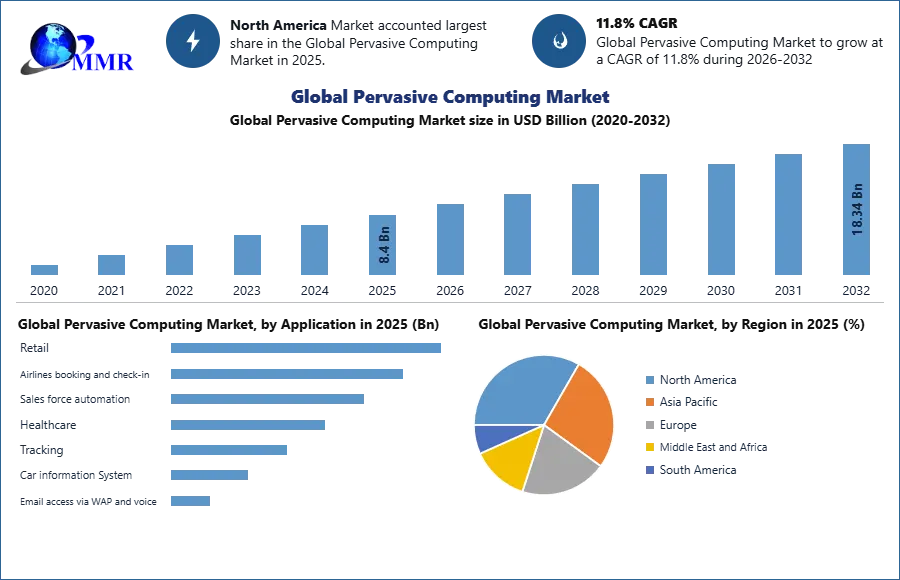
The Pervasive Computing Market size was valued at USD 8.4 Bn. in 2025 and is expected to grow at a CAGR of 11.8% over 2026-2032, it is expected to reach USD 18.34 Bn. in 2032.
Pervasive Computing Market Overview:
Pervasive Computing (Ubiquitous Computing) is a concept in computer science and software engineering where computing is made to appear everywhere and anytime. Pervasive computing means embedding microprocessors in mobile devices like wearable computing devices, smartphones, sensors, tablets. Pervasive computing is the novel trend toward embedding daily objects with microprocessors so that they can communicate information. The underlying technologies like internet capabilities, wireless communications, sensors, advanced middleware, networking I/O, and user interfaces, mobile protocols, voice recognition support pervasive computing, embedded systems, AI, location, and positioning.
To know about the Research Methodology:- Request Free Sample Report
Pervasive computing will offer us small portable personal assistant devices having wireless communication, coin-sized disk device, data storage in persistent memory, lower power consumption rate, high speed, small colour display video, and speech processing technology. All these features will give the users the freedom to efficiently communicate and access information from any place in the globe at any time.
Pervasive Computing and the (IoT) Internet of Things:
Nowadays, pervasive computing (Ubiquitous Computing) is also identified as Internet-of-things (IoT) which means connecting everyday objects to devices and networks. The IoT has largely changed out of pervasive computing. Like pervasive computing, IoT-connected devices communicate and offer notifications about usage. The vision of pervasive computing is computing power extensively dispersed through daily life in everyday objects.
Internet of things (IoT) can employ wireless sensor networks. In one application of the technology, such as an Apple Watch, the processing and collection of data is better sent directly to a server on the internet in which the computing technology is consolidated.
Pervasive Computing Market Dynamics:
The emergence of smart devices and technological proliferation around the globe is driving the growth of the pervasive computing market globally. The machine-to-machine (M2M) communications, reduced production cost & data communications cost, and decrease the size of the transistors, these factors are leading to the growth of the global pervasive computing market. Furthermore, the developing application of pervasive computing technology in different industries around the world is expected to create market opportunities for the global pervasive computing market during the forecast period.
On the flip side, user privacy concerns alongside energy management issues may hamper the growth of the pervasive computing technology market. The pervasive computing market faces many technological challenges for instance, energy management issues, flaws in human-machine interfaces, cyber forage, users’ intent, and context awareness along with user privacy concerns. From the perspective of big data, the challenge for ubiquitous computing is to integrate data from numerous disparate sources.
Pervasive Computing Market Segment Analysis:
Based on Applications, the retail segment is projected to witness the highest CAGR of 12.56% during 2026-2032. In the retail industry, there is a necessity for faster and cheaper methods to carry goods to the buyer from stores by the Internet. Mobile computers are provided with bar code readers for tracking the product throughout manufacture. Presently consumers use computers to select products. In the future, consumers will use pervasive devices and PDA (Personal Digital Assistant) in the domestic markets too.
The Summary of Technology to be Developed, Which Countries on the Globe Are Driving: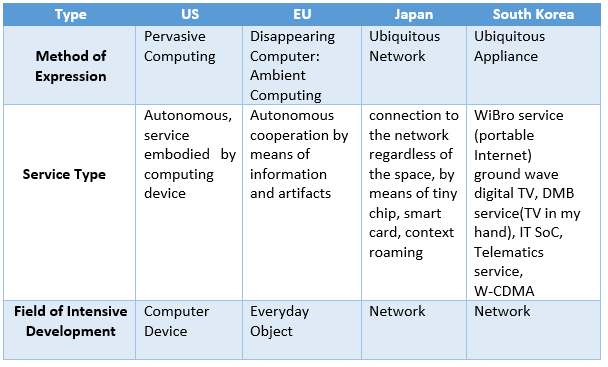
Pervasive Computing Market Regional Analysis:
North America accounted for the largest market share in 2025, the regional market is expected to register a CAGR of 13.03% during 2026-2032. The development of the market in the USA is ascribed to the growing use of cell phones among individuals. North America and Europe are considered to be matured countries in terms of technology adoption thanks to the presence of major players like IBM Corporation in the respective region are expected to drive the growth of the pervasive computing market during 2026-2032.
The U.S. is expected to lead the North American market by 2032. The U.S s leading technologies in approximately all fields related to pervasive computing. The United States goals to develop Peta-grade high-performance computing technology in the field of hardware as part of its strategy for technology advancement.
In the APAC region, emerging economies like India and China are expected to drive the demand for pervasive computing because of expansion in the automotive industry, growing smartphone penetration, and rising number of internet subscribers.
The objective of the report is to present a comprehensive analysis of the global Pervasive Computing Market to the stakeholders in the industry. The past and current status of the industry with the forecasted market size and trends are presented in the report with the analysis of complicated data in simple language. The report covers all the aspects of the industry with a dedicated study of key players that include market leaders, followers, and new entrants.
PORTER, PESTEL analysis with the potential impact of micro-economic factors of the market have been presented in the report. External as well as internal factors that are supposed to affect the business positively or negatively have been analyzed, which will give a clear futuristic view of the industry to the decision-makers.
The reports also help in understanding the Pervasive Computing Market dynamic, structure by analyzing the market segments and projecting the Pervasive Computing Market size. Clear representation of competitive analysis of key players by Vehicle type, price, financial position, product portfolio, growth strategies, and regional presence in the Pervasive Computing Market make the report investor’s guide.
Pervasive Computing Market Scope: Inquire before buying
| Global Pervasive Computing Market | |||
|---|---|---|---|
| Report Coverage | Details | ||
| Base Year: | 2025 | Forecast Period: | 2026-2032 |
| Historical Data: | 2020 to 2025 | Market Size in 2025: | 8.4 USD Billion |
| Forecast Period 2026-2032 CAGR: | 11.8% | Market Size in 2032: | 18.34 USD Billion |
| Segments Covered: | by Type | Distributed Computing Mobile Computing Location Computing Mobile Networking Context-Aware Computing Sensor Networks Human-Computer Interaction Artificial Intelligence |
|
| by Application | Retail Airlines booking and check-in Sales force automation Healthcare Tracking Car information System Email access via WAP and voice |
||
| by Technology | Internet of Things (IoT) Artificial Intelligence (AI) Edge Computing Sensor Networks Wireless Connectivity |
||
Pervasive Computing Market, by Region:
● North America (United States, Canada and Mexico)
● Europe (UK, France, Germany, Italy, Spain, Sweden, Austria, Turkey, Russia and Rest of Europe)
● Asia Pacific (China, India, Japan, South Korea, Australia, ASEAN and Rest of APAC)
● Middle East and Africa (South Africa, GCC, Egypt, Nigeria and Rest of ME&A)
● South America (Brazil, Argentina, Columbia and Rest of South America)
Key Players / Competitors Profiles Covered in Brief in Global Pervasive Computing Market Report in Strategic Perspective:
1. Blazon Marketing Inc.
2. E-Tron CO.
3. Hewlett-Packard
4. Neo Metal Co., Ltd.,
5. Palo Alto Research Center Incorporated (PARC)
6. T&T Inc.
7. Maruhachi Warehouse Co., Ltd.
8. IBM Corporation
9. Fujitsu Laboratories of America, Inc.
10. Tata Consultancy Services Limited
11. Microsoft Corporation
12. HP Inc.
13. AT&T Inc.
14. Fujitsu Limited
15. SAP SE
16. Oracle Corporation
17. Cloudera Inc.
18. Intel Corporation
19. Cisco Systems, Inc.
20. Huawei Technologies Co., Ltd.
21. Verizon Communications Inc.
22. Dell Technologies Inc.
23. Robert Bosch GmbH
24. Panasonic Holdings Corporation
25. Xiaomi Corporation
26. Schneider Electric SE
27. Telefonaktiebolaget LM Ericsson
28. NEC Corporation
29. MediaTek Inc.
30. NXP Semiconductors N.V.
31. Rockwell Automation Inc.
32. Garmin Ltd.
33. Samsara Inc.
Recent Industry Developments (2025–2026)
| Exact Date | Company | Development | Impact |
|---|---|---|---|
| 18 February 2026 | Qualcomm | Completed the acquisition of Edge Impulse to integrate its pervasive computing tools into the Snapdragon platform. | Significantly accelerates edge AI deployment across millions of mobile and IoT devices worldwide. |
| 29 January 2026 | UMBC | Launched a new Pervasive Computing and Communication initiative focusing on AI analysis of 3 million+ smart home messages. | Advances the context-aware computing segment by improving how idle smart devices interact with users. |
| 14 January 2026 | Google Cloud | Introduced ubiquitous quantum-ready cloud services for real-time edge integration and generative AI tools. | Lowers the entry barrier for enterprises to implement high-performance pervasive analytics in industrial settings. |
| 10 November 2025 | N-iX / Gartner | Released the 2026 Ubiquitous Computing Roadmap, highlighting a shift toward real-time serverless edge architectures. | Drives standardization in IoT protocols, enabling seamless data exchange between disparate vendor ecosystems. |
| 15 May 2025 | HCLTech / Cisco | Commercialized Pervasive Wireless Mobility as-a-Service utilizing Ultra-Reliable Wireless Backhaul (URWB) technology. | Provides uninterrupted connectivity for mission-critical pervasive applications in mining and healthcare. |
| 20 April 2025 | Ericsson | Announced that global cellular IoT connections surpassed 4 billion, driven by Broadband IoT adoption. | Solidifies the infrastructure base for massive IoT deployment, a core component of the pervasive market. |