
Oxetane Market By Product Type, By Chemical Structure, By Application, By Functionality, By End-Use Industry and Regional Insights 2034
Overview
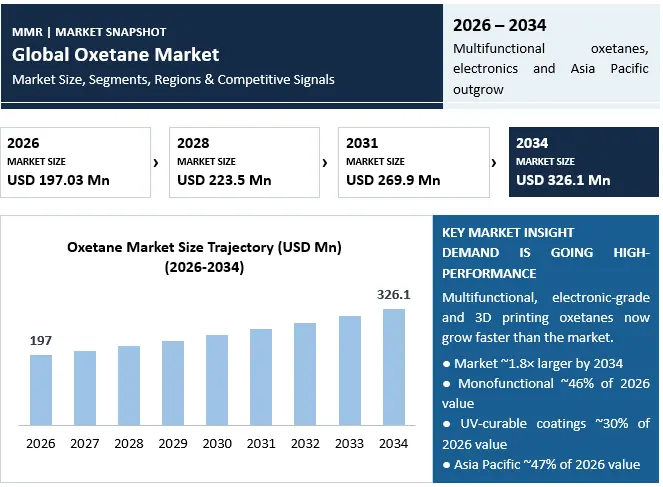
The Global Oxetane Market was valued at USD 197.03 million in 2026 and is projected to reach USD 326.1 million by 2034, growing at a CAGR of 6.5% during 2026–2034, according to Maximize Market Research (MMR). Oxetanes are four-membered cyclic ethers whose strained ring opens readily under cationic conditions, making oxetane monomers, derivatives and oxetane-based resins valuable reactive diluents, crosslinkers and modifiers in UV-curable coatings, inks, adhesives, electronics and 3D printing resins.
This Oxetane Market analysis answers both sides of the search: what the market is worth for monomer producers, resin and formulation companies and investors, and what technical buyers and procurement teams want to know, from what counts as an oxetane to the oxetane compounds market, oxetane derivatives market, oxetane monomers market, oxetane chemical market, UV-curable oxetane monomers and oxetane-based resins. This market overview and market analysis offer market insights into Oxetane consumption, Oxetane demand and Oxetane supply, with a clear market summary and market outlook for stakeholders.
Monofunctional oxetane monomers and UV-curable coatings anchor the market and Asia Pacific is the largest regional buyer, but Oxetane Market growth is shifting toward multifunctional and hybrid epoxy-oxetane systems, electronic materials, 3D printing resins and low-emission formulations as cationic ring-opening polymerization, UV-LED curing and low-shrinkage, high-adhesion materials widen the number of industrial uses. These industry trends and market dynamics highlight emerging markets and growth prospects across the industry landscape.
Maximize Market Research provides comprehensive analysis of global Oxetane Market size, share, product type, chemical structure, application, functionality, end-use industry and regional segmentation, the Oxetane competitive landscape, strategic scenarios and growth opportunities. The report helps global oxetane manufacturers, raw material and photoinitiator suppliers, resin and formulation companies, coating, ink and adhesive producers and investors decide which segments, applications and countries to prioritise through 2034. The market research findings also cover market segmentation, market dynamics, key players, market strategies and market entry options, along with the revenue generated by each segment.
| 2026 | BASE YEAR | 2034 | FORECAST | GROWTH RATE | LARGEST REGION |
| USD 197.03 Mn | USD 326.1 Mn | 6.5% | Asia Pacific |
Global Oxetane Market Overview:
The market is measured at manufacturer-selling-price level across monofunctional, difunctional, trifunctional and multifunctional oxetane monomers and functionalized and specialty oxetane compounds, supplied in drums, pails and bulk containers to resin makers, formulators and industrial users in coatings, inks, adhesives, electronics and 3D printing. Finished UV-curable coatings, inks and adhesives, conventional epoxy resins and non-oxetane reactive diluents are excluded.
Three shifts shape 2026–2034: demand is broadening from specialty intermediates into advanced functional materials; value is moving toward multifunctional, hydroxyl-functionalized and hybrid epoxy-oxetane products used in electronics and additive manufacturing; and growth is rotating toward Asia Pacific, UV-LED cationic curing and low-volatility, low-emission formulations. Suppliers are answering substitution risk from conventional diluents with higher-reactivity grades, tighter purity specifications and formulation support. This market synopsis reflects the key growth drivers, market opportunities and challenges, along with economic factors, technological advancements and regulatory influences affecting Oxetane demand and Oxetane supply.
Oxetane Market Analysis from 2025 to 2034
To know about the Research Methodology :- Request Free Sample Report
Key Findings: Eight Insights Shaping the Global Oxetane Market
MMR’s analysis of published market data, company announcements, regulatory frameworks and industry developments points to eight findings that explain where Oxetane Market growth and value are created through 2034. These market insights summarise the Oxetane Market forecast, market segmentation and competitive landscape in one view.
| Sr.No. | Findings | Evidence | So what |
| 1 | The market grows about 1.8× by 2034 | USD 197.03 Mn (2026) to USD 326.1 Mn (2034) at 6.5% CAGR | Monomer capacity, purification yield and precursor supply must scale about 1.8× by 2034 |
| 2 | Monofunctional monomers are the base, multifunctional grades the growth edge | Monofunctional ~46% of 2026 value; multifunctional oxetanes 8.4% CAGR | Grade development and reactivity tuning become the margin engine |
| 3 | Asia Pacific is the largest region | ~47% share in 2026, led by Japan, China, South Korea and Taiwan | Local supply, qualification and technical service set share in the largest region |
| 4 | 3D printing and electronics outgrow the market | 3D printing resins 10.6% CAGR; electronic materials 9.1% CAGR | Purity, low-ionic grades and cationic-curing know-how open premium revenue |
| 5 | UV-curable coatings remain the core application | UV-curable coatings ~30% of 2026 value at 6.9% CAGR | Low-viscosity diluent performance anchors competitiveness |
| 6 | Reactive diluents are the leading function | Reactive diluents and viscosity modifiers ~34% of 2026 value | Diluent substitution from epoxy and acrylate systems drives volume demand |
| 7 | The supply base is concentrated and Asia-led | Japanese specialty chemical groups, led by Toagosei and UBE, anchor commercial supply | Scale, patents and customer qualification shape competitive position |
| 8 | Sustainability is a competitive lever | UV-LED curing, low-volatility and low-emission formulations gain share | Greener synthesis and low-emission grades raise the bar for new entrants |
Global Oxetane Market Dynamics:
Global Oxetane Market Growth Drivers: UV-Curable Formulations, Cationic Curing, Low-Shrinkage Materials and Electronics Demand
The Global Oxetane Market is supported by the adoption of UV-curable technologies, cationic photopolymerization and high-performance epoxy modification. Oxetane monomers deliver low viscosity, fast cationic reactivity, low shrinkage and strong adhesion, which makes UV-curable oxetane monomers a practical upgrade for formulators that want faster curing without sacrificing film properties. Packaging, electronics, automotive and construction demand for durable coatings, inks and adhesives pulls Oxetane consumption upward, and repeat purchasing under qualified specifications gives the Oxetane Market a recurring revenue base. These factors support steady Oxetane Market growth across mature and emerging regions, although buying decisions still depend on purity, reactivity, price and technical support. Demand and supply dynamics, innovation in the industry and consumer preferences evolution act as market drivers and growth catalysts for Oxetane demand.
Technology and application breadth are adding new layers of demand. Cationic ring-opening polymerization lets oxetane-based resins cure in the presence of oxygen and with limited shrinkage, hybrid epoxy-oxetane formulations improve toughness and cure speed, and oxetane chemicals for electronics support encapsulation, optical and insulating materials. Toagosei, which first commercialized the ARON OXETANE series, and UBE, whose ETERNACOLL oxetane range includes the EHO and HBOX reactive diluents and the halogen-free OXMA hybrid monomer for electronic materials, show how commercial grades are tailored to coatings, 3D printing resins and electronics. Resin makers and formulators, together with downstream coating, ink and adhesive producers, keep B2B volume demand high through long-term qualified supply agreements.
Global Oxetane Market Restraints: Specialty Synthesis Cost, Limited Supply Base, Precursor Price Volatility and Substitute Chemistries
Production cost and supply concentration are the main restraints. Oxetane synthesis involves multi-step cyclization, purification and distillation of intermediates such as pentaerythritol-derived polyols, halogenated alcohols and epoxide precursors, so yields, purity and energy use determine cost. Petrochemical feedstock prices, trade policy and currency movements shape Oxetane supply and pricing, and a small number of qualified producers limits sourcing alternatives. Customers need lengthy approval and switching cycles because oxetane grades must be matched to photoinitiators and formulations. Market constraints, market volatility, industry fluctuations and macroeconomic factors, along with environmental factors such as emissions and waste handling, shape Oxetane supply and market fluctuation analysis.
Regulation, handling and competition also limit growth. Chemical registration under REACH and the Toxic Substances Control Act, Globally Harmonized System classification, safety data sheet requirements and transport rules add time and cost, while skin-irritation and toxicity profiles must be managed in formulation. Conventional epoxy, vinyl ether, acrylate and other reactive diluent chemistries compete for the same formulations, and some buyers hesitate to change proven systems. Energy-intensive purification and solvent use add further pressure on margins and increase the importance of greener process routes.
What Are the Biggest Oxetane Market Opportunities Through 2034?
Multifunctional and hybrid epoxy-oxetane products, 3D printing resins and electronic materials represent the most significant Oxetane Market opportunities because they extend revenue beyond standard monofunctional reactive diluents. 3D printing and additive manufacturing resins are projected to grow at 10.6% CAGR, and electronic materials at 9.1% CAGR, as brands specify low-shrinkage, high-adhesion and low-ionic oxetane grades. Halogen-free, low-volatility and bio-based oxetane development shows how chemistry can become a marketing advantage. Suppliers with validated formulations, strong technical service and secure precursor supply may be better positioned to win new qualifications. Oxetane Market opportunities, Oxetane Market challenges and Oxetane consumer demographics, covering resin makers, formulators and industrial buyers, are assessed for each segment.
Emerging-market expansion, UV-LED curing and customized monomer development offer further routes to growth. Asia Pacific is projected to be the fastest-growing region at 7.4% CAGR as China, Japan, South Korea, Taiwan, India and Southeast Asia expand electronics, packaging and coatings output, while Middle East & Africa and South America benefit from specialty chemical imports and industrial investment. Customized molecular design, contract manufacturing and co-development with resin makers can widen distribution and shorten qualification. Emerging trends, a market gap in low-emission cationic curing and untapped market areas create attractive segment-specific opportunities.
Oxetane Market Trends: Cationic UV Curing, Low-Viscosity Diluents, Electronic-Grade Materials and Sustainable Synthesis
Four Oxetane Market trends stand out through 2034. First, cationic UV curing: UV-LED and dual-cure systems are moving into mainstream coatings, inks and adhesives. Second, low-viscosity reactive diluents: formulators want lower viscosity and better adhesion without volatile solvents. Third, electronic-grade materials: oxetane chemicals for electronics support encapsulation, optical adhesives and semiconductor packaging. Fourth, sustainable synthesis: low-emission, low-volatility and bio-based routes align with regulatory pressure. Process intensification, continuous manufacturing and photoinitiator innovation enable these shifts. Customer engagement dynamics and technology trends further support market trends analysis and industry evolution. Oxetane Market consumer behavior trends, competitive forces, market growth factors, industry disruptors and socioeconomic influences interact with market forces, economic indicators and competitive landscape shifts, while regulatory changes, innovation impact, market responsiveness, external market influences, market adaptability, strategic market changes, market segmentation shifts and industry resilience determine how suppliers respond.
Global Oxetane Market Segment Analysis:
Oxetane Monomers Market, Oxetane Derivatives Market, Product Type and Chemical Structure Analysis
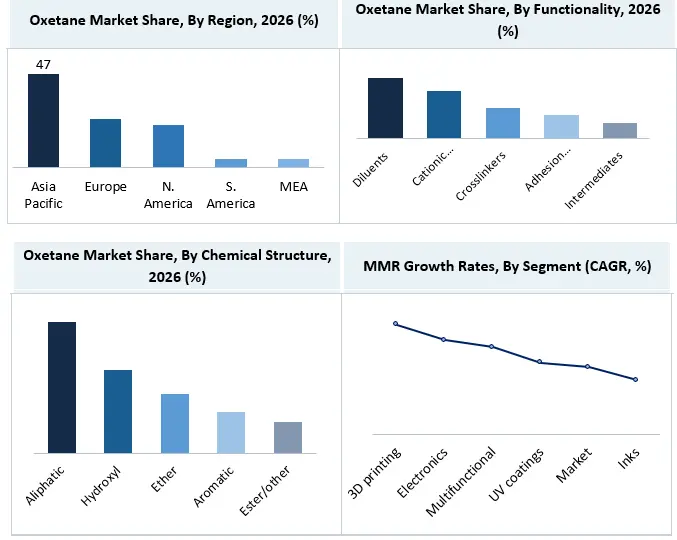
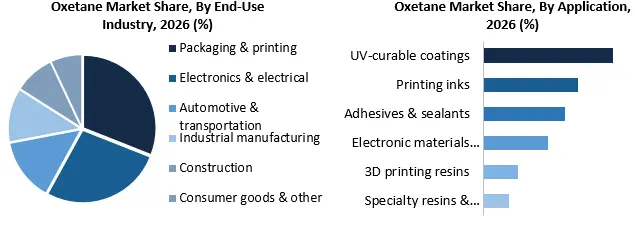
Monofunctional oxetane monomers are the largest product type at about 46% of 2026 value, difunctional monomers hold about 27%, trifunctional and multifunctional oxetanes about 15% and functionalized and specialty oxetane compounds about 12%, with multifunctional grades growing at 8.4% CAGR. By chemical structure, aliphatic oxetane compounds lead at about 38%, followed by hydroxyl-functionalized compounds at 24%, ether-functionalized compounds at 17%, aromatic compounds at 12% and ester-functionalized and other modified compounds at 9%. By application, UV-curable coatings account for about 30% of value, printing inks 22%, adhesives and sealants 19%, electronic materials and encapsulation 15%, 3D printing resins 8% and specialty resins and other uses 6%. Packaging and printing is the largest end-use industry at about 31%. This market segment analysis covers industry segmentation, target market analysis, product segmentation, geographic segmentation, market share by segment, segment growth analysis and market subsegments, while consumer demographics and customer profiling focus on resin makers, formulators and industrial buyers. Niche markets, emerging market segments, segment attractiveness, behavioral segmentation, micro-segmentation and segmentation strategies reveal unexplored market niches, untapped market areas and segment-specific opportunities. Segment-based marketing, customized market strategies, demographic profiling, market niche exploration, market segment dynamics, customer behavior segmentation, specialized market segments, segment-specific trends, tailored marketing strategies, market fragment analysis, unique market sectors, granular market breakdown and comprehensive market sector analysis support the competitive segment landscape for the Oxetane Compounds Market and the Oxetane Chemical Market.
Global Oxetane Market Regional Analysis:
Asia Pacific is the largest regional market, accounting for about 47% of global value in 2026. Japan is the technology anchor, home to leading oxetane producers and UV-curable resin suppliers such as Toagosei, UBE, Daicel and Nagase, while China, South Korea and Taiwan add large electronics, packaging and coatings consumption and growing local supply. The region is also the fastest-growing, at about 7.4% CAGR, led by electronic materials, 3D printing resins and UV-LED cured coatings. Europe holds about 24% of 2026 value, supported by specialty polymer manufacturing in Germany, France, the Netherlands and the United Kingdom, strong packaging ink and industrial coating demand and sustainability-led reformulation; Europe is expected to grow at about 5.6% CAGR. Regional market trends, market performance by region and regional market share show how local consumer behavior and regional economic factors influence Oxetane consumption.
North America holds about 21% of 2026 value and is projected to grow at about 5.9% CAGR, led by the United States, where UV-curable coatings, adhesives, electronics and additive manufacturing create steady Oxetane demand and import reliance on Asian and European supply. Middle East & Africa is a smaller market, about 4% of 2026 value, with growth of about 6.1% CAGR as specialty chemical imports and industrial investment expand in the Gulf, Turkey, Israel, Egypt and South Africa. South America, also about 4%, is projected to grow at about 5.8% CAGR, led by Brazil, Argentina, Chile and Colombia, where packaging, construction and industrial coatings support emerging oxetane consumption. Geographic analysis, area-specific market dynamics, local market influences, regional market segmentation, geographical trends, regional challenges, area-specific opportunities, regional competitive landscape, market growth by location, region-specific industry outlook, local market entry strategies, economic impact by region, regional market development, territorial dynamics, locational market nuances, area-centric market shifts, geographic market intricacies, regional consumer patterns, local economic factors, demographic trends by region, localized market challenges, regionally-driven opportunities, locational market share, geo-strategic influences, area-centric growth factors, regional industry outlook, market trends in designated areas and geopolitical influences, including trade policy and chemical regulation, shape the regional outlook for global oxetane manufacturers. Oxetane regional market challenges, market trends in specific regions, the territorial competitive landscape and regional market entry strategies guide expansion planning for suppliers.
Oxetane Companies and Competitive Landscape:
The Oxetane competitive landscape includes several distinct groups rather than a single set of comparable companies. Direct oxetane manufacturers and specialty chemical suppliers, such as Toagosei, UBE, Osaka Organic Chemical Industry, Tokyo Chemical Industry, Merck KGaA (Sigma-Aldrich) and Thermo Fisher Scientific, together with China-based fine chemical suppliers such as Chemenu, Hairui Chemical and CAPOT Chemical, supply oxetane monomers and building blocks. Specialty monomer, resin and photopolymerization companies, including Mitsubishi Chemical Group, Daicel, DIC, Nagase, Nippon Shokubai, Arkema (Sartomer), BASF, Evonik, Covestro, Allnex, IGM Resins, Eternal Materials, Miwon Specialty Chemical and Kukdo Chemical, supply the UV-curable resin and cationic chemistry ecosystem. Downstream coating, ink and adhesive groups such as Sun Chemical, Flint Group, Siegwerk, Toyo Ink, H.B. Fuller, Henkel, PPG, AkzoNobel, DELO and Dymax consume oxetane-based materials in finished formulations. These groups compete on different dimensions and should not be ranked as though they were identical producers. Competitor analysis, competitive intelligence and competitor profiling help assess competitive positioning and competitive advantage assessment among industry players.
Competition is increasingly shaped by reactivity, purity, grade breadth and technical support. Japanese specialty chemical groups hold the deepest portfolios of commercial oxetane monomers, while Chinese suppliers compete on price and fine chemical availability and European and American resin and formulation companies compete through system know-how. Smaller players differentiate through customized monomers, electronic-grade purity and regional supply. Consolidation, licensing and co-development moves are likely to continue as manufacturers seek scale in cationically curable materials. Company revenue, company net sales, industry rivals examination, market rivalry assessment, competitor benchmarking, competitive strategy review, industry player dynamics, rivalry impact analysis, competitor evaluation, competitive landscape trends, market rivalry intensity, competitive benchmark analysis, rival market share, competitive market evolution, competitor differentiation, market rival scrutiny, competitive ecosystem analysis, competitive matrix investigation, business opponent profiling, sectorial rivalry dynamics, competitive maneuver examination, competing force scrutiny, rivalry intensity mapping, industry opposition tactics and strategic analysis are central to the competitive landscape of the market. An industry competition overview of market player strategies, together with industry adversary exploration, rivalry landscape intricacies and opponent landscape divergence, completes the picture.
Global Oxetane Market Recent Developments
| Period | Development | Why it matters |
| 2026 | Independent research houses publish 2026 oxetane estimates ranging from about USD 52 Mn to more than USD 900 Mn | Scope definition drives wide variance, so clear market boundaries matter |
Global Oxetane Market Scope:Inquire before buying
| Global Oxetane Market | |||
|---|---|---|---|
| Report Coverage | Details | ||
| Base Year: | 2026 | Forecast Period: | 2027-2034 |
| Historical Data: | 2021 to 2026 | Market Size in 2026: | USD 197.03 Million |
| Forecast Period 2027 to 2034 CAGR: | 6.5% | Market Size in 2034: | USD 326.1 Million |
| Segments Covered: | By Product Type | Monofunctional Oxetane Monomers Difunctional Oxetane Monomers Trifunctional and Multifunctional Oxetane Monomers Functionalized and Specialty Oxetane Compounds |
|
| By Chemical Structure | Aliphatic Oxetane Compounds Aromatic Oxetane Compounds Hydroxyl-Functionalized Oxetane Compounds Ether-Functionalized Oxetane Compounds Ester-Functionalized and Other Modified Oxetane Compounds |
||
| By Application | UV-Curable Coatings Printing Inks Adhesives and Sealants Electronic Materials and Encapsulation 3D Printing and Additive Manufacturing Resins Specialty Resins and Other Applications |
||
| By Functionality | Reactive Diluents and Viscosity Modifiers Cationically Curable Monomers Crosslinking Agents and Network Formers Adhesion and Performance Modifiers Functional Polymerization Intermediates |
||
| By End-Use Industry | Packaging and Printing Electronics and Electrical Automotive and Transportation Construction and Building Materials Industrial Manufacturing Consumer Goods and Other Industries |
||
Global Oxetane Market, By Region
North America (United States, Canada, Mexico, Rest of North America)
Europe (Germany, United Kingdom, France, Italy, Spain, Netherlands, Switzerland, Belgium, Sweden, Poland, Austria, Rest of Europe)
Asia Pacific (China, Japan, India, South Korea, Taiwan, Singapore, Australia, Indonesia, Thailand, Malaysia, Rest of Asia Pacific)
Middle East & Africa (United Arab Emirates, Saudi Arabia, Israel, Turkey, South Africa, Kuwait, Egypt, Palestine, Qatar, Morocco, Rest of Middle East & Africa)
South America (Brazil, Argentina, Chile, Colombia, Rest of South America)
Global Oxetane Market, Key Players
A. Direct Oxetane Manufacturers & Specialty Chemical Companies
1. Toagosei Co., Ltd. – Japan
2. UBE Corporation – Japan
3. Osaka Organic Chemical Industry Ltd. – Japan
4. Tokyo Chemical Industry Co., Ltd. (TCI) – Japan
5. Merck KGaA (Sigma-Aldrich) – Germany
6. Thermo Fisher Scientific – United States
7. Aladdin Scientific – United States
8. Chemenu – China
9. Hairui Chemical – China
10. CAPOT Chemical – China
11. Finetech Industry Limited – China
12. Cooke Chemical – China
13. Sinfoo Biotech – China
14. Allbio Pharm – China
B. Specialty Monomers, Resins & Photopolymerization Companies
15. Mitsubishi Chemical Group – Japan
16. Daicel Corporation – Japan
17. DIC Corporation – Japan
18. Nagase & Co., Ltd. – Japan
19. Nippon Shokubai Co., Ltd. – Japan
20. NOF Corporation – Japan
21. Miwon Specialty Chemical – South Korea
22. Kukdo Chemical – South Korea
23. Eternal Materials Co., Ltd. – Taiwan
24. Allnex – Belgium
25. Arkema – France
26. BASF SE – Germany
27. Evonik Industries – Germany
28. Covestro AG – Germany
29. Synthomer plc – United Kingdom
30. IGM Resins – Netherlands
31. Double Bond Chemical – Taiwan
32. Sartomer (Arkema) – France
33. Mitsui Chemicals – Japan
34. Kuraray Co., Ltd. – Japan
C. UV-Curable Coatings, Printing Inks & Adhesive Companies
35. Sun Chemical – United States
36. Flint Group – Luxembourg
37. Siegwerk Druckfarben – Germany
38. Toyo Ink SC Holdings – Japan
39. Dainichiseika Color & Chemicals – Japan
40. FUJIFILM Corporation – Japan
41. Nazdar – United States
42. INX International Ink Co. – United States
43. Marabu GmbH & Co. KG – Germany
44. Kao Corporation – Japan
45. H.B. Fuller Company – United States
46. Henkel AG & Co. KGaA – Germany
47. Huntsman Corporation – United States
48. PPG Industries – United States
49. The Sherwin-Williams Company – United States
50. AkzoNobel – Netherlands
51. Jotun – Norway
52. Axalta Coating Systems – United States
53. Nippon Paint Holdings – Japan
54. Kansai Paint Co., Ltd. – Japan
55. Sika AG – Switzerland
56. DELO Industrie Klebstoffe – Germany
57. Dymax Corporation – United States
58. Panacol-Elosol GmbH – Germany
59. Master Bond Inc. – United States
60. Permabond LLC – United Kingdom
61. ThreeBond Holdings – Japan
62. Nagase ChemteX Corporation – Japan
63. Electrolube – United Kingdom
64. Resonac Holdings Corporation – Japan
Others
Global Oxetane Market FAQs: Frequently Asked Questions
What is the size and forecast of the global Oxetane market?
MMR values the global Oxetane Market at USD 197.03 million in 2026, USD 197.0 million in 2026 and USD 326.1 million in 2034, a 6.5% CAGR. Published estimates vary by scope: independent 2026 estimates for oxetane range from about USD 52 million to more than USD 900 million, while most specialty-chemical reports cluster between roughly USD 150 million and USD 240 million depending on whether oxetane monomers, derivatives or oxetane-based resins are counted. This market size view reflects Oxetane demand, Oxetane supply and Oxetane consumption trends.
Which region and country is the largest Oxetane market?
Asia Pacific holds the largest Oxetane Market share at about 47% in 2026, with Japan as the principal technology and supply anchor and China, South Korea and Taiwan as major consumers. Asia Pacific is also the fastest-growing region at about 7.4% CAGR, followed by Middle East & Africa at 6.1%, North America at 5.9% and South America at 5.8%. Geographic analysis and regional market performance confirm these regional insights.
Which Oxetane segments are growing fastest?
Monofunctional oxetane monomers are the largest product type at about 46% of 2026 value, while multifunctional oxetanes grow at 8.4% CAGR. By application, 3D printing and additive manufacturing resins lead growth at 10.6% CAGR, followed by electronic materials at 9.1%, UV-curable coatings at 6.9% and printing inks at 5.2%. Reactive diluents and viscosity modifiers are the largest functional segment at about 34% of value.
Who are the leading Oxetane companies?
Leading names include Toagosei, UBE Corporation, Nagase, Daicel, Mitsubishi Chemical Group, DIC, Osaka Organic Chemical Industry, Tokyo Chemical Industry, Merck KGaA (Sigma-Aldrich), Arkema (Sartomer), BASF, Evonik, Allnex and Eternal Materials, along with fine chemical suppliers such as Chemenu, Hairui Chemical and CAPOT Chemical. The Oxetane competitive landscape is fragmented by role: direct oxetane manufacturers, specialty monomer and resin companies and downstream coating, ink and adhesive groups each compete in different channels.
Are oxetanes still growing compared with other reactive diluents and monomers?
Yes. Oxetanes compete with epoxy, vinyl ether and acrylate reactive diluents, and production cost, a concentrated supply base and customer qualification cycles are real pressures. But low-viscosity cationic curing, low shrinkage, strong adhesion and rising demand from electronics, packaging and 3D printing support a 6.5% CAGR through 2034, while hybrid epoxy-oxetane systems and UV-LED curing extend reach into new formulations.
Global Oxetane Market Research Methodology
MMR sized the market top-down from a 2026 base of USD 197.03 million and cross-checked it bottom-up using consumption of monofunctional, difunctional, multifunctional and functionalized oxetanes by application, end-use industry and region. Inputs included company announcements and filings, product catalogues, technical and patent literature, trade and regulatory publications, raw material price series for pentaerythritol derivatives, halogenated alcohols and epoxide precursors, and published third-party estimates, which were reconciled to MMR’s scope of oxetane monomers, derivatives and functional compounds (excluding finished UV-curable coatings, inks and adhesives and conventional epoxy resins). Segment shares and growth rates were then modelled by product type, chemical structure, application, functionality, end-use industry and region, and reviewed for consistency with the 2026–2034 forecast.