
Optical Network Hardware Market Size by Type, Technology, End User, Application, Region, Industry-Wide Analysis, Competitive Landscape Assessment & Long-Term Forecast to 2032
Overview
Optical Network Hardware Market size was valued at USD 21.12 Bn in 2024, and the Optical Network Hardware Market revenue is expected to grow at a CAGR of 7.06% from 2025 to 2032, reaching nearly USD 36.45 Bn.
The report study has analyzed revenue impact of the COVID-19 pandemic on the sales revenue of the market leader, market followers and market disrupters in the report and same is reflected in our analysis.
An optical networking is a technique that carries digital information via light waves over fiber optic cables. The optical networking is communication system, which usage the light signals. It usages optical fiber cables as the primary communication medium for transforming data as light pulses between sender and receiver nodes.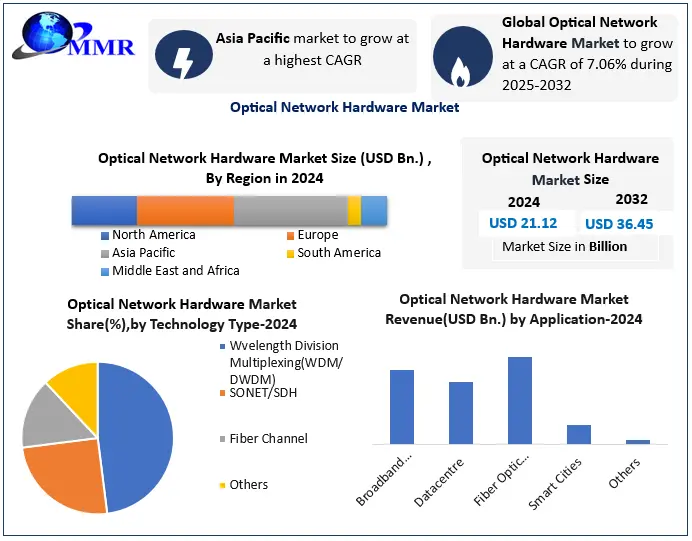 To know about the Research Methodology :- Request Free Sample Report
The adoption of cloud services, use of connected virtual devices, and integration of mobile services of Wi-Fi, and 3G or 4G technology are some of the prominent factors behind the optical network hardware market growth. An increase in demand of high bandwidth services, introduction of IoT technologies, and usage of internet for personal and commercial purpose by consumers are also expected to boost the market growth. Currently, many applications have transformed from function specific dedicated hardware platforms to virtualized services deployed within cloud datacenters that is increasing the demand for the optical network hardware.
On the other hand, lack of Infrastructure in developing and under-developed countries and high cost of transition and maintenance are expected to limit the global optical network hardware market growth.
Wavelength-Division Multiplexing is helps in multiplexing of number of optical fiber carrier signals into a single fiber optic cable by using different wavelengths of light. It provides multiple wavelengths in a single fiber cable. For enterprises, it delivers benefits like full duplex transmission, similar optical network hardware components, and also provides high security. The multiplexing offers an additional benefit of higher bandwidth that achieving the high speed internet across the optical fiber channel. WDM technology-based optical networking is expected to contribute xx% share in the global optical network hardware market. An introduction of ROADM-based WDM networking solutions is one of the promising trends in the global optical networking hardware market. Some of the prominent key players are investing huge capital in building WDM ROADM-based optical equipment, which can provide faster and higher transmission capacity networks to their customers.
Optical Network Hardware Market Segment Analysis:
Based on Product Type, The Chlorinated Paraffin Wax Market segmented into Short-Chain Chlorinated Paraffin (SCCP), Medium-Chain Chlorinated Paraffin (MCCP), and Long-Chain Chlorinated Paraffin (LCCP). We expect that MCCP projected to the largest segment of the Chlorinated Paraffin Wax Market in 2024 based on versatility of applications in many industries considering regulatory considerations in many regions. SCCPs are facing intense regulatory scrutiny in North America and Europe considering health and environmental concerns, however have a more stable regulatory status which leads to much wider acceptance for general applications. MCCPs already have wide acceptance across many applications, including metal working fluids, lubricants, flame retardants, and plasticizers for PVC applications. The chemical stability, cost, and applicability of MCCP, specifically the similarity and crossover that can be seen across many industrial applications, make it fundamentally a key option in the marketplace in numerous sectors, including automotive, construction, and manufacturing.
Optical Network Hardware Market Regional Insights:
Asia-Pacific region is expected to contribute xx% share in the global optical network hardware market during the forecast period. The growth in the market is attributed to the growth in investment by Asian government in building high capacity network, increasing trend of broadband network, and emerging datacenter market in the region. The region is a major hub for consumer electronics, automotive, and industrial verticals. The region has become a global focal point for significant investments and business expansions. The many users have upgraded their connectivity solutions from 3G to 4G technologies and the development of 5G mobile technologies, with commercial deployments planned in Japan and China are also expected to boost the regional market growth.
The rise in adoption of smart phones, a number of internet users , the demand for connectivity, focus on enhancing existing networks and establishing new connectivity networks, and bandwidth-intensive applications, like video-on-demand services are some of the driving factors behind the market growth. Presence of the high population base, increase in investments for R&D activities, and the focus of international and domestic IT companies on the growth of big data analytics and cloud-based services are expected to drive the growth of optical network hardware market in the region.
The objective of the report is to present a comprehensive analysis of the Global Optical Network Hardware Market including all the stakeholders of the industry. The past and current status of the industry with forecasted market size and trends are presented in the report with the analysis of complicated data in simple language. The report covers all the aspects of the industry with a dedicated study of key players that includes market leaders, followers and new entrants by region. PORTER, SVOR, PESTEL analysis with the potential impact of micro-economic factors by region on the market has been presented in the report. External as well as internal factors that are supposed to affect the business positively or negatively have been analyzed, which will give a clear futuristic view of the industry to the decision-makers.
The report also helps in understanding Global Optical Network Hardware Market dynamics, structure by analyzing the market segments and projects the global market size. Clear representation of competitive analysis of key players by Application, price, financial position, Product portfolio, growth strategies, and regional presence in the global market make the report investor’s guide.
Optical Network Hardware Market Scope: Inquire before buying
| Optical Network Hardware Market | |||
|---|---|---|---|
| Report Coverage | Details | ||
| Base Year: | 2024 | Forecast Period: | 2025-2032 |
| Historical Data: | 2019 to 2024 | Market Size in 2024: | USD 1.76 Bn. |
| Forecast Period 2025 to 2032 CAGR: | 4.30% | Market Size in 2032: | USD 2.46 Bn. |
| Segments Covered: | by Type | WDM SONET/SDH |
|
| by Technology | Wavelength Division Multiplexing (WDM/DWDM) SONET/SDH Fiber Channel Others |
||
| by End User | Telecommunication Service Providers Internet Service Providers (ISPs) Government & Defence Agencies Healthcare Institutions Banking, Financial Services & Insurance (BFSI) Educational Institutions Others |
||
| by Application | Broadband Infrastructure Datacentre Fiber Optic Networks Smart Cities Others |
||
Optical Network Hardware Market, by Region
North America (United States, Canada, and Mexico)
Europe (UK, France, Germany, Italy, Spain, Sweden, Austria, and the Rest of Europe)
Asia Pacific (China, South Korea, Japan, India, Australia, ASEAN, Indonesia, Philippines, Malaysia, Vietnam, Thailand, ASEAN, Rest of Asia Pacific)
Middle East & Africa (South Africa, GCC, Nigeria, Rest of ME&A)
South America (Brazil, Argentina, Rest of South America)
Optical Network Hardware Market Key Players
1. ADTRAN, Inc.
2. ADVA Optical Networking
3. Ericsson
4. ZTE Corporation
5. Huawei Technologies Co., Ltd.
6. Infinera Corporation
7. Fujitsu Ltd.
8. Nokia Corp
9. ALE International
10.Alcatel-Lucent
11.Ciena Corporation
12.TE Connectivity Ltd.
13.Cisco Systems
14.Telefonaktiebolaget LM Ericsson
15.Juniper Networks Inc
16.NEC Corp
Frequently Asked Questions:
1. Which region has the largest share in Global Optical Network Hardware Market?
Ans: Asia-Pacific region held the highest share in 2024.
2. What is the growth rate of Global Optical Network Hardware Market?
Ans: The Global Optical Network Hardware Market is growing at a CAGR of 7.06% during forecasting period 2025-2032.
3. What is scope of the Global Optical Network Hardware market report?
Ans: Global Optical Network Hardware Market report helps with the PESTEL, PORTER, COVID-19 Impact analysis, Recommendations for Investors & Leaders, and market estimation of the forecast period.
4. Who are the key players in Global Optical Network Hardware market?
Ans: The important key players in the Global Optical Network Hardware Market are – ADTRAN, Inc., ADVA Optical Networking, Ericsson, ZTE Corporation, Huawei Technologies Co. Ltd., Infinera Corporation, Fujitsu Ltd., Nokia Corp, ALE International, Alcatel - Lucent, Ciena Corporation, TE Connectivity Ltd., Cisco Systems, Telefonaktiebolaget LM Ericsson, Juniper Networks Inc, and NEC Corp
5. What is the study period of Optical Network Hardware market?
Ans: The Global Optical Network Hardware Market is studied from 2024 to 2032.