
Nylon Market Size by Product, Application, Packaging Type and Region – Segment-Level Market Assessment, Growth Opportunity Analysis, Competitive Mapping & Forecast to 2034
Overview
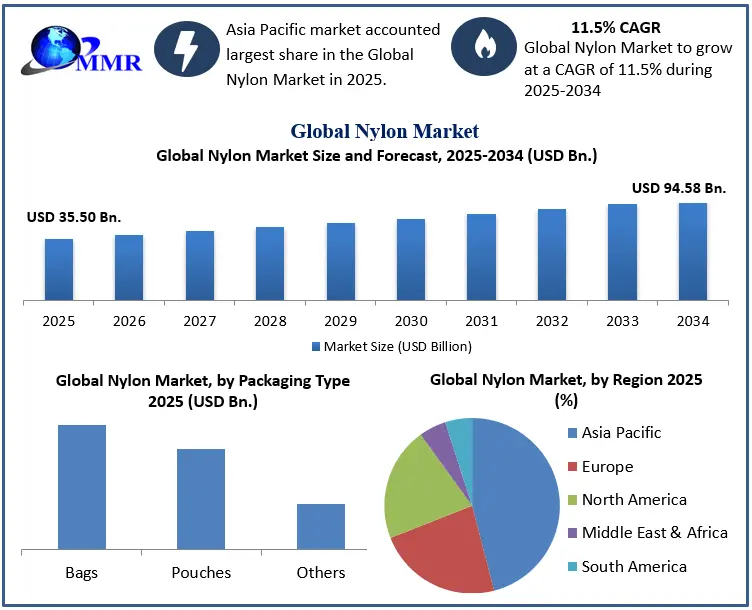
The Global Nylon Market was valued at USD 35.50 Billion in 2025 and is estimated to grow at a CAGR of 11.5% over the forecast period, reaching USD 94.56 Billion by 2034.
Global Nylon Market Overview:
Nylon is a synthetic engineering polymers known for its strength, toughness, abrasion resistance, chemical resistance, and relatively low weight. Common product include Nylon 6, Nylon 6,6, and specialty nylon compounds, which are processed into fibers, films, molded components, industrial parts, and consumer products. The nylon market covers the production, processing, and consumption of these materials across automotive, electrical and electronics, textiles, industrial machinery, consumer goods, packaging, and other applications. Its importance is increasing as manufacturers seek lightweight materials that can replace metals and improve component durability.
The market is changing through automotive lightweighting, electric vehicle development, electronics miniaturization, high-performance engineering plastics, and increasing demand for durable synthetic fibers. Automotive manufacturers use nylon compounds for under-the-hood components, connectors, housings, brackets, and other lightweight parts, while electrical and electronics manufacturers use nylon for insulation, connectors, and structural components. Asia Pacific represents an important production and consumption region, supported by its large automotive, electronics, textile, and manufacturing base. The broader plastics industry also continues to expand in emerging Asian economies, with the OECD (Organisation for Economic Co-operation and Development) identifying Asia among the regions where plastics use is expected to grow strongly.
MMR's Nylon Market research provides a structured assessment of market segmentation, nylon types, product forms, applications, end-use industries, regional demand, competitive landscape, market drivers, restraints, opportunities, and emerging trends. The research helps clients understand opportunities linked to EV components, lightweight automotive parts, electrical and electronic components, high-performance nylon grades, sustainable nylon, recycled polyamide, bio-based materials, and advanced nylon compounds. It also examines how regulatory and circular-economy developments are influencing material selection; for example, the OECD (Organisation for Economic Co-operation and Development) highlights stronger recycled-plastics markets, technological innovation, and circularity policies as important areas for the plastics value chain.
Nylon Market Size, Growth and Share Analysis
To know about the Research Methodology :- Request Free Sample Report
Global Nylon Market Dynamics
Global Nylon Market Drivers
The nylon market is gaining momentum from the increasing use of lightweight and durable materials across automotive, electrical and electronics, industrial, textile, and consumer product applications. Automotive manufacturers are using nylon compounds to reduce component weight while maintaining strength, dimensional stability, and resistance to heat and chemicals. The growth of electric vehicles is also creating demand for nylon in connectors, electrical housings, battery-related components, cable management systems, and other lightweight parts. In electrical and electronics manufacturing, nylon is valued for its insulation properties, mechanical strength, and suitability for precision molded components. Growing demand for technical textiles, industrial fibers, films, and engineered components is further supporting consumption. The development of reinforced nylon, flame-retardant grades, heat-resistant formulations, and application-specific compounds is also expanding the range of applications and supporting market growth.
Global Nylon Market Restraints
The nylon market faces limitations from fluctuations in the prices and availability of key petrochemical feedstocks, particularly those used to produce nylon intermediates. Changes in crude oil, energy, and chemical input costs can influence manufacturing expenses and create pricing uncertainty for producers and downstream users. Nylon production can also require significant energy and specialized processing, which increases cost pressures in regions with high energy prices or stricter environmental requirements. Competition from polypropylene, polyester, polycarbonate, PBT, POM, and other engineering plastics can restrict nylon adoption where customers prioritize lower material costs or different performance characteristics. In textile applications, manufacturers may also face pressure to balance nylon performance with sustainability expectations. These factors can make material selection more complex, particularly for price-sensitive applications where the performance advantages of nylon do not fully offset its higher cost.
Global Nylon Market Opportunities
The nylon industry has significant opportunities in high-performance engineering applications, electric mobility, electronics, sustainable materials, and advanced manufacturing. The transition toward electric and hybrid vehicles is creating new opportunities for specialized nylon components that require electrical insulation, dimensional stability, thermal resistance, and lightweight construction. Demand for recycled nylon is also increasing as manufacturers seek to reduce dependence on virgin raw materials and improve the circularity of plastic products. Bio-based nylon and lower-impact production technologies provide additional opportunities for companies responding to sustainability requirements. Specialty grades such as glass-fiber-reinforced nylon, flame-retardant nylon, heat-stabilized nylon, and wear-resistant formulations can expand usage in demanding industrial and electronic applications. Additive manufacturing and advanced polymer processing may further create opportunities for customized nylon components, while growing electronics production can support demand for precision-molded nylon parts and insulation materials.
Global Nylon Market Challenges
The challenge for the nylon market is balancing performance, cost, and environmental requirements at the same time. Manufacturers are under increasing pressure to reduce emissions, improve resource efficiency, and provide recyclable or recycled-content materials without compromising the mechanical, thermal, and chemical properties expected from nylon. Recycled nylon can present challenges related to feedstock quality, contamination, consistency, and processing performance, particularly for applications with strict technical specifications. Producers also need to manage fluctuations in raw material availability and maintain reliable supply across international markets. Competition from alternative polymers and material-substitution technologies adds further pressure on manufacturers to improve product performance and cost efficiency. In addition, changing regulations concerning plastics, recycling, waste management, and product sustainability can require companies to adapt formulations, production processes, and supply chains.
Global Nylon Market Key Trends:
| Key Market Trend | Description |
| Growth of High-Heat Nylon Compounds | Demand is moving toward nylon grades with improved thermal stability, flame resistance and mechanical strength. These materials are being developed for applications where conventional grades may not provide sufficient performance, particularly in electrical components, industrial equipment and vehicle systems. |
| More Nylon in Electrified Vehicle Components | The shift toward electric and hybrid vehicles is changing the type of nylon products required by automotive manufacturers. Engineering compounds are increasingly being specified for connectors, electrical housings, insulation-related components and other parts exposed to heat and electrical loads. |
| Growth of Specialty Polyamide Grades | Manufacturers are putting greater emphasis on specialty materials such as PA12, long-glass-fiber reinforced nylon, flame-retardant grades and bio-based polyamides. These products allow suppliers to serve applications where standard Nylon 6 and Nylon 6,6 cannot meet specific performance or sustainability requirements. |
| Regionalization of Nylon Supply Chains | Producers are increasing regional production and feedstock availability to reduce dependence on long international supply chains. Asia, particularly China, continues to see significant investment in caprolactam and other nylon-related production capacity, strengthening the region's role in the global supply network. |
| Greater Focus on Traceable Sustainable Materials | Nylon buyers are paying more attention to the origin and environmental profile of the material, particularly in consumer products, automotive supply chains and technical textiles. This is encouraging suppliers to offer recycled-content grades, bio-based alternatives and clearer material traceability. |
| Increasing Technical Requirements in Electronics | Miniaturized electronic systems are creating demand for nylon compounds that combine dimensional stability, electrical insulation, heat resistance and flame-retardant performance. This is shifting product development toward more application-specific formulations rather than one-grade-fits-all materials. |
| Supply-Demand Management Becoming More Important | Nylon producers are increasingly adjusting operating rates and inventories in response to uneven demand across automotive and industrial markets. This reflects a market where capacity availability, feedstock economics and customer inventory levels can influence pricing and production decisions alongside long-term consumption growth. |
Global Nylon Market Segment Analysis
Global Nylon Market Segment Analysis, by Product
By product, Nylon 6 is the leading segment of nylon revenue, supported by its established use across fibers, films, molded products, and engineering applications. In the current market, however, the two grades are increasingly serving different performance requirements rather than competing on exactly the same basis. Nylon 6 is gaining continued volume demand where processing flexibility, established supply availability, and balanced performance are important, while Nylon 6,6 is attracting greater attention in applications that require more demanding thermal and mechanical performance, particularly specialized automotive, electrical and industrial components. Current industry data indicates that Nylon 6,6 is the faster-growing product segment. Nylon 6 is presently the dominant product by market share, while Nylon 6,6 represents the stronger growth-oriented segment as manufacturers increasingly specify higher-performance polyamides for technically demanding applications.
Global Nylon Market Segment Analysis, by Packaging Type
By packaging type, Bags is currently the leading segment in the provided market split, reflecting the established use of nylon-based films where puncture resistance, toughness, flexibility, and product protection are important. Nylon bags are used across food, industrial, agricultural, chemical, and other packaging applications, with current product development also focusing on stronger films and multilayer structures. Pouches remain an important and increasingly specialized format, particularly for food, liquid, retort, vacuum, and convenience-oriented packaging where lightweight construction and product protection are required. The Others category includes specialized nylon packaging formats serving applications with particular performance or processing requirements. Overall, the present market structure indicates that Bags lead in existing demand, while Pouches are gaining attention through the expansion of flexible and higher-performance packaging formats.
Global Nylon Market Regional Analysis
Asia Pacific is the leading regional market for nylon, supported by its large-scale manufacturing base and strong presence of textile, electronics, automotive, and packaging industries. China remains a major production and consumption center, while India is adding demand through expanding automotive, consumer goods, and industrial manufacturing. Japan and South Korea contribute more toward technically specialized nylon materials used in electronics and engineered components.
Europe represents a mature nylon market with demand increasingly shaped by material performance, product quality, and sustainability requirements. Germany, France, Italy, and other manufacturing economies maintain demand from automotive components, industrial equipment, electrical products, and technical applications. The region is also seeing greater attention toward recycled and lower-impact polyamide materials as manufacturers respond to evolving sustainability requirements.
North America is an important market supported by established polymer production, engineering plastics manufacturing, and downstream automotive and electrical industries. The United States accounts for a substantial portion of regional demand, while manufacturers are increasingly developing nylon formulations for specialized components rather than relying only on conventional grades. This creates opportunities for higher-performance materials with improved thermal, mechanical, and processing characteristics.
South America is a developing regional market where nylon demand is linked mainly to packaging, automotive components, consumer products, textiles, and industrial applications. Brazil represents an important consumption base because of its manufacturing and agricultural economy, while other countries contribute through downstream processing and regional distribution. Market development is increasingly connected with the expansion of local manufacturing and the replacement of conventional materials with engineered polymers.
Middle East & Africa is a smaller but emerging nylon market, with demand developing through industrialization, packaging, construction-related manufacturing, automotive activities, and consumer goods. The region also benefits from its petrochemical base, particularly in the Gulf countries, which supports the broader availability of chemical feedstocks and polymer-related production. As downstream manufacturing capabilities expand, demand is gradually shifting toward more specialized nylon applications.
Global Nylon Market Competitive Landscape
The nylon market is highly competitive, with leading manufacturers focusing on Nylon 6, Nylon 6,6, engineering plastics, specialty polyamides, recycled nylon, and application-specific compounds to strengthen their market presence. Key companies include BASF SE, INVISTA, Ascend Performance Materials, Toray Industries, UBE Corporation, Asahi Kasei, LANXESS, DOMO Chemicals, AdvanSix, and RadiciGroup. Competition is increasingly shaped by product performance, polymer quality, supply reliability, application-specific development, and sustainable material solutions rather than capacity alone. Companies are expanding their portfolios for automotive, electrical and electronics, packaging, industrial, and consumer applications while investing in recycled polyamide, circular feedstocks, lightweight engineering materials, and high-performance nylon grades. Recent industry developments indicate that manufacturers are also strengthening regional production and technical capabilities to respond to changing customer requirements and reduce supply-chain exposure, making specialty nylon development, sustainable polyamide solutions, and customized engineering compounds important areas of competitive differentiation.
Global Nylon Market Recent Development
| Month | Company | Recent Development in 2026 |
| January 2026 | UBE Corporation | UBE introduced a new Nylon 6 and Nylon 66 grade designed to provide a combination of high flexibility and transparency for specialized applications. |
| February 2026 | RadiciGroup | RadiciGroup presented high performance polyamide solutions at PlastIndia 2026, including recycled PA6 materials and bio based polyamide products for automotive and electrical applications. |
| April 2026 | RadiciGroup | RadiciGroup announced stronger commitment to the Chinese market for high performance polymers used in automotive, electric mobility, electrical and electronics, consumer and industrial applications. |
| May 2026 | DOMO Chemicals and RadiciGroup | The acquisition of DOMO Engineered Materials by Lone Star was completed and the business was combined with RadiciGroups high performance polymers and specialty chemicals activities to form a global engineering polymer platform. |
| July 2026 | BASF | BASF is growing its engineering materials activities, with second quarter results showing stronger group sales and continued focus on materials related growth areas. |
| August 2026 | Toray Industries | Toray reported its first quarter fiscal 2026 results, providing an updated view of its materials and advanced polymer business performance. |
Global Nylon Market Scope: Inquire before buying
| Nylon Market | |||
|---|---|---|---|
| Report Coverage | Details | ||
| Base Year: | 2025 | Forecast Period: | 2026-2034 |
| Historical Data: | 2020 to 2025 | Market Size in 2025: | US $ 35.5 Bn. |
| Forecast Period 2026 to 2034 CAGR: | 11.5% | Market Size in 2034: | US $ 94.56 Bn. |
| Segments Covered: | by Product | Nylon 6 Nylon6,6 |
|
| by Application | Automotive Electrical & Electronics Appliances Film & Coating Wire & Cable Consumer Industrial & Machinery Others |
||
| by Packaging Type | Pouches Bags Others |
||
Nylon Market, by Region
North America (United States, Canada and Mexico)
Europe (UK, France, Germany, Italy, Spain, Sweden, Austria, Turkey, Russia and Rest of Europe)
Asia Pacific (China, India, Japan, South Korea, Australia, ASEAN and Rest of APAC)
Middle East and Africa (South Africa, GCC, Egypt, Nigeria and Rest of ME&A)
South America (Brazil, Argentina, Columbia and Rest of South America)
Global Nylon Market Key Players
1. BASF SE
2. DuPont de Nemours Inc.
3. INVISTA
4. Ascend Performance Materials
5. AdvanSix Inc.
6. UBE Corporation
7. Toray Industries Inc.
8. LANXESS AG
9. RadiciGroup
10. Envalior
11. Asahi Kasei Corporation
12. Shenma Industrial Co Ltd
13. Formosa Plastics Corporation
14. Formosa Chemicals and Fibre Corporation
15. Huafon Group
16. Highsun Holding Group
17. Jiangsu Haiyang Chemical Fiber Co Ltd
18. Fujian Zhongjin New Material Co Ltd
19. Fujian Yongrong Jinjiang Co Ltd
20. Hengshen Group
21. Luxi Chemical Group
22. Mitsubishi Chemical Group
23. Mitsui Chemicals Inc.
24. Evonik Industries AG
25. Arkema Group
26. Solvay SA
27. SABIC
28. Celanese Corporation
29. Huntsman Corporation
30. Domo Chemicals
31. Kolon Industries Inc.
32. Hyosung Corporation
33. Toyobo Co Ltd
34. Nylene
35. Nylon Corporation of America Inc.
36. EMS Group
37. Aquafil Group
38. LIBOLON
39. Kordsa Global
40. Nilit
Global Nylon Market Frequently Asked Questions
1. Which region has the largest share in Global Nylon Market?
Ans: Asia Pacific held the highest share in 2025.
2. What is the growth rate of Global Nylon Market?
Ans: The Global Nylon Market is growing at a CAGR of 11.5% during 2026 to 2034.
3. What is the scope of the Global Nylon Market report?
Ans: The report covers market size, segmentation, regional analysis, trends, dynamics, competitive landscape, and forecasts.
4. Who are the key players in Global Nylon Market?
Ans: Key players include BASF SE, DuPont, INVISTA, Ascend Performance Materials, UBE Corporation, Toray Industries, LANXESS AG, RadiciGroup, Envalior, and AdvanSix.
5. What is the study period of this Market?
Ans: The Global Nylon Market is studied from 2025 to 2034.