
Non-invasive Fat Reduction Market – Global Market Size, Strategic Growth Drivers, Risk Assessment Framework, Regulatory Landscape Review, Competitive Intensity Mapping & Long-Term Industry Outlook to 2032
Overview
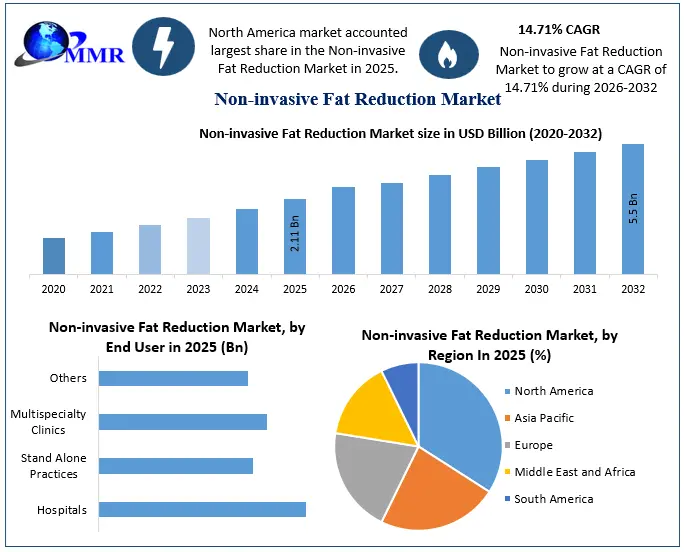
The Non-invasive Fat Reduction Market size was valued at USD 2.11 Billion in 2025 and the total Non-invasive Fat Reduction revenue is expected to grow at a CAGR of 14.71% from 2026 to 2032, reaching nearly USD 5.5 Billion.
Non-invasive Fat Reduction Market Overview:
Non-invasive fat reduction is one of the processes which is not involving the introduction of instruments into the body to decrease the fat in to the body. There several methods used in non-invasive procedure like – radiofrequency, laser lipolysis, cryolipolysis. Changing lifestyle, increasing prevalence of obesity is the reason of growing the market fast.
Non-invasive Fat Reduction Market Snapshot
To know about the Research Methodology :- Request Free Sample Report
The report explores the Non-invasive Fat Reduction Market's segments (Technology, End-User, Region). Data has been provided by market participants, and regions (North America, Asia Pacific, Europe, Middle East & Africa, and South America). The MMR market report provides a thorough analysis of the rapid advances that are currently taking place across all industry sectors. Facts and figures, illustrations, and presentations are used to provide key data analysis for the historical period from 2020 to 2025. The report investigates the Non-invasive Fat Reduction Market’s drivers, limitations, prospects, and barriers. This MMR report includes investor recommendations based on a thorough examination of the Non-invasive Fat Reduction Market's contemporary competitive scenario.
Non-invasive Fat Reduction Market Dynamics:
Non-invasive procedures are fast replacing invasive surgeries, and individuals are opting for aesthetic procedures like body contouring because the risks are minimal, and these treatments are garnering a lot of attention thanks to social media platforms.
Obesity is responsible for over 2 million deaths per year. Physical inactivity, sedentary and long work hours, as well as behavioral risk factors such as alcohol drinking, smoking, and stress, are all contributing to an unhealthy lifestyle, which has resulted in diseases such as diabetes and obesity. People with less time to focus on their physical health as a result of urbanization are looking for other ways to lose stubborn fat.
Outpatient clinics and beauty facilities offer non-surgical fat removal. In comparison to surgical liposuction, nonsurgical liposuction requires less recovery time. These operations, however, are limited to specific body parts.
Drivers:
Growing demand of body shaping is increasing the market of the non-invasive fat reduction market. Sedentary lifestyles and excessive eating habits are the main cause that contribute to the increasing number of obesity in the young population and children. According to WHO, around 16% people over 18 are obese, while it is around 40% globally. Most of the non-invasive fat reduction is happened in US, followed by Brazil.
The market's expansion is being fueled by factors such as rising acceptance and demand for liposuction treatments, an increase in health-care spending, and an increase in the prevalence of obesity. People are increasingly opting for aesthetic procedures as the quantity of money they have for their bills grows.
According to the International Society of Aesthetic Plastic Surgery, in 2023, around 2 lakh non-surgical fat reduction treatments were performed on males worldwide. The use of such procedures has increased in popularity among men, and it is projected to continue to do so in the future. This is due to technology developments in this category, which are accompanied by swift and dramatic results and benefits, resulting in a rise in public acceptance. The simplicity of performing such procedures, as well as their pricing, are enticing millennials to seek such treatment.
Restrain:
The risk of complications like- necrosis, infection, seroma and bruising after fat reduction procedures may delay the adoption of fat reduction procedures. High costs associated with the non-invasive fat reduction treatment are costly is hindering the market growth. Because of lack of awareness, skilled and technical physicians in the emerging countries further hamper the non-invasive fat reduction market.
Opportunities:
Players are required to introduce new business frameworks, including new vendor engagement techniques, that will enable them to keep their profits in the long run while also allowing them to become more agile. In addition, research into the potential of some cutting-edge technology has opened up new opportunities in the non-invasive fat reduction sector. Extracorporeal shockwave therapy is one example. Manufacturers are concentrating their efforts on lowering the likelihood of adverse outcomes following such procedures. The introduction of innovative approaches in skin collagen remodeling will open up new paths for non-invasive fat reduction.
Proponents of these procedures in developed countries that have experienced an increase in demand in the non-invasive fat reduction market have focused on the long-term negative effects. Obese patients with clinically substantial skin flaccidity also appear to be a promising target group. An important trend that will help technology makers handle fresh challenges in the non-invasive fat reduction sector is the advancement of low-level laser therapy. The Covid-19 epidemic has created significant supply chain interruptions in raw chemicals, notably in medical devices. The outlines of the market's evolution have also changed as a result of this.
The use of such procedures has increased in popularity among men, and it is projected to continue to do so in the future. This is due to technology developments in this category, which are accompanied by swift and dramatic results and benefits, resulting in a rise in public acceptance. The simplicity of performing such procedures, as well as their pricing, are enticing millennials to seek such treatment.
Higher cosmetic surgery costs in the United States and Europe are encouraging the expansion of body contouring medical tourism in ASEAN and South America. The market's growth is being stifled by a lack of reimbursements for body reshaping treatments and a higher treatment cost in the United States. People are turning to neighboring countries like Mexico for cost-effective health-care options. The cost of a body sculpting operation in Mexico is 60 percent less than in the United States and Canada. Countries in Asia, such as India and Thailand, are also popular among Europeans. These countries have a 60 percent lower cost of cosmetic operations than Europe.
Challenges:
High cost, low awareness is the biggest of hindering the market of this industry also for the lack of reimbursement policy people don’t show that much interest on this procedures.
Non-invasive Fat Reduction Market Segment Analysis:
Based on the Technology:
Cryolipolysis segment is dominating the market with highest CAGR during forecasting period. People are opting for a low-risk procedure that provides immediate and long-term results. Demand for cryolipolysis is predicted to increase because it is more economical, has relatively common problems such as transient soreness, has no downtime, and a number of campaigns have been undertaken by various major parties to raise knowledge about the device's safety and benefits. Low-level lasers, which use lower laser light with wavelengths of 635–680 nm to liquefy and permanently eliminate targeted fat cells, are another fast-growing technical category.
Non-invasive Fat Reduction Market, by Technology in 2025 (%)

Based on the end user:
Hospital segment is dominating the market with highest CAGR of xx% during the forecast period. Hospital facilities are well equipped with advanced tech, fat reduction devices, skilled practitioners, and the required infrastructure to conduct out such procedures; also, when the treatment is performed in a hospital, there is a sense of confidence and reliability. The accreditation of a hospital is an important factor that determines a patient's decision to undergo aesthetic operations.
Non-invasive Fat Reduction Market Recent Development
| Date | Company | Development | Impact |
|---|---|---|---|
| 18 January 2025 | Cutera, Inc. | The company launched its next-generation truSculpt iD Ultra system, featuring an enhanced monopolar radiofrequency (RF) platform designed for customized, full-body fat reduction. | The system reduces treatment duration to just 15 minutes per zone, significantly improving clinic throughput and expanding non-invasive body sculpting options. |
| 04 March 2025 | Allergan Aesthetics (an AbbVie company) | The company secured FDA clearance for its new CoolSculpting Elite EliteMax applicators designed specifically for targeted submental and abdominal fat reduction. | This clearance expands the brand's multi-applicator capability, providing a 30% increase in tissue contact area and reducing overall patient treatment sessions. |
| 14 May 2025 | InMode Ltd. | The company entered a strategic distribution partnership with Lumenis to co-market the EvolveX hands-free body contouring platform across the Asia-Pacific region. | The collaboration accelerates market penetration by leveraging joint networks, targeting a 25% volume growth in regional medical spa installations. |
| 22 September 2025 | Cynosure Lutronic, Inc. | The newly merged entity commercialized the SculpSure Advanced, combining 1060nm laser technology with AI-driven thermal regulation sensors. | The AI integration optimizes safety and comfort, delivering up to a 24% permanent fat reduction per treated area with zero downtime. |
| 11 February 2026 | BTL Industries | The medical device manufacturer expanded its manufacturing footprint by opening a state-of-the-art facility dedicated to production of the Emsculpt Neo and Exion platforms. | The expansion boosts global production capacity by 40%, mitigating supply chain backlogs for combined HIFEM and RF devices globally. |
Non-invasive Fat Reduction Market Regional Insights:
The North America region dominated the market with xx % share in 2025. The North America region is expected to witness significant growth at a CAGR of xx% through the forecast period. The United States is the country with the most nonsurgical operations, according to the International Society of Aesthetic Plastic surgery with around 32 lakh procedures performed in 2025.
Obesity is on the rise in the region, as is the region's R&D spending, per capita disposable income, adoption of new technology, and constant public awareness initiatives. The regional market is growing due to the growing demand for ideal look and confidence through physical qualities in the primary fields of work. The country's non-invasive fat reduction industry is being fuelled by the development of convenient techniques and easy access to healthcare facilities.
Low treatment costs, increased patient knowledge, availability and benefits of body contouring treatments, increased desire for aesthetics, cultural acceptance from western economies, and marketing methods used by main industry participants All of these variables will combine to make Asia Pacific the most attractive, high-growth market throughout the projection period.
The objective of the report is to present a comprehensive analysis of the Non-invasive Fat Reduction Market to the stakeholders in the industry. The past and current status of the industry with the forecasted market size and trends are presented in the report with the analysis of complicated data in simple language. The report covers all the aspects of the industry with a dedicated study of key players that include market leaders, followers, and new entrants.
PORTER, PESTEL analysis with the potential impact of micro-economic factors of the market have been presented in the report. External as well as internal factors that are supposed to affect the business positively or negatively have been analyzed, which will give a clear futuristic view of the industry to the decision-makers.
The reports also help in understanding the Non-invasive Fat Reduction Market dynamic, structure by analyzing the market segments and projecting the Non-invasive Fat Reduction Market size. Clear representation of competitive analysis of key players by Vehicle type, price, financial position, product portfolio, growth strategies, and regional presence in the Non-invasive Fat Reduction Market make the report investor’s guide.
Non-invasive Fat Reduction Market Scope: Inquiry Before Buying
| Global Non-invasive Fat Reduction Market | |||
|---|---|---|---|
| Report Coverage | Details | ||
| Base Year: | 2025 | Forecast Period: | 2026-2032 |
| Historical Data: | 2020 to 2025 | Market Size in 2025: | USD 2.11 Bn. |
| Forecast Period 2026 to 2032 CAGR: | 14.71% | Market Size in 2032: | USD 5.5 Bn. |
| Segments Covered: | by Technology | Cryolipolysis Ultrasound Low-Level Lasers Others |
|
| by End User | Hospitals Stand Alone Practices Multispecialty Clinics Others |
||
Non-invasive Fat Reduction Market, by Region
North America (United States, Canada and Mexico)
Europe (UK, France, Germany, Italy, Spain, Sweden, Austria, Turkey, Russia and Rest of Europe)
Asia Pacific (China, India, Japan, South Korea, Australia, ASEAN and Rest of APAC)
Middle East and Africa (South Africa, GCC, Egypt, Nigeria and Rest of ME&A)
South America (Brazil, Argentina, Columbia and Rest of South America)
Non-invasive Fat Reduction Market, Key Players are
1. Cryolipolysis (Fat Freezing) Technology Providers
These companies develop systems that use controlled cooling technology to destroy fat cells without damaging surrounding tissues.
North America
1. AbbVie Inc. (Allergan Aesthetics) – United States
2. Venus Concept Inc. – United States
Europe
1. Cocoon Medical S.L. – Spain
Asia Pacific
1. Classys Inc. – South Korea
2. Hironic Co., Ltd. – South Korea
2. Radiofrequency (RF) Body Contouring Device Manufacturers
These companies provide radiofrequency-based systems that reduce fat and tighten skin through controlled thermal energy.
North America
1. Cutera, Inc. – United States
2. InMode Ltd. – United States
Europe
1. BTL Industries – Czech Republic
Asia Pacific
1. Jeisys Medical Inc. – South Korea
3. Ultrasound & Energy-Based Fat Reduction Companies
These companies develop ultrasound and other energy-based technologies for non-surgical fat reduction and body sculpting.
North America
1. Solta Medical, Inc. – United States
2. Cutera, Inc. – United States
Europe
1. BTL Industries – Czech Republic
Asia Pacific
1. Classys Inc. – South Korea
4. Electromagnetic Muscle Toning & Body Sculpting Device Providers
These companies manufacture devices that use high-intensity electromagnetic energy to strengthen muscles and improve body contouring while reducing fat.
North America
1. InMode Ltd. – United States
Europe
1. BTL Industries – Czech Republic
Asia Pacific
1. WONTECH Co., Ltd. – South Korea
5. Aesthetic Laser & Body Contouring System Manufacturers
These companies offer comprehensive aesthetic platforms for fat reduction, skin tightening, body sculpting, and cosmetic treatments.
North America
1. Cynosure LLC – United States
2. Candela Corporation – United States
3. Cutera, Inc. – United States
Europe
1. DEKA M.E.L.A. S.r.l. – Italy
Asia Pacific
1. Lutronic Corporation – South Korea
2. Hironic Co., Ltd. – South Korea
Frequently Asked Questions:
1] What segments are covered in the Non-invasive Fat Reduction Market report?
Ans. The segments covered in the Non-invasive Fat Reduction Market report are based on Technology and End-user.
2] Which region is expected to hold the highest share in the Non-invasive Fat Reduction Market?
Ans. North America region is expected to hold the highest share in the Non-invasive Fat Reduction Market.
3] What is the market size of the Non-invasive Fat Reduction Market by 2032?
Ans. The market size of the Non-invasive Fat Reduction Market by 2032 is expected to reach USD 5.5 Bn.
4] What is the forecast period for the Non-invasive Fat Reduction Market?
Ans. The forecast period for the Non-invasive Fat Reduction Market is 2026-2032.
5] What was the Global Non-invasive Fat Reduction Market size in 2025?
Ans: The Global Non-invasive Fat Reduction Market size was USD 2.11 Billion in 2025.