
Next-Generation Supply Chain Market Size – Industry Structure Evaluation, Demand Drivers Analysis, Regional Growth Analysis and Identification, Competitive Positioning Review & Global Market Size Forecast to 2034
Overview
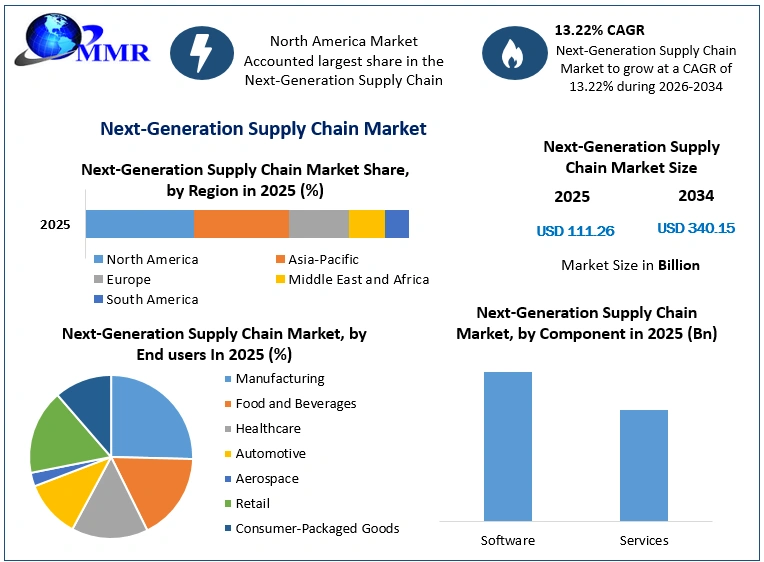
The Next-Generation Supply Chain Market size was valued at USD 111.26 Billion in 2025 and the total Next-Generation Supply Chain revenue is expected to grow at a CAGR of 13.22% from 2026 to 2034, reaching nearly USD 340.15 Billion.
Next-Generation Supply Chain Market Definition:
The Next Generation Supply chain is about the application of the Internet of Things, the use of advanced robotics, and the application of advanced analytics of big data in supply chain management. It provides real-time, end-to-end transparency throughout the supply chain. It provides joint information basis for all levels of management and functions in the supply chain.
Next-Generation Supply Chain Market Growth Outlook
To Know About The Research Methodology :- Request Free Sample Report
Next-Generation Supply Chain Market Dynamics:
Innovations in businesses, uncertainties together with shorter and tougher business cycles, expanding and demanding consumer base, converging wages and increasing costs; and the evolution of big data. Each of these will have a significant bearing on the way today’s supply chains operate and will drive the next generation supply chain market.
With the adoption of exponential technologies, organizations worldwide are moving away from the traditional and linear supply chain models to connected, intelligent, scalable, customizable, and nimble supply networks. Early adopters and innovative companies were shifting to dynamic and integrated networks that deliver a continuous flow of products, services, information, and analytics for decision making. Traditional organizations are evolving their supply chain functions to meet increasingly volatile consumer preferences while trying to stay ahead of the competition.
Volatility in business or with partners has always remained a challenge. Business risks driven by uncertainties in the value chain, non-economic factors, macro-regulatory environment, and global interconnections have increased in frequency and intensity. This has expanded the boundaries of the global supply chain's search for the right partners and customers, which acts as the driving factor for the growth of the Global Next-Generation Supply Chain Market. New cities will emerge and existing cities will cater to a large population. India will see more than 1,000 new urban centres over the next 20 years and China will see more than 60 percent of retail demand coming from tier 3/4 cities. Increasing demand from across the country will drive supply chain network complexity and challenges inefficient last-mile distribution.
The world is creating and storing data at a rapid pace, much faster than in the past. The data is getting captured and distributed across multiple nodes in real-time. With significant improvements in analytics capabilities, analyzing big data will provide key insights and has the potential to develop innovations that lead to competitive advantages.
The increasing use of online channels is driving the reduction of response times and forcing the supply chain to find new answers for global micro-delivery of multiple small-customer orders, instead of the large-batch movements. Maximizing supply chain flexibility and managing multiple supply chain configurations have become the new imperatives for today’s supply chain executives.
Also, radiofrequency identification (RFID) and other digital technologies lead to new frontiers in supply chain transparency and process automation. These technologies enable multiple supply chain partners along the value chain to seamlessly interact in the joint design, manufacture, delivery, and service of complex customer orders acting as a driver to the growth of the Global Next-Generation Supply Chain Market.
Next-Generation Supply Chain Market Segment Analysis:
The report groups the Global Next Generation Supply ChainMarket in different segments like by component, end-user, and regionto forecast the revenues and analyze the market share of each segment over the forecast period.
Based on Component, the Global Next-Generation Supply Chain Market is segmented into Software and Services. The Software segment was dominant in 2025 and is expected to command a market share of xx% by 2034. With the increasing number of smart devices being used in the supply chain, the need to handle all the networks can be addressed by the use of Software. It enables a massive amount of data collected from remote and mobile devices analyzed in real-time to drive transportation management optimization and predictive analytics.
Based on type, the Global Next-Generation Supply Chain Market is segmented into Transportation Management systems, Warehouse Management systems, Sourcing & Procurement, Supply Chain Planning, and Manufacturing Execution systems. The Supply chain planning segment was dominant in 2025 and is expected to command a market share of xx% by 2034.The increasing demand for enhancing factory scheduling, production planning evolving agility, digitization of existing processes, and optimization of supply chain decision making are the main factors contributing to the growth of the segment.
Next-Generation Supply Chain Market Regional Insights:
North America is expected to command the largest market share of xx% by 2034
Adoption of new technology and the need for efficient supply chain functions like logistics, warehousing, production, and transportation have increased the growth of Next Generation Supply Chain Market in the region. Also, the presence of stringent regulations and trade agreements related to the supply chain across the region is another factor driving the growth of the SCM in the region.
In Asia Pacific, with 65% of the goods being moved through the road network, the concentrated manufacturing and dispersed demand points have a significant impact on the supply chains of companies. With the implementation of GST, logistics hubs have emerged and existing ones have been re-oriented. The government of India is planning multi-modal logistics hubs across India on a public – private partnership model which is expected to drive long haul movement across hubs and also reduce transportation cost, which is expected to boost the Global Next-Generation Supply Chain Market.
The objective of the report is to present a comprehensive analysis of the Global Next-Generation Supply Chain Market to the stakeholders in the industry. The past and current status of the industry with forecasted market size and trends are presented in the report with the analysis of complicated data in simple language.
The report covers all the aspects of the industry with a dedicated study of key players that include market leaders, followers, and new entrants. PORTER, SVOR, PESTEL analysis with the potential impact of micro-economic factors of the market have been presented in the report. External as well as internal factors that are supposed to affect the business positively or negatively have been analyzed, which will give a clear futuristic view of the industry to the decision-makers.
The report also helps in understanding the Global Next-Generation Supply Chain Market dynamics, structure by analyzing the market segments and projects Global market size. Clear representation of competitive analysis of key players by product, price, financial position, product portfolio, growth strategies, and regional presence in the Global Next-Generation Supply Chain Market make the report investor’s guide.
Make the report investor’s guide, Key Highlights:
Global Next-Generation Supply Chain Market make the report investor’s guide analysis and forecast, in terms of value.
Comprehensive study and analysis of market drivers, restraints and opportunities influencing the growth of the Global market make the report investor’s guide
Global Next-Generation Supply Chain Market make the report investor’s guide segmentation on the basis of type, source, end-user, and region (country-wise) has been provided.
Next-Generation Supply Chain Market make the report investor’s guide strategic analysis with respect to individual growth trends, future prospects along with the contribution of various sub-market stakeholders have been considered under the scope of study.
Global Next-Generation Supply Chain Market make the report investor’s guide analysis and forecast for five major regions namely North America, Europe, Asia Pacific, the Middle East & Africa (MEA) and Latin America along with country-wise segmentation.
Profiles of key industry players, their strategic perspective, market positioning and analysis of core competencies are further profiled.
Competitive developments, investments, strategic expansion and competitive landscape of the key players operating in the Global Next-Generation Supply Chain Market make the report investor’s guide are also profiled.
Next-Generation Supply Chain Market Recent Industry Developments
| Date | Company | Development | Impact |
|---|---|---|---|
| 12 May 2026 | EcoVadis | EcoVadis formed a strategic partnership with Workiva Inc. to directly integrate primary supplier carbon data into Workiva's AI-powered reporting platform. | This collaboration enables enterprise procurement teams to replace industry estimates with verified, audit-ready Scope 3 emissions data across the entire supply chain. |
| 14 April 2026 | Makersite | Makersite acquired Siemens' SiGREEN platform to consolidate product carbon footprint tracking and supply chain data exchange capabilities. | The acquisition enhances end-to-end supply chain transparency by combining AI-driven product lifecycle intelligence with real-world supplier emissions data. |
| 15 October 2025 | Kinaxis Inc. | Kinaxis launched Maestro Agents, introducing context-aware AI digital co-workers natively embedded into its supply chain planning platform. | The rollout accelerates transition toward autonomous supply chain orchestration, enabling faster decision-making during real-time network disruptions. |
| 15 July 2025 | Green Project Technologies | Green Project Technologies acquired Emitwise, expanding its capabilities in automated product carbon footprint management and supplier engagement. | The deal scales audit-grade carbon accounting software across complex global supply networks in manufacturing, automotive, and FMCG sectors. |
Next-Generation Supply Chain Market Scope: Inquire before buying
| Next-Generation Supply Chain Market | |||
|---|---|---|---|
| Report Coverage | Details | ||
| Base Year: | 2025 | Forecast Period: | 2026-2034 |
| Historical Data: | 2020 to 2025 | Market Size in 2025: | USD 111.26 Billion |
| Forecast Period 2026 to 2034 CAGR: | 13.22% | Market Size in 2034: | USD 340.15 Billion |
| Segments Covered: | by Component | Software Services |
|
| by End users | Manufacturing Food and Beverages Healthcare Automotive Aerospace Retail Consumer-Packaged Goods |
||
Next-Generation Supply Chain Market, by Region
North America (United States, Canada and Mexico)
Europe (UK, France, Germany, Italy, Spain, Sweden, Austria and Rest of Europe)
Asia Pacific (China, South Korea, Japan, India, Australia, Indonesia, Malaysia, Vietnam, Taiwan, Bangladesh, Pakistan and Rest of APAC)
Middle East and Africa (South Africa, GCC, Egypt, Nigeria and Rest of ME&A)
South America (Brazil, Argentina Rest of South America)
Next-Generation Supply Chain Market, Key Players are:
1. SAP SE
2. Oracle Corporation
3. JDA Software Group, Inc.
4. Infor
5. Manhattan Associates
6. Epicor Software Corporation
7. The Descartes Systems Group Inc.
8. HighJump
9. Kinaxis Inc.
10.IBM Corporation
11.Top of Form
12.E2open, LLC
13.Descartes Systems Group
14.WiseTech Global
15.Jaggaer
16.Kewill Systems
17.Dassault Systemes
18.Vanguard Software
19.Amadeus
20.Coupa Software
21.Blue yonder
22.Verizon connect
23.BluJay Solutions
24.SPS Commerce Inc.
25.Zaragoza Logistics Center (ZLC)
26.Melcombe Partners
27.Ikanuki
28.ThoughtWire
29.Via and Voxme Software Inc.
30.Vendorful
31.Smart Software
32.Procure Xperts
33.OdooTec
Frequently Asked Questions:
1. Which region has the largest share in Global Next-Generation Supply Chain Market?
Ans: North America region held the highest share in 2025.
2. What was the Global Next-Generation Supply Chain Market size in 2025?
Ans: The Global Next-Generation Supply Chain Market size was USD 111.26 Billion in 2025.
3. What is scope of the Global Next-Generation Supply Chain Market report?
Ans: Global Next-Generation Supply Chain Market report helps with the PESTEL, PORTER, COVID-19 Impact analysis, Recommendations for Investors & Leaders, and market estimation of the forecast period.
4. Who are the key players in Global Next-Generation Supply Chain Market?
Ans: The important key players in the Global Next-Generation Supply Chain Market are – SAP SE, Oracle Corporation, JDA Software Group, Inc., Infor, Manhattan Associates, Epicor Software Corporation, The Descartes Systems Group Inc., HighJump, Kinaxis Inc., IBM Corporation, Top of Form, E2open, LLC, Descartes Systems Group, WiseTech Global, Jaggaer, Kewill Systems, Dassault Systemes, Vanguard Software, Amadeus, Coupa Software, Blue yonder, Verizon connect, BluJay Solutions, SPS Commerce Inc., Zaragoza Logistics Center (ZLC), Melcombe Partners, Ikanuki, ThoughtWire, Via and Voxme Software Inc., Vendorful, Smart Software, Procure Xperts, and OdooTec
5. What is the study period of this Market?
Ans: The Global Next-Generation Supply Chain Market is studied from 2020 to 2034.