
Nerve Regeneration Market By Product Type, By Material, By Repair Function, By Clinical Application, By Anatomical Site, By End User, By Distribution Channel and Regional Insights 2034
Overview
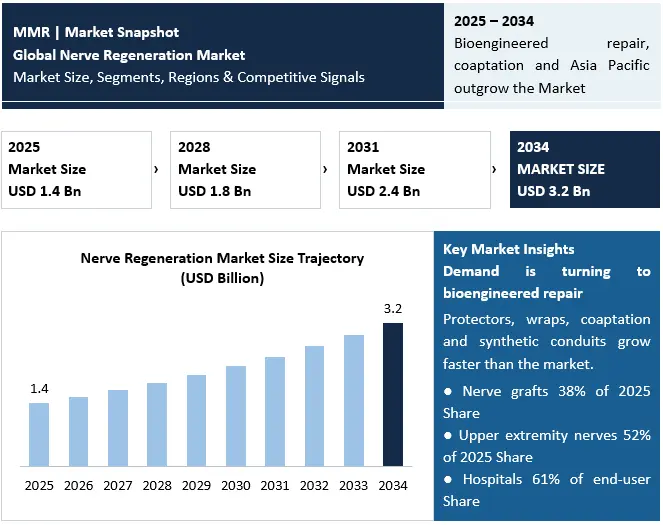
The Global Nerve Regeneration Market was valued at USD 1.4 Bn in 2025 and is expected to reach USD 3.2 Bn by 2034, growing at a CAGR of 9.4% during 2026–2034. Nerve regeneration is the clinical and biological process of restoring the structure and function of an injured peripheral nerve, supported by nerve grafts, nerve guidance conduits, nerve protectors and wraps, and coaptation devices that bridge a gap, protect the repair site and guide axons back to their targets. The Global Nerve Regeneration Market, also referred to as the Nerve Repair and Regeneration Market, spans surgical products that help restore sensation and movement after trauma, surgery, tumor resection or compression.
This Nerve Regeneration Market analysis is valuable for nerve repair device manufacturers, tissue banks, biomaterial suppliers, hospital and surgical center buyers, and investors, and for what surgeons, procurement teams and product developers want to know, from how peripheral nerve repair works to the economics of nerve grafts, conduits and protectors, reimbursement and regulatory approval.
Nerve grafts anchor the Nerve Regeneration industry and hospitals are the largest buyers, But Nerve Regeneration Market growth is shifting toward nerve protectors and wraps, sutureless coaptation devices, synthetic biodegradable conduits, ambulatory surgical centers and Asia Pacific as reimbursement clarity, bioengineered biomaterials and wider surgeon awareness reshape procedure and product demand.
Maximize Market Research provides comprehensive analysis of the global nerve regeneration market size, share, product type, material, repair function, clinical application, anatomical site, end user, distribution channel and regional segmentation, the nerve regeneration competitive landscape, strategic scenarios and growth opportunities. The report helps nerve repair device manufacturers, allograft processors, biomaterial and contract manufacturing suppliers, hospital systems, distributors and investors decide which segments, technologies and countries to prioritise through 2034.
| 2025 | Base Year | 2034 | Forecast | Growth Rate | Largest Region |
| USD 1.4 Bn | USD 3.2 Bn | 9.4% | North America |
Nerve Regeneration Market Size, Market Growth and Industry Outlook to 2034
The Nerve Regeneration Market is measured at product level: nerve grafts (processed nerve allografts and other commercially supplied graft products), nerve guidance conduits, nerve protectors and wraps, and nerve coaptation and repair aids, sold to hospitals, ambulatory surgical centers and specialty clinics worldwide for peripheral nerve repair. Neurostimulation and neuromodulation devices, surgeon and facility fees, autograft harvest as a surgical procedure, and cell or growth-factor therapies that are not yet commercial are excluded to prevent double counting.
Three shifts shape 2026–2034: demand is broadening from autograft-led repair to licensed allografts, bioengineered conduits and protectors; value is moving toward products that carry regulatory approval, clinical evidence and payer coverage; and Nerve Regeneration Market growth is rotating toward ambulatory surgical centers, sutureless coaptation and Asia Pacific as surgical infrastructure matures. Nerve repair device manufacturers are answering reimbursement and evidence gaps with confirmatory trials, surgeon training and off-the-shelf products that avoid donor-site surgery.
Nerve Regeneration Market Growth Analysis
To know about the Research Methodology :- Request Free Sample Report
Key Findings: Insights Shaping the Global Nerve Regeneration Market
The company announcements, regulatory decisions and industry reports point to eight findings that explain where nerve regeneration market growth and value are created through 2034.
| Sr. No. | Findings | Evidence | Descriptions |
| 1 | The market more than doubles by 2034 | USD 1.4 Bn (2025) to USD 3.2 Bn (2034) at 9.4% CAGR | Graft processing, conduit and wrap manufacturing and surgeon training must scale about 2.24× by 2034 |
| 2 | Grafts are the base, coaptation and protectors the growth edge | Nerve grafts 38% of 2025 value; coaptation aids grow at XX% | Sutureless and protective products widen the addressable procedure pool |
| 3 | North America is the largest region | 43% of 2025 value, led by the United States | Reimbursement, specialized centers and product approvals set pricing and standards |
| 4 | Asia Pacific is the fastest-growing region | XX% CAGR; China, Japan, India and South Korea | Local manufacturing, hospital build-out and regulatory pathways decide share gains |
| 5 | Traumatic injury remains the core use | Traumatic repair about XX% of 2025 value | Upper extremity and hand surgery anchor procedure volumes |
| 6 | Regulatory approvals are reshaping competition | Avance BLA (Dec 2025); COAPTIUM CONNECT De Novo (Jun 2025) | Approved products gain payer access and exclusivity leverage |
| 7 | Ambulatory surgical centers and distributors gain share | ASCs XX% CAGR; distributors XX% | Outpatient shift and distributor networks open new accounts |
Global Nerve Regeneration Market Dynamics
Nerve Regeneration Market Drivers: Peripheral Nerve Injury Burden, Licensed Allografts, Reimbursement Gains and Biomaterial Innovation
Peripheral nerve injuries from trauma, surgery, tumor resection and compression create a large, recurring procedure pool, and outcomes remain incomplete when repair relies on sutures or autografts alone. Orthocell notes that more than 700,000 peripheral nerve repair procedures are performed each year in the United States and that most still use suture-only repair, which frames the headroom for grafts, conduits, protectors and wraps.
Regulatory clarity is a major driver of Nerve Regeneration Market growth. On 3 December 2025 the FDA approved Axogen’s Biologics License Application for Avance, an acellular nerve allograft, for sensory, mixed and motor nerve discontinuities in patients aged one month and older, with the longer-gap sensory and the mixed and motor indications approved under accelerated approval and dependent on confirmatory studies. In June 2025 the FDA granted De Novo authorization to TISSIUM’s COAPTIUM CONNECT, a sutureless coaptation system, creating a new device category.
Reimbursement is improving. Axogen management said in March 2026 that CMS had unbundled nerve procedures, created a dedicated nerve code and raised outpatient payments, while the company was awaiting decisions from commercial insurers.
Biomaterials, tissue engineering and surgical training add further layers of demand. Synthetic biodegradable polymers grow at XX% CAGR as manufacturers refine conduit architecture, degradation profiles and bioactive coatings, and ambulatory surgical centers, growing at XX% CAGR, expand outpatient hand and upper extremity reconstruction.
Nerve Regeneration Market Challenges and Restraints: Clinical Evidence, Payer Coverage, Donor Supply and Cost Pressure
Clinical evidence and coverage gaps remain the most visible challenges for the Nerve Regeneration Market. Many nerve repair products were cleared on device pathways with limited comparative trial data, and payers have historically treated some products as experimental. In 2026, it still faces a coverage gap of 35% of commercial lives and that adoption is constrained mainly by awareness and payer coverage. Accelerated approval pathways also require confirmatory studies, which add cost and timeline risk for sponsors.
Biological limits and supply constraints add friction. Functional recovery after nerve repair is often incomplete, long-gap and proximal injuries are difficult to treat, and outcomes depend on the time to surgery, the gap length and the nerve type. Human-derived products depend on donor tissue availability, screening, processing and sterilization capacity, while animal-derived and synthetic conduits face material qualification, biocompatibility and batch-consistency requirements. Hospital value-analysis committees press on price, and autograft remains an established, low-cost standard that products must outperform on outcomes or procedure efficiency.
Nerve Regeneration Market Opportunities Through 2034
Sutureless coaptation, protectors and wraps, and licensed allografts represent the most significant opportunities because they widen the use of nerve repair beyond conventional suture-based repair. In the United States, Orthocell’s Remplir collagen nerve wrap gained approval for sale across 51 Department of Defense hospitals and 170 Veterans Affairs medical centers in April 2026, and the company reported record FY26 revenue of USD 8.90 million, up 44%. Suppliers that combine regulatory approval, surgeon education, distributor coverage and outcome data may be better positioned to win hospital contracts.
The new anatomical sites and next-generation biomaterials offer further routes to growth. Asia Pacific is projected to be the fastest-growing region at XX% CAGR as China, Japan, India and South Korea build surgical capacity and regenerative medicine programs, and South America grows at about XX%. Cranial and facial nerve repair grows at 10.5%, tumor resection-associated reconstruction at 10.3%, and entrapment and compression-related repair at XX%. Growth-factor delivery, cell-seeded scaffolds and 3D-printed constructs add longer-dated optionality.
Nerve Regeneration Market Trends: Biologic Regulation, Sutureless Repair, Bioactive Scaffolds and Outpatient Shift
The biologic regulation: allograft products are moving from a human-tissue framework to licensed biologics, which changes evidence, labeling and competitive exclusivity, boosting the Nerve Regeneration Market. The sutureless and atraumatic repair: polymer-assisted coaptation, as with COAPTIUM CONNECT, aims to cut microsurgical complexity and nerve trauma. The bioactive and biodegradable scaffolds: conduits and wraps with aligned microstructures, hydrogels and controlled growth-factor release are moving through development. Fourth, outpatient migration: more hand, upper extremity and reconstructive nerve procedures are being performed in ambulatory surgical centers and specialty clinics, which favors off-the-shelf products and distributor-led supply.
Nerve Regeneration Technologies: Biomaterials, Nerve Conduits, Nerve Grafts and Regenerative Therapies
Nerve Regeneration Technologies Landscape: From Autograft to Bioengineered Repair
After a peripheral nerve is cut, the distal segment undergoes Wallerian degeneration, with axonal continuity typically lost within 24–72 hours of injury. Schwann cells become activated within 24 hours, proliferate, clear cellular debris and form bands of Büngner that guide regenerating axons toward their targets. The peripheral nerve injuries occur in 3% of trauma patients, increasing to 5% when nerve root, plexus, digital and minor nerve injuries are included. Axonal regeneration generally progresses at 1 mm per day, with a reported range of 0.5–3 mm per day, making timely surgical intervention important for functional recovery. Autologous nerve grafting remains a surgical reference for gaps that cannot be repaired without tension, but it requires a second surgical site and may cause donor-site morbidity.
The U.S. Food and Drug Administration (FDA) identifies more than 50,000 peripheral nerve injury cases annually in the United States and notes that nerve conduits are typically used for shorter gaps of 30 mm or less. Nerve regeneration technologies therefore focus on providing off-the-shelf biological scaffolds, protected repair environments and structural guidance for axonal growth, ehich helps to drive Nerve Regeneration Market growth. Processed nerve allografts preserve native extracellular matrix architecture, while conduits bridge selected nerve defects and protectors and wraps help reduce surrounding scar formation and adhesions. In December 2025, the FDA approved Axogen's Avance acellular nerve allograft for sensory nerve discontinuities of 25 mm or less, with accelerated approval for larger sensory gaps and mixed or motor nerve discontinuities, marking an important regulatory development in nerve regeneration technologies.
Biomaterials for Nerve Regeneration: Collagen, Synthetic Polymers, Hydrogels, Electrospun Fibers and 3D Bioprinting
Biomaterial choice drives performance, handling and cost. Collagen, fibrin and extracellular matrix-based materials offer biocompatibility and cell guidance, and animal-derived materials hold about 29% of 2025 value. Synthetic biodegradable polymers allow tunable degradation and consistent manufacturing and are the fastest-growing material group at 11.6% CAGR, while nonbiodegradable polymers are a small and slower-growing niche. Hydrogels, electrospun aligned nanofibers and 3D-bioprinted constructs are advancing in preclinical and early clinical work, with the aim of replicating the internal architecture of a nerve rather than only supplying a tube.
Nerve Conduits and Nerve Protectors: Design, Gap Bridging and Clinical Performance
Nerve guidance conduits hold about 28% of 2025 value and grow at 9.1% CAGR, with biological (mainly collagen) conduits about XX% and synthetic conduits about XX%. Conduit performance depends on gap length, diameter, wall permeability, degradation rate and internal microstructure, which is why multichannel and bioactive designs are an active area of development. Nerve protectors and wraps hold about XX% of value and grow at XX% CAGR as surgeons use them to protect coaptation sites and reduce adhesions in primary repair, revision and complex surgery.
Emerging Nerve Regeneration Technologies: Stem Cells, Growth Factors, Electrical Stimulation and Sutureless Coaptation
Cell-based and biologic approaches, including Schwann cell-seeded scaffolds, mesenchymal stem cell therapies and controlled delivery of neurotrophic factors such as NGF, BDNF and GDNF, remain largely in preclinical and clinical development, with manufacturing scalability, delivery efficiency and regulatory approval presenting major commercialization challenges. Electrical stimulation is emerging as an adjunct to surgical nerve repair, while neurostimulation devices designed primarily to modulate neural activity are classified by MMR as an adjacent market to avoid revenue overlap. In June 2025, the U.S. Food and Drug Administration (FDA) granted De Novo authorization to TISSIUM's COAPTIUM CONNECT with TISSIUM LIGHT, establishing a regulatory pathway for polymer-based sutureless peripheral nerve repair.
The technology is intended for selected nerve repairs involving gaps of 1 cm or less, providing an alternative to conventional sutured coaptation. The device received Class II classification under 21 CFR 882.5270, supporting commercialization of polymer-based nerve repair technologies. These regulatory developments, combined with advances in bioresorbable polymers, precision nerve alignment and minimally invasive repair techniques, are expected to accelerate adoption of sutureless coaptation technologies. MMR projects coaptation aids to be among the fastest-growing product categories in the Nerve Regeneration Market during the forecast period, supported by technological innovation and increasing demand for advanced nerve repair solutions.
Global Nerve Regeneration Market Segment Analysis:
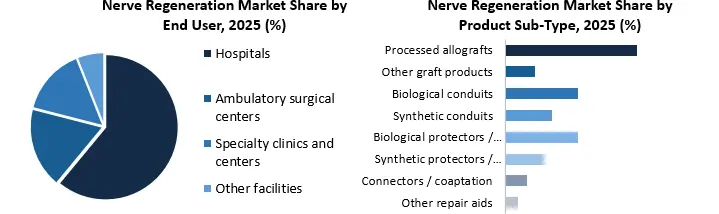
Nerve Regeneration Technologies Market by End User and Product Sub-Type: Nerve Grafts, Nerve Conduits, Protectors and Coaptation Aids
Peripheral Nerve Repair, Nerve Grafts and Neurostimulation Devices: Product Type, Material and Clinical Application Analysis
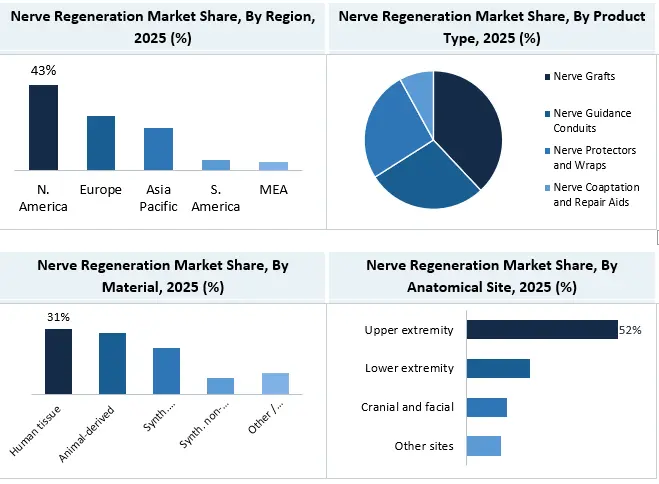
By Product Type, nerve grafts led with about 38% of the 2025 value for the Nerve Regeneration Market growth, led by processed nerve allografts at about 31%, with other graft products at XX%. Processed nerve allografts accounted for 31%, while other graft products contributed 7%. The segment's leadership is attributed to the ability of nerve grafts to bridge nerve discontinuities, preserve extracellular matrix architecture and support axonal regeneration without requiring autologous donor nerve harvesting in selected procedures. Increasing demand for tension-free nerve reconstruction, advancements in graft processing technologies and expanding availability of commercially manufactured nerve allografts are expected to strengthen segment growth through 2034.
By Repair Function, nerve gap bridging and reconstruction held about 64% of value in 2025 fpr Nerve Regeneration Market growth, protection and adhesion management about 26% and coaptation and reinforcement about 10%. Iatrogenic and post-surgical nerve repair represents another significant application, supported by growing adoption of microsurgical nerve reconstruction and regenerative medicine solutions.
By Anatomical Site, upper extremity nerve repair holds the leading position, owing to the frequency of hand, wrist and arm nerve injuries requiring nerve grafts, nerve conduits and nerve protection devices. Hospitals remain the primary end users, supported by specialized surgical infrastructure, advanced microsurgical capabilities and access to peripheral nerve repair technologies. Direct manufacturer sales represent the leading distribution channel, supported by hospital procurement contracts and established medical device supply networks. Neurostimulation devices, including spinal cord stimulation, vagus nerve stimulation, sacral nerve stimulation and deep brain stimulation systems, primarily modulate neural activity to manage neurological disorders, chronic pain and nerve dysfunction rather than structurally repair damaged nerves or promote peripheral nerve regeneration.
| Segmentation | Largest segment (2025 share) | Fastest segment (CAGR) | MMR view |
| Product type | Nerve Grafts (38%) | Nerve Coaptation and Repair Aids (XX%) | Grafts anchor value; coaptation and protectors add growth |
| Material | Human-Derived Biological Tissue (XX%) | Synthetic Biodegradable Polymers (XX%) | Synthetics gain on tunable degradation and supply |
| Repair function | Nerve Gap Bridging and Reconstruction (XX%) | Nerve Coaptation and Repair Reinforcement (XX%) | Gap bridging dominates; reinforcement grows from a small base |
| Clinical application | Traumatic Peripheral Nerve Injury Repair (XX%) | Entrapment and Compression-Related Repair (XX%) | Trauma is the base; elective indications add growth |
| Anatomical site | Upper Extremity Peripheral Nerves (XX%) | Cranial and Facial Peripheral Nerves (XX%) | Hand and arm surgery anchor volumes |
| End user | Hospitals (XX%) | Ambulatory Surgical Centers (XX%) | Outpatient shift lifts ASCs |
| Distribution channel | Direct Manufacturer Sales (XX%) | Authorized Medical Device Distributors (XX%) | Distributors extend reach for challengers |
Nerve Regeneration Market Regional Outlook:
The North America Nerve Regeneration Market held the largest Nerve Regeneration Market Share, about 43% of global value in 2025. The United States anchors demand through a large volume of upper extremity and hand surgery, specialized peripheral nerve centers, early adoption of licensed allografts, protectors and sutureless coaptation, and an evolving reimbursement framework, while Canada and Mexico add smaller volumes. Growth is projected at about XX% CAGR as coverage widens and outpatient settings expand. Europe holds about XX% of 2025 value, led by Germany, the United Kingdom, France and Italy, where CE marking under the Medical Device Regulation, established hospital procurement and strong microsurgery expertise shape demand; growth is about XX% CAGR.
The Asia Pacific Nerve Regeneration Market is expected to be the fastest-growing region, with a 11.4% CAGR through 2034. Japan is a mature market with domestic conduit and biomaterial makers, China is scaling local manufacturing and surgical capacity, India and South Korea are expanding trauma and reconstructive surgery access, and Australia is both a growing market and the home of an emerging nerve wrap developer. Middle East & Africa is a smaller market, about 4% of 2025 value, with growth of about XX% CAGR as Gulf states, Turkey, Israel, South Africa and Egypt invest in specialized surgical care. South America, about XX%, is expected to grow at about 10.2% CAGR, led by Brazil, with Argentina, Chile and Colombia building private-sector surgical capacity.
| Region | 2025 share | 2025 (USD Bn) | 2034 (USD Bn) | CAGR | Notes |
| North America | 43.0% | XX | XX | 8.5% | US hand and upper extremity surgery; licensed allografts and sutureless coaptation; evolving CMS coding and payer coverage |
| Europe | XX% | XX | XX | 8.7% | Germany, UK, France and Italy lead; MDR and CE marking shape launches; strong microsurgery base |
| Asia Pacific | XX% | XX | XX | XX% | Japan, China, India and South Korea expand surgical capacity and regenerative programs; fastest region |
| Middle East & Africa | XX% | XX | XX | XX% | Gulf, Turkey, Israel and South Africa invest in specialized surgical care |
| South America | 5.0% | XX | XX | 10.2% | Brazil leads; private hospital capacity and distributor-led access in Argentina, Chile and Colombia |
Nerve Regeneration Market Forecast 2026–2034: Revenue Trajectory, Growth Phases and Scenario Drivers
MMR forecasts the Nerve Regeneration Market to grow from USD 1.4 Bn in 2025 to USD 1,586 Mn in 2026 and USD 3.2 Bn by 2034, a 9.4% CAGR over 2026–2034 that adds USD 1.8 Bn of annual revenue over the period. Annual revenue added rises from USD 136 Mn in 2026 to USD 280 Mn in 2034, as the larger base compounds. In 2026–2027, licensed allograft supply, new protector and coaptation launches and payer coverage decisions set the pace. In 2028–2031, outpatient migration, distributor expansion and wider evidence for sutureless and synthetic products lift the growth mix, with Asia Pacific gaining share. In 2032–2034, next-generation bioactive scaffolds and, if clinical results support them, cell and growth-factor combinations could add upside beyond the base case. Downside risks include slower coverage gains, confirmatory trial setbacks and donor-tissue or supply interruptions.
Nerve Regeneration Market Key Players: Competitive Landscape and Nerve Repair Device Manufacturers
The Nerve Regeneration Market competitive landscape includes several distinct groups rather than a single set of comparable companies. Nerve graft and allograft specialists such as Axogen, AlloSource and LifeNet Health supply processed human tissue products. Diversified surgical and regenerative medicine groups, including Integra LifeSciences, Stryker, Baxter and B. Braun, sell conduits, protectors and wraps through broad hospital networks. Nerve repair device manufacturers focused on conduits and protectors, such as Polyganics, Cook Biotech, Toyobo, Regenity Biosciences and Salumedica, coaptation and sutureless innovators such as TISSIUM and BioCircuit Technologies, and cell and biologic developers such as NervGen, Neuraptive and Renerva complete the ecosystem. These groups compete on different dimensions and should not be ranked as though they were identical producers.
Competition is increasingly shaped by regulatory status, clinical evidence and surgeon education. In March 2026 that it expected at least 18% revenue growth to about USD 266 million, with Avance contributing roughly 60% of revenue, and it completed a USD 142 million financing. TISSIUM made the first commercial US use of COAPTIUM CONNECT in November 2025, and Orthocell reported 92 US Remplir units in October 2026, its strongest month since launch. Smaller players differentiate through bioactive scaffolds, off-the-shelf formats without cold-chain needs, sutureless technology and regional distributor coverage. Partnerships, licensing and consolidation are likely to continue as hospitals and payers favor products with approvals and outcome data.
Top Nerve Regeneration Companies: Allograft Specialists, Surgical Leaders, Conduit Makers and Biologic Developers
MMR separates participants by role, because an allograft processor, a conduit manufacturer and a cell therapy developer do not compete with each other.
Nerve Regeneration Company Benchmark: Strategic Signals, 2025–2026
| Company | Strategic signal |
| Axogen | FDA approved the Avance BLA on 3 Dec 2025; guided to at least 18% growth (about USD 266 Mn) for 2026; Avance about 60% of revenue |
| TISSIUM | FDA De Novo for COAPTIUM CONNECT (Jun 2025); US launch (Jul 2025); first commercial use at Cooper University Hospital (Nov 2025) |
| Orthocell | Remplir approved for 51 DoD hospitals and 170 VA centers (Apr 2026); record FY26 revenue of USD 8.90 Million, up 44%; 92 US units in Oct 2026 |
Global Nerve Regeneration Market Recent Developments
| Date | Development | Why it matters |
| Jun 2025 | The nerve conduit, wrap and graft repair product market valued at USD 1.2 Bn in 2024, growing at 9% annually. | Establishes a device-only benchmark for market sizing and scope. |
| 23 Jun 2025 | FDA grants De Novo authorization to TISSIUM's COAPTIUM CONNECT with TISSIUM Light, a Class II sutureless nerve coaptation system. | Establishes a regulatory pathway for sutureless nerve repair devices. |
| 23 Jul 2025 | TISSIUM announces the US commercial launch of COAPTIUM CONNECT. | Introduces sutureless nerve coaptation technology into the US market. |
| Nov 2025 | First US commercial use of COAPTIUM CONNECT at Cooper University Hospital, New Jersey. | Signals early clinical adoption of atraumatic nerve repair technology. |
| 3 Dec 2025 | Axogen announces FDA approval of the Avance acellular nerve allograft BLA. | Strengthens the regulatory framework for processed nerve allografts. |
| Mar 2026 | Axogen forecasts at least 18% revenue growth, citing CMS coding changes and pending payer decisions. | Highlights reimbursement as an important driver of nerve repair product adoption. |
| 16 Apr 2026 | Orthocell secures approval to sell Remplir across 51 DoD hospitals and 170 VA medical centers. | Expands government healthcare distribution opportunities for collagen nerve wraps. |
| 13 Jul 2026 | Orthocell reports record FY2026 revenue of USD 8.90 Mn, representing 44% growth in its originally. | Demonstrates commercial expansion of an emerging nerve repair technology provider. |
| 1 Nov 2026 | Orthocell reports sales of 92 Remplir units in the US and October 2026 revenue of USD 0.19 Mn. | Indicates increasing US commercialization activity for nerve repair products. |
Global Nerve Regeneration Market Scope:Inquire before buying
| Global Nerve Regeneration Market | |||
|---|---|---|---|
| Report Coverage | Details | ||
| Base Year: | 2025 | Forecast Period: | 2026-2034 |
| Historical Data: | 2020 to 2025 | Market Size in 2025: | USD 1.4 Billion |
| Forecast Period 2026 to 2034 CAGR: |
9.4% | Market Size in 2034: | USD 3.2 Billion |
| Segments Covered: | By Product Type | Nerve Grafts Processed Nerve Allografts Other Commercially Supplied Nerve Graft Products Nerve Guidance Conduits Biological Nerve Guidance Conduits Synthetic Nerve Guidance Conduits Nerve Protectors and Wraps Biological Nerve Protectors and Wraps Synthetic Nerve Protectors and Wraps Nerve Coaptation and Repair Aids Nerve Connectors and Coaptation Devices Other Specialized Nerve Repair Aids |
|
| By Material | Human-Derived Biological Tissue Animal-Derived Biological Materials Synthetic Biodegradable Polymers Synthetic Nonbiodegradable Polymers Other and Composite Materials |
||
| By Repair Function | Nerve Gap Bridging and Reconstruction Nerve Protection and Adhesion Management Nerve Coaptation and Repair Reinforcement |
||
| By Clinical Application | Traumatic Peripheral Nerve Injury Repair Iatrogenic and Post-Surgical Nerve Injury Repair Tumor Resection-Associated Nerve Reconstruction Nerve Entrapment and Compression-Related Repair Other Peripheral Nerve Reconstruction Applications |
||
| By Anatomical Site | Upper Extremity Peripheral Nerves Lower Extremity Peripheral Nerves Cranial and Facial Peripheral Nerves Other Peripheral Nerve Sites |
||
| By End User | Hospitals Ambulatory Surgical Centers Specialty Surgical Clinics and Centers Other Healthcare Facilities |
||
| By Distribution Channel | Direct Manufacturer Sales Authorized Medical Device Distributors Tissue Bank and Specialized Biological Product Distribution Other Institutional Procurement Channels |
||
Global Nerve Regeneration Market, By Region
North America (United States, Canada, Mexico)
Europe (Germany, United Kingdom, France, Italy, Spain, Netherlands, Switzerland, Sweden, Denmark, Belgium, Austria, Poland, Rest of Europe)
Asia Pacific (China, Japan, India, South Korea, Australia, New Zealand, Singapore, Taiwan, Thailand, Malaysia, Indonesia, Rest of Asia Pacific)
Middle East & Africa (United Arab Emirates, Saudi Arabia, Israel, Turkey, South Africa, Egypt, Rest of Middle East & Africa)
South America (Brazil, Argentina, Chile, Colombia, Rest of South America)
Global Nerve Regeneration Key Players
North America
1. Axogen, Inc. (United States)
2. Integra LifeSciences Holdings Corporation (United States)
3. Stryker Corporation (United States)
4. Baxter International Inc. (United States)
5. Checkpoint Surgical, Inc. (United States)
6. Regenity Biosciences (United States)
7. Cook Biotech Incorporated (United States)
8. BioCircuit Technologies, Inc. (United States)
9. Alafair Biosciences, Inc. (United States)
10. Renerva, LLC (United States)
11. Neuraptive Therapeutics, Inc. (United States)
12. NervGen Pharma Corp. (Canada)
13. Auxilium Biotechnologies, Inc. (United States)
14. Salumedica, LLC (United States)
15. LifeNet Health (United States)
16. AlloSource (United States)
17. Arthrex, Inc. (United States)
18. TissueGen, Inc. (United States)
19. Acera Surgical, Inc. (United States)
20. Neuros Medical, Inc. (United States)
Europe
21. Polyganics B.V. (Netherlands)
22. Medovent GmbH (Germany)
23. KeriMedical SA (Switzerland)
24. TISSIUM SA (France)
25. Newrotex Limited (United Kingdom)
26. KLISBio S.r.l. (Italy)
27. Cousin Surgery (France)
28. B. Braun Melsungen AG (Germany)
29. CorTec GmbH (Germany)
30. Neuroplast B.V. (Netherlands)
31. GATT Technologies B.V. (Netherlands)
32. Collagen Solutions plc (United Kingdom)
33. Tissue Regenix Group plc (United Kingdom)
34. LivaNova PLC (United Kingdom)
Asia Pacific
35. Toyobo Co., Ltd. (Japan)
36. Orthocell Limited (Australia)
37. ReNerve Limited (Australia)
38. Gunze Limited (Japan)
39. Mochida Pharmaceutical Co., Ltd. (Japan)
40. Seikagaku Corporation (Japan)
41. Nipro Corporation (Japan)
42. Terumo Corporation (Japan)
43. J-TEC (Japan Tissue Engineering Co., Ltd.) (Japan)
44. Beijing TianXinFu Medical Appliance Co., Ltd. (China)
45. Shandong Weigao Group Medical Polymer Company Limited (China)
46. PolyNovo Limited (Australia)
47. Stempeutics Research Pvt. Ltd. (India)
48. Cyfuse Biomedical K.K. (Japan)
Others
Global Nerve Regeneration Market FAQs: Frequently Asked Questions
What is the Nerve Regeneration Market Size?
Ans. MMR values the global nerve regeneration market at USD 1.4 Bn in 2025, USD 1,586 Mn in 2026 and USD 3.2 Bn by 2034, a 9.4% CAGR over 2026–2034. The 2034 value is about 2.24 times the 2025 base. By scope, from about USD 1.2 billion for device-only nerve conduit, wrap and graft products in 2024 to roughly USD 7–12 billion for broader nerve repair and regeneration markets that include neurostimulation devices.
What Drives Nerve Regeneration Market Growth?
Ans. Nerve regeneration market growth is driven by the large burden of peripheral nerve injuries from trauma, surgery, tumor resection and compression; licensed and approved products such as the Avance allograft and the COAPTIUM CONNECT sutureless system; improving reimbursement and payer coverage; advances in biodegradable biomaterials; and the shift of nerve procedures to ambulatory surgical centers, which grow at 11.1% CAGR.
Which region and country is the largest nerve regeneration market?
Ans. North America holds the largest nerve regeneration market share in 2025, at about 43%, led by the United States. Europe follows at about 27% and Asia Pacific at about XX%. Asia Pacific is the fastest-growing region at XX% CAGR, led by China, Japan, India and South Korea.
Which nerve regeneration segments are growing fastest?
Ans. Nerve grafts are the largest product type at about 38% of 2025 value, while nerve coaptation and repair aids grow fastest at XX% CAGR, followed by nerve protectors and wraps at 10.2%. Synthetic biodegradable polymers grow at XX% , ambulatory surgical centers at 11.1% and cranial and facial nerve repair at XX% , all above the XX% market rate.
Who are the leading nerve regeneration companies and nerve repair device manufacturers?
Ans. Leading names include Axogen, Integra LifeSciences, Stryker, Baxter, Polyganics, Cook Biotech, Regenity Biosciences, Toyobo, TISSIUM and Orthocell, alongside allograft processors such as AlloSource and LifeNet Health and biologic developers such as NervGen, Neuraptive and Renerva. This is the core of the nerve regeneration market key players landscape.
How do nerve grafts, nerve conduits and nerve protectors differ in peripheral nerve repair?
Ans. Nerve grafts, including processed nerve allografts and autografts, bridge a gap with tissue that provides an internal scaffold for regrowing axons. Nerve guidance conduits are tubes, collagen-based or synthetic, that bridge shorter gaps and guide regrowth. Nerve protectors and wraps surround a repair or injured nerve to reduce scar and adhesions, and coaptation devices join nerve ends without or with fewer sutures.
What are the main nerve regeneration market trends and future outlook?
Ans. The nerve regeneration market trends and future outlook centre on five themes: the move of allografts to licensed biologic status, sutureless and atraumatic coaptation, bioactive and biodegradable scaffolds, ambulatory surgical center adoption, and early-stage cell and growth-factor therapies. MMR expects the market to roughly double to USD 3.2 Bn by 2034, with Asia Pacific, coaptation aids and protectors growing fastest.
Where are the nerve regeneration market investment opportunities through 2034?
Ans. Opportunities sit in sutureless coaptation, nerve protectors and wraps, licensed allografts and off-the-shelf conduits, new anatomical sites such as cranial and facial nerves, and distributor-led expansion in Asia Pacific and South America. Returns depend on regulatory status, confirmatory evidence, payer coverage and manufacturing capacity.
Global Nerve Regeneration Market Research Methodology
MMR sized the Nerve Regeneration Market top-down from a 2025 base of USD 1.4 Bn and a 9.4% CAGR for 2026–2034, , company announcements, regulatory decisions and press releases (Axogen, TISSIUM, Orthocell and others) through November 2026. The market boundary covers nerve grafts, nerve guidance conduits, nerve protectors and wraps, and nerve coaptation and repair aids, and excludes neurostimulation and neuromodulation devices, surgeon and facility fees, and pipeline cell and growth-factor therapies that are not yet commercial. Segment shares and regional splits are MMR anchored to published splits (for example North America as the largest region and nerve grafts as the largest product type) and are normalised so every segment sums to the Nerve Regeneration Market total. Annual values are constant-CAGR interpolation. Segment CAGRs are the effective rates after normalisation; scenario analysis and opportunity levers are MMR judgement.