
Natural Skin Care Products Market Size – Industry Structure Evaluation, Demand Drivers Analysis, Regional Growth Analysis and Identification, Competitive Positioning Review & Global Market Size Forecast to 2034
Overview
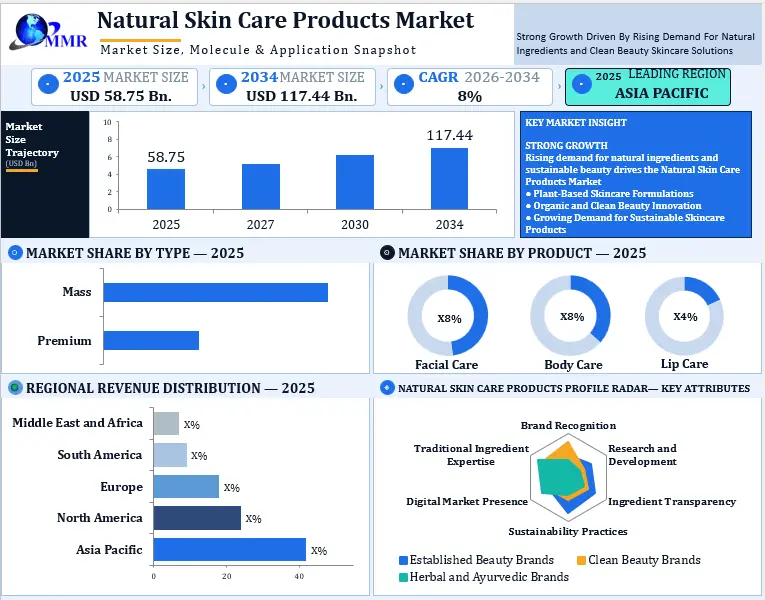
The Natural Skin Care Products Market size was valued at USD 58.75 Billion in 2025 and the total Natural Skin Care Products revenue is expected to grow at a CAGR of 8% from 2026 to 2034, reaching USD 117.44 Billion by 2034.
Natural Skin Care Products Market Overview:
The natural skin care products market comprises beauty and personal care products formulated with naturally derived ingredients such as botanical extracts, plant oils, herbal ingredients, fruit extracts, and minerals to support skin cleansing, hydration, nourishment, and protection. Natural skin care products include facial cleansers, moisturizers, serums, body lotions, facial masks, and anti-aging formulations. The market matters as consumers increasingly seek clean beauty products, plant-based skin care, sustainable cosmetics, and skin-friendly personal care solutions. Growing awareness of ingredient transparency, environmental sustainability, and responsible beauty practices is encouraging demand for natural facial care products and organic skin care alternatives.
The natural skin care products market is expanding as consumers shift toward clean label beauty, vegan skin care, cruelty-free cosmetics, organic facial care, and environmentally conscious personal care products. Increasing demand from millennials and younger consumers, growing online beauty retail, social media influence, and rising interest in botanical skin care formulations are encouraging brands to introduce innovative natural beauty products. Companies such as The Estee Lauder Companies through its Origins brand and L'Oreal through its natural-inspired skin care offerings illustrate the industry's focus on ingredient-led beauty innovation. Asia Pacific presents opportunities through growing beauty consumption and established botanical ingredient traditions, while North America and Europe remain important markets for clean beauty and sustainable skin care. Regulatory guidance from organizations such as the U.S. Food and Drug Administration and the European Commission also influences cosmetic safety, ingredient labeling, and product compliance, making transparency and consumer trust important factors in market expansion.
MMR's natural skin care products market research provides an in-depth assessment of market trends, competitive strategies, consumer preferences, product segmentation, regional demand, and emerging business opportunities. The report evaluates growth opportunities in plant-based formulations, organic skin care, anti-aging products, sustainable packaging, premium natural beauty, and direct-to-consumer online sales. It also examines changing purchasing behavior, distribution channel developments, product innovation, and competitive positioning to help manufacturers, investors, retailers, and new entrants identify market potential and develop effective business strategies.
Natural Skin Care Products Market Growth and Share Analysis
To know about the Research Methodology :- Request Free Sample Report
Natural Skin Care Products Market Dynamics:
Natural Skin Care Products Market Driver
Rising Consumer Demand for Clean Beauty and Plant Based Skin Care Products
The natural skin care products market is driven by increasing consumer preference for clean beauty, botanical ingredients, and environmentally responsible personal care products. Consumers are increasingly evaluating ingredient lists, product safety, and sourcing transparency before purchasing natural facial cleansers, moisturizers, serums, and organic skin care formulations. The United Nations Environment Programme promotes responsible consumption and production through Sustainable Development Goal 12, supporting broader industry attention to sustainable manufacturing and packaging. Manufacturers are incorporating ingredients such as aloe vera, green tea, coconut oil, chamomile, and shea butter into formulations targeting different skin care needs. Brands are also investing in fragrance-free products, plant-based moisturizers, and cruelty-free beauty ranges to attract ingredient-conscious customers. Rising online beauty purchases, social media product education, and demand for transparent labeling further encourage innovation across natural cosmetics. These developments strengthen consumer interest in natural skin care products and support demand across premium beauty retailers, pharmacies, specialty stores, and online marketplaces.
Natural Skin Care Products Restraint
High Manufacturing Costs and Fluctuating Botanical Ingredient Prices
The natural skin care products market faces cost pressures from botanical ingredient sourcing, organic certification, specialized processing, and product quality testing. Depending on ingredient type and sourcing conditions, botanical raw material prices can fluctuate by 10 to 30 percent between procurement periods, creating potential challenges for manufacturers managing production budgets. Seasonal harvesting, weather disruptions, transportation expenses, and limited supplies of certified organic ingredients can affect the availability of aloe vera, essential oils, shea butter, and herbal extracts. Natural formulations may also require repeated stability assessments across different storage conditions, including temperature ranges of 5 degrees Celsius to 40 degrees Celsius, depending on the product and its intended use. Manufacturers must maintain suitable preservation systems and microbial safety without compromising formulation quality. In addition, certification, packaging, and regulatory compliance expenses can increase the final retail price, making premium organic skin care products less accessible to price-sensitive consumers and creating challenges for smaller cosmetic businesses.
Natural Skin Care Products Opportunities
Increasing Demand for Organic Beauty and Sustainable Skin Care Packaging
The natural skin care products market offers opportunities through organic facial care, vegan cosmetics, personalized skin care, and sustainable beauty packaging. Manufacturers can introduce specialized product lines for dry, sensitive, oily, and mature skin while developing formulations that respond to specific consumer preferences. Packaging innovation presents another opportunity, with brands adopting refillable containers, recyclable materials, and reduced-plastic designs to support responsible consumption. For example, companies can introduce refill systems designed to reduce packaging material use by 20 to 30 percent compared with selected conventional packaging formats, provided the reduction is validated for the specific design. The United Nations Environment Programme's Sustainable Development Goal 12 provides a relevant framework for responsible resource use and waste reduction. Digital distribution also creates opportunities to reach customers through online beauty marketplaces, brand websites, and subscription services. Businesses can strengthen market positioning through traceable ingredients, transparent product claims, dermatologically evaluated formulations, and targeted natural skin care solutions, creating opportunities across premium beauty retail and emerging consumer markets.
Natural Skin Care Products Market Challenges
Cosmetic Safety Compliance and Verification of Natural Ingredient Claims
The natural skin care products market faces challenges involving ingredient safety, product stability, regulatory compliance, and consumer trust. Cosmetic manufacturers must assess potential irritation, allergic reactions, contamination, and formulation incompatibility, as naturally derived ingredients are not automatically safe for every user. Products may undergo microbial testing, stability evaluation, and packaging compatibility assessments at multiple stages before commercial release, depending on their formulation and applicable regulations. For example, a manufacturer may evaluate a product under three or more controlled storage conditions to understand how temperature and storage affect appearance, texture, fragrance, and performance; the appropriate testing protocol depends on the product and relevant standards. The United States Food and Drug Administration and the European Commission provide regulatory frameworks relevant to cosmetic safety, labeling, and ingredient compliance. Brands must also distinguish between naturally derived, natural, and certified organic ingredients to avoid misleading marketing claims. Maintaining consistent ingredient quality across batches, meeting market-specific requirements, and communicating substantiated product benefits remain important challenges for manufacturers competing in the natural skin care products market.
Global Natural Skin Care Products Market Key Trends
| Key Trend | Description |
| Science Backed Botanical Skin Care Formulations | Natural skin care brands are moving beyond basic herbal ingredients by developing botanical formulations with measurable skin benefits. Plant extracts are increasingly combined with advanced processing and standardized active ingredients to improve consistency, hydration, and product performance. Industry data indicates a 15% increase in personal care product launches carrying botanical or herbal claims over the past three years, reflecting continued interest in plant-based skin care innovation. |
| Rising Demand for Ingredient Transparency and Traceability | Consumers are paying closer attention to ingredient lists, sourcing practices, and the evidence behind natural and organic skin care claims. Brands are responding with clearer ingredient labeling, traceable botanical supplies, and more specific product information. This trend encourages manufacturers to substantiate natural beauty claims and build consumer trust through transparent sourcing and responsible formulation practices. |
| Sustainable Skin Care Packaging Innovation | Natural skin care manufacturers are adopting recyclable containers, refillable bottles, reduced-plastic packaging, and responsibly sourced materials to address environmental concerns. Sustainable packaging is becoming an important purchasing consideration alongside formulation quality. Industry tracking reported a 20% year-over-year increase in personal care product launches featuring sustainable packaging from 2024 to 2025, highlighting the growing importance of eco-conscious beauty packaging. |
| Growth of Microbiome Friendly Skin Care Products | Skin care brands are developing products that focus on maintaining the skin barrier and supporting a balanced skin environment. Formulations featuring gentle cleansers, barrier-supporting moisturizers, and selected prebiotic or postbiotic ingredients are attracting interest among consumers concerned about dryness and skin sensitivity. Industry data recorded a 33% annual increase in microbiome-related claims across personal care launches between October 2020 and September 2025, indicating growing product development activity in this area. |
| Premiumization of Natural and Organic Skin Care | Consumers seeking specialized skin care solutions are creating opportunities for premium botanical serums, organic facial oils, advanced moisturizers, and targeted anti-aging products. Brands are differentiating their offerings through verified ingredient sourcing, formulation quality, third-party certifications, and demonstrated product performance. This trend allows manufacturers to move beyond basic herbal products and compete in higher-value natural beauty categories. |
| Digital Retail and Personalized Natural Skin Care | Online beauty stores, direct-to-consumer websites, and digital skin assessment tools are changing how consumers discover and purchase natural skin care products. Brands use online consultations, ingredient education, customer reviews, and personalized product recommendations to match formulations with individual skin concerns. This approach helps emerging natural beauty companies reach new customers, strengthen repeat purchasing, and offer targeted skin care solutions across different consumer groups. |
Natural Skin Care Products Market Segment Analysis:
By Type, the Mass segment dominated the market with a 59 % share in 2025. The concentration of manufacturers offering regular-use natural skincare products while keeping an eye on the affordability of their products. The natural personal care brand Himalayan offers a wide range of products at affordable prices, including skincare, body care, disinfection, and hair care products. These factors are driving the growth of the segment through the forecast period.
The premium segment is expected to grow at a CAGR of 4.8 % through the forecast period. True Botanicals, Amala, Dr. Brands such as Alkaitis, Alitura Naturals, and Vered Organic Botanicals are one of the premium brands offering natural products. These products have tangible and intangible properties such as plant mixtures that consumers pay more. Quality and value-added products are important elements of the market. These are expected to drive the market growth through the forecast period.
By Product, Facial Care dominated the market with a 64 % share in 2025. Natural skincare products such as cleansers, face masks and facial masks, scrubs, and moisturizers are highly favored by consumers who prefer to moisturize their skin and improve its radiance and health the growing preference for complex facial care routines for women and men has been a major driver of segment growth. Due to the popularity of facial products, established manufacturers are expanding their product offerings by acquiring promising companies in the field of natural skincare. The companies are majorly focusing on anti-aging and specialize in providing natural ingredients such as cleansers, toners, brighteners, scrubs, moisturizers. These factors are driving the market growth of the segment.
The body care segment is expected to grow at a CAGR of 6.1 % through the forecast period. Changes in consumer awareness of overall healthy skin, high levels of brand promotion through online channels, and regular product launches are expected to drive the market growth through the forecast period.
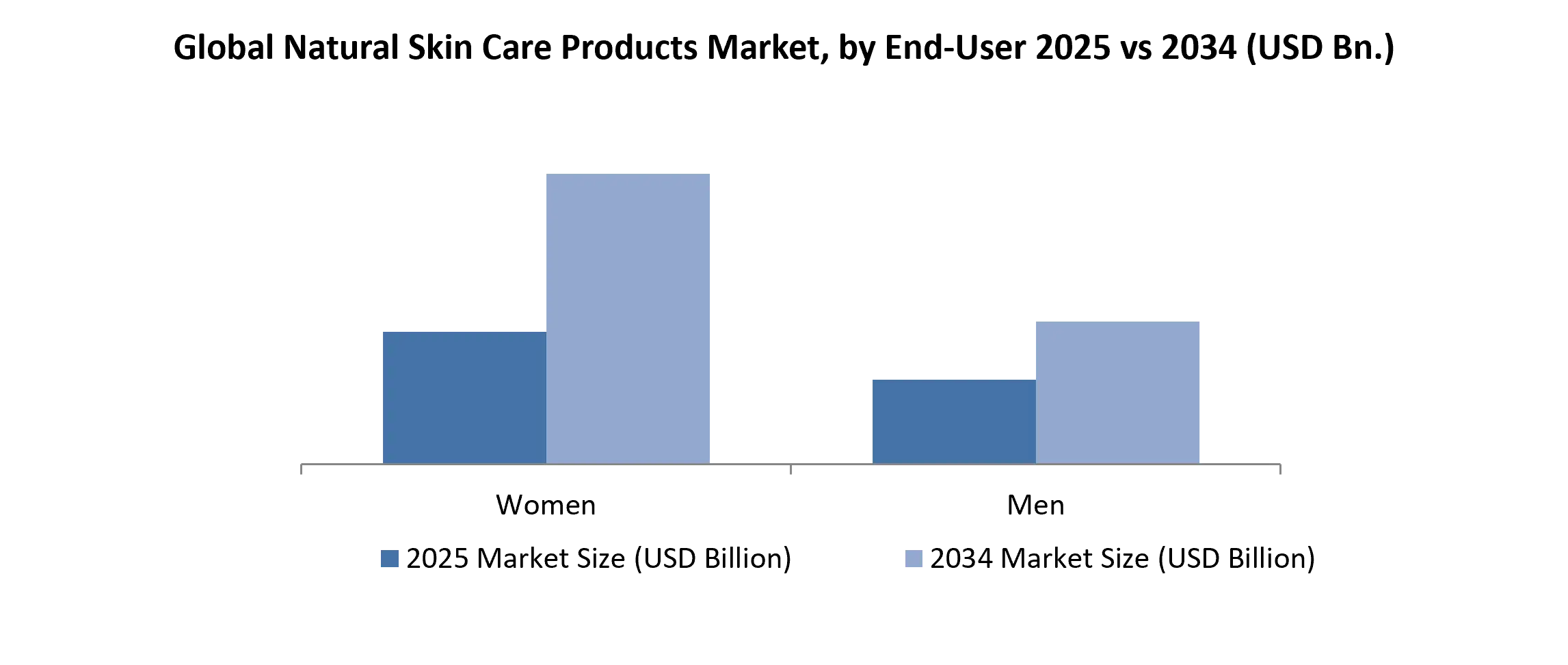
By End-Use, the Women segment dominated the market with a 61 % share in 2025. Rapid urbanization and a gradual increase in the number of working-class women are driving demand for natural skincare products and driving the consumption of chemical-free cosmetology products around the world. The growing preference for natural skincare products to prevent acne and skin irritation caused by chemical skincare products is one of the major drivers of segment growth. Women value appearance more than men, so they pay attention to the quality of their skin and the products they use. Manufacturers in the natural skincare industry have entered relatively new categories such as face masks, face wash, lotions, and serums. These factors are driving the growth of the segment in the market.
The men segment is expected to grow at a CAGR of 6 % through the forecast period. Increasing awareness of men's personal care and skin nutrition around the world is driving the demand for natural skincare products for men. This has led manufacturers to focus on the men's skincare product line. These factors are expected to drive the growth of the segment through the forecast period.
 Natural Skin Care Products Market Regional Insights:
Asia Pacific is the leading region in natural skin care products market, consumer demand benefits from established herbal beauty traditions, rising disposable incomes, and growing interest in plant-based skin care formulations. Consumers in India, China, Japan, and South Korea increasingly seek botanical facial cleansers, natural moisturizers, herbal skin care products, and ingredient-conscious beauty solutions. The region also benefits from traditional ingredients such as aloe vera, green tea, turmeric, and other plant extracts, which support product innovation across facial care and body care categories. Online beauty platforms and domestic skin care brands improve product accessibility, while younger consumers increasingly explore natural formulations for daily skin care routines. These factors strengthen Asia Pacific's leading position in the natural skin care products market.
North America maintains a strong position in the natural skin care products market through established beauty retail networks, high consumer awareness of clean beauty, and demand for premium botanical formulations. Consumers in the United States and Canada increasingly prioritize ingredient transparency, cruelty-free products, sustainable packaging, and skin care solutions designed for specific concerns. Beauty brands are investing in plant-derived serums, natural anti-aging creams, sensitive skin moisturizers, and personalized skin care products to differentiate their offerings. E-commerce, specialty beauty retailers, and direct-to-consumer platforms also help manufacturers reach customers seeking natural and organic skin care products. These factors support regional demand and encourage continuous product innovation.
Europe maintains a mature natural skin care products market, supported by consumer interest in certified organic cosmetics, sustainable beauty, and transparent ingredient sourcing. Consumers in Germany, France, the United Kingdom, and Italy show interest in botanical skin care products that combine natural ingredients with reliable product performance. Regulatory requirements for cosmetic safety, ingredient labeling, and product claims encourage manufacturers to emphasize formulation quality and responsible marketing. Demand for vegan cosmetics, recyclable packaging, organic facial care, and premium natural moisturizers also creates opportunities for established brands and specialized skin care companies. These conditions reinforce Europe's importance in the natural beauty industry.
South America presents opportunities in the natural skin care products market through its botanical resources, growing beauty industry, and consumer interest in plant-based personal care. Brazil plays an important role through its established cosmetics sector and the use of regionally sourced ingredients such as açaí, cupuaçu, and other botanical extracts. Manufacturers can develop natural body lotions, facial creams, cleansing products, and nourishing oils that reflect local ingredient traditions. Improving digital retail access and rising awareness of sustainable beauty also help brands reach new consumer groups. Ingredient traceability, responsible sourcing, and affordable product positioning remain important factors for companies targeting regional demand.
The Middle East and Africa region offers opportunities for natural skin care products through rising interest in premium beauty, herbal formulations, and products suited to local climate conditions. Consumers in the United Arab Emirates and Saudi Arabia show interest in moisturizing skin care, botanical facial products, and premium personal care offerings, while South Africa provides opportunities through its established beauty retail market and regional botanical resources. Ingredients such as shea butter, baobab oil, and aloe vera support product development across moisturizing and nourishing skin care categories. Retail modernization, digital beauty shopping, and interest in ingredient transparency create further opportunities, while price sensitivity and differences in distribution access influence market adoption.
Global Natural Skin Care Products Market Competitive Landscape
The Natural Skin Care Products Market is characterized by strong competition among established beauty companies, natural skincare specialists, and emerging clean beauty brands. Leading players such as L’Oreal S.A., Unilever PLC, The Estee Lauder Companies Inc., The Procter & Gamble Company, Weleda AG, The Body Shop, and Burt’s Bees strengthen their market presence through product innovation, brand development, and extensive distribution networks. Specialized companies, including Tata Harper Skincare, Herbivore Botanicals, Juice Beauty, and Neal’s Yard Remedies, compete by emphasizing plant-based skincare ingredients, organic formulations, cruelty-free products, and sustainable beauty practices.
In India, companies such as Himalaya Wellness, Biotique, Forest Essentials, Kama Ayurveda, and Mamaearth target consumers seeking herbal skincare, Ayurvedic beauty products, and naturally derived facial care solutions. Competition in the natural skincare industry increasingly focuses on clean beauty products, organic face creams, natural facial cleansers, botanical serums, anti-aging skincare, and moisturizers for sensitive skin. Manufacturers are also investing in ingredient transparency, eco-friendly skincare packaging, personalized beauty solutions, and online skincare sales to attract health-conscious consumers and strengthen customer loyalty. Companies that combine effective natural skincare formulations, credible product claims, competitive pricing, and strong digital marketing strategies are better positioned to capture emerging opportunities in the natural skin care products market.
| Region sequence | Country | Company | Market relevance | competitive point |
| North America | United States | The Procter & Gamble Company | Major consumer goods competitor with skincare products across mass-market segments. | Leverages large-scale distribution, consumer research, and established skincare brands to reach a broad customer base. |
| North America | United States | Burt’s Bees | Natural personal care brand known for botanical ingredients and nature-inspired formulations. | Differentiates through natural ingredient positioning, accessible pricing, and environmentally conscious brand messaging. |
| North America | United States | Tata Harper Skincare | Premium natural skincare specialist targeting consumers seeking high-performance botanical formulations. | Focuses on ingredient traceability, natural-origin formulations, premium positioning, and third-party certification standards. |
| Europe | France | L’Oréal S.A. | Major beauty company with extensive skincare research, international distribution, and a broad brand portfolio. | Can leverage research capabilities and established retail networks to develop and scale skincare products featuring naturally derived ingredients. |
| Europe | Switzerland | Weleda AG | Established natural cosmetics specialist with a strong botanical skincare heritage. | Builds differentiation through certified natural cosmetics, sustainability initiatives, and continued product innovation. |
| Europe | United Kingdom | Unilever PLC | Global consumer goods company competing through broad personal care distribution and established beauty brands. | Benefits from international retail access, brand-building capabilities, and opportunities to expand naturally positioned skincare offerings. |
| Asia Pacific | India | Himalaya Wellness Company | Recognized for herbal and Ayurvedic skincare and personal care products. | Combines traditional herbal knowledge with accessible product ranges to serve consumers interested in plant-based skincare. |
| Asia Pacific | Japan | Shiseido Company, Limited | Established beauty company with strong skincare research and premium beauty expertise. | Can apply formulation research, skin science, and premium product development capabilities to naturally inspired skincare solutions. |
Global Natural Skin Care Products Market Recent Development
| Month / 2026 | Company | Recent development |
| January 2026 | L’Oréal | L’Oréal selected its first group of startups and small businesses for its sustainability innovation programme to advance solutions for environmental impact and circularity across the beauty industry. |
| March 2026 | Dabur India Limited | Dabur announced an investment of 60 crore rupees for a minority stake in RAS Beauty, a digital first luxury skincare brand known for nature derived ingredients and farm to face products. |
| April 2026 | Weleda | Weleda introduced its new Skin Food Face Care series featuring day and night creams formulated with olive leaf extract and organic sacha inchi oil to support skin hydration and nourishment. |
| April 2026 | Burt’s Bees | Burt’s Bees launched Rescue Lip Butter in cherry vanilla, expanding its lip care portfolio with a product developed around consumer interest in trending flavours and everyday lip care. |
| June 2026 | L’Oréal and Institut Pasteur | L’Oréal and Institut Pasteur announced a scientific research partnership focused on skin health, microbiome research, and biological markers to support the development of next generation skincare solutions. |
Natural Skin Care Products Market Scope: Inquire before buying
| Natural Skin Care Products Market | |||
|---|---|---|---|
| Report Coverage | Details | ||
| Base Year: | 2025 | Forecast Period: | 2026-2034 |
| Historical Data: | 2020 to 2025 | Market Size in 2025: | USD 58.75 Bn. |
| Forecast Period 2026 to 2034 CAGR: | 8 % | Market Size in 2034: | USD 117.44 Bn. |
| Segments Covered: | by Type | Mass Premium |
|
| by Product | Facial Care Body Care |
||
| by End-User | Women Men |
||
Natural Skin Care Products Market, by Region
Asia Pacific (China, South Korea, Japan, India, Australia, Indonesia, Malaysia, Vietnam, Taiwan, Bangladesh, Pakistan and Rest of APAC)
Europe (UK, France, Germany, Italy, Spain, Sweden, Austria and Rest of Europe)
North America (United States, Canada and Mexico)
Middle East and Africa (South Africa, GCC, Egypt, Nigeria and Rest of ME&A)
South America (Brazil, Argentina Rest of South America)
Natural Skin Care Products Market, Key Players
1. The Procter & Gamble Company
2. The Estée Lauder Companies Inc.
3. Mamaearth
4. Unilever PLC
5. The Clorox Company
6. The Honest Company
7. The Body Shop
8. L’Oréal S.A.
9. FOM London Skincare
10. Bloomtown
11. Bare Essentials
12. Burt’s Bees
13. Aveda Corporation
14. The Hain Celestial Group
15. Oriflame Cosmetics S.A.
16. Yves Rocher
17. Weleda AG
18. Aubrey Organics
19. Forest Essentials
20. Kama Ayurveda
21. Himalaya Wellness Company
22. Biotique
23. Forest Essentials
24. Tata Harper Skincare
25. Juice Beauty
26. Herbivore Botanicals
27. True Botanicals
28. Pai Skincare
29. Neal’s Yard Remedies
30. KORA Organics
31. Dr. Hauschka
32. WALA Heilmittel GmbH
33. L’Occitane en Provence
34. Origins Natural Resources
35. Dr. Bronner’s
36. The Organic Pharmacy
37. Eminence Organic Skin Care
38. 100% Pure
39. OSEA Malibu
40. Trilogy Natural Products
41. Sukin
42. Antipodes
43. Jurlique
44. Lavera Naturkosmetik
45. Logona Naturkosmetik
46. Khadi Natural
47. Juicy Chemistry
48. SoulTree
49. The Moms Co.
50. Forest Essentials
Frequently Asked Questions:
1] What segments are covered in the Natural Skin Care Products Market report?
Ans. The segments covered in the Natural Skin Care Products Market report are based on Type, Product, and End-Use.
2] Which region is expected to hold the highest share in the Natural Skin Care Products Market?
Ans. Asia Pacific Region is expected to hold the highest share in the Natural Skin Care Products Market.
3] What is the market size of Natural Skin Care Products Market by 2034?
Ans. The market size of Natural Skin Care Products Market by 2034 is USD 117.44 Bn.
4] Who are the top key players in the Natural Skin Care Products Market?
Ans. Procter & Gamble, Estee Lauder, Mama Earth, Unilever, Clorox Co., Honest Co., The Body Shop, Loreal, FOM London Skincare, Bloomtown, Bare Essentials, Burt's Bees, Aveda Corporation, The Hain Celestial Group, Oriflame Cosmetics S.A., Yves Rocher, Weleda, Aubrey Organics.
5] What was the Global Natural Skin Care Products Market size in 2025?
Ans: The Global Natural Skin Care Products Market size was USD 58.75 Billion in 2025.