
Organic Skin Care Products Market Size by Product Type, Distribution Channel and Region - Segment-Level Market Assessment, Growth Opportunity Analysis, Competitive Mapping & Forecast to 2034
Overview
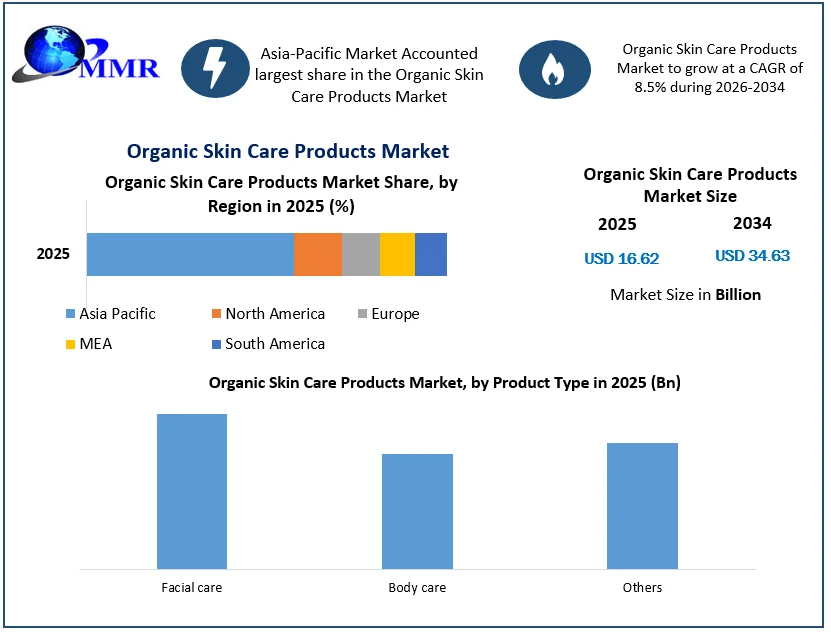
Organic Skin Care Products Market size was valued at USD 16.62 Billion in 2025 and the total Organic Skin Care Products revenue is expected to grow at a CAGR of 8.5% from 2026 to 2034, reaching nearly USD 34.63 Billion.
Organic Skin Care Products Market Overview:
Skincare preserves the highest billing in the international organic beauty market & is anticipated to evolve as one of the most attractive sectors, closely followed by haircare. This means that natural & organic skincare, collectively with organic haircare, will create half of the entire global organic beauty market. The development of the skincare products sector in the international natural & organic skin care products market is motivated mainly by growing request for clean label things, with growing number of health conscious customers worldwide.
Due to growing popularity & customer shift towards online retail channel for buying cosmetics & hair care products, the total market is anticipated to see major evolution during the forecast period.
Organic Skin Care Products Market Size, Growth and Share Analysis
To know about the Research Methodology :- Request Free Sample Report
Circumstances which last to support the skin care industry:
Buyers, generally women, are on a journey of search. They are loving innovative products & finding different brands. This is a part of a superior generational move of younger customers refusing the big brands which their parents favored & looking for locally made, natural products in all customer groups.
Self-determining brands are supporting a surge in inspiration. It looks like every day there is a different brand with a fresh idea about how to stay beautiful. Private enterprises are roasting over in the skin care industry. These new brands are maintained by the physical retail skin care channel.
Acquisitions by the key skin care players of smaller players at very high prices are drawing in more creators & pouring more inspiration each day. The acquisitions are taking place as the key skin care products are threatened by the new, independent brands which buyers want now-a-days. These circumstances have occurred before in many customer sectors.
Key Market Trends Parabens Free Products:
Customers are becoming more concerned to avoid parabens as an element from their skin care products. With the development of organic products, artificial complexes such as propylparaben & butylparaben are not measured to be harmless to be used. Just 35% of skin care products comprise parabens. For the skin care sector, there are several sets which still originate a major share of sales from products with parabens & other unwanted elements but those groups still deeply concentrate on parabens while some of them are shifting to parabens-free. Over the past two years, facial makeups products have gone from just 43% parabens-free to 54%.
Highest Growth Rate in Asia-Pacific:
The Asia-Pacific is the second-largest market for beauty products, henceforth remains an impending market for globally. The Asia-Pacific is anticipated to witness the fastest progress over the forecast time. An aged population & a growing total of millennials, with more figure of working women, is the motivating reason for organic skin care during the forecast period. In Asia-Pacific, China has led the market followed by Japan & others.
The objective of the report is to present a comprehensive analysis of the Global Market including all the stakeholders of the industry. The past and current status of the industry with forecasted market size and trends are presented in the report with the analysis of complicated data in simple language. The report covers all the aspects of the industry with a dedicated study of key players that includes market leaders, followers and new entrants.
PORTER, SVOR, PESTEL analysis with the potential impact of micro-economic factors of the market have been presented in the report. External as well as internal factors that are supposed to affect the business positively or negatively have been analyzed, which will give a clear futuristic view of the industry to the decision-makers.
The report also helps in understanding Global Market dynamics, structure by analyzing the market segments and project the Global Organic Skin Care Products Market size. Clear representation of competitive analysis of key players by Distribution Channel, price, financial position, Product portfolio, growth strategies, and regional presence in the Global Organic Skin Care Products Market make the report investor’s guide.
Organic Skin Care Products Market Recent Development
| Date | Company | Development | Impact |
|---|---|---|---|
| 15 January 2025 | L'Oréal | L'Oréal expanded its plant-based portfolio by acquiring a controlling stake in a leading certified organic botanical skincare brand. | This acquisition significantly enhances the company's sustainable product line and expands its footprint in the premium organic beauty segment across Europe. |
| 28 March 2025 | Estée Lauder Companies | Estée Lauder launched a novel 100% bio-based anti-aging serum line utilizing upcycled botanical extracts. | The product launch drives consumer trust through USDA Organic certification while reducing overall carbon footprint by 30%. |
| 12 June 2025 | The Body Shop | The Body Shop partnered with local agricultural collectives in Southeast Asia to secure sustainable sourcing for fair-trade organic cold-pressed oils. | The strategic partnership secures a transparent supply chain and supports biodiversity-friendly farming initiatives. |
| 09 September 2025 | Johnson & Johnson | Johnson & Johnson introduced a new line of dermatologist-tested organic sensitive skincare products free from synthetic preservatives. | This move expands clean beauty offerings to address the growing demand for hypoallergenic organic facial care. |
| 18 November 2025 | Unilever | Unilever expanded its manufacturing facility in Germany to scale production of refillable organic skincare packaging. | The facility upgrade increases eco-friendly production capacity by 45% to meet accelerating global market demand. |
| 10 February 2026 | Shiseido Company | Shiseido unveiled an advanced microbiome-friendly organic skin barrier cream utilizing proprietary fermented plant extracts. | The innovation accelerates product efficacy while strengthening position in the luxury clinical organic skincare sector. |
Organic Skin Care Products Market Scope: Inquire before buying
| Organic Skin Care Products Market | |||
|---|---|---|---|
| Report Coverage | Details | ||
| Base Year: | 2025 | Forecast Period: | 2026-2034 |
| Historical Data: | 2020 to 2025 | Market Size in 2025: | US $ 16.62 Bn. |
| Forecast Period 2026 to 2034 CAGR: | 8.5% | Market Size in 2034: | US $ 34.63 Bn. |
| Segments Covered: | by Product Type | Facial care Body care Others |
|
| by Distribution Channel | Supermarkets/Hypermarkets Conveniences Stores Specialist Stores Online Retail Stores |
||
Organic Skin Care Products Market, by Region
North America (United States, Canada and Mexico)
Europe (UK, France, Germany, Italy, Spain, Sweden, Austria, Turkey, Russia and Rest of Europe)
Asia Pacific (China, India, Japan, South Korea, Australia, ASEAN and Rest of APAC)
Middle East and Africa (South Africa, GCC, Egypt, Nigeria and Rest of ME&A)
South America (Brazil, Argentina, Columbia and Rest of South America)
Organic Skin Care Products Market, Key Players
Organic Skin Care Products is defined as the sum total of all face and body care products available globally, which use natural ingredients without the addition of any artificial pesticide or chemicals. Major categories of organic skin care products include face creams & moisturizers, cleansers, and serums.
| Company Name | Headquarters | Core Competencies |
| L'Oréal S.A. | Clichy, France | Organic and natural skincare, dermocosmetics, premium beauty products |
| Unilever PLC | London, England, UK | Natural skincare, personal care, sustainable beauty products |
| The Estée Lauder Companies Inc. | New York, New York, USA | Premium skincare, botanical formulations, luxury beauty products |
| Shiseido Company, Limited | Tokyo, Japan | Botanical skincare, anti-aging products, premium cosmetics |
| Beiersdorf AG | Hamburg, Germany | Dermatological skincare, natural formulations, personal care |
| Natura &Co | São Paulo, Brazil | Organic cosmetics, sustainable skincare, natural beauty products |
| Weleda AG | Arlesheim, Switzerland | Certified natural and organic skincare, body care, wellness products |
| The Body Shop International Limited | London, England, UK | Naturally inspired skincare, ethically sourced beauty products |
| Burt's Bees | Durham, North Carolina, USA | Natural skincare, lip care, personal care products |
| Juice Beauty, Inc. | San Rafael, California, USA | Certified organic skincare, antioxidant-based beauty products |
Frequently Asked Questions:
1. Which region has the largest share in Global Market?
Ans: Asia Pacific region held the highest share in 2025.
2. What is the growth rate of Global Market?
Ans: The Global Organic Skin Care Products Market is growing at a CAGR of 8.5% during forecasting period 2026-2034.
3. What is scope of the Global Market report?
Ans: Global Organic Skin Care Products Market report helps with the PESTEL, PORTER, COVID-19 Impact analysis, Recommendations for Investors & Leaders, and market estimation of the forecast period.
4. Who are the key players in Global Organic Skin Care Products Market?
Ans: The important key players in the Global Organic Skin Care Products Market are – L'Oréal S.A., Unilever, Beiersdorf AG, The Colgate-Palmolive Company, The Estée Lauder Companies, Inc., Johnson and Johnson, Avon Products, Inc., Shiseido Co., Ltd., The Procter & Gamble Company, Revlon and Inc.
5. What is the study period of this Market?
Ans: The Global Organic Skin Care Products Market is studied from 2020 to 2034.