
Muconic Acid Market Size Segment-Level Market Assessment, Growth Opportunity Analysis, Competitive Mapping & Forecast to 2032
Overview
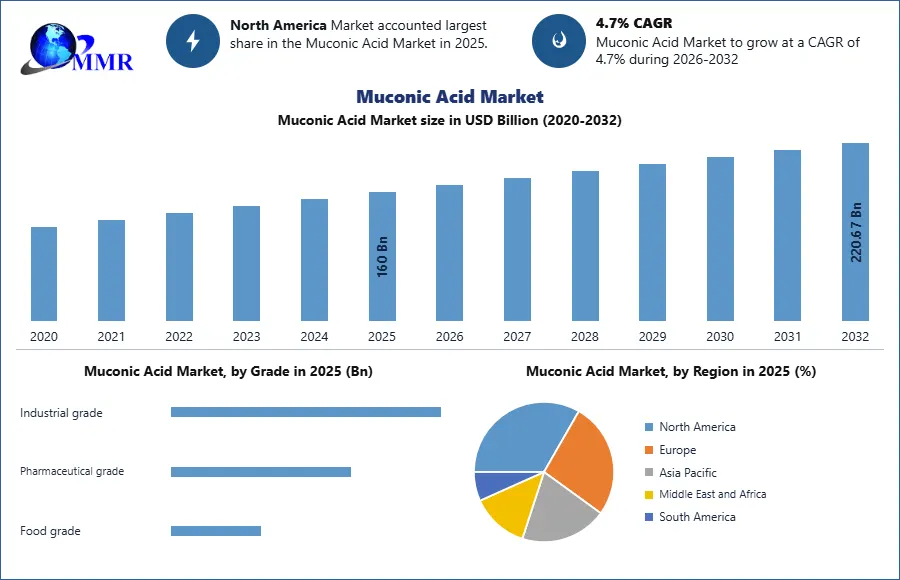
The Muconic Acid Market was valued at USD 160.0 Million in 2025 and is estimated to grow at a CAGR of 4.7% over the forecast period, reaching USD 238.0 Million by 2032.
Muconic Acid Market Overview:
The Muconic Acid Market is a rapidly growing segment within the bio-based chemicals industry, driven by the increasing demand for sustainable and renewable feedstocks across various industries such as plastics, automotive, pharmaceuticals, and textiles. Muconic acid, a key building block in the production of bio-based polymers like nylon, is derived through fermentation processes, making it a sustainable alternative to traditional petroleum-based chemicals. Technological advancements in metabolic engineering and fermentation technologies have significantly improved production yields, reducing costs and making bio-based muconic acid commercially viable.
Key growth factors include the rise in demand for bio-based chemicals, as industries shift towards more sustainable and eco-friendly production methods. Government regulations encouraging the use of renewable resources, along with consumer demand for environmentally friendly products, are further contributing to the growth of the Muconic Acid Market. The technological developments in muconic acid production, particularly through innovations in fermentation processes and biocatalysts, are expected to continue playing a critical role in expanding market capacity.
The outlook for muconic acid demand remains positive, with an increasing number of industries seeking to replace conventional chemicals with bio-based alternatives. The market is also set to benefit from the growing focus on carbon neutrality and the adoption of sustainable materials in manufacturing processes.
Muconic Acid Market Dynamics
Muconic Acid Market Drivers
- Technological Advancements: The rapid evolution of fermentation and metabolic engineering technologies has significantly increased the production efficiency and yield of muconic acid. The shift from traditional chemical synthesis to biological processes in muconic acid production is lowering costs, improving scalability, and offering a more sustainable production pathway. As these technologies continue to evolve, production capacity will grow, supporting the increasing demand for bio-based chemicals in key industries such as textiles, automotive, and packaging.
- Industry Demand: The growing demand for sustainable and environmentally friendly products across industries is driving the market for bio-based chemicals, including muconic acid. In particular, the increasing use of muconic acid derivatives like nylon 6,6 and other polymers in automotive, packaging, and textiles is fueling this demand. Manufacturers are increasingly adopting muconic acid-based polymers to meet consumer preferences for eco-friendly and recyclable products.
- Regulatory Support: Global regulatory support, including stricter environmental regulations and sustainability initiatives, is encouraging industries to adopt bio-based alternatives. Governments worldwide are providing incentives for green technologies, and regulations on carbon emissions and plastic waste are pushing manufacturers to adopt renewable feedstocks like muconic acid. This regulatory landscape is a significant driver for the growth of the Muconic Acid Market.
Muconic Acid Market Restraints
- High Production Costs: Despite technological advancements, the production of muconic acid is still costly, particularly in comparison to conventional petroleum-based chemicals. High raw material costs and the complexity of bio-based production methods contribute to these expenses. These factors hinder the widespread adoption of muconic acid, especially in regions where cost-effectiveness is crucial.
- Regulatory Challenges: While regulations are generally supportive, the regulatory environment for bio-based chemicals like muconic acid can be complex. Compliance with food, pharmaceutical, and chemical safety standards can be time-consuming and expensive. Additionally, the regulatory framework for novel chemicals and materials is still evolving, creating uncertainties for manufacturers.
- Supply Chain Disruptions: The global supply chain for raw materials used in muconic acid production is vulnerable to disruptions, including fluctuations in the availability of renewable feedstocks and transportation challenges. These disruptions can lead to delays in production and affect the overall supply chain, thereby limiting the growth potential of the market.
Muconic Acid Market Opportunities
- Emerging Markets: The growing industrialization in emerging markets, particularly in Asia-Pacific and Latin America, presents significant opportunities for muconic acid. The increased adoption of sustainable materials in these regions, alongside government initiatives to promote bio-based chemicals, offers new avenues for market expansion.
- Innovation: Ongoing innovation in muconic acid production processes, particularly through the optimization of fermentation pathways and the development of new biocatalysts, presents opportunities to reduce production costs and improve yields. These innovations could significantly enhance the commercial viability of muconic acid, making it more competitive with traditional chemical production methods.
- New Applications: The potential for muconic acid and its derivatives to be used in new applications such as bio-based coatings, adhesives, and medical devices presents significant market opportunities. As industries seek to diversify their use of sustainable materials, the versatility of muconic acid as a feedstock for various products opens up new avenues for growth.
Muconic Acid Market Segmentation
Muconic Acid Market Segmentation, by Type
The Cis,Cis-Muconic Acid segment led the Muconic Acid Market in 2025. It dominated due to its critical role in the production of bio-based nylon, particularly nylon 6,6, which is widely used in automotive and textile applications. The segment's dominance can be attributed to its higher yield in fermentation processes compared to other isomers, as well as its significant adoption in the production of sustainable polymers. Furthermore, strict environmental regulations and increasing consumer preference for recyclable and bio-based materials have contributed to the growing demand for Cis,Cis-Muconic Acid in key industries.
Muconic Acid Market Regional Analysis
In 2025, North America was the leading region in the Muconic Acid Market. This dominance was driven by strong industrial growth, particularly in the automotive and textiles sectors, where the demand for sustainable and bio-based polymers is high. The United States, in particular, played a central role in driving market growth through its large-scale adoption of bio-based materials in manufacturing processes. Government policies supporting renewable chemicals and sustainability initiatives further bolstered market growth. The region’s advanced technological infrastructure also facilitated the development and commercialization of muconic acid production technologies.
To know about the Research Methodology :- Request Free Sample Report
The application of muconic acid and its derivatives as biomarkers is gaining traction in the muconic acid market during the projected period. A derivative of the muconic acid, alpha-adipic acid is widely used as a biomarker for cancer. Biomarkers like trans-muconic acid are used to trace the occurrence of benzene, which causes health issues by damaging the hematopoietic functions and cells. The muconic acid biomarker manufacturers are also undergoing growth opportunities owing to the production of high-grade muconic acid as a biomarker through technical developments. The high-molecular-weight polymers like nylon produced by using muconic acid and its derivatives. To increase the lifespan of the product, nylon is used. It is highly used in several applications in end-user industries like textiles, carpets, and automobiles owing to its high strength and it provides supple tactile feeling and resistance to abrasion. These are several factors that help to propel the growth of the muconic acid market.
The report study has analyzed revenue impact of covid-19 pandemic on the sales revenue of market leaders, market followers and disrupters in the report and same is reflected in our analysis.
Muconic acid Market Segment Analysis:
Muconic Acid Market Segmentation, by Type
The Cis,Cis-Muconic Acid segment led the Muconic Acid Market in 2025. It dominated due to its critical role in the production of bio-based nylon, particularly nylon 6,6, which is widely used in automotive and textile applications. The segment's dominance can be attributed to its higher yield in fermentation processes compared to other isomers, as well as its significant adoption in the production of sustainable polymers. Furthermore, strict environmental regulations and increasing consumer preference for recyclable and bio-based materials have contributed to the growing demand for Cis,Cis-Muconic Acid in key industries.
Muconic acid Market Regional Analysis:
In 2025, North America was the leading region in the Muconic Acid Market. This dominance was driven by strong industrial growth, particularly in the automotive and textiles sectors, where the demand for sustainable and bio-based polymers is high. The United States, in particular, played a central role in driving market growth through its large-scale adoption of bio-based materials in manufacturing processes. Government policies supporting renewable chemicals and sustainability initiatives further bolstered market growth. The region’s advanced technological infrastructure also facilitated the development and commercialization of muconic acid production technologies.
The objective of the report is to present a comprehensive analysis of the Global Muconic acid Market including all the stakeholders of the industry. The past and current status of the industry with forecasted market size and trends are presented in the report with the analysis of complicated data in simple language.
The report covers all the aspects of the industry with a dedicated study of key players that includes market leaders, followers and new entrants. PORTER, SVOR, PESTEL analysis with the potential impact of micro-economic factors of the market has been presented in the report. External as well as internal factors that are supposed to affect the business positively or negatively have been analysed, which will give a clear futuristic view of the industry to the decision-makers.
The report also helps in understanding Global Market dynamics, structure by analysing the market segments and projects the Global Muconic acid Market size. Clear representation of competitive analysis of key players by Application, price, financial position, Product portfolio, growth strategies, and regional presence in the Global Muconic acid Market make the report investor’s guide.
Muconic acid Market Scope : Inquire before buying
| Muconic Acid Market | |||
|---|---|---|---|
| Report Coverage | Details | ||
| Base Year: | 2025 | Forecast Period: | 2026-2032 |
| Historical Data: | 2020 to 2025 | Market Size in 2025: | 160 USD Billion |
| Forecast Period 2026-2032 CAGR: | 4.7% | Market Size in 2032: | 220.67 USD Billion |
| Segments Covered: | by Grade | Industrial grade Pharmaceutical grade Food grade |
|
| by Type | Trans-Muconic Acid Cis-Muconic Acid Cis-Trans-Muconic Acid |
||
| by Derivatives | Adipic Acid Caprolactam Others |
||
| by Application | Bio-based chemicals Polymers Pharmaceuticals Food and beverage Other applications |
||
Muconic Acid Market, by Region:
North America (United States, Canada and Mexico)
Europe (UK, France, Germany, Italy, Spain, Sweden, Austria and Rest of Europe)
Asia Pacific (China, South Korea, Japan, India, Australia, Indonesia, Malaysia, Vietnam, Taiwan, Bangladesh, Pakistan and Rest of APAC)
Middle East and Africa (South Africa, GCC, Egypt, Nigeria and Rest of ME&A)
South America (Brazil, Argentina Rest of South America)
Recent Development
In September 2024, Amyris Inc. entered into a strategic partnership with Braskem to establish bio-based chemical production facilities in Brazil, focusing on muconic acid derivatives for sustainable polymer applications. The collaboration aims to achieve an annual production capacity of 50,000 tons by 2027, leveraging Brazil’s abundant renewable feedstock resources.
In June 2024, DSM-Firmenich expanded its biotechnology research center in the Netherlands with a EUR 120 million investment. The expansion allocates 40% of the facility's capacity to the development of bio-based chemicals, including optimization of muconic acid production. The upgraded center features cutting-edge fermentation technologies and automated downstream processing capabilities.
In March 2024, Genomatica Inc. secured USD 85 million in Series D funding to scale up muconic acid production through advancements in metabolic engineering. This investment will support the construction of a pilot plant and technology licensing agreements with chemical manufacturers in Asia, with plans for commercial production by 2026.
In January 2024, Novozymes A/S introduced a new enzyme platform designed to enhance muconic acid biosynthesis, achieving a 35% improvement in yield over traditional fermentation methods. This technology is now available for licensing to biotechnology and chemical manufacturers globally.
Muconic acid Market, Key Players are:
- Amyris Inc.
- Braskem
- DSM-Firmenich
- Genomatica Inc.
- Novozymes A/S
- BASF
- Lonza Group
- Cargill Inc.
- DuPont
- Toray Industries
- Evonik Industries
- LG Chem
- Asahi Kasei Corporation
- Solvay S.A.
- Mitsubishi Chemical Corporation
- Sumitomo Chemical Co.
- Ineos Group
- Covestro AG
- Lanxess AG
- Huntsman Corporation
- Clariant AG
- SABIC
- Roche Holding AG
- Kingfa Sci & Tech Co.
- Molekule Inc.