
Modular Data Center Market Size by Components, Data Center Size, Tier Type, End-User, Region, Industry-Wide Analysis, Competitive Landscape Assessment & Long-Term Forecast to 2032
Overview
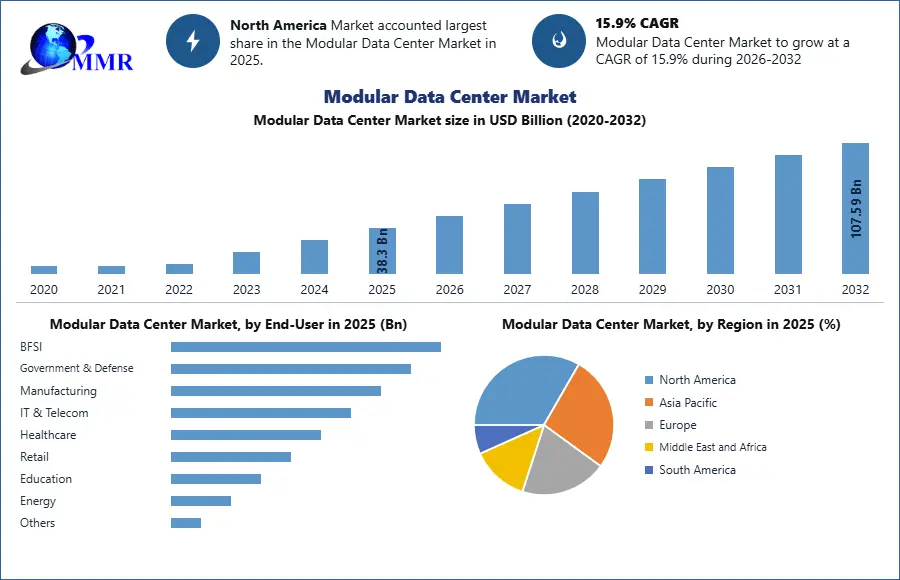
Modular Data Center Market is expected to reach US$ 107.59 Bn by 2032, at a CAGR of 15.9%during the forecast period.
The market is estimated by triangulation of data points obtained from various sources and feeding them into a simulation model created individually for each market. The data points are obtained from paid and unpaid sources along with paid primary interviews with key opinion leaders (KOLs) in the market. KOLs from both, demand and supply side were considered while conducting interviews to get unbiased idea of the market. This exercise was done at country level to get fair idea of the market in countries considered for this study. Later this country specific data was accumulated to come up with regional numbers and then arrive at global market value for Modular Data Center market.The report study has analyzed revenue impact of COVID -19 pandemic on the sales revenue of market leaders, market followers and market disrupters in the report and same is reflected in our analysis.
To know about the Research Methodology :- Request Free Sample Report
The key driving factor for this Global Modular Data Center Market include the growing necessity for energy efficient data centers, reduced capex, growing demand for easily deployable data centers. Reduction in real estate expenditure and deployments in the disaster prone areas are the key growth opportunities factors for market.
The services sub-segment among the component segment is anticipated to hold the largest market share over the forecast period. Services segment is expected to lead the market due to growing demand for scalable infrastructure in order to support the high end applications and the growing investments in data centers technologies globally.
Geographically, the Global Market has been segmented into North America, Europe, Asia Pacific, Middle East & Africa and Latin America. The swift growth of the market in the North America region is expected to be the fastest-growing region in the global market. The growth in the region is attributed to number of developing countries, and the rising demand for the and adoption of by small and medium enterprises is expected to lead the market growth in this region. APAC region is anticipated to have a greater growth opportunities due to the growing economies and many organizations investing huge fund in expanding the business in APAC region.
Modular Data Center Market Key Highlights:
Complete analysis with respect to individual growth trends are incorporated within the scope of our study.
Assessment of Modular Data Center Market definition along with the identification of key drivers, restraints opportunities for this market
Comprehensive analysis of factors that are instrumental in changing the market scenario, prospective opportunities, market shares, growth strategies along with identification of key companies are profiled.
Detailed quantitative analysis of the current and future trends for the forecast period has been profiled.
A Modular Data Center Market analysis and segmentation with respect to component, data centers size, tier type, industry and geography.
The Modular Data Center Market analysis and forecast for five major geographies- North America, Europe, Asia Pacific, Middle East & Africa and Latin America along with their key regions
Modular Data Center Market Research Methodology:
The market is estimated by triangulation of data points obtained from various sources and feeding them into a simulation model created individually for each market. The data points are obtained from paid and unpaid sources along with paid primary interviews with key opinion leaders (KOLs) in the market. KOLs from both, demand and supply side were considered while conducting interviews to get unbiased idea of the market. This exercise was done at country level to get fair idea of the market in countries considered for this study. Later this country specific data was accumulated to come up with regional numbers and then arrive at global market value for Global Modular Data Center Market.
The objective of the report is to present comprehensive Global Modular Data Center Market including all the stakeholders of the industry. The past and current status of the industry with forecasted market size and trends are presented in the report with analysis of complicated data in simple language. The report covers all the aspects of industry with dedicated study of key players that includes market leaders, followers and new entrants by region. PORTER, SVOR, PESTEL analysis with the potential impact of micro-economic factors by region on the market have been presented in the report. External as well as internal factors that are supposed to affect the business positively or negatively have been analyzed, which will give clear futuristic view of the industry to the decision makers.
The report also helps in understanding GlobalCenter Market North America for Asia Pacific dynamics, structure by analyzing the market segments, and project the Global Data Center Market North America for Asia Pacific size. Clear representation of competitive analysis of key players by type, price, financial position, product portfolio, growth strategies, and regional presence in the Global Market North America for Asia Pacific make the report investor’s guide.
Key Target Audience:
Information Technology (IT) service providers
Component providers
IT infrastructure equipment providers
System integrators
Consulting service providers
Support service providers
Cloud service providers
Colocation providers
Data center vendors
Data center vendors
Government and standardization bodies
Available Customization:
Maximize Market Research offers customization of the report and scope of the report according to specific requirement of our clients. Research report categorizes the Global Modular Data Center Market based on components, data center size, tire type, industry and geography (region wise). Market size by value is estimated and forecasted with the revenues of leading companies operating in the Global Modular Data Center Market with key developments in companies and market trends
Modular Data Center Market Scope: Inquire before buying
| Modular Data Center Market | |||
|---|---|---|---|
| Report Coverage | Details | ||
| Base Year: | 2025 | Forecast Period: | 2026-2032 |
| Historical Data: | 2020 to 2025 | Market Size in 2025: | 38.3 USD Billion |
| Forecast Period 2026-2032 CAGR: | 15.9% | Market Size in 2032: | 107.59 USD Billion |
| Segments Covered: | by Component | Functional Module Solution Services |
|
| by Data Center Size | Mid-sized Data Centers Large Data Centers Enterprise Data Centers |
||
| by Tier Type | Tier 1 Tier 2 Tier 3 Tier 4 |
||
| by End-User | BFSI Government & Defense Manufacturing IT & Telecom Healthcare Retail Education Energy Others |
||
Modular Data Center Market, by Region:
North America (United States, Canada and Mexico)
Europe (UK, France, Germany, Italy, Spain, Sweden, Austria and Rest of Europe)
Asia Pacific (China, South Korea, Japan, India, Australia, Indonesia, Malaysia, Vietnam, Taiwan, Bangladesh, Pakistan and Rest of APAC)
Middle East and Africa (South Africa, GCC, Egypt, Nigeria and Rest)
Key Players are:
1. NVIDIA Corporation
2. Advanced Micro Devices, Inc.
3. Intel Corporation
0. Qualcomm Technologies, Inc.
5. Imagination Technologies
6. ARM Holdings
7. Graphcore
8. Cerebras Systems
9. Groq Inc.
10.Tenstorrent
11.SambaNova Systems
12.Mythic AI
13.d-Matrix
14.Huawei Technologies Co., Ltd.
15.Biren Technology
16.Moore Threads
17.Innosilicon
18.Jingjia Micro
19.Enflame Technology
20.Horizon Robotics
21.Cambricon Technologies
22.Iluvatar CoreX
23.MetaX Integrated Circuits
Frequently Asked Questions:
1. Which region has the largest share in Global Modular Data Center Market?
Ans: North America region held the highest share in 2025.
2. What is the growth rate of Global Modular Data Center Market?
Ans: The Global Modular Data Center Market is expected to grow at a CAGR of 15.9% during forecast period 2026-2032.
3. What is scope of the Global Modular Data Center Market report?
Ans: Global Modular Data Center Market report helps with the PESTEL, PORTER, COVID-19 Impact analysis, Recommendations for Investors & Leaders, and market estimation of the forecast period.
4. Who are the key players in Global Modular Data Center Market?
Ans: The important key players in the Global Modular Data Center Market are - IBM, Huawei, Eaton, Bladeroom, Commscope, Cannon Technologies, Dell, HP Enterprises, Flexenclosure, Schneider Electric, Rittal, Baselayer, Vertiv, Huawei, Hewlett Packard Enterprise Development LP, Cannon Technologies Ltd, Eltek AS, Edge Mission Critical Systems, LLC, Rahi Systems Pvt Ltd., STULZ GmbH, ScaleMatrix Holdings, Inc., Cupertino Electric, Inc., and Asperitas.
5. What is the study period of this market?
Ans: The Global Modular Data Center Market is studied from 2025 to 2032.