
Medical Telepresence Robot Market Size by Product, Application, Region – Segment-Level Market Assessment, Growth Opportunity Analysis, Competitive Mapping & Forecast to 2032
Overview
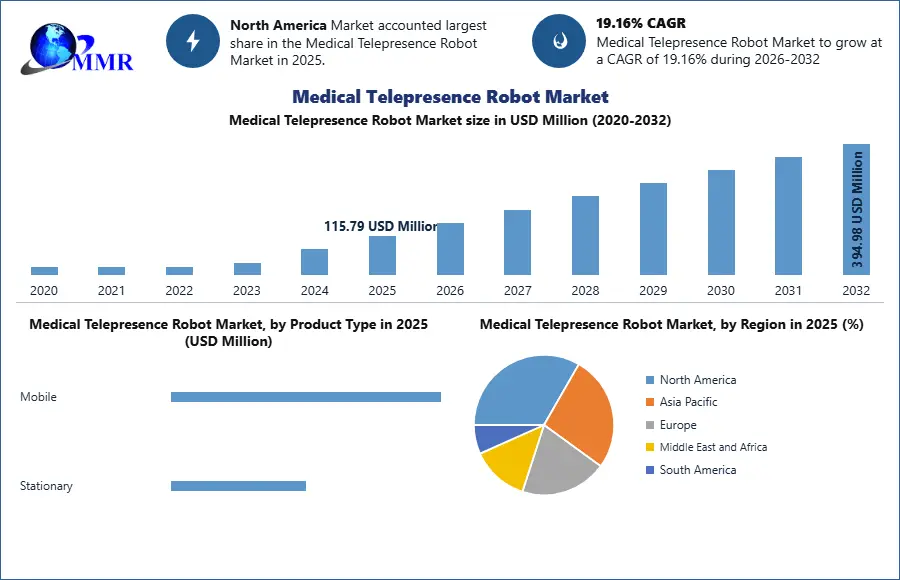
Medical Telepresence Robot Market size is expected to reach nearly US$ 394.98 Mn by 2032 with the CAGR of 19.16% during the forecast period.
Medical Telepresence Robot Market Overview
The Global Medical Telepresence Robot Market is witnessing strong growth due to the increasing adoption of remote healthcare technologies, rising demand for telemedicine services, and continuous advancements in robotic healthcare systems. Medical telepresence robots are transforming hospital communication, patient monitoring, remote diagnosis, and virtual healthcare delivery by enabling healthcare professionals to interact with patients from distant locations in real time. These robots integrate artificial intelligence (AI), high-definition cameras, autonomous navigation systems, sensors, and cloud-based communication technologies to improve clinical efficiency and patient outcomes.
The growing focus on digital healthcare infrastructure, smart hospitals, remote intensive care unit (ICU) management, and elderly care solutions is accelerating market expansion. Healthcare providers are increasingly deploying telepresence robots for infection control, emergency response, specialist consultations, and post-operative monitoring. The expansion of 5G connectivity, Internet of Medical Things (IoMT), and AI-powered healthcare automation is further strengthening the adoption of medical telepresence robots across hospitals, clinics, rehabilitation centers, and home healthcare settings.
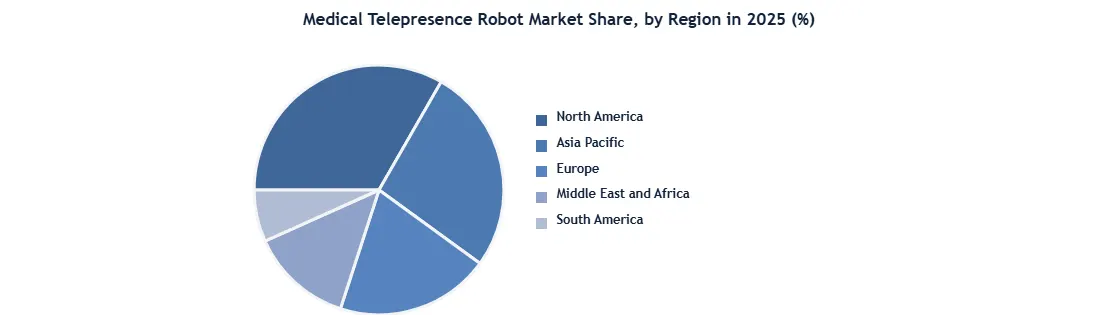
The market is also benefiting from increased healthcare investments, rising healthcare workforce shortages, and growing demand for contactless patient care solutions. North America currently dominates the market due to advanced healthcare infrastructure and rapid technology adoption, while Asia-Pacific is emerging as the fastest-growing region driven by expanding telehealth initiatives and rising healthcare digitization.
 To know about the Research Methodology :- Request Free Sample Report
Medical Telepresence Robot Market Dynamics:
Growing Integration of AI-Powered Telepresence Robots in Smart Hospitals:
One of the major trends shaping the Global Medical Telepresence Robot Market is the increasing integration of artificial intelligence (AI) and automation technologies into smart hospital environments. Healthcare providers are rapidly adopting AI-powered telepresence robots to enhance remote patient monitoring, virtual consultations, hospital communication, and clinical workflow efficiency. These advanced robots are equipped with autonomous navigation systems, real-time video conferencing, facial recognition, voice assistance, and predictive analytics capabilities, enabling healthcare professionals to deliver faster and more accurate patient care. The growing demand for contactless healthcare services and digital hospital infrastructure is accelerating the deployment of intelligent robotic systems across emergency rooms, intensive care units (ICUs), rehabilitation centers, and elderly care facilities.
The expansion of 5G connectivity and cloud-based healthcare platforms is further supporting seamless communication between patients and medical professionals. Hospitals are increasingly utilizing telepresence robots to reduce staff workload, improve infection control, and enhance healthcare accessibility in remote locations. In addition, healthcare organizations are investing in robotics-as-a-service (RaaS) models to reduce upfront costs and improve operational flexibility. The rising adoption of Internet of Medical Things (IoMT), machine learning, and AI-assisted diagnostics is expected to further transform the medical telepresence robotics industry in the coming years.
Medical Telepresence Robot Market Segment Analysis :
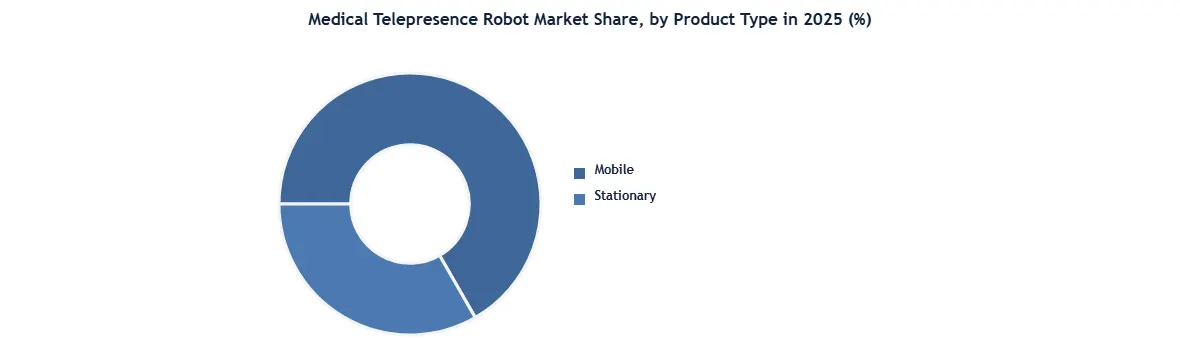
Based on Product Type :The mobile medical telepresence robots segment dominates the Global Medical Telepresence Robots Market with nearly 66% market share, driven by increasing demand for flexible and autonomous healthcare communication systems. These robots are widely used in hospitals, emergency care units, long-term care facilities, and rehabilitation centers due to their ability to move across multiple departments and patient rooms efficiently. Healthcare providers are increasingly adopting mobile telepresence robots for remote ward rounds, virtual consultations, and real-time patient monitoring. Advanced features such as autonomous navigation, obstacle detection, AI-enabled communication, and extended battery performance are further accelerating segment growth. The growing focus on workflow optimization, hospital automation, and remote healthcare delivery continues to strengthen demand for mobile robotic solutions.
Meanwhile, stationary medical telepresence robots account for approximately 34% of the market and are primarily utilized in fixed healthcare settings such as intensive care units (ICUs), specialist consultation rooms, and tele-ICU environments. These systems offer stable high-definition communication, continuous patient monitoring, reliable performance, and seamless integration with existing hospital infrastructure, supporting steady market demand globally.
Medical Telepresence Robot Market Regional Analysis :
North America dominates the Global Medical Telepresence Robot Market due to the region’s highly advanced healthcare infrastructure, strong adoption of digital healthcare technologies, and increasing investment in healthcare automation systems. The United States accounts for the largest market share because hospitals and healthcare providers are rapidly implementing telemedicine platforms, AI-powered healthcare robotics, and remote patient monitoring solutions to improve clinical efficiency and patient care quality. The growing demand for virtual healthcare services, smart hospitals, and contactless medical communication systems is further accelerating the adoption of medical telepresence robots across the region.
In addition, the presence of major healthcare robotics companies, strong research and development activities, and favorable government support for healthcare digitalization significantly contribute to regional market growth. North America also benefits from high healthcare spending, advanced internet connectivity, and widespread integration of cloud-based healthcare technologies. The increasing elderly population, rising chronic disease cases, and growing focus on infection prevention technologies continue to strengthen North America’s leadership in the Medical Telepresence Robot Market.
Medical Telepresence Robot Market Recent Development :
- January 2026 – OhmniLabs expanded its healthcare telepresence robot portfolio with AI-enabled communication systems and autonomous navigation technologies for remote healthcare services.
- December 2025 – Double Robotics launched upgraded telepresence robots featuring enhanced HD video communication, obstacle avoidance, and improved mobility solutions for hospitals.
- November 2025 – SoftBank Robotics strengthened its healthcare robotics business by expanding AI-powered hospital and elderly care robotic solutions.
- October 2025 – Cisco Systems Inc. enhanced cloud-based telehealth communication infrastructure supporting connected medical telepresence robots.
- September 2025 – Fujitsu Limited increased investments in AI-driven robotic telemedicine platforms and smart healthcare technologies.
- August 2025 – Ava Robotics introduced autonomous telepresence robots with advanced touchless communication and remote collaboration capabilities.
- July 2025 – UBTECH Robotics expanded AI-powered healthcare robotics solutions for hospitals and rehabilitation centers.
- June 2025 – Omron Corporation accelerated development of robotic patient monitoring and hospital automation systems.
- May 2025 – Panasonic Holdings Corporation expanded robotic healthcare communication technologies supporting remote patient care.
- April 2025 – LG Electronics launched AI-powered healthcare service robots for smart hospital applications.
- March 2025 – Toyota Motor Corporation expanded investments in assistive healthcare robotics and telepresence technologies for elderly care.
- February 2025 – PAL Robotics enhanced telepresence robots with autonomous navigation and AI-assisted healthcare interaction technologies.
Scope of the Global Medical Telepresence Robot Market: Inquire before buying
| Medical Telepresence Robot Market | |||
|---|---|---|---|
| Report Coverage | Details | ||
| Base Year: | 2025 | Forecast Period: | 2026-2032 |
| Historical Data: | 2020 to 2025 | Market Size in 2025: | 115.79 USD Million |
| Forecast Period 2026-2032 CAGR: | 19.16% | Market Size in 2032: | 394.98 USD Million |
| Segments Covered: | by Product Type | Mobile Stationary |
|
| by Component | Camera Display Speaker Microphone Power Source Sensors & Control System Others |
||
| by End-use | Hospitals & Assisted Living Facilities Home Use Others |
||
Medical Telepresence Robot Market, by Region
• North America (United States, Canada and Mexico)
• Europe (UK, France, Germany, Italy, Spain, Sweden, Austria and Rest of Europe)
• Asia Pacific (China, South Korea, Japan, India, Australia, Indonesia, Malaysia, Vietnam, Taiwan, Bangladesh, Pakistan and Rest of APAC)
• Middle East and Africa (South Africa, GCC, Egypt, Nigeria and Rest of ME&A)
• South America (Brazil, Argentina Rest of South America)