Material Handling Robotics Market by Product Type, by Function, by Payload Capacity, by Automation Level, by Application, by End-Use Industry and Regional Insights 2034

10.65%
CAGR (2026-2034)
37.99 USD Bn.
Forecast Market Size
322
Report Pages
158
Market Tables

Overview

The Material Handling Robotics Market was valued at USD 37.99 Bn. in 2025, and the total global Material Handling Robotics Market is estimated to reach a value of USD 94.46 Bn. in 2034. The global Material Handling Robotics Market size is estimated to grow at a CAGR of 10.65% over the forecast period.

Material Handling Robotics Market Overview

The global Material Handling Robotics Market comprises robotic systems and automated technologies used to move, lift, pick, place, sort, transport, stack, and manage materials across manufacturing facilities, warehouses, distribution centers, and logistics operations. Integration of artificial intelligence (AI), machine vision, advanced sensors, and warehouse management systems enhances operational efficiency, inventory accuracy, workplace safety, and supply chain productivity. Increasing demand for warehouse automation, smart manufacturing, and intelligent intralogistics supports the expansion of the global market.

Material handling robots are used in the manufacturing line to automate some of the most tedious, dull, and risky tasks and is one of the easiest methods to enlarge automation. Material handling robots are utilized in different streams like palletizing or depalletizing, pick and place, and the packaging sector. They are utilized to improve material handling proficiency, flexibility, and steadiness in manufacturing procedures. The steadiness of material handling robots in a manufacturing plant not only decreases the ergonomic threats as well as supports to advance the lean management system of the business.The market continues to benefit from investments in smart factories, automated distribution centers, and digitally connected supply chains.

Asia Pacific represents a leading region in the global Material Handling Robotics Market, supported by its extensive manufacturing base, expanding e-commerce sector, and growing investments in warehouse automation. China, Japan, South Korea, and India contribute to regional demand through industrial modernization and the adoption of robotics in automotive, electronics, food processing, and logistics operations.

Key Highlights of the Global Material Handling Robotics Market

• Market Size: The global Material Handling Robotics Market reaches USD 37.99 billion in 2025 and is projected to reach USD 94.46 billion by 2034.
• CAGR: The market grows at an estimated 10.65% CAGR during 2025–2034, driven by increasing industrial automation and warehouse robotics adoption.
• Leading Region: Asia Pacific holds the largest market share in 2025, supported by manufacturing expansion, e-commerce growth, and investments in smart factories across China, Japan, South Korea, and India.
• Leading Product Segment: Autonomous Mobile Robots (AMRs) lead the product category due to flexible navigation, scalability, and suitability for warehouse and industrial material transportation.
• Dominant Function: Transportation dominates the functional segment in 2025 as companies automate the movement of goods, raw materials, and inventory.
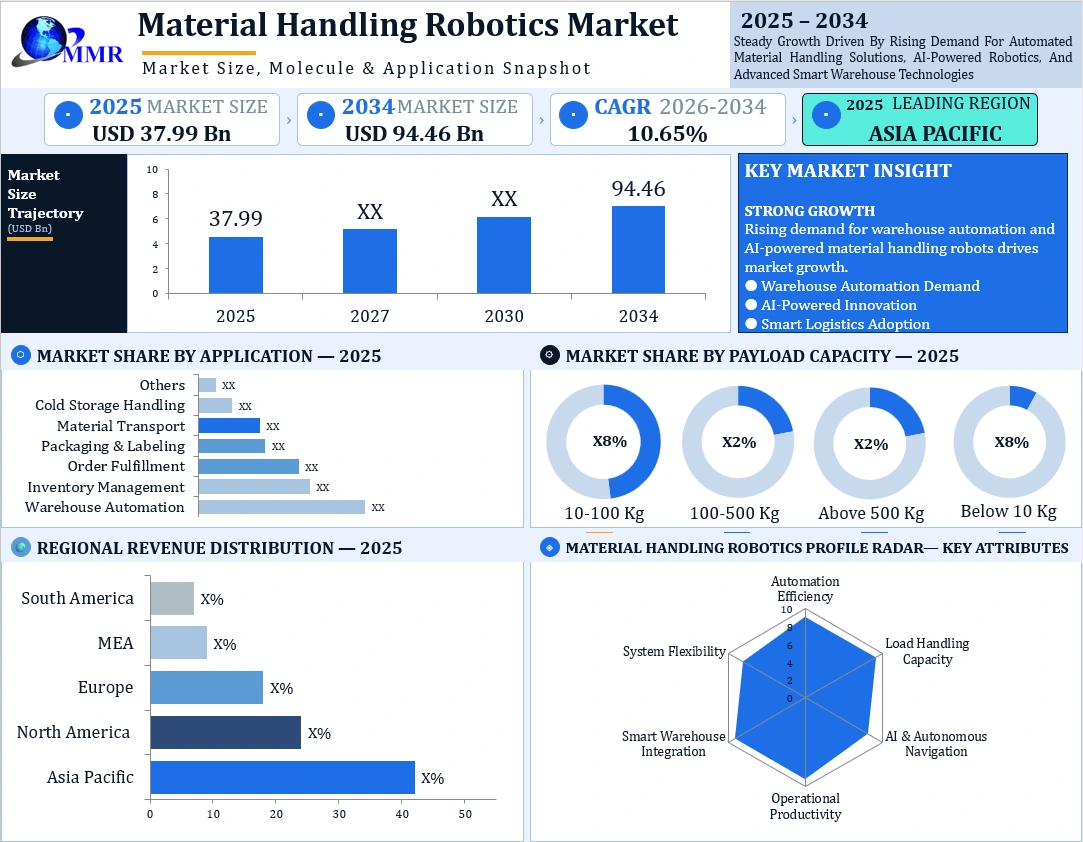
Material Handling Robotics Market Growth

To know about the Research Methodology :- Request Free Sample Report

Material Handling Robotics Market Dynamics

Material Handling Robotics Market Driver

The increasing adoption of warehouse automation and industrial robotics drives the global Material Handling Robotics Market. Manufacturers, logistics providers, and e-commerce companies deploy robotic material handling systems to improve productivity, accelerate order fulfillment, reduce manual handling, and maintain consistent operational performance. Rising labor costs and workforce shortages further encourage businesses to automate repetitive tasks such as palletizing, depalletizing, picking, sorting, and material transportation. The expansion of smart factories and Industry 4.0 initiatives also supports demand for AI-powered robotics, machine vision, and automated intralogistics solutions.

Material Handling Robotics Market Restraint

High initial investment and integration costs remain major restraints for the Material Handling Robotics Market. Purchasing robotic arms, AMRs, AGVs, sensors, fleet management software, and supporting infrastructure requires substantial capital expenditure. Integration with existing warehouse management systems (WMS), enterprise resource planning (ERP) platforms, and legacy production equipment increases implementation complexity. Small and medium-sized enterprises (SMEs) also face difficulties in financing automation projects and accessing specialized robotics expertise. These factors can extend implementation timelines and delay returns on investment, particularly in facilities with limited automation budgets.

Material Handling Robotics Market Opportunity

The expansion of e-commerce and smart warehouse infrastructure creates significant opportunities for the Material Handling Robotics Market. Online retailers, third-party logistics (3PL) providers, and distribution centers increasingly require high-speed order picking, goods-to-person systems, automated sorting, and robotic palletizing solutions. Robotics-as-a-Service (RaaS) models provide an additional growth opportunity by allowing small and medium-sized enterprises to access robotic automation through subscription-based payments rather than large upfront purchases. Emerging demand for flexible automation, cold-chain logistics, pharmaceutical warehousing, and AI-enabled inventory management further expands the addressable market.

Material Handling Robotics Market Challenge

The complexity of robotic system integration and human–robot collaboration presents a major challenge for market participants. Material handling robots must safely navigate changing warehouse layouts, handle products of different sizes and weights, and coordinate with workers, conveyors, and other automated systems. Inconsistent communication standards, cybersecurity risks, system downtime, and dependence on skilled maintenance personnel can affect deployment efficiency. Companies also need to demonstrate measurable return on investment (ROI), reliable performance, and compatibility with existing infrastructure before expanding automation across multiple facilities.

Material Handling Robotics Market Trend

• Growing Adoption of Autonomous Mobile Robots (AMRs): One of the major trends shaping the Material Handling Robotics Market is the rapid adoption of Autonomous Mobile Robots (AMRs) across warehouses, manufacturing facilities, and e-commerce fulfillment centers. Companies are increasingly integrating AI-powered AMRs to automate inventory movement, warehouse navigation, and material transportation processes. Unlike traditional systems, AMRs use advanced sensors, machine vision, and real-time mapping technologies to navigate dynamically without fixed infrastructure. The growing expansion of e-commerce, same-day delivery models, and smart warehousing is accelerating demand for flexible robotic systems capable of improving operational efficiency and reducing labor dependency. Major logistics and retail companies are investing heavily in robotic fulfillment centers integrated with AMRs, cloud-based fleet management software, and IoT-enabled warehouse automation systems. Additionally, Industry 4.0 adoption and increasing demand for contactless material handling operations are supporting the deployment of intelligent robotics solutions.

Material Handling Robotics Market Segment Analysis

By Product Type, The Autonomous Mobile Robots (AMRs) segment dominates the Material Handling Robotics Market due to its flexibility, scalability, and advanced navigation capabilities in warehouse and industrial environments. AMRs are increasingly preferred over traditional fixed-path automation systems because they can operate dynamically using AI, LiDAR sensors, machine vision, and real-time mapping technologies. E-commerce companies, third-party logistics providers, and manufacturing industries are rapidly deploying AMRs to improve warehouse productivity, reduce labor dependency, and accelerate order fulfillment operations. These robots efficiently transport materials, manage inventory movement, and support collaborative warehouse workflows with minimal infrastructure modification requirements. The growing expansion of smart warehouses and omnichannel retail distribution networks is significantly increasing AMR demand globally.

By Function, The Transportation dominated Material Handling Robotics Market share in 2025  due to the increasing need for efficient movement of goods, raw materials, and inventory across warehouses, production facilities, and distribution centers. Material transportation robots such as AGVs and AMRs are widely used to automate repetitive logistics tasks, improve workflow efficiency, and reduce manual labor involvement. The rapid expansion of e-commerce, retail logistics, and high-volume manufacturing operations has significantly increased demand for robotic transportation systems capable of handling continuous material movement with high accuracy. These systems help companies optimize warehouse space utilization, reduce transportation errors, and improve order fulfillment speed. Additionally, transportation robots enhance workplace safety by minimizing manual lifting and reducing accident risks in industrial environments.
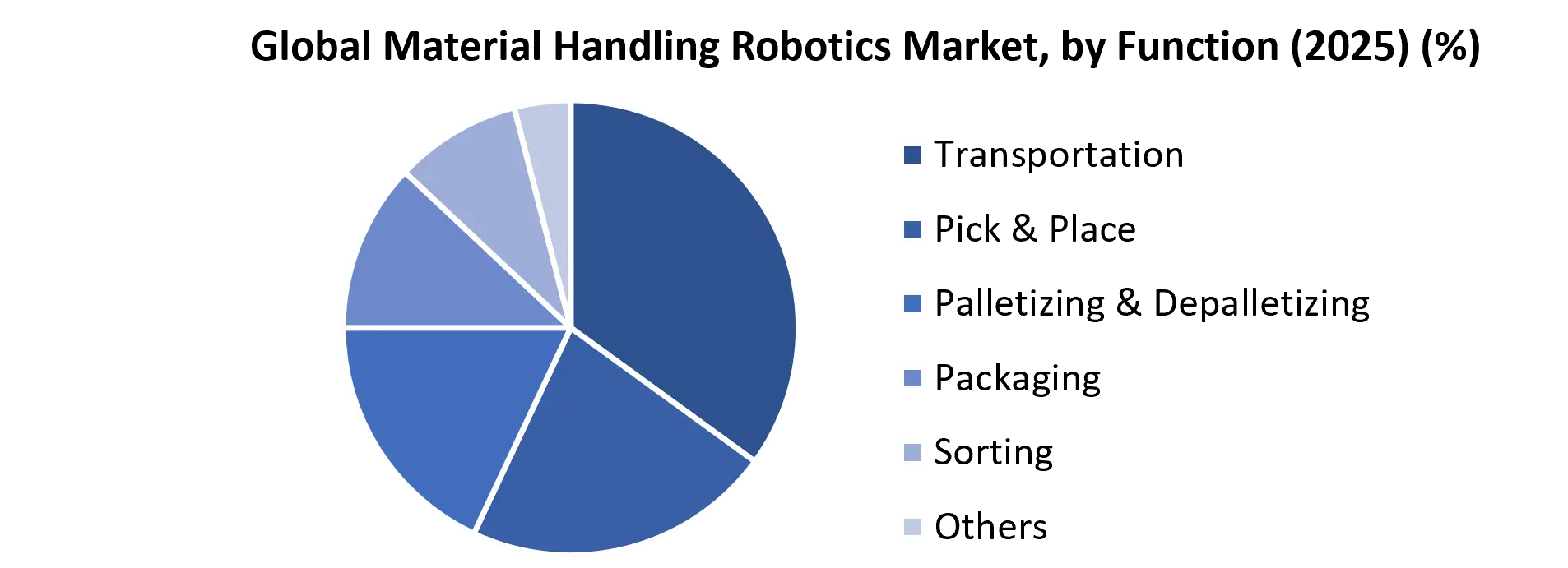
Material Handling Robotics Market, by Function

Material Handling Robotics Market Regional Analysis

By Payload Capacity The Material Handling Robotics Market by Payload Capacity is segmented into below 10 kg, 10–100 kg, 100–500 kg, and above 500 kg. The below 10 kg segment supports precision picking, electronics assembly, and pharmaceutical packaging. The 10–100 kg segment serves machine tending, component transfer, sorting, and light palletizing applications. The 100–500 kg segment addresses heavy-duty handling in automotive, metal processing, and machinery manufacturing. The above 500 kg segment caters to extra-heavy loads, including industrial castings, large assemblies, and heavy tooling. Growing industrial automation and warehouse modernization support demand across all segments.

Material Handling Robotics Market Regional Analysis

North America represents a significant region in the Material Handling Robotics Market, driven by increasing investments in warehouse automation, advanced manufacturing, and smart logistics infrastructure. The United States leads regional demand through the expansion of e-commerce, fulfillment centers, automotive production, and food processing facilities. Growing labor costs and workforce shortages encourage companies to adopt autonomous mobile robots (AMRs), automated guided vehicles (AGVs), robotic picking systems, and palletizing solutions. The presence of major automation providers and the increasing integration of artificial intelligence (AI) and machine vision further support regional market growth.

Europe experiences steady growth in the Material Handling Robotics Market due to strong industrial automation, advanced manufacturing capabilities, and increasing demand for efficient intralogistics solutions. Germany leads regional adoption, supported by its automotive, machinery, and industrial engineering sectors, while France, Italy, and the United Kingdom contribute through investments in automated warehouses and production facilities. Increasing emphasis on workplace safety, energy efficiency, and operational productivity encourages the adoption of collaborative robots, autonomous material transportation systems, and intelligent robotic handling solutions. Industry 4.0 initiatives and investments in smart factories further strengthen regional demand.

Asia Pacific held the largest Material Handling Robotics Market Share in 2025 and is expected to continue its dominance over the forecast period.The market is driven by rapid industrialization, strong manufacturing activity, and growing investments in warehouse automation across China, Japan, South Korea, and India. China remains the largest regional market driven by the expansion of e-commerce giants, large-scale logistics infrastructure, and government support for smart manufacturing initiatives under “Made in China 2025.” Japan and South Korea are major innovation hubs for industrial robotics and automation technologies, with companies heavily investing in AI-enabled material handling systems and smart factories. The rapid growth of automotive, electronics, food & beverage, and consumer goods industries is increasing demand for robotic material handling solutions across the region. Additionally, rising labor costs and workforce shortages are encouraging industries to automate repetitive warehouse and manufacturing operations. The presence of leading robotics manufacturers such as FANUC, Yaskawa, Mitsubishi Electric, and Omron further strengthens regional market growth. Increasing adoption of Industry 4.0 technologies and smart logistics solutions continues to position Asia-Pacific as the dominant regional market globally.

The Middle East and Africa Material Handling Robotics Market develops as businesses invest in logistics infrastructure, industrial diversification, and automated distribution facilities. Saudi Arabia and the United Arab Emirates support regional demand through smart logistics projects, modern warehouses, e-commerce growth, and industrial development initiatives. Increasing investments in ports, airports, manufacturing facilities, and large distribution centers encourage the adoption of autonomous mobile robots, automated storage systems, and robotic palletizing solutions. In Africa, expanding retail distribution, manufacturing activities, and logistics modernization create additional opportunities, although high implementation costs and limited technical expertise remain challenges.

South America experiences gradual growth in the Material Handling Robotics Market, driven by industrial modernization, expanding e-commerce operations, and increasing demand for warehouse efficiency. Brazil represents a key regional market, supported by its automotive, food and beverage, agricultural processing, and consumer goods industries. Argentina and other regional economies contribute through manufacturing automation and logistics development. Companies increasingly adopt robotic palletizing, automated guided vehicles, and robotic picking systems to improve productivity and reduce manual handling. However, economic uncertainty, infrastructure limitations, high initial investment costs, and restricted access to specialized robotics expertise influence the pace of adoption.

Material Handling Robotics Market Competitive Landscape

The global Material Handling Robotics Market is highly competitive, with major players focusing on technological innovation, automation capabilities, strategic partnerships, and product development to strengthen their market positions. ABB Ltd. focuses on intelligent material handling robots, machine vision, and integrated automation solutions that improve manufacturing efficiency. FANUC Corporation emphasizes high-speed industrial robots, precision handling, reliability, and advanced factory automation technologies. KUKA AG strengthens its position through robotic palletizing, high-payload handling systems, autonomous mobile robotics, and connected manufacturing solutions. Yaskawa Electric Corporation combines industrial robotics and motion-control technologies to automate material transfer, machine tending, and production-line operations. Kawasaki Robotics Inc. focuses on high-payload robotic handling, palletizing, and application-specific automation for demanding industrial environments. Geek+ Inc. differentiates itself through autonomous mobile robots and AI-enabled warehouse automation solutions, including goods-to-person and shelf-to-person systems, supporting flexible order fulfillment and efficient intralogistics operations.

Material Handling Robotics Market Recent Developments

Company Date Recent development Market significance
KUKA September 2026 Introduces the KMF 1500P-CB autonomous forklift for transporting pallets and containers weighing up to 1,500 kg. Strengthens autonomous material transportation in warehouses and manufacturing facilities.
ABB Robotics July 7, 2026 Launches the Flexley Stack F712 autonomous forklift featuring Visual SLAM navigation technology. Improves autonomous navigation and fleet coordination across industrial facilities.
Amazon June 4, 2026 Unveils advancements in Proteus mobile robots, STARK tote handling, and Vulcan tactile-sensing robotics. Advances AI-powered warehouse automation, picking, and material movement.
OMRON Robotics June 2026 Announces the LD-150 and LD-300 autonomous mobile robots with enhanced payload capacity and safety features. Supports flexible material transportation and automated intralogistics.
Corvus Robotics April 2026 Introduces Trident AI Copilot for pallet movement tracking and warehouse inventory visibility. Improves inventory monitoring, traceability, and warehouse operational efficiency.
Geek+ May 2026 Partners with Mindugar to expand Shelf-to-Person and Tote-to-Person warehouse automation in Latin America. Supports scalable order fulfillment and improved warehouse storage utilization.

Global Material Handling Robotics Market Scope: Inquire before buying

Material Handling Robotics Market
Report Coverage Details
Base Year: 2025 Forecast Period: 2026-2034
Historical Data: 2020 to 2025 Market Size in 2025: 37.99 USD Bn
Forecast Period 2026-2034 CAGR: 10.65% Market Size in 2034: 94.46 USD Bn
Segments Covered: by Product Type Automated Guided Vehicles (AGVs)
Autonomous Mobile Robots (AMRs)
Articulated Robots
SCARA Robots
Cartesian Robots
Collaborative Robots (Cobots)
Palletizing Robots
Others
by Function Pick & Place
Packaging
Sorting
Transportation
Palletizing & Depalletizing
Others
by Payload Capacity Below 10 Kg
10–100 Kg
100–500 Kg
Above 500 Kg
by Automation Level Semi-Autonomous
Fully Autonomous
by Application Warehouse Automation
Inventory Management
Order Fulfillment
Packaging & Labeling
Material Transport
Cold Storage Handling
others
by End-Use Industry Automotive
E-commerce & Retail
Food & Beverage
Pharmaceuticals
Electronics & Semiconductor
Logistics & Warehousing
Healthcare
Chemicals
Aerospace & Defense
Others

Material Handling Robotics Market, by Region:

North America (United States, Canada and Mexico)
Europe (UK, France, Germany, Italy, Spain, Sweden, Austria and Rest of Europe)
Asia Pacific (China, South Korea, Japan, India, Australia, Indonesia, Malaysia, Vietnam, Taiwan, Bangladesh, Pakistan and Rest of APAC)
Middle East and Africa (South Africa, GCC, Egypt, Nigeria and Rest of ME&A)
South America (Brazil, Argentina Rest of South America)

Key players/Competitors profiles covered in the Material Handling Robotics Market report in strategic perspective

1. ABB Ltd.
2. FANUC Corporation
3. KUKA AG
4. Yaskawa Electric Corporation
5. Kawasaki Robotics Inc.
6. Mitsubishi Electric Corporation
7. Denso Corporation
8. Omron Corporation
9. Epson Robots
10. Universal Robots A/S
11. Dematic Corporation
12. Honeywell Intelligrated
13. Daifuku Co., Ltd.
14. SSI SCHAEFER Group
15. Swisslog Holding AG
16. Murata Machinery Ltd.
17. Geek+ Inc.
18. GreyOrange
19. Symbotic LLC
20. IAM Robotics
21. Fetch Robotics (Zebra Technologies)
22. Locus Robotics
23. AutoStore Holdings Ltd.
24. Knapp AG
25. TGW Logistics Group
26. Stäubli International AG
27. Nachi-Fujikoshi Corp.
28. Siasun Robot & Automation Co., Ltd.
29. Bosch Rexroth AG
30. KION Group AG
31. Jungheinrich AG
32. Toyota Industries Corporation
33. Mecalux, S.A.
34. Bastian Solutions
35. Mujin, Inc.
36. ForwardX Robotics
37. Quicktron Intelligent Technology Co., Ltd.
38. Hikrobot Co., Ltd.
39. OTTO Motors (Rockwell Automation)
40. Mobile Industrial Robots (MiR)

Frequently Asked Questions:

Q1.What is the size of the Material Handling Robotics Market?
Ans: The Material Handling Robotics market was valued at USD 37.99 billion in 2025 and is projected to reach USD 94.46 billion by 2034, driven by AI advancements, automation demand, and global labor shortages.

Q2. What is the CAGR of Material Handling Robotics Market?
Ans: The Material Handling Robotics market is expected to grow at a CAGR of 10.65% during 2025–2034 due to increasing adoption across manufacturing, logistics, healthcare, and personal assistance applications.

Q3. Which region dominates Material Handling Robotics Market?
Ans: Asia Pacific holds a leading position in the global Material Handling Robotics Market, supported by rapid industrialization, strong manufacturing activity, expanding e-commerce, and increasing investments in warehouse automation.

Q4. Who are key players in Material Handling Robotics Market?
Ans: The key players include ABB Ltd., FANUC Corporation, KUKA AG, Yaskawa Electric Corporation, Kawasaki Robotics Inc., Mitsubishi Electric Corporation, Denso Corporation, Omron Corporation, Epson Robots, Universal Robots A/S, Dematic Corporation, Honeywell Intelligrated, Daifuku Co., Ltd., SSI SCHAEFER Group.

Table of Contents

1. Material Handling Robotics Market Introduction 1.1. Study Assumption and Market Definition 1.2. Scope of the Study 1.3. Executive Summary 2. Global Material Handling Robotics Market: Competitive Landscape 2.1. MMR Competition Matrix 2.2. Competitive Landscape 2.3. Key Players Benchmarking 2.3.1. Company Name 2.3.2. Business Segment 2.3.3. End-user Segment 2.3.4. Revenue (2025) 2.3.5. Company Locations 2.4. Leading Material Handling Robotics Market Companies, by market capitalization 2.5. Market Structure 2.5.1. Market Leaders 2.5.2. Market Followers 2.5.3. Emerging Players 2.6. Mergers and Acquisitions Details 3. Material Handling Robotics Market: Dynamics 3.1. Material Handling Robotics Market Trends by Region 3.1.1. North America Material Handling Robotics Market Trends 3.1.2. Europe Material Handling Robotics Market Trends 3.1.3. Asia Pacific Material Handling Robotics Market Trends 3.1.4. Middle East and Africa Material Handling Robotics Market Trends 3.1.5. South America Material Handling Robotics Market Trends 3.2. Material Handling Robotics Market Dynamics by Region 3.2.1. North America 3.2.1.1. North America Material Handling Robotics Market Drivers 3.2.1.2. North America Material Handling Robotics Market Restraints 3.2.1.3. North America Material Handling Robotics Market Opportunities 3.2.1.4. North America Material Handling Robotics Market Challenges 3.2.2. Europe 3.2.2.1. Europe Material Handling Robotics Market Drivers 3.2.2.2. Europe Material Handling Robotics Market Restraints 3.2.2.3. Europe Material Handling Robotics Market Opportunities 3.2.2.4. Europe Material Handling Robotics Market Challenges 3.2.3. Asia Pacific 3.2.3.1. Asia Pacific Material Handling Robotics Market Drivers 3.2.3.2. Asia Pacific Material Handling Robotics Market Restraints 3.2.3.3. Asia Pacific Material Handling Robotics Market Opportunities 3.2.3.4. Asia Pacific Material Handling Robotics Market Challenges 3.2.4. Middle East and Africa 3.2.4.1. Middle East and Africa Material Handling Robotics Market Drivers 3.2.4.2. Middle East and Africa Material Handling Robotics Market Restraints 3.2.4.3. Middle East and Africa Material Handling Robotics Market Opportunities 3.2.4.4. Middle East and Africa Material Handling Robotics Market Challenges 3.2.5. South America 3.2.5.1. South America Material Handling Robotics Market Drivers 3.2.5.2. South America Material Handling Robotics Market Restraints 3.2.5.3. South America Material Handling Robotics Market Opportunities 3.2.5.4. South America Material Handling Robotics Market Challenges 3.3. PORTER's Five Forces Analysis 3.4. PESTLE Analysis 3.5. Technology Roadmap 3.6. Regulatory Landscape by Region 3.6.1. North America 3.6.2. Europe 3.6.3. Asia Pacific 3.6.4. Middle East and Africa 3.6.5. South America 3.7. Key Opinion Leader Analysis For Material Handling Robotics Industry 3.8. Analysis of Government Schemes and Initiatives For Material Handling Robotics Industry 3.9. Material Handling Robotics Market Trade Analysis 3.10. The Global Pandemic Impact on Material Handling Robotics Market 4. Material Handling Robotics Market: Global Market Size and Forecast by Segmentation (in USD Bn) 2025-2034 4.1. Material Handling Robotics Market Size and Forecast, by Product Type (2025-2034) 4.1.1. Automated Guided Vehicles (AGVs) 4.1.2. Autonomous Mobile Robots (AMRs) 4.1.3. Articulated Robots 4.1.4. SCARA Robots 4.1.5. Cartesian Robots 4.1.6. Collaborative Robots (Cobots) 4.1.7. Palletizing Robots 4.1.8. Others 4.2. Material Handling Robotics Market Size and Forecast, by Function (2025-2034) 4.2.1. Pick & Place 4.2.2. Packaging 4.2.3. Sorting 4.2.4. Transportation 4.2.5. Palletizing & Depalletizing 4.2.6. Others 4.3. Material Handling Robotics Market Size and Forecast, by Payload Capacity (2025-2034) 4.3.1. Below 10 Kg 4.3.2. 10–100 Kg 4.3.3. 100–500 Kg 4.3.4. Above 500 Kg 4.4. Material Handling Robotics Market Size and Forecast, by Automation Level (2025-2034) 4.4.1. Semi-Autonomous 4.4.2. Fully Autonomous 4.5. Material Handling Robotics Market Size and Forecast, by Application (2025-2034) 4.5.1. Warehouse Automation 4.5.2. Inventory Management 4.5.3. Order Fulfillment 4.5.4. Packaging & Labeling 4.5.5. Material Transport 4.5.6. Cold Storage Handling 4.5.7. others 4.6. Material Handling Robotics Market Size and Forecast, by End-Use Industry (2025-2034) 4.6.1. Automotive 4.6.2. E-commerce & Retail 4.6.3. Food & Beverage 4.6.4. Pharmaceuticals 4.6.5. Electronics & Semiconductor 4.6.6. Logistics & Warehousing 4.6.7. Healthcare 4.6.8. Chemicals 4.6.9. Aerospace & Defense 4.6.10. Others 4.7. Material Handling Robotics Market Size and Forecast, by Region (2025-2034) 4.7.1. North America 4.7.2. Europe 4.7.3. Asia Pacific 4.7.4. Middle East and Africa 4.7.5. South America 5. North America Material Handling Robotics Market Size and Forecast by Segmentation (in USD Bn) 2025-2034 5.1. North America Material Handling Robotics Market Size and Forecast, by Product Type (2025-2034) 5.1.1. Automated Guided Vehicles (AGVs) 5.1.2. Autonomous Mobile Robots (AMRs) 5.1.3. Articulated Robots 5.1.4. SCARA Robots 5.1.5. Cartesian Robots 5.1.6. Collaborative Robots (Cobots) 5.1.7. Palletizing Robots 5.1.8. Others 5.2. North America Material Handling Robotics Market Size and Forecast, by Function (2025-2034) 5.2.1. Pick & Place 5.2.2. Packaging 5.2.3. Sorting 5.2.4. Transportation 5.2.5. Palletizing & Depalletizing 5.2.6. Others 5.3. North America Material Handling Robotics Market Size and Forecast, by Payload Capacity (2025-2034) 5.3.1. Below 10 Kg 5.3.2. 10–100 Kg 5.3.3. 100–500 Kg 5.3.4. Above 500 Kg 5.4. North America Material Handling Robotics Market Size and Forecast, by Automation Level (2025-2034) 5.4.1. Semi-Autonomous 5.4.2. Fully Autonomous 5.5. North America Material Handling Robotics Market Size and Forecast, by Application (2025-2034) 5.5.1. Warehouse Automation 5.5.2. Inventory Management 5.5.3. Order Fulfillment 5.5.4. Packaging & Labeling 5.5.5. Material Transport 5.5.6. Cold Storage Handling 5.5.7. others 5.6. North America Material Handling Robotics Market Size and Forecast, by End-Use Industry (2025-2034) 5.6.1. Automotive 5.6.2. E-commerce & Retail 5.6.3. Food & Beverage 5.6.4. Pharmaceuticals 5.6.5. Electronics & Semiconductor 5.6.6. Logistics & Warehousing 5.6.7. Healthcare 5.6.8. Chemicals 5.6.9. Aerospace & Defense 5.6.10. Others 5.7. North America Material Handling Robotics Market Size and Forecast, by Country (2025-2034) 5.7.1. United States 5.7.1.1. United States Material Handling Robotics Market Size and Forecast, by Product Type (2025-2034) 5.7.1.1.1. Automated Guided Vehicles (AGVs) 5.7.1.1.2. Autonomous Mobile Robots (AMRs) 5.7.1.1.3. Articulated Robots 5.7.1.1.4. SCARA Robots 5.7.1.1.5. Cartesian Robots 5.7.1.1.6. Collaborative Robots (Cobots) 5.7.1.1.7. Palletizing Robots 5.7.1.1.8. Others 5.7.1.2. United States Material Handling Robotics Market Size and Forecast, by Function (2025-2034) 5.7.1.2.1. Pick & Place 5.7.1.2.2. Packaging 5.7.1.2.3. Sorting 5.7.1.2.4. Transportation 5.7.1.2.5. Palletizing & Depalletizing 5.7.1.2.6. Others 5.7.1.3. United States Material Handling Robotics Market Size and Forecast, by Payload Capacity (2025-2034) 5.7.1.3.1. Below 10 Kg 5.7.1.3.2. 10–100 Kg 5.7.1.3.3. 100–500 Kg 5.7.1.3.4. Above 500 Kg 5.7.1.4. United States Material Handling Robotics Market Size and Forecast, by Automation Level (2025-2034) 5.7.1.4.1. Semi-Autonomous 5.7.1.4.2. Fully Autonomous 5.7.1.5. United States Material Handling Robotics Market Size and Forecast, by Application (2025-2034) 5.7.1.5.1. Warehouse Automation 5.7.1.5.2. Inventory Management 5.7.1.5.3. Order Fulfillment 5.7.1.5.4. Packaging & Labeling 5.7.1.5.5. Material Transport 5.7.1.5.6. Cold Storage Handling 5.7.1.5.7. others 5.7.1.6. United States Material Handling Robotics Market Size and Forecast, by End-Use Industry (2025-2034) 5.7.1.6.1. Automotive 5.7.1.6.2. E-commerce & Retail 5.7.1.6.3. Food & Beverage 5.7.1.6.4. Pharmaceuticals 5.7.1.6.5. Electronics & Semiconductor 5.7.1.6.6. Logistics & Warehousing 5.7.1.6.7. Healthcare 5.7.1.6.8. Chemicals 5.7.1.6.9. Aerospace & Defense 5.7.1.6.10. Others 5.7.2. Canada 5.7.2.1. Canada Material Handling Robotics Market Size and Forecast, by Product Type (2025-2034) 5.7.2.1.1. Automated Guided Vehicles (AGVs) 5.7.2.1.2. Autonomous Mobile Robots (AMRs) 5.7.2.1.3. Articulated Robots 5.7.2.1.4. SCARA Robots 5.7.2.1.5. Cartesian Robots 5.7.2.1.6. Collaborative Robots (Cobots) 5.7.2.1.7. Palletizing Robots 5.7.2.1.8. Others 5.7.2.2. Canada Material Handling Robotics Market Size and Forecast, by Function (2025-2034) 5.7.2.2.1. Pick & Place 5.7.2.2.2. Packaging 5.7.2.2.3. Sorting 5.7.2.2.4. Transportation 5.7.2.2.5. Palletizing & Depalletizing 5.7.2.2.6. Others 5.7.2.3. Canada Material Handling Robotics Market Size and Forecast, by Payload Capacity (2025-2034) 5.7.2.3.1. Below 10 Kg 5.7.2.3.2. 10–100 Kg 5.7.2.3.3. 100–500 Kg 5.7.2.3.4. Above 500 Kg 5.7.2.4. Canada Material Handling Robotics Market Size and Forecast, by Automation Level (2025-2034) 5.7.2.4.1. Semi-Autonomous 5.7.2.4.2. Fully Autonomous 5.7.2.5. Canada Material Handling Robotics Market Size and Forecast, by Application (2025-2034) 5.7.2.5.1. Warehouse Automation 5.7.2.5.2. Inventory Management 5.7.2.5.3. Order Fulfillment 5.7.2.5.4. Packaging & Labeling 5.7.2.5.5. Material Transport 5.7.2.5.6. Cold Storage Handling 5.7.2.5.7. others 5.7.2.6. Canada Material Handling Robotics Market Size and Forecast, by End-Use Industry (2025-2034) 5.7.2.6.1. Automotive 5.7.2.6.2. E-commerce & Retail 5.7.2.6.3. Food & Beverage 5.7.2.6.4. Pharmaceuticals 5.7.2.6.5. Electronics & Semiconductor 5.7.2.6.6. Logistics & Warehousing 5.7.2.6.7. Healthcare 5.7.2.6.8. Chemicals 5.7.2.6.9. Aerospace & Defense 5.7.2.6.10. Others 5.7.3. Mexico 5.7.3.1. Mexico Material Handling Robotics Market Size and Forecast, by Product Type (2025-2034) 5.7.3.1.1. Automated Guided Vehicles (AGVs) 5.7.3.1.2. Autonomous Mobile Robots (AMRs) 5.7.3.1.3. Articulated Robots 5.7.3.1.4. SCARA Robots 5.7.3.1.5. Cartesian Robots 5.7.3.1.6. Collaborative Robots (Cobots) 5.7.3.1.7. Palletizing Robots 5.7.3.1.8. Others 5.7.3.2. Mexico Material Handling Robotics Market Size and Forecast, by Function (2025-2034) 5.7.3.2.1. Pick & Place 5.7.3.2.2. Packaging 5.7.3.2.3. Sorting 5.7.3.2.4. Transportation 5.7.3.2.5. Palletizing & Depalletizing 5.7.3.2.6. Others 5.7.3.3. Mexico Material Handling Robotics Market Size and Forecast, by Payload Capacity (2025-2034) 5.7.3.3.1. Below 10 Kg 5.7.3.3.2. 10–100 Kg 5.7.3.3.3. 100–500 Kg 5.7.3.3.4. Above 500 Kg 5.7.3.4. Mexico Material Handling Robotics Market Size and Forecast, by Automation Level (2025-2034) 5.7.3.4.1. Semi-Autonomous 5.7.3.4.2. Fully Autonomous 5.7.3.5. Mexico Material Handling Robotics Market Size and Forecast, by Application (2025-2034) 5.7.3.5.1. Warehouse Automation 5.7.3.5.2. Inventory Management 5.7.3.5.3. Order Fulfillment 5.7.3.5.4. Packaging & Labeling 5.7.3.5.5. Material Transport 5.7.3.5.6. Cold Storage Handling 5.7.3.5.7. others 5.7.3.6. Mexico Material Handling Robotics Market Size and Forecast, by End-Use Industry (2025-2034) 5.7.3.6.1. Automotive 5.7.3.6.2. E-commerce & Retail 5.7.3.6.3. Food & Beverage 5.7.3.6.4. Pharmaceuticals 5.7.3.6.5. Electronics & Semiconductor 5.7.3.6.6. Logistics & Warehousing 5.7.3.6.7. Healthcare 5.7.3.6.8. Chemicals 5.7.3.6.9. Aerospace & Defense 5.7.3.6.10. Others 6. Europe Material Handling Robotics Market Size and Forecast by Segmentation (in USD Bn) 2025-2034 6.1. Europe Material Handling Robotics Market Size and Forecast, by Product Type (2025-2034) 6.2. Europe Material Handling Robotics Market Size and Forecast, by Function (2025-2034) 6.3. Europe Material Handling Robotics Market Size and Forecast, by Payload Capacity (2025-2034) 6.4. Europe Material Handling Robotics Market Size and Forecast, by Automation Level (2025-2034) 6.5. Europe Material Handling Robotics Market Size and Forecast, by Application (2025-2034) 6.6. Europe Material Handling Robotics Market Size and Forecast, by End-Use Industry (2025-2034) 6.7. Europe Material Handling Robotics Market Size and Forecast, by Country (2025-2034) 6.7.1. United Kingdom 6.7.1.1. United Kingdom Material Handling Robotics Market Size and Forecast, by Product Type (2025-2034) 6.7.1.2. United Kingdom Material Handling Robotics Market Size and Forecast, by Function (2025-2034) 6.7.1.3. United Kingdom Material Handling Robotics Market Size and Forecast, by Payload Capacity (2025-2034) 6.7.1.4. United Kingdom Material Handling Robotics Market Size and Forecast, by Automation Level (2025-2034) 6.7.1.5. United Kingdom Material Handling Robotics Market Size and Forecast, by Application (2025-2034) 6.7.1.6. United Kingdom Material Handling Robotics Market Size and Forecast, by End-Use Industry (2025-2034) 6.7.2. France 6.7.2.1. France Material Handling Robotics Market Size and Forecast, by Product Type (2025-2034) 6.7.2.2. France Material Handling Robotics Market Size and Forecast, by Function (2025-2034) 6.7.2.3. France Material Handling Robotics Market Size and Forecast, by Payload Capacity (2025-2034) 6.7.2.4. France Material Handling Robotics Market Size and Forecast, by Automation Level (2025-2034) 6.7.2.5. France Material Handling Robotics Market Size and Forecast, by Application (2025-2034) 6.7.2.6. France Material Handling Robotics Market Size and Forecast, by End-Use Industry (2025-2034) 6.7.3. Germany 6.7.3.1. Germany Material Handling Robotics Market Size and Forecast, by Product Type (2025-2034) 6.7.3.2. Germany Material Handling Robotics Market Size and Forecast, by Function (2025-2034) 6.7.3.3. Germany Material Handling Robotics Market Size and Forecast, by Payload Capacity (2025-2034) 6.7.3.4. Germany Material Handling Robotics Market Size and Forecast, by Automation Level (2025-2034) 6.7.3.5. Germany Material Handling Robotics Market Size and Forecast, by Application (2025-2034) 6.7.3.6. Germany Material Handling Robotics Market Size and Forecast, by End-Use Industry (2025-2034) 6.7.4. Italy 6.7.4.1. Italy Material Handling Robotics Market Size and Forecast, by Product Type (2025-2034) 6.7.4.2. Italy Material Handling Robotics Market Size and Forecast, by Function (2025-2034) 6.7.4.3. Italy Material Handling Robotics Market Size and Forecast, by Payload Capacity (2025-2034) 6.7.4.4. Italy Material Handling Robotics Market Size and Forecast, by Automation Level (2025-2034) 6.7.4.5. Italy Material Handling Robotics Market Size and Forecast, by Application (2025-2034) 6.7.4.6. Italy Material Handling Robotics Market Size and Forecast, by End-Use Industry (2025-2034) 6.7.5. Spain 6.7.5.1. Spain Material Handling Robotics Market Size and Forecast, by Product Type (2025-2034) 6.7.5.2. Spain Material Handling Robotics Market Size and Forecast, by Function (2025-2034) 6.7.5.3. Spain Material Handling Robotics Market Size and Forecast, by Payload Capacity (2025-2034) 6.7.5.4. Spain Material Handling Robotics Market Size and Forecast, by Automation Level (2025-2034) 6.7.5.5. Spain Material Handling Robotics Market Size and Forecast, by Application (2025-2034) 6.7.5.6. Spain Material Handling Robotics Market Size and Forecast, by End-Use Industry (2025-2034) 6.7.6. Sweden 6.7.6.1. Sweden Material Handling Robotics Market Size and Forecast, by Product Type (2025-2034) 6.7.6.2. Sweden Material Handling Robotics Market Size and Forecast, by Function (2025-2034) 6.7.6.3. Sweden Material Handling Robotics Market Size and Forecast, by Payload Capacity (2025-2034) 6.7.6.4. Sweden Material Handling Robotics Market Size and Forecast, by Automation Level (2025-2034) 6.7.6.5. Sweden Material Handling Robotics Market Size and Forecast, by Application (2025-2034) 6.7.6.6. Sweden Material Handling Robotics Market Size and Forecast, by End-Use Industry (2025-2034) 6.7.7. Austria 6.7.7.1. Austria Material Handling Robotics Market Size and Forecast, by Product Type (2025-2034) 6.7.7.2. Austria Material Handling Robotics Market Size and Forecast, by Function (2025-2034) 6.7.7.3. Austria Material Handling Robotics Market Size and Forecast, by Payload Capacity (2025-2034) 6.7.7.4. Austria Material Handling Robotics Market Size and Forecast, by Automation Level (2025-2034) 6.7.7.5. Austria Material Handling Robotics Market Size and Forecast, by Application (2025-2034) 6.7.7.6. Austria Material Handling Robotics Market Size and Forecast, by End-Use Industry (2025-2034) 6.7.8. Rest of Europe 6.7.8.1. Rest of Europe Material Handling Robotics Market Size and Forecast, by Product Type (2025-2034) 6.7.8.2. Rest of Europe Material Handling Robotics Market Size and Forecast, by Function (2025-2034) 6.7.8.3. Rest of Europe Material Handling Robotics Market Size and Forecast, by Payload Capacity (2025-2034) 6.7.8.4. Rest of Europe Material Handling Robotics Market Size and Forecast, by Automation Level (2025-2034) 6.7.8.5. Rest of Europe Material Handling Robotics Market Size and Forecast, by Application (2025-2034) 6.7.8.6. Rest of Europe Material Handling Robotics Market Size and Forecast, by End-Use Industry (2025-2034) 7. Asia Pacific Material Handling Robotics Market Size and Forecast by Segmentation (in USD Bn) 2025-2034 7.1. Asia Pacific Material Handling Robotics Market Size and Forecast, by Product Type (2025-2034) 7.2. Asia Pacific Material Handling Robotics Market Size and Forecast, by Function (2025-2034) 7.3. Asia Pacific Material Handling Robotics Market Size and Forecast, by Payload Capacity (2025-2034) 7.4. Asia Pacific Material Handling Robotics Market Size and Forecast, by Automation Level (2025-2034) 7.5. Asia Pacific Material Handling Robotics Market Size and Forecast, by Application (2025-2034) 7.6. Asia Pacific Material Handling Robotics Market Size and Forecast, by End-Use Industry (2025-2034) 7.7. Asia Pacific Material Handling Robotics Market Size and Forecast, by Country (2025-2034) 7.7.1. China 7.7.1.1. China Material Handling Robotics Market Size and Forecast, by Product Type (2025-2034) 7.7.1.2. China Material Handling Robotics Market Size and Forecast, by Function (2025-2034) 7.7.1.3. China Material Handling Robotics Market Size and Forecast, by Payload Capacity (2025-2034) 7.7.1.4. China Material Handling Robotics Market Size and Forecast, by Automation Level (2025-2034) 7.7.1.5. China Material Handling Robotics Market Size and Forecast, by Application (2025-2034) 7.7.1.6. China Material Handling Robotics Market Size and Forecast, by End-Use Industry (2025-2034) 7.7.2. S Korea 7.7.2.1. S Korea Material Handling Robotics Market Size and Forecast, by Product Type (2025-2034) 7.7.2.2. S Korea Material Handling Robotics Market Size and Forecast, by Function (2025-2034) 7.7.2.3. S Korea Material Handling Robotics Market Size and Forecast, by Payload Capacity (2025-2034) 7.7.2.4. S Korea Material Handling Robotics Market Size and Forecast, by Automation Level (2025-2034) 7.7.2.5. S Korea Material Handling Robotics Market Size and Forecast, by Application (2025-2034) 7.7.2.6. S Korea Material Handling Robotics Market Size and Forecast, by End-Use Industry (2025-2034) 7.7.3. Japan 7.7.3.1. Japan Material Handling Robotics Market Size and Forecast, by Product Type (2025-2034) 7.7.3.2. Japan Material Handling Robotics Market Size and Forecast, by Function (2025-2034) 7.7.3.3. Japan Material Handling Robotics Market Size and Forecast, by Payload Capacity (2025-2034) 7.7.3.4. Japan Material Handling Robotics Market Size and Forecast, by Automation Level (2025-2034) 7.7.3.5. Japan Material Handling Robotics Market Size and Forecast, by Application (2025-2034) 7.7.3.6. Japan Material Handling Robotics Market Size and Forecast, by End-Use Industry (2025-2034) 7.7.4. India 7.7.4.1. India Material Handling Robotics Market Size and Forecast, by Product Type (2025-2034) 7.7.4.2. India Material Handling Robotics Market Size and Forecast, by Function (2025-2034) 7.7.4.3. India Material Handling Robotics Market Size and Forecast, by Payload Capacity (2025-2034) 7.7.4.4. India Material Handling Robotics Market Size and Forecast, by Automation Level (2025-2034) 7.7.4.5. India Material Handling Robotics Market Size and Forecast, by Application (2025-2034) 7.7.4.6. India Material Handling Robotics Market Size and Forecast, by End-Use Industry (2025-2034) 7.7.5. Australia 7.7.5.1. Australia Material Handling Robotics Market Size and Forecast, by Product Type (2025-2034) 7.7.5.2. Australia Material Handling Robotics Market Size and Forecast, by Function (2025-2034) 7.7.5.3. Australia Material Handling Robotics Market Size and Forecast, by Payload Capacity (2025-2034) 7.7.5.4. Australia Material Handling Robotics Market Size and Forecast, by Automation Level (2025-2034) 7.7.5.5. Australia Material Handling Robotics Market Size and Forecast, by Application (2025-2034) 7.7.5.6. Australia Material Handling Robotics Market Size and Forecast, by End-Use Industry (2025-2034) 7.7.6. Indonesia 7.7.6.1. Indonesia Material Handling Robotics Market Size and Forecast, by Product Type (2025-2034) 7.7.6.2. Indonesia Material Handling Robotics Market Size and Forecast, by Function (2025-2034) 7.7.6.3. Indonesia Material Handling Robotics Market Size and Forecast, by Payload Capacity (2025-2034) 7.7.6.4. Indonesia Material Handling Robotics Market Size and Forecast, by Automation Level (2025-2034) 7.7.6.5. Indonesia Material Handling Robotics Market Size and Forecast, by Application (2025-2034) 7.7.6.6. Indonesia Material Handling Robotics Market Size and Forecast, by End-Use Industry (2025-2034) 7.7.7. Malaysia 7.7.7.1. Malaysia Material Handling Robotics Market Size and Forecast, by Product Type (2025-2034) 7.7.7.2. Malaysia Material Handling Robotics Market Size and Forecast, by Function (2025-2034) 7.7.7.3. Malaysia Material Handling Robotics Market Size and Forecast, by Payload Capacity (2025-2034) 7.7.7.4. Malaysia Material Handling Robotics Market Size and Forecast, by Automation Level (2025-2034) 7.7.7.5. Malaysia Material Handling Robotics Market Size and Forecast, by Application (2025-2034) 7.7.7.6. Malaysia Material Handling Robotics Market Size and Forecast, by End-Use Industry (2025-2034) 7.7.8. Vietnam 7.7.8.1. Vietnam Material Handling Robotics Market Size and Forecast, by Product Type (2025-2034) 7.7.8.2. Vietnam Material Handling Robotics Market Size and Forecast, by Function (2025-2034) 7.7.8.3. Vietnam Material Handling Robotics Market Size and Forecast, by Payload Capacity (2025-2034) 7.7.8.4. Vietnam Material Handling Robotics Market Size and Forecast, by Automation Level (2025-2034) 7.7.8.5. Vietnam Material Handling Robotics Market Size and Forecast, by Application (2025-2034) 7.7.8.6. Vietnam Material Handling Robotics Market Size and Forecast, by End-Use Industry (2025-2034) 7.7.9. Taiwan 7.7.9.1. Taiwan Material Handling Robotics Market Size and Forecast, by Product Type (2025-2034) 7.7.9.2. Taiwan Material Handling Robotics Market Size and Forecast, by Function (2025-2034) 7.7.9.3. Taiwan Material Handling Robotics Market Size and Forecast, by Payload Capacity (2025-2034) 7.7.9.4. Taiwan Material Handling Robotics Market Size and Forecast, by Automation Level (2025-2034) 7.7.9.5. Taiwan Material Handling Robotics Market Size and Forecast, by Application (2025-2034) 7.7.9.6. Taiwan Material Handling Robotics Market Size and Forecast, by End-Use Industry (2025-2034) 7.7.10. Rest of Asia Pacific 7.7.10.1. Rest of Asia Pacific Material Handling Robotics Market Size and Forecast, by Product Type (2025-2034) 7.7.10.2. Rest of Asia Pacific Material Handling Robotics Market Size and Forecast, by Function (2025-2034) 7.7.10.3. Rest of Asia Pacific Material Handling Robotics Market Size and Forecast, by Payload Capacity (2025-2034) 7.7.10.4. Rest of Asia Pacific Material Handling Robotics Market Size and Forecast, by Automation Level (2025-2034) 7.7.10.5. Rest of Asia Pacific Material Handling Robotics Market Size and Forecast, by Application (2025-2034) 7.7.10.6. Rest of Asia Pacific Material Handling Robotics Market Size and Forecast, by End-Use Industry (2025-2034) 8. Middle East and Africa Material Handling Robotics Market Size and Forecast by Segmentation (in USD Bn) 2025-2034 8.1. Middle East and Africa Material Handling Robotics Market Size and Forecast, by Product Type (2025-2034) 8.2. Middle East and Africa Material Handling Robotics Market Size and Forecast, by Function (2025-2034) 8.3. Middle East and Africa Material Handling Robotics Market Size and Forecast, by Payload Capacity (2025-2034) 8.4. Middle East and Africa Material Handling Robotics Market Size and Forecast, by Automation Level (2025-2034) 8.5. Middle East and Africa Material Handling Robotics Market Size and Forecast, by Application (2025-2034) 8.6. Middle East and Africa Material Handling Robotics Market Size and Forecast, by End-Use Industry (2025-2034) 8.7. Middle East and Africa Material Handling Robotics Market Size and Forecast, by Country (2025-2034) 8.7.1. South Africa 8.7.1.1. South Africa Material Handling Robotics Market Size and Forecast, by Product Type (2025-2034) 8.7.1.2. South Africa Material Handling Robotics Market Size and Forecast, by Function (2025-2034) 8.7.1.3. South Africa Material Handling Robotics Market Size and Forecast, by Payload Capacity (2025-2034) 8.7.1.4. South Africa Material Handling Robotics Market Size and Forecast, by Automation Level (2025-2034) 8.7.1.5. South Africa Material Handling Robotics Market Size and Forecast, by Application (2025-2034) 8.7.1.6. South Africa Material Handling Robotics Market Size and Forecast, by End-Use Industry (2025-2034) 8.7.2. GCC 8.7.2.1. GCC Material Handling Robotics Market Size and Forecast, by Product Type (2025-2034) 8.7.2.2. GCC Material Handling Robotics Market Size and Forecast, by Function (2025-2034) 8.7.2.3. GCC Material Handling Robotics Market Size and Forecast, by Payload Capacity (2025-2034) 8.7.2.4. GCC Material Handling Robotics Market Size and Forecast, by Automation Level (2025-2034) 8.7.2.5. GCC Material Handling Robotics Market Size and Forecast, by Application (2025-2034) 8.7.2.6. GCC Material Handling Robotics Market Size and Forecast, by End-Use Industry (2025-2034) 8.7.3. Nigeria 8.7.3.1. Nigeria Material Handling Robotics Market Size and Forecast, by Product Type (2025-2034) 8.7.3.2. Nigeria Material Handling Robotics Market Size and Forecast, by Function (2025-2034) 8.7.3.3. Nigeria Material Handling Robotics Market Size and Forecast, by Payload Capacity (2025-2034) 8.7.3.4. Nigeria Material Handling Robotics Market Size and Forecast, by Automation Level (2025-2034) 8.7.3.5. Nigeria Material Handling Robotics Market Size and Forecast, by Application (2025-2034) 8.7.3.6. Nigeria Material Handling Robotics Market Size and Forecast, by End-Use Industry (2025-2034) 8.7.4. Rest of ME&A 8.7.4.1. Rest of ME&A Material Handling Robotics Market Size and Forecast, by Product Type (2025-2034) 8.7.4.2. Rest of ME&A Material Handling Robotics Market Size and Forecast, by Function (2025-2034) 8.7.4.3. Rest of ME&A Material Handling Robotics Market Size and Forecast, by Payload Capacity (2025-2034) 8.7.4.4. Rest of ME&A Material Handling Robotics Market Size and Forecast, by Automation Level (2025-2034) 8.7.4.5. Rest of ME&A Material Handling Robotics Market Size and Forecast, by Application (2025-2034) 8.7.4.6. Rest of ME&A Material Handling Robotics Market Size and Forecast, by End-Use Industry (2025-2034) 9. South America Material Handling Robotics Market Size and Forecast by Segmentation (in USD Bn) 2025-2034 9.1. South America Material Handling Robotics Market Size and Forecast, by Product Type (2025-2034) 9.2. South America Material Handling Robotics Market Size and Forecast, by Function (2025-2034) 9.3. South America Material Handling Robotics Market Size and Forecast, by Payload Capacity (2025-2034) 9.4. South America Material Handling Robotics Market Size and Forecast, by Automation Level (2025-2034) 9.5. South America Material Handling Robotics Market Size and Forecast, by Application (2025-2034) 9.6. South America Material Handling Robotics Market Size and Forecast, by End-Use Industry (2025-2034) 9.7. South America Material Handling Robotics Market Size and Forecast, by Country (2025-2034) 9.7.1. Brazil 9.7.1.1. Brazil Material Handling Robotics Market Size and Forecast, by Product Type (2025-2034) 9.7.1.2. Brazil Material Handling Robotics Market Size and Forecast, by Function (2025-2034) 9.7.1.3. Brazil Material Handling Robotics Market Size and Forecast, by Payload Capacity (2025-2034) 9.7.1.4. Brazil Material Handling Robotics Market Size and Forecast, by Automation Level (2025-2034) 9.7.1.5. Brazil Material Handling Robotics Market Size and Forecast, by Application (2025-2034) 9.7.1.6. Brazil Material Handling Robotics Market Size and Forecast, by End-Use Industry (2025-2034) 9.7.2. Argentina 9.7.2.1. Argentina Material Handling Robotics Market Size and Forecast, by Product Type (2025-2034) 9.7.2.2. Argentina Material Handling Robotics Market Size and Forecast, by Function (2025-2034) 9.7.2.3. Argentina Material Handling Robotics Market Size and Forecast, by Payload Capacity (2025-2034) 9.7.2.4. Argentina Material Handling Robotics Market Size and Forecast, by Automation Level (2025-2034) 9.7.2.5. Argentina Material Handling Robotics Market Size and Forecast, by Application (2025-2034) 9.7.2.6. Argentina Material Handling Robotics Market Size and Forecast, by End-Use Industry (2025-2034) 9.7.3. Rest Of South America 9.7.3.1. Rest Of South America Material Handling Robotics Market Size and Forecast, by Product Type (2025-2034) 9.7.3.2. Rest Of South America Material Handling Robotics Market Size and Forecast, by Function (2025-2034) 9.7.3.3. Rest Of South America Material Handling Robotics Market Size and Forecast, by Payload Capacity (2025-2034) 9.7.3.4. Rest Of South America Material Handling Robotics Market Size and Forecast, by Automation Level (2025-2034) 9.7.3.5. Rest Of South America Material Handling Robotics Market Size and Forecast, by Application (2025-2034) 9.7.3.6. Rest Of South America Material Handling Robotics Market Size and Forecast, by End-Use Industry (2025-2034) 10. Company Profile: Key Players 10.1. ABB Ltd. 10.1.1. Company Overview 10.1.2. Business Portfolio 10.1.3. Financial Overview 10.1.4. SWOT Analysis 10.1.5. Strategic Analysis 10.1.6. Scale of Operation (small, medium, and large) 10.1.7. Details on Partnership 10.1.8. Regulatory Accreditations and Certifications Received by Them 10.1.9. Awards Received by the Firm 10.1.10. Recent Developments 10.2. FANUC Corporation 10.3. KUKA AG 10.4. Yaskawa Electric Corporation 10.5. Kawasaki Robotics Inc. 10.6. Mitsubishi Electric Corporation 10.7. Denso Corporation 10.8. Omron Corporation 10.9. Epson Robots 10.10. Universal Robots A/S 10.11. Dematic Corporation 10.12. Honeywell Intelligrated 10.13. Daifuku Co., Ltd. 10.14. SSI SCHAEFER Group 10.15. Swisslog Holding AG 10.16. Murata Machinery Ltd. 10.17. Geek+ Inc. 10.18. GreyOrange 10.19. Symbotic LLC 10.20. IAM Robotics 10.21. Fetch Robotics (Zebra Technologies) 10.22. Locus Robotics 10.23. AutoStore Holdings Ltd. 10.24. Knapp AG 10.25. TGW Logistics Group 10.26. Stäubli International AG 10.27. Nachi-Fujikoshi Corp. 10.28. Siasun Robot & Automation Co., Ltd. 10.29. Bosch Rexroth AG 10.30. KION Group AG 10.31. Jungheinrich AG 10.32. Toyota Industries Corporation 10.33. Mecalux, S.A. 10.34. Bastian Solutions 10.35. Mujin, Inc. 10.36. ForwardX Robotics 10.37. Quicktron Intelligent Technology Co., Ltd. 10.38. Hikrobot Co., Ltd. 10.39. OTTO Motors (Rockwell Automation) 10.40. Mobile Industrial Robots (MiR) 11. Key Findings 12. Industry Recommendations 13. Material Handling Robotics Market: Research Methodology

Custom Market Research Services

We Will Customise The Research For You, In Case The Report Listed Above Does Not Meet With Your Requirements