
Manufacturing Execution System Market Size by Offering, Deployment, Organization Size, End-User, Region – Segment-Level Market Assessment, Growth Opportunity Analysis, Competitive Mapping & Forecast to 2032
Overview
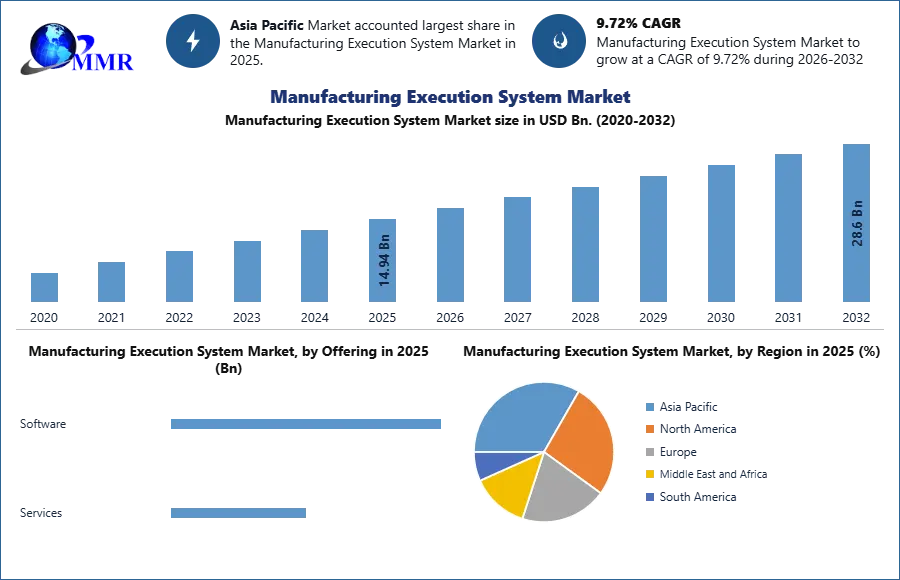
Manufacturing Execution System Market size was valued at US 15.94 Bn. in 2025 and the total revenue is expected to grow at 9.72% through 2026 to 2032, reaching nearly USD 28.6 Bn.
Manufacturing Execution System Market Overview:
Production execution systems (MES) are IT-based technologies that help production line engineers and executives ultimately enhance their operations. The main part of the system will control the complex manufacturing system connected to the monitors on the factory floor. The goal of implementing production is to ensure the effective execution of production operations and increase production output. The Manufacturing Execution System (MES) market is divided into process industry, function, discrete industry and various regions. The various functions of MES system management are document control, analysis, inventory management, production tracking, production performance analysis, resource allocation, etc. When information and data collection is automated, MES plans, tracks, and modifies production activities also monitors and controls the performance of the suite.
To know about the Research Methodology :- Request Free Sample Report
Manufacturing Execution System Market Dynamics:
The manufacturing industry is undergoing major transformations as a result of Industry 4.0 and the digitalization revolution. This manufacturing sector innovation is assisting the industry in increasing flexibility by placing an additional load on product operation while maintaining a high degree of quality. Manufacturing Execution System (MES) is a software solution that helps manufacturing companies accomplish their objectives by executing and monitoring their production processes using an ERP system. Food and beverage, chemical and pharmaceutical, oil and gas, energy, pulp and paper and other process sectors all employ MES.
The Manufacturing Execution System monitors and organises various plant-related operational operations across the world, and connects them in real time to the business for optimal use. The production execution system, which uses a computer system and electrical assistance, keeps track of all operations from the start of the product through the delivery of the order. This also leads in a reduction in paper use and, as a result, a cost reduction. The advantages of MES include the elimination of non-value factors, systematic and standard processing throughout all plants, control of all manufacturing and supply chain activities, analysis of issues from the root and immediate resolution, constant product and service improvement, and cost reduction through effective resource utilisation. MES gives a 360-degree operational perspective and provides a centralised platform for all concerns with this stakeholder may obtain total visibility with organisational operations.
According to a research carried by Jabil (a well-known manufacturing services company based in the United States) in 2018, nearly 94 percent of manufacturing companies said they were investing in areas such as IoT, intelligent digital supply chains, additive manufacturing, and automation, among other things. Production asset maintenance, manufacturing intelligence, and product quality improvement are among the possible use cases for IoT in the manufacturing industry.
However, the market's growth is being limited by challenges such as SMEs' lack of understanding of the benefits of MES systems. Additionally, the high investment and operating costs associated with the deployment and update of industrial execution systems for small-scale production are expected to stifle growth throughout the forecast period.
COVID-19 Impact:
The ongoing COVID-19 pandemic continues to cause long-term disruptions to several major processes and discrete industries. However, in the processing industry, the impact of different vertical industries is different. For example, the impact on aviation, oil and gas, and many materials industries is very large, resulting in a substantial reduction in their continuous production. During the pandemic, industries such as food and beverages, pharmaceuticals, power generation, and chemicals noticed limited damage in different economies. Therefore, the nationwide blockade to minimize the spread of the virus has severely disrupted supply chain activities and the production of many manufacturers, especially small and medium-sized business owners.
Global Manufacturing Execution System Market Segment Analysis:
The global Manufacturing Execution System Market is segmented by Offering, Deployment, Organization Size and End-User.
Based on the Offering, the global Manufacturing Execution System market is sub-segmented into Software and Services. The Services segment held the largest market share of 40.1% in 2025. Because the post-implementation process is so important to the operation of industrial execution systems, the services play an important role in increasing efficiency and lowering waste and output time. Users might get services from the producers of factory execution systems in addition to the software. Installation, training, servicing, and software updates are some of the post-sales services available. During and after deployment, the primary manufacturing execution system procedures are carried out.
Based on the End-User, the global Manufacturing Execution System market is sub-segmented into Food & Beverages, Automotive, Aerospace & Defense, Pharmaceutical, Electronics and Semiconductor, Consumer Packaged Goods and Others. The Pharmaceutical segment held the largest market share 2025. Manufacturers are under a lot of pressure to continue with changing industry dynamics and adjust their processes to satisfy new needs. Manufacturing Execution Systems (MES) aid the pharmaceutical business in lowering manufacturing costs while also guaranteeing regulatory compliance. Additionally, as concerns about fraudulent medications entering the supply chain have grown, global track and trace measures have been adopted to safeguard patient safety and maintain product integrity. Manufacturers are now attempting to assure compliance with the EU Falsified Medicine Directive (EUFMD), the US Drug Supply Chain Act (DSCSA), and other universal laws by adding innovative technology and increasing resources to manage the added administrative load.
Global Manufacturing Execution System Market Regional Insights:
Asia Pacific held the largest market share of 41.2% in 2025 and it is expected to grow at a highest CAGR of 16.1% in the global Manufacturing Execution System market during the forecast period. The manufacturing industry is one of Asia Pacific most important economic development engines. Manufacturing is a major industry in the area. Significant companies have raised their research investment in medium-technology industries such as automotive, industrial, and consumer electronics production. Due to the enormous volume of the automotive sector in the region, demand for manufacturing execution systems is likely to rise. According to the report, China has experienced growing salaries and rigorous regulations, which are likely to enhance operating costs and drive production toward higher value products.
North America held the 2nd largest market share of 29.5% in 2025. Since numerous major MES providers, such as Honeywell (United States), Oracle Corporation (United States), Emerson (United States), and Rockwell Automation (United States), among others, push innovation As a result, the participants are in a fierce battle. Additionally, North America's strong financial position allows it to spend substantially in cutting-edge solutions and technology, giving it a competitive advantage in the market. In addition, the area is witnessing a number of market participant alliances, which are assisting them in combining their solutions and offers in terms of enhancing their market position.
Recent Industry Developments (2025–2026):
| Exact Date | Company | Development | Impact |
|---|---|---|---|
| 09 March 2026 | Capgemini | Signed a definitive agreement to acquire Piterion, a specialist in Manufacturing Operations Management (MOM) and PLM integration services. | The acquisition expands Capgemini's ability to provide end-to-end industrial digitalization and cloud-native manufacturing execution solutions. |
| 22 January 2026 | Emerson | Unveiled an AI-driven Asset Performance Management solution designed to scale industrial reliability across complex manufacturing sites. | The solution leverages predictive analytics to minimize unplanned downtime and optimize throughput in execution-heavy environments. |
| 09 September 2025 | Rockwell Automation | Released a major update for the Plex MES platform, introducing new QMS APIs and enhanced document composition tools. | These enhancements improve interoperability between quality systems and manufacturing execution layers for real-time compliance tracking. |
| 13 May 2025 | Rockwell Automation | Officially launched FactoryTalk PharmaSuite 12.00, featuring a containerized architecture and modular, cloud-ready deployment tools. | The update significantly reduces system validation costs and accelerates time-to-market for regulated life sciences manufacturers. |
| 27 March 2025 | Siemens | Partnered with Audi to deploy the Simatic S7-1500V, the first completely virtual controller, for automotive body shop automation. | This collaboration advances software-defined automation and merges IT/OT levels for highly adaptable vehicle production lines. |
| 27 January 2025 | Emerson | Announced a formal proposal to acquire the remaining outstanding shares of Aspen Technology to fully integrate its software portfolio. | This strategic consolidation strengthens Emerson's position in autonomous operations and high-performance manufacturing software. |
The objective of the report is to present a comprehensive analysis of the global Manufacturing Execution System Market to the stakeholders in the industry. The past and current status of the industry with the forecasted market size and trends are presented in the report with the analysis of complicated data in simple language. The report covers all the aspects of the industry with a dedicated study of key players that include market leaders, followers, and new entrants.
PORTER, PESTEL analysis with the potential impact of micro-economic factors of the market has been presented in the report. External as well as internal factors that are supposed to affect the business positively or negatively have been analyzed, which will give a clear futuristic view of the industry to the decision-makers.
The reports also helps in understanding the global Manufacturing Execution System Market dynamic, structure by analyzing the market segments and project the global Manufacturing Execution System Market size. Clear representation of competitive analysis of key players by product, price, financial position, product portfolio, growth strategies, and regional presence in the global Manufacturing Execution System Market make the report investor’s guide.
Global Manufacturing Execution System Market Scope: Inquiry Before Buying
| Manufacturing Execution System Market | |||
|---|---|---|---|
| Report Coverage | Details | ||
| Base Year: | 2025 | Forecast Period: | 2026-2032 |
| Historical Data: | 2020 to 2025 | Market Size in 2025: | 14.94 USD Bn. |
| Forecast Period 2026-2032 CAGR: | 9.72% | Market Size in 2032: | 28.6 USD Bn. |
| Segments Covered: | by Offering | Software Services |
|
| by Deployment | On-premise On-demand Hybrid |
||
| by Organization Size | Small and Medium Size Enterprise Large Enterprise |
||
| by End User | Food & Beverages Automotive Aerospace & Defense Pharmaceutical Electronics and Semiconductor Consumer Packaged Goods Others |
||
Global Manufacturing Execution System Market, by Region:
Asia Pacific (China, South Korea, Japan, India, Australia, Indonesia, Malaysia, Vietnam, Taiwan, Bangladesh, Pakistan and Rest of APAC)
Europe (UK, France, Germany, Italy, Spain, Sweden, Austria and Rest of Europe)
North America (United States, Canada and Mexico)
Middle East and Africa (South Africa, GCC, Egypt, Nigeria and Rest of ME&A)
South America (Brazil, Argentina Rest of South America)
Key Players / Competitors Profiles Covered in Brief in Global Manufacturing Execution System Market Report in Strategic Perspective:
- Siemens
- Rockwell Automation
- SAP
- ABB
- Werum It Solutions
- Honeywell International
- AVEVA
- Applied Materials
- Yokogawa Electric
- Emerson Electric
- Schneider Electric
- GE Digital
- Oracle
- Körber AG
- Critical Manufacturing
- MPDV Mikrolab
- Aptean
- iBASEt
- Parsec Automation
- Aegis Software
- Epicor Software
- Infor
- 42Q
- Aspen Technology
- Andea Solutions