
Low Calorie Food Market– Industry Structure Evaluation, Demand Drivers Analysis, Regional Growth Analysis and Identification, Competitive Positioning Review & Global Market Size Forecast to 2030
Overview
The Low Calorie Food Market size was valued at USD 12.43 Billion in 2023 and the total Low Calorie Food revenue is expected to grow at a CAGR of 6.5% from 2024 to 2030, reaching nearly USD 19.33 Billion.
Low Calorie Food Market Overview
The low-calorie market focuses on food and beverage products with reduced calorie content, catering to health-conscious individuals seeking healthier alternatives. It encompasses various sectors such as food, beverages, snacks, desserts, condiments, and meal replacements. The market has experienced significant growth recently, with global estimates reaching billions of dollars. North America, Europe, and Asia Pacific are prominent regions driving this growth. The market's growth is attributed to increasing consumer awareness about health and wellness and rising obesity rates.
Coca-Cola, PepsiCo, Nestlé, General Mills, and Unilever are the major players in the low-calorie market. These companies offer a range of low-calorie options within their product portfolios, from diet sodas to reduced-fat snacks and low-calorie frozen meals. Smaller, niche brands also contribute to the market, offering innovative and specialized low-calorie products. The growth potential for the low-calorie market remains significant due to the rising demand for healthier options and the increasing focus on weight management. Governments and health organizations are actively promoting healthier eating habits, further driving the market growth. The market's competitiveness is evident, with major players and smaller brands vying to capture their share in this expanding market.
 To know about the Research Methodology :- Request Free Sample Report
Low Calorie Food Market Report Scope
The scope of the low-calorie food market report encompasses a comprehensive analysis of key aspects within the industry. Reports include market segmentation based on product type, distribution channel, and geographical regions. The report includes an assessment of the current market size, growth potential, and competitive landscape. It includes examine consumer trends and preferences, considering factors such as health consciousness and convenience. The regulatory environment surrounding low-calorie food products, including labeling requirements and food safety regulations, will also be analysed. The regional analysis will highlight market trends specific to different areas. Insights into prospects, emerging trends, and recommendations for stakeholders will be provided.
Low Calorie Food Market Dynamics
Low Calorie Food Market Drivers
The low-calorie food market's growth is predominantly driven by increasing health awareness among consumers prompting a demand for healthier options. Rising global obesity, rates further fuel the need for low-calorie alternatives. Government initiatives that promote low-calorie food raise awareness and drive market growth. Dietary restrictions/preferences contribute to the market's expansion. Technological advancements produce appealing low-calorie alternatives. The expansion of retail and e-commerce channels enhances accessibility. These drivers collectively propel the market, creating opportunities for manufacturers to meet the demands of health-conscious consumers.
Low Calorie Food Market Challenges
One key challenge is creating low-calorie foods that are both nutritious and appealing in taste. Overcoming the perception that low-calorie products compromise on flavor is crucial to their acceptance by consumers. Additionally, the cost and affordability of producing low-calorie alternatives pose a hurdle, as specialized ingredients and research increase production expenses. Building consumer trust is another challenge, as skepticism exists regarding the effectiveness and authenticity of low-calorie foods. The fierce market competition requires effective branding and innovative strategies to stand out. Compliance with regulatory standards regarding labeling and health claims adds complexity. Sourcing low-calorie ingredients and maintaining a stable supply chain is challenging. Increasing consumer awareness about low-calorie food and debunking misconceptions about them is an ongoing process.
Low Calorie Food Market Opportunities
The low-calorie food market presents promising opportunities for growth due to increasing health consciousness, rising obesity rates, dietary preferences, innovative product development, retail and e-commerce expansion, collaborations, and global market reach. The emphasis on health and wellness drives demand for low-calorie options, while the prevalence of obesity necessitates nutritious alternatives. Specific dietary preferences like gluten-free and vegan diets create niche markets. Innovative product development that replicates high-calorie foods attracts more consumers. The accessibility provided by retail and e-commerce channels widens the market reach. Collaborations with fitness centers and wellness brands create synergies. Expanding into global markets and adapting to cultural preferences unlocks further growth potential. By leveraging these opportunities, businesses can thrive in the dynamic low-calorie food market.
Low Calorie Food Market Trends
Trends in the low-calorie food market vary across regions, countries, and globally, driven by distinct factors and consumer preferences. Regionally, different areas exhibit specific trends based on cultural influences, dietary habits, and local market dynamics. In North America, there is a growing demand for plant-based alternatives and clean-label ingredients. In Europe, the focus is on organic and sustainable low-calorie options. Asia-Pacific showcases trends such as functional low-calorie foods and the incorporation of traditional ingredients into low-calorie products.
Country-wise, specific factors shape trends. The American market inclines low-calorie snacks and beverages, while the Indian market has demanded low-calorie options with traditional flavors. Country-specific health concerns, like obesity or diabetes, greatly influence the demand for low-calorie food products.
Globally, broad patterns start to form. Sustainability and environmentally friendly packaging are two other major trends, along with the growing desire for plant-based alternatives and clear, honest labeling. These tendencies reveal consumers' rising concern for their health and their openness to trying new, lower-calorie food options.
Low Calorie Food Market Regional Analysis
North America sees high demand for low-calorie snacks, beverages, and meal replacements, driven by health-conscious consumers who prioritize clean labels and convenience. Europe emphasizes sustainability, organics, and local sourcing, with growing interest in plant-based alternatives and functional low-calorie foods. In Asia-Pacific, increasing health awareness and evolving lifestyles drive demand for low-calorie options incorporating traditional flavors, alongside functional low-calorie foods. South America shows rising interest in low-calorie products due to a focus on healthy living and weight management. The Middle East and Africa witness growing awareness of low-calorie options amid changing dietary habits and obesity concerns. Regional cultural, social, and economic factors shape consumer preferences, enabling businesses to tailor strategies and offerings to meet specific market demands.
Low Calorie Food Market Segment Analysis
The low-calorie food market is analyzed through segment analysis, which identifies distinct categories catering to specific consumer preferences. One prominent segment is low-calorie beverages, encompassing diet sodas, flavored water, and sugar-free juices, providing flavourful options with reduced calorie content. Another significant segment focuses on low-calorie snacks and desserts, including baked chips, protein bars, and low-sugar cookies, offering satisfying treats with lower calorie counts. Meal replacements form a separate segment, providing convenient options like shakes, bars, and pre-packaged meals, allowing individuals to manage their calorie intake while ensuring balanced nutrition. Calorie-conscious consumers are demanding low-calorie condiments and sauces. The most popular condiments among customers have been sugar-free ketchup, light salad dressings, and reduced-fat mayonnaise.
Low Calorie Food market competitive landscape
There is fierce competition in this market between beverage companies. This competitive market includes Nestle, PepsiCo, Coca-Cola, and General Mills. Private label and shop brands also matter. Businesses create new products, flavors, and packaging to stay competitive. Low-calorie solutions are in demand, which will increase competition. To satisfy health-conscious consumers in this dynamic market, product differentiation, focused marketing, and portfolio development are necessary. Product variety, brand familiarity, health and wellness trends, ingredient transparency, and innovation make the low-calorie food market competitive. This store sells low-calorie snacks, beverages, frozen dinners, and meal replacements. Nestle, PepsiCo, Coca-Cola, and General Mills influence customer tastes.
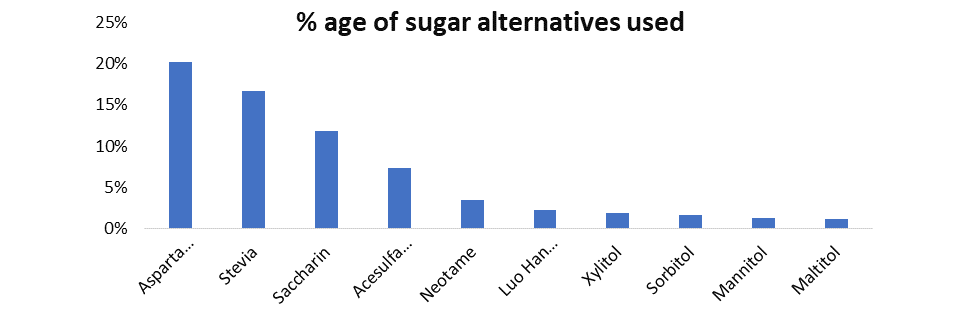 The most popular substitute sugar is sucralose. It holds 32.4% of the global alternative sugar market. Sucralose is 600 times sweeter than sugar and has zero calories. It is in soft drinks, candies, and baked products.
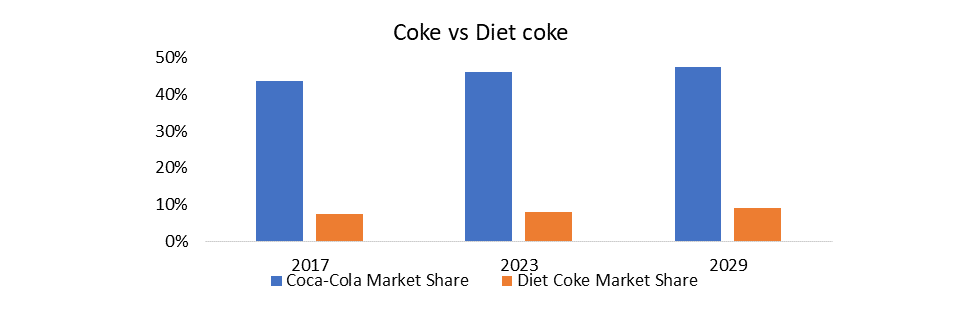 Coca-Cola has a larger market share than Diet Coke in all three years this is because Coca-Cola has been around for longer, has been more widely available, and is more affordable.
Low Calorie Food Market Scope: Inquire before buying
| Low Calorie Food Market | |||
|---|---|---|---|
| Report Coverage | Details | ||
| Base Year: | 2023 | Forecast Period: | 2024-2030 |
| Historical Data: | 2018 to 2023 | Market Size in 2023: | USD 12.43 billion |
| Forecast Period 2024 to 2030 CAGR: | 6.5% | Market Size in 2030: | USD 19.33 billion |
| Segments Covered: | by Product type | Snacks Beverage Frozen meals Baked goods Dairy products |
|
| by distribution channel | Supermarket Hypermarket Convenience stores Online retail stores |
||
| by packaging type | Bottles Cans Pouches |
||
| by ingredients | Natural sweeteners Sugar substitutes Low fat Fat-free Plant-based |
||
| by by brand positioning | Mainstream Health-focused Organic or natural Specialty |
||
Low Calorie Food Market, by Region
North America (United States, Canada and Mexico)
Europe (UK, France, Germany, Italy, Spain, Sweden, Austria and Rest of Europe)
Asia Pacific (China, South Korea, Japan, India, Australia, Indonesia, Malaysia, Vietnam, Taiwan, Bangladesh, Pakistan and Rest of APAC)
Middle East and Africa (South Africa, GCC, Egypt, Nigeria and Rest of ME&A)
South America (Brazil, Argentina Rest of South America)
Company Profile: Low-calorie food Key players
North America:
1. General Mills (United States)
2. Kraft Heinz Company (United States)
3. Campbell Soup Company (United States)
4. Conagra Brands (United States)
5. Kellogg Company (United States)
6. Mondelez International (United States)
7. The Hershey Company (United States)
8. Abbott Nutrition (United States)
9. The J.M. Smucker Company (United States)
10.Hormel Foods Corporation (United States)
Europe:
1. Nestle (Switzerland)
2. Unilever (Netherlands/United Kingdom)
3. Danone (France)
4. Premier Foods (United Kingdom)
5. Dr. Oetker (Germany)
6. Barilla Group (Italy)
7. FrieslandCampina (Netherlands)
8. Orkla ASA (Norway)
9. Arla Foods (Denmark)
10.Grupo Siro (Spain)
Asia Pacific:
1. Nestle (Switzerland)
2. Unilever (Netherlands/United Kingdom)
3. Danone (France)
4. Premier Foods (United Kingdom)
5. Dr. Oetker (Germany)
6. Barilla Group (Italy)
7. FrieslandCampina (Netherlands)
8. Orkla ASA (Norway)
9. Arla Foods (Denmark)
10.Grupo Siro (Spain)
Middle East and Africa:
1. Yili Group (China)
2. CJ CheilJedang Corporation (South Korea)
3. Marico Limited (India)
4. Meiji Co., Ltd. (Japan)
5. Sanitarium Health Food Company (Australia)
6. Uni-President Enterprises Corporation (Taiwan)
7. Thai Union Group (Thailand)
8. McCormick & Company, Inc. (Singapore)
9. Suntory Beverage & Food Limited (Japan)
10.Vitasoy International Holdings Limited (Hong Kong)
South America:
1. BRF S.A. (Brazil)
2. Bunge Limited (Brazil)
3. Cargill Incorporated (United States/Brazil)
4. JBS S.A. (Brazil)
5. Molinos Rio de la Plata (Argentina)
6. Grupo Arcor (Argentina)
7. Compania de Alimentos Fargo S.A. (Colombia)
8. Postobon S.A. (Colombia)
9. Marfrig Global Foods S.A. (Brazil)
10.Grupo Bimbo (Mexico)
FAQs
1: What are the key drivers fuelling the growth of the low-calorie food market?
Ans: The increasing health consciousness among consumers, rising obesity rates, and the growing demand for weight management solutions are driving the growth of the low-calorie food market.
2: Which regions are witnessing the highest demand for low-calorie food products?
Ans: North America and Europe are currently the leading regions in terms of demand for low-calorie food products. However, the market is also expanding rapidly in the Asia Pacific, driven by changing dietary patterns and increasing health awareness.
3: What are the main challenges faced by the low-calorie food market?
Ans: Some of the key challenges in the low-calorie food market include competition from traditional, high-calorie alternatives, taste and texture limitations of low-calorie products, and the need for effective marketing strategies to educate consumers about the benefits of low-calorie options.
4: What are the opportunities for growth in the low-calorie food market?
Ans: The market presents opportunities for innovation and product development, particularly in the areas of clean-label ingredients, plant-based alternatives, functional foods, and personalized nutrition. Additionally, the growing online retail sector provides avenues for reaching a wider consumer base.
5: Who are the major players in the low-calorie food market?
Ans: The market is highly competitive, with major players including well-known food and beverage companies, specialized health brands, and emerging startups. Key players in the market include Nestle, PepsiCo, Coca-Cola, and General Mills, among others.