Logistics Market by Transportation Mode, Logistics Type, End Use and Region - Global Market Size Estimation, Industry-Wide Analysis, Competitive Landscape Assessment & Long-Term Forecast to 2032

7.2%
CAGR (2026-2032)
318.44 USD Bn.
Market Size
318
Report Pages
136
Market Tables

Overview

The Global Logistics Market is expected to grow from USD 318.44 Billion in 2025 to USD 518.08 Billion by 2032, at a CAGR of 7.2%, driven by e-commerce expansion, IoT-enabled tracking, automation, AI-driven supply chain management, and smart multimodal transport solutions.

Global Logistics Market Key Highlights:

• E-commerce Growth: Global e-commerce sales surged from USD 4.98 trillion in 2021 to USD 6.86 trillion in 2025, driving demand for last-mile and cross-border logistics.
• Parcel Volume: China leads with over 900 million parcels annually, followed by the USA with 500 million and Germany at 400 million, emphasizing concentrated logistics activity.
• Automation Adoption: 53% of OECD logistics firms use robotics in warehouses, improving operational efficiency and handling over 1.2 million shipments daily in high-volume regions.
• Delivery Efficiency: Average urban delivery time decreased from 2.36 days in 2022 to 2.15 days in 2023, reflecting enhanced performance through micro-fulfilment centers and regional hubs.
• Dominating Region – Asia Pacific: Asia Pacific leads global logistics, handling over 1.8 billion e-commerce parcels annually, driven by China, India, and Southeast Asia’s rapid digital commerce expansion.
• IoT & Digital Logistics: 48% of advanced economy logistics firms leverage IoT tracking, while 67% of cross-border operators utilize digital documentation for predictive delivery and supply chain transparency.
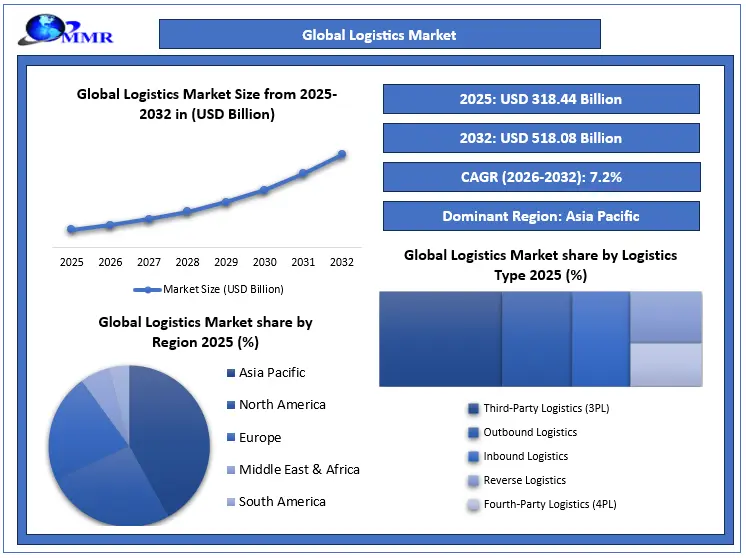
Logistics Market Shares

To know about the Research Methodology :- Request Free Sample Report

Logistics Market Trends – Consumer Demand for Faster Last-Mile Delivery

The global logistics market is increasingly shaped by consumer demand for faster last-mile delivery, driven by the surge in e-commerce and urban online shopping. Last-mile deliveries are projected to grow 78% globally by 2030, while delivery vehicles may increase 36% in the 100 busiest cities, contributing up to 13% of urban emissions. Average urban delivery time decreased from 2.36 days (2022) to 2.15 days (2023), reflecting operational responsiveness.

• Micro-fulfilment centres and regional hubs for faster e-commerce logistics.
• KPIs aligned with World Bank LPI to monitor efficiency and consumer satisfaction.
• Collaboration with municipalities to manage congestion and optimize freight and cargo transportation.
• Adoption of green logistics and low-emission vehicles to reduce environmental impact.

Logistics Market Drivers – E-Commerce & Online Shopping Expansion

The global logistics market growth is significantly driven by the rapid expansion of e commerce and online shopping, which increases demand for transportation, warehousing, fulfilment, and last mile delivery services. Global e commerce sales rose from nearly USD 4.98 trillion in 2021 to nearly USD 6.86 trillion in 2025, with forecasts exceeding USD 8 trillion by 2027, reflecting sustained expansion of digital commerce. The number of online shoppers grew from 2.37 billion in 2020 to nearly 2.77 billion in 2025, with online retail accounting for around 21–22.5% of global retail sales by 2025. This structural shift drives higher volumes requiring third party logistics (3PL), enhanced supply chain management, digital logistics, and real time logistics tracking solutions to support cross border fulfilment and delivery optimization.

Logistics Market Opportunities – Technology-Enabled & Personalized Logistics

• Digital Infrastructure Adoption: High-income and 32% of developing countries’ logistics firms leverage cloud-based logistics platforms for real-time shipment visibility and coordination.
• Automation & Robotics: 53% of OECD logistics companies use robotics for warehousing, enhancing operational efficiency and throughput.
• IoT-Enabled Tracking: 48% adoption in advanced economies enables precise cargo monitoring, predictive delivery, and smart logistics solutions.
• Digital Documentation: 67% of cross-border operators implement electronic workflows for streamlined supply chain management.
• Blockchain & AI Integration: 45% exploring blockchain for transparency and AI-driven analytics for predictive insights, creating strategic differentiation.

Logistics Market Restraints – Rising Logistics & Transportation Costs

Rising logistics and transportation costs are constraining the global logistics market, impacting supply chain efficiency, delivery pricing, and consumer satisfaction. In India, total logistics expenditure accounted for 7.97% of GDP in 2024 and 9.09% of non-services output, with freight costs exceeding 80% of total logistics spending. Transport mode costs range from ₹1.96/tonne km (rail) to ₹72/tonne km in air, while labor and warehousing costs add further financial pressures, highlighting the need for smart logistics solutions, automation, and digital logistics platforms.

• Operational Optimization: Optimize multimodal transport for cost, speed, and service, and implement IoT- and AI-enabled supply chain management to enhance efficiency.
• Technology & Sustainability Investment: Invest in automated warehousing, handling technologies, and adopt green logistics solutions for cost-effective and eco-friendly last-mile delivery.

Logistics Market Technology Impact Matrix

Technology Warehousing Efficiency Transportation Visibility Route Optimization Coordination & Control Emissions Management
Automation & Robotics High Low Low Medium Medium
IoT Tracking Low High Medium Medium Medium
AI-Based Planning Medium Medium High High Medium
Cloud Platforms Medium Medium Medium High Low
Green Logistics Low Low Medium Low High

Global Logistics Market Analysis by Segments

The Global Logistics Market segmentation reveals how transportation modes, service types, logistics types, and end use industries drive operational strategy, cost efficiency, and growth forecasts. Asia Pacific dominates volume and segment demand within the global supply chain and logistics market outlook.

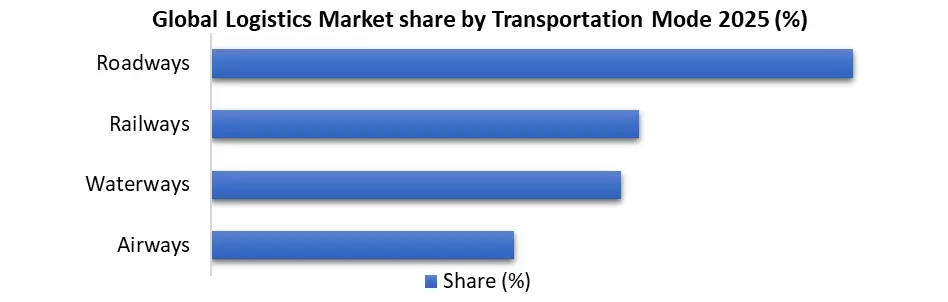
By Transportation Mode: Rail, road, waterways, and air define cost speed trade offs and service reach. In 2025, road and air transport together held nearly 45% share of intermodal freight value, while rail remains cost efficient for bulk freight and essential to multimodal logistics strategies within global supply chains.Logistics by transportation mode
By Service Type: Core logistics functions encompass transportation, warehousing, inventory management, order fulfilment, packaging, material handling, reverse logistics, and solutions that improve delivery performance and supply chain responsiveness across industries.
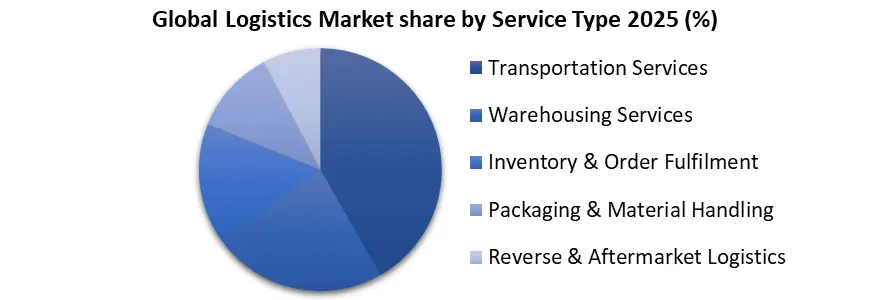
Logistics by service type
Logistics Market Regional Insights

The global logistics market is increasingly driven by high-volume parcel flows, with Asia Pacific dominating last-mile delivery and supply chain operations. China leads with over 900 million parcels annually, followed by the USA with 500 million parcels and Germany at 400 million parcels, highlighting concentrated e-commerce logistics activity. This surge underscores demand for digital logistics, IoT-enabled shipment tracking, AI in supply chain management, and smart logistics solutions to improve operational efficiency, predictive delivery, and personalized services. These regions represent strategic hubs for optimizing transportation, warehousing, and third-party logistics capabilities across global supply chains.

• Invest in automation and robotics to manage 1.2 million daily shipments in Europe and 850,000 parcels per day in India, enhancing efficiency.
• Expand cloud-based and IoT-enabled logistics platforms to track 1.8 billion e-commerce parcels across top markets, optimize multi-modal transport, and enable predictive analytics for faster, reliable deliveries.
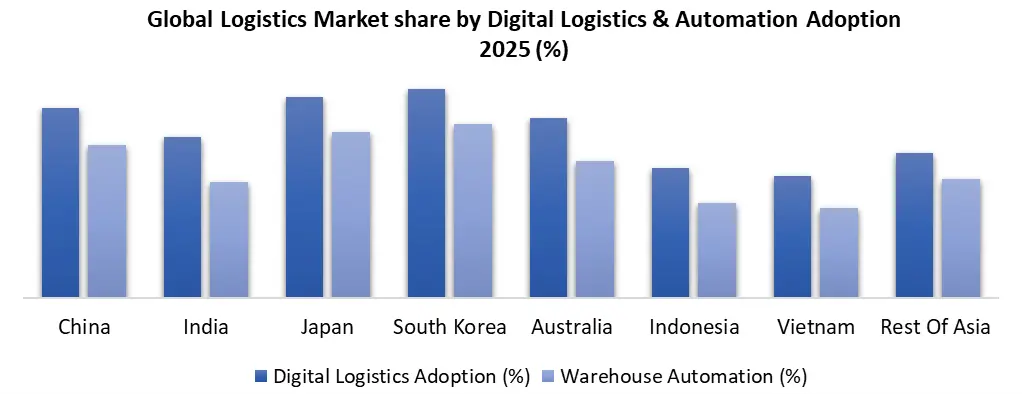
Logistics by automation

Logistics Market Competitive Landscape

• Global and regional logistics integrators such as DHL, Kuehne + Nagel, DSV, UPS, and Sinotrans leverage multimodal transportation, cross-border logistics compliance, and digital logistics tracking to serve high-volume international supply chains. North America specialists and emerging regional players focus on last-mile delivery, domestic freight, and e-commerce logistics, optimizing transportation, warehousing, and third-party logistics capabilities.

• Specialized providers such as Lineage Logistics and Americold operate over 120 temperature-controlled warehouses globally, serving 400 million cold chain shipments annually, differentiating through IoT-enabled monitoring, predictive analytics, and AI-driven supply chain management to strengthen last-mile delivery efficiency.

Logistics Market Recent Developments

Company Year Development Business Implication
DHL Group 2025 Opened Europe Innovation Center (5,360 m²) for AI, robotics, IoT, sustainability Strengthens innovation and digital/logistics automation across Europe & global network
DHL Group 2025 EUR 500 million investment in Middle East logistics (2024–2030) Enhances express delivery, freight, warehousing & regional trade connectivity
Kuehne + Nagel 2025 Launched air logistics gateway in Bengaluru, India Increases cross-border capacity & service reliability for healthcare, tech, and automotive logistics
CEVA Logistics 2026 Opened eCommerce warehouse in Dubai Expands regional fulfillment & contract logistics for Middle East e-commerce market
CEVA Logistics 2025 Tested 100% electric heavy-duty truck in Spain Advances sustainable logistics and reduces road freight emissions

Logistics Market Scope: Inquiry Before Buying

Logistics Market
Report Coverage Details
Base Year: 2025 Forecast Period: 2026-2032
Historical Data: 2020 to 2025 Market Size in 2025: USD 318.44 Bn.
Forecast Period 2026 to 2032 CAGR: 7.2% Market Size in 2032: USD 518.08 Bn.
Segments Covered: by Transportation Mode Railways
Roadways
Waterways
Airways
by Service Type Transportation
Warehousing
Inventory & Order Fulfilment
Packaging & Material Handling
Reverse & Aftermarket Services
by Logistics Type Inbound Logistics
Outbound Logistics
Reverse Logistics
Third-Party Logistics (3PL)
Fourth-Party Logistics (4PL)
by Technology Conventional Logistics Services
Digital Logistics
Smart and Automated Logistics
IoT-Enabled Logistics Solutions
AI and Data-Driven SCM
by End Use Healthcare
Manufacturing
Aerospace
Telecommunication
Government & Public Utilities
Banking & Financial Services
Retail
Media & Entertainment
Technology
Trade & Transportation
Others

Logistics Market, by Region:

North America (United States, Canada and Mexico)
Europe (UK, France, Germany, Italy, Spain, Sweden, Austria and Rest of Europe)
Asia Pacific (China, South Korea, Japan, India, Australia, Indonesia, Malaysia, Vietnam, Taiwan, Bangladesh, Pakistan and Rest of APAC)
Middle East and Africa (South Africa, GCC, Egypt, Nigeria and Rest of ME&A)
South America (Brazil, Argentina Rest of South America)

Global Logistics Market Key players:

1) DHL
2) Kuehne + Nagel
3) DSV A/S
4) DB Schenker
5) CEVA Logistics
6) A.P. Moller – Maersk
7) C.H. Robinson Worldwide
8) UPS Supply Chain Solutions
9) Expeditors International
10) Sinotrans Limited
11) GXO Logistics
12) J.B. Hunt Transport Services
13) Rhenus Logistics
14) DACHSER
15) DP World Logistics
16) Ryder Supply Chain Solutions
17) Nippon Express
18) Kintetsu World Express
19) CJ Logistics
20) Lineage Logistics
21) Delhivery
22) Blue Dart Express
23) Mahindra Logistics
24) Allcargo Logistics
25) Safexpress
26) Gati-Kintetsu Express
27) Hellmann Worldwide Logistics
28) Penske Logistics
29) Americold Logistics
30) Imperial Logistics

FAQs of Global Logistics Market:

Q1: What is driving the growth of the global logistics market?
A1: The growth is driven by e-commerce expansion, IoT-enabled tracking, automation, AI-driven supply chain management, and smart multimodal transport solutions.

Q2: Which region dominates the global logistics market?
A2: Asia Pacific dominates, handling over 1.8 billion e-commerce parcels annually, led by China, India, and Southeast Asia.

Q3: How is technology transforming logistics operations?
A3: Adoption of robotics, IoT-enabled tracking, cloud platforms, and AI enhances operational efficiency, predictive delivery, and supply chain transparency.

Q4: What are the main challenges in logistics?
A4: Rising transportation, labor, and warehousing costs, along with freight expenditure exceeding 80% of logistics spending, constrain efficiency and pricing.

Q5: What are the major opportunities in the logistics market?
A5: Opportunities include cloud-based platforms, automation & robotics, IoT-enabled tracking, digital documentation, blockchain, and AI-driven predictive analytics for supply chain optimization.

Table of Contents

1. Logistics Market Introduction 1.1. Study Assumption and Market Definition 1.2. Scope of the Study 1.3. Executive Summary 2. Global Logistics Market: Competitive Landscape 2.1. MMR Competition Matrix 2.2. Key Players Benchmarking 2.2.1. Company Name 2.2.2. Headquarter 2.2.3. Transportation Mode Segment 2.2.4. End-User Segment 2.2.5. Revenue Details in 2025 2.2.6. Market Share (%) 2.2.7. Growth Rate (%) 2.2.8. Return on Investment (%) 2.2.9. Technological Capabilities 2.2.10. Geographical Presence 2.3. Market Structure 2.3.1. Market Leaders 2.3.2. Market Followers 2.3.3. Emerging Players 2.4. Mergers and Acquisitions Details 3. Logistics Market: Dynamics 3.1. Logistics Market Trends 3.2. Logistics Market Dynamics 3.2.1. Drivers 3.2.2. Restraints 3.2.3. Opportunities 3.2.4. Challenges 3.3. PORTER’s Five Forces Analysis 3.4. PESTLE Analysis 3.5. Regulatory Landscape by Region 3.6. Key Opinion Leader Analysis for the Global Industry 3.7. Analysis of Government Schemes and Initiatives for Industry 4. Regional Logistics Production and Market Analysis 4.1. Major logistics hubs and infrastructure clusters by region (Asia-Pacific, Europe, North America) 4.2. Freight movement statistics by mode (road, rail, air, waterways, multimodal) 4.3. Regional dependence on cross-border trade and supply chain concentration risks 4.4. Role of government logistics policies, trade facilitation programs, and infrastructure incentives 4.5. Integration between shippers, 3PLs, 4PLs, ports, airports, and last-mile operators 5. Pricing and Cost Analysis 5.1. Historical and current logistics cost trends by region and transport mode 5.2. Pricing comparison by service type (freight forwarding, warehousing, last-mile delivery) 5.3. Impact of fuel costs, labor, warehousing rents, and technology adoption on logistics pricing 5.4. Global logistics cost structure: transportation, storage, handling, IT, and distribution 5.5. Cost volatility, margin pressure, and service affordability analysis 6. Customer Behavior and Demand Patterns 6.1. Logistics demand by end-user industry (retail, manufacturing, healthcare, automotive) 6.2. Regional preferences for express, standard, cold chain, and reverse logistics 6.3. Seasonal demand spikes, e-commerce events, and urban vs. rural delivery patterns 6.4. Sustainability expectations, delivery speed preferences, and service customization trends 6.5. Correlation between consumption growth, urbanization, and logistics demand 6.6. Market penetration by SME vs. enterprise customers and geographic density 7. Import and Trade Analysis 7.1. Global freight import–export volumes by region and corridor 7.2. Trade flow dynamics between producing and consuming regions 7.3. Impact of trade policies, tariffs, customs procedures, and border delays 7.4. Export opportunities in value-added logistics, cold chain, and e-commerce fulfillment 7.5. Trade balance implications on regional logistics capacity and competitiveness 8. Regional Logistics Market Overview 8.1. High-volume logistics regions by shipment flow and network density 8.2. Distribution reach, fulfillment center density, and last-mile coverage by region 8.3. Urbanization, income growth, and logistics service diversification correlation 8.4. Logistics demand growth in emerging economies and secondary cities 8.5. High-growth logistics corridors and future expansion hotspots 9. Logistics Technology and Service Innovation 9.1. Adoption of digital logistics, smart warehousing, and automated handling systems 9.2. Use of AI, predictive analytics, route optimization, and real-time tracking 9.3. Compliance with safety, emissions, and operational standards in logistics operations 9.4. Innovation in cold chain, battery logistics, and specialized cargo handling 9.5. Software platforms, cloud-based TMS/WMS, and logistics digitalization 10. E-Commerce and Digital Transformation 10.1. Growth of e-commerce logistics and omnichannel fulfillment models 10.2. Subscription-based logistics, contract logistics, and B2B fleet solutions 10.3. Expansion of D2C fulfillment and platform-based logistics providers 10.4. Role of customer feedback, SLA performance, and retention metrics 10.5. Impact of last-mile delivery innovation and virtual logistics platforms 11. Sustainability and ESG Practices 11.1. Low-emission transportation, electric delivery fleets, and fuel optimization 11.2. Sustainable warehousing, packaging reduction, and circular logistics practices 11.3. Climate-resilient logistics infrastructure and energy-efficient facilities 11.4. Workforce development, safety programs, and community engagement 11.5. ESG reporting, certifications, and global compliance requirements 12. Global Logistics Statistical and Comparative Analysis 12.1. Per capita parcel volume and shipment intensity by region 12.2. Growth comparison across freight, express, and last-mile logistics 12.3. Cost sensitivity, service differentiation, and premium logistics analysis 12.4. Network efficiency, asset utilization, and supply chain performance metrics 12.5. Correlation between economic growth, trade activity, and logistics demand 13. Logistics Infrastructure, Storage, and Distribution Analysis 13.1. Warehousing capacity, fleet size, and distribution center infrastructure 13.2. Regional infrastructure gaps, congestion points, and bottlenecks 13.3. Cold chain, hazardous goods, and battery storage challenges 13.4. Adoption of smart warehouses, IoT monitoring, and automation 13.5. Cost optimization, resilience planning, and risk mitigation strategies 14. Operations and Supply Chain Analysis 14.1. Global sourcing, routing strategies, and network optimization 14.2. Role of shippers, 3PLs, 4PLs, and integrators in service delivery 14.3. Order processing, packaging, inventory, and fulfillment efficiency 14.4. Impact of disruptions, labor shortages, and geopolitical risks 14.5. Strategies for resilient, flexible, and sustainable logistics operations 15. Investment and Funding Landscape 15.1. Investment trends in logistics infrastructure, automation, and digital platforms 15.2. M&A activity and strategic partnerships among logistics providers 15.3. Venture capital interest in tech-enabled and last-mile logistics startups 15.4. Capacity expansion investments in warehousing and fleet electrification 15.5. Outlook for returns, consolidation, and long-term capital deployment 16. Regulatory and Compliance Landscape 16.1. Global transportation safety, labor, and operational regulations 16.2. Emissions standards, green logistics incentives, and carbon regulations 16.3. Data privacy, digital documentation, and cross-border compliance 16.4. Regulations for hazardous goods, cold chain, and waste logistics 16.5. Regulatory impact on market entry, service innovation, and technology adoption 17. Logistics Market: Global Market Size and Forecast by Segmentation (by Value in USD Million) (2025-2032) 17.1. Logistics Market Size and Forecast, By Transportation Mode (2025-2032) 17.1.1. Railways 17.1.2. Roadways 17.1.3. Waterways 17.1.4. Airways 17.2. Logistics Market Size and Forecast, By Service Type (2025-2032) 17.2.1. Transportation 17.2.2. Warehousing 17.2.3. Inventory & Order Fulfillment 17.2.4. Packaging & Material Handling 17.2.5. Reverse & Aftermarket Services 17.3. Logistics Market Size and Forecast, By Logistics Type (2025-2032) 17.3.1. Inbound Logistics 17.3.2. Outbound Logistics 17.3.3. Reverse Logistics 17.3.4. Third-Party Logistics (3PL) 17.3.5. Fourth-Party Logistics (4PL) 17.4. Logistics Market Size and Forecast, By Technology (2025-2032) 17.4.1. Conventional Logistics Services 17.4.2. Digital Logistics 17.4.3. Smart and Automated Logistics 17.4.4. IoT-Enabled Logistics Solutions 17.4.5. AI and Data-Driven SCM 17.5. Logistics Market Size and Forecast, By End User (2025-2032) 17.5.1. Healthcare 17.5.2. Manufacturing 17.5.3. Aerospace 17.5.4. Telecommunication 17.5.5. Government & Public Utilities 17.5.6. Banking & Financial Services 17.5.7. Retail 17.5.8. Media & Entertainment 17.5.9. Technology 17.5.10. Trade & Transportation 17.5.11. Others 17.6. Logistics Market Size and Forecast, By Region (2025-2032) 17.6.1. North America 17.6.2. Europe 17.6.3. Asia Pacific 17.6.4. Middle East and Africa 17.6.5. South America 18. North America Logistics Market Size and Forecast by Segmentation (by Value in USD Million) (2025-2032) 18.1. North America Logistics Market Size and Forecast, By Transportation Mode (2025-2032) 18.1.1. Railways 18.1.2. Roadways 18.1.3. Waterways 18.1.4. Airways 18.2. North America Logistics Market Size and Forecast, By Service Type (2025-2032) 18.2.1. Transportation 18.2.2. Warehousing 18.2.3. Inventory & Order Fulfillment 18.2.4. Packaging & Material Handling 18.2.5. Reverse & Aftermarket Services 18.3. North America Logistics Market Size and Forecast, By Logistics Type (2025-2032) 18.3.1. Inbound Logistics 18.3.2. Outbound Logistics 18.3.3. Reverse Logistics 18.3.4. Third-Party Logistics (3PL) 18.3.5. Fourth-Party Logistics (4PL) 18.4. North America Logistics Market Size and Forecast, By Technology (2025-2032) 18.4.1. Conventional Logistics Services 18.4.2. Digital Logistics 18.4.3. Smart and Automated Logistics 18.4.4. IoT-Enabled Logistics Solutions 18.4.5. AI and Data-Driven SCM 18.5. North America Logistics Market Size and Forecast, By End User (2025-2032) 18.5.1. Healthcare 18.5.2. Manufacturing 18.5.3. Aerospace 18.5.4. Telecommunication 18.5.5. Government & Public Utilities 18.5.6. Banking & Financial Services 18.5.7. Retail 18.5.8. Media & Entertainment 18.5.9. Technology 18.5.10. Trade & Transportation 18.5.11. Others 18.6. North America Logistics Market Size and Forecast, by Country (2025-2032) 18.6.1. United States 18.6.2. Canada 18.6.3. Mexico 19. Europe Logistics Market Size and Forecast by Segmentation (by Value in USD Million) (2025-2032) 19.1. Europe Logistics Market Size and Forecast, By Transportation Mode (2025-2032) 19.2. Europe Logistics Market Size and Forecast, By Service Type (2025-2032) 19.3. Europe Logistics Market Size and Forecast, By Logistics Type (2025-2032) 19.4. Europe Logistics Market Size and Forecast, By Technology (2025-2032) 19.5. Europe Logistics Market Size and Forecast, By End User (2025-2032) 19.6. Europe Logistics Market Size and Forecast, by Country (2025-2032) 19.6.1. United Kingdom 19.6.1.1. United Kingdom Logistics Market Size and Forecast, By Transportation Mode (2025-2032) 19.6.1.2. United Kingdom Logistics Market Size and Forecast, By Service Type (2025-2032) 19.6.1.3. United Kingdom Logistics Market Size and Forecast, By Logistics Type (2025-2032) 19.6.1.4. United Kingdom Logistics Market Size and Forecast, By Technology (2025-2032) 19.6.1.5. United Kingdom Logistics Market Size and Forecast, By End User (2025-2032) 19.6.2. France 19.6.3. Germany 19.6.4. Italy 19.6.5. Spain 19.6.6. Sweden 19.6.7. Russia 19.6.8. Rest of Europe 20. Asia Pacific Logistics Market Size and Forecast by Segmentation (by Value in USD Million) (2025-2032) 20.1. Asia Pacific Logistics Market Size and Forecast, By Transportation Mode (2025-2032) 20.2. Asia Pacific Logistics Market Size and Forecast, By Service Type (2025-2032) 20.3. Asia Pacific Logistics Market Size and Forecast, By Logistics Type (2025-2032) 20.4. Asia Pacific Logistics Market Size and Forecast, By Technology (2025-2032) 20.5. Asia Pacific Logistics Market Size and Forecast, By End User (2025-2032) 20.6. Asia Pacific Logistics Market Size and Forecast, by Country (2025-2032) 20.6.1. China 20.6.2. S Korea 20.6.3. Japan 20.6.4. India 20.6.5. Australia 20.6.6. Indonesia 20.6.7. Malaysia 20.6.8. Philippines 20.6.9. Thailand 20.6.10. Vietnam 20.6.11. Rest of Asia Pacific 21. Middle East and Africa Logistics Market Size and Forecast (by Value in USD Million) (2025-2032) 21.1. Middle East and Africa Logistics Market Size and Forecast, By Transportation Mode (2025-2032) 21.2. Middle East and Africa Logistics Market Size and Forecast, By Service Type (2025-2032) 21.3. Middle East and Africa Logistics Market Size and Forecast, By Logistics Type (2025-2032) 21.4. Middle East and Africa Logistics Market Size and Forecast, By Technology (2025-2032) 21.5. Middle East and Africa Logistics Market Size and Forecast, By End User (2025-2032) 21.6. Middle East and Africa Logistics Market Size and Forecast, by Country (2025-2032) 21.6.1. South Africa 21.6.2. GCC 21.6.3. Egypt 21.6.4. Nigeria 21.6.5. Rest of ME&A 22. South America Logistics Market Size and Forecast by Segmentation (by Value in USD Million) (2025-2032) 22.1. South America Logistics Market Size and Forecast, By Transportation Mode (2025-2032) 22.2. South America Logistics Market Size and Forecast, By Service Type (2025-2032) 22.3. South America Logistics Market Size and Forecast, By Logistics Type (2025-2032) 22.4. South America Logistics Market Size and Forecast, By Technology (2025-2032) 22.5. South America Logistics Market Size and Forecast, By End User (2025-2032) 22.6. South America Logistics Market Size and Forecast, by Country (2025-2032) 22.6.1. Brazil 22.6.2. Argentina 22.6.3. Colombia 22.6.4. Chile 22.6.5. Rest Of South America 23. Logistics Market Company Profile: Key Players 23.1. DHL 23.1.1. Company Overview 23.1.2. Business Portfolio 23.1.3. Financial Overview 23.1.4. SWOT Analysis 23.1.5. Strategic Analysis 23.1.6. Recent Developments 23.2. Kuehne + Nagel 23.3. DSV A/S 23.4. DB Schenker 23.5. CEVA Logistics 23.6. A.P. Moller – Maersk (Logistics & Services) 23.7. C.H. Robinson Worldwide 23.8. UPS Supply Chain Solutions 23.9. Expeditors International 23.10. Sinotrans Limited 23.11. GXO Logistics 23.12. J.B. Hunt Transport Services 23.13. Rhenus Logistics 23.14. DACHSER 23.15. DP World Logistics 23.16. Ryder Supply Chain Solutions 23.17. Nippon Express 23.18. Kintetsu World Express 23.19. CJ Logistics 23.20. Lineage Logistics 23.21. Delhivery 23.22. Blue Dart Express 23.23. Mahindra Logistics 23.24. Allcargo Logistics 23.25. Safexpress 23.26. Gati-Kintetsu Express 23.27. Hellmann Worldwide Logistics 23.28. Penske Logistics 23.29. Americold Logistics 23.30. Imperial Logistics 24. Logistics Market Key Findings 25. Logistics Market Analyst Recommendations 26. Logistics Market: Research Methodology

Custom Market Research Services

We Will Customise The Research For You, In Case The Report Listed Above Does Not Meet With Your Requirements