Liquid Cooling System Market - Industry Structure Evaluation, Demand Drivers Analysis, Regional Growth Analysis and Identification, Competitive Positioning Review & Global Market Size Forecast to 2032

16.5%
CAGR (2026-2032)
5.9 USD Bn.
Market Size
312
Report Pages
146
Market Tables

Overview

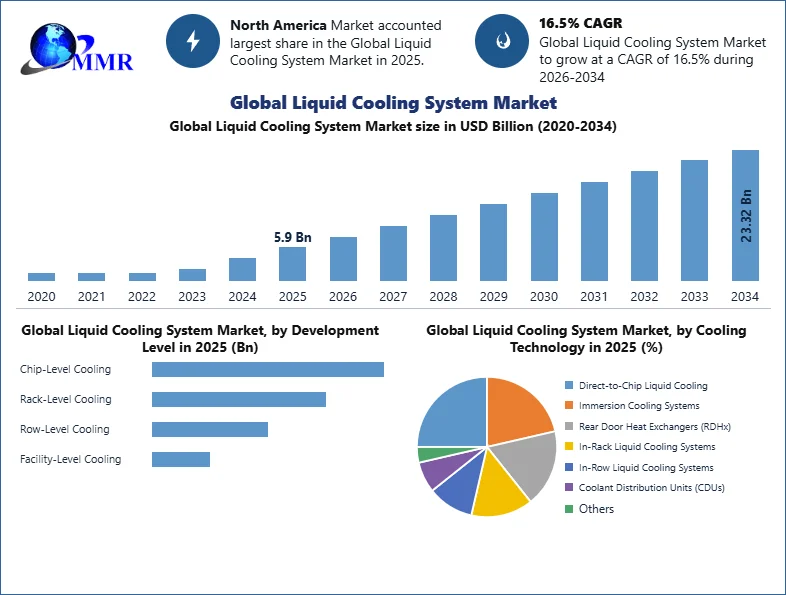
Liquid Cooling System Market size was valued at US$ 5.9 Bn. in 2025 and the total revenue is expected to grow at a CAGR of 16.5% through 2026 to 2032, reaching nearly US$ 17.18 Bn.

Liquid Cooling System Market Overview:

Liquid cooling is a form of active thermal management system that removes thermal energy from electronic applications using a pumped liquid. A liquid cooling system has a higher thermal transfer efficiency than traditional cooling systems because to its high-power modules. Furthermore, the liquid cooling technology provides an effective cooling solution while also helping to reduce noise generated by higher processor units. To circulate the chilled liquid across electronic applications, you will need a circulating pump and connect hoses.Liquid Cooling System Market Snapshot

To know about the Research Methodology:- Request Free Sample Report

Liquid Cooling System Market Dynamics:

The rising demand for liquid cooling systems from the gaming and IT industries is expected to drive market growth during the forecast period 2026-2032. Besides, the global market is being driven by the requirement for increased liquid cooling system-based data centres as a result of the large number of data being generated.

Due to an increase in demand for liquid cooling systems from Smartphone manufacturers throughout the world, the Liquid Cooling System Market is expected to grow significantly during the forecast period. Furthermore, technological advancements in the IT sector are expected to provide lucrative chances for the Liquid Cooling System Market to grow.

The significant maintenance costs associated with liquid cooling systems, on the other hand, are limiting market growth. During the forecast period, however, the development of portable liquid cooling systems for in-build server rooms and sectors with mild temperatures is expected to provide a lucrative potential for the Liquid Cooling System Market to grow.

Liquid Cooling System Market Segment Analysis:

Based on the Type, the market is segmented into Liquid heat exchanger system, and Compressor based system. Liquid heat exchanger system segment is expected to hold the largest market shares of xx% by 2032. This is due to the increased demand for liquid heat exchangers among SMEs and large businesses to transfer heat from a liquid loop to another fluid stream while maintaining a specific machine temperature.

Compressor based system segment is expected to grow rapidly at a CAGR of xx% during the forecast period 2026-2032. This is due to increased use of compressor-based liquid cooling systems in the residential and commercial sectors. Many leading organisations across the world are stepping up their efforts to promote the use of compressor-based liquid cooling systems in the residential and retail sectors, resulting in a more flexible and secure environment.

Based on the End-User, the market is segmented into BFSI, Manufacturing, IT & Telecom, Media & Entertainment, Retail, Government & Defence, Healthcare, Energy, and Others. IT & Telecom and Media & Entertainment segments are expected to grow rapidly at a CAGR of xx% and xx% respectively during the forecast period 2026-2032. This is due to the rising demand for liquid cooling systems in IT & Telecom and Media & Entertainment industries as it offers plenty of benefits to the industries.

Liquid Cooling System Market Regional Insights:

North America is expected to dominate the Liquid Cooling System Market during the forecast period 2026-2032. North America is expected hold the largest market share of xx% by 2032. This is due to the presence of leading market players, as well as an increase in artificial intelligence-based applications across key industries in the North America region. These are the major factors that drive the growth of this region in the Liquid Cooling System Market during the forecast period 2026-2032.

Asia Pacific is expected to grow rapidly at a CAGR of xx% during the forecast period 2026-2032. This is due to increased industrialization and urbanisation in the Asia-Pacific region.

The objective of the report is to present a comprehensive analysis of the Global Liquid Cooling System Market to the stakeholders in the industry. The past and current status of the industry with the forecasted market size and trends are presented in the report with the analysis of complicated data in simple language. The report covers all the aspects of the industry with a dedicated study of key players that include market leaders, followers, and new entrants.

PORTER, PESTEL analysis with the potential impact of micro-economic factors of the market have been presented in the report. External as well as internal factors that are supposed to affect the business positively or negatively have been analyzed, which will give a clear futuristic view of the industry to the decision-makers.

The reports also help in understanding the Global Liquid Cooling System Market dynamic, structure by analyzing the market segments and project the Global Liquid Cooling System Market size. Clear representation of competitive analysis of key players by product, price, financial position, product portfolio, growth strategies, and regional presence in the Global Liquid Cooling System Market make the report investor’s guide.

Liquid Cooling System Market Scope: Inquire before buying

Liquid Cooling System Market
Report Coverage Details
Base Year: 2025 Forecast Period: 2026-2032
Historical Data: 2020 to 2025 Market Size in 2025: 5.9 USD Billion
Forecast Period 2026-2032 CAGR: 16.5% Market Size in 2032: 17.18 USD Billion
Segments Covered: by Type Direct-to-Chip Cooling
Immersion Cooling
Rear-door Liquid Cooling
by Component Chiller
Cold Plate
Coolants
    Dielectric Fluid
    Water
Cooling Distribution Unit
Heat Exchanger
Pump
Others
by System Type Closed-Loop Cooling Systems
Open-Loop Cooling Systems
by Installation Type OEM Integrated
Retrofit
by Capacity Below 100 kW
100-500 kW
500 kW-1 MW
Above 1 MW
by Application Data Centers & Cloud Computing
Semiconductor Fabrication (Fabs)
HVAC & Building Cooling Systems
Healthcare / Medical Devices
Industrial Equipment & Manufacturing
Automotive & Power Electronics
Aerospace & Defense
Consumer Electronics
High-Performance Computing (HPC)
Others
by End User BFSI
Manufacturing
IT & Telecom
Media & Entertainment
Retail
Government & Defense
Healthcare
Energy
Others
by Distribution Channel Direct
Indirect

Liquid Cooling System Market, by Region

North America (United States, Canada and Mexico)
Europe (UK, France, Germany, Italy, Spain, Sweden, Austria and Rest of Europe)
Asia Pacific (China, South Korea, Japan, India, Australia, Indonesia, Malaysia, Vietnam, Taiwan, Bangladesh, Pakistan and Rest of APAC)
Middle East and Africa (South Africa, GCC, Egypt, Nigeria and Rest of ME&A)
South America (Brazil, Argentina Rest of South America)

Liquid Cooling System Market Key Players

1. Asetek Inc.
2. Boyd Corporation
3. CoolIT Systems Inc.
0. Submer Technologies
5. Schneider Electric SE
6. Vertiv Group Corp.
7. AMETEK, Inc.
8. Rittal GmbH & Co. KG
9. ALFA LAVAL
10.Green Revolution Cooling (GRC)
11.Midas Green Technologies LLC
12.Chilldyne Inc.
13.LiquidStack Holding B.V.
14.Iceotope Technologies Ltd.
15.Asperitas
16.LiquidCool Solutions Inc.
17.Motivair Corporation
18.Laird Thermal Systems
19.Parker Hannifin Corporation
20.Mikros Technologies
21.Delta Electronics, Inc.
22.Fujitsu Limited
23.Lenovo Group Limited
24.Dell Technologies Inc.
25.Supermicro
26.Huawei Technologies Co., Ltd.
27.IBM Corporation
28.Intel Corporation
29.ZutaCore Ltd.
30.Bitfury Group

Frequently Asked Questions:

1. Which region has the largest share in Global Liquid Cooling System Market?
Ans: North America region held the highest share in 2025.

2. What is the growth rate of Global Liquid Cooling System Market?
Ans: The Global Liquid Cooling System Market is growing at a CAGR of 16.5% during forecasting period 2026-2032.

3. What is scope of the Global Liquid Cooling System Market report?
Ans: Global Liquid Cooling System Market report helps with the PESTEL, PORTER, COVID-19 Impact analysis, Recommendations for Investors & Leaders, and market estimation of the forecast period.

4. Who are the key players in Global Liquid Cooling System Market?
Ans: The important key players in the Global Liquid Cooling System Market are – Allied Control Ltd., Asetek, Inc., Boyd Corporation, CooIIT Systems, Inc., Emerson Electric Co., Green Revolution Cooling Inc., Laird Thermal Systems, Midas Green Technologies LLC, Rittal GmbH & Co. KG, Schneider Electric SE, Lytron, Koolance, Millerwelds, Parker NA, Watteredge

5. What is the study period of this Market?
Ans: The Global Liquid Cooling System Market is studied from 2025 to 2032.

Table of Contents

1. Liquid Cooling System Market : Market Introduction 1.1. Executive Summary 1.2. Market Size (2025), CAGR (%),Y-O-Y & Forecast (2026-2032) 1.3. Market Size (USD Million and 000'Units) and Market Share (%) - By Segments, Regions and Country 2. Competitive Landscape 2.1. MMR Competition Matrix 2.2. Competitive Analysis of key players 2.3. Key Players Benchmarking 2.3.1 Company Name 2.3.2 Headquarter 2.3.3 Business Portfolio 2.3.4 Revenue (2025) 2.3.5 Market Share (%) 2025 2.3.6 Profit Margin (%) 2.3.7 R & D Investment % 2.3.8 Technological Innovation 2.3.9 Patents 2.3.10 Certifications 2.3.11 Energy Efficiency (%) 2.3.12 Supply Chain Strength 2.3.13 Carbon Footprint Disclosure 2.3.14 Geographical Presence 2.4. Market Structure 2.4.1 Market Leaders 2.4.2 Market Followers 2.4.3 Emerging Players 2.5. Research and Development 2.6 Market Share Distribution of Leading Liquid Cooling System Providers (2025) 2.6.1 Market share analysis of leading liquid cooling system providers 2.6.2 Revenue benchmarking across system integrators, OEMs, and component suppliers 2.6.3 Market share comparison across direct-to-chip, immersion, and rear door cooling providers 2.6.4 Top 10 vendor share analysis across data centers, semiconductor fabs, and industrial applications 2.6.5 Vendor concentration ratio analysis (Top 5 vs Top 10 players) 2.6.6 Regional market share distribution across North America, Europe, Asia-Pacific, and Middle East 2.6.7 Market fragmentation assessment across specialized cooling solution providers 2.6.8 Historical market share shifts driven by AI, cloud, and semiconductor demand 2.7 Strategic Partnerships & OEM Ecosystem Collaborations 2.7.1 Collaborations between liquid cooling providers and hyperscale data center operators 2.7.2 Strategic partnerships with semiconductor companies for fab and chip-level cooling 2.7.3 Alliances with server OEMs for rack-level and direct-to-chip cooling integration 2.7.4 Partnerships with HVAC and district cooling providers for infrastructure-level deployment 2.7.5 Collaborations with telecom companies for 5G and edge data center cooling 2.7.6 Joint development agreements between coolant suppliers and system manufacturers 2.7.7 Supply agreements with cloud service providers and colocation data centers 2.8 Technology Leadership & Cooling Performance Benchmarking 2.8.1 Innovation benchmarking across direct-to-chip, immersion, and hybrid cooling systems 2.8.2 Adoption of advanced cooling fluids and dielectric technologies 2.8.3 Heat removal capacity and cooling efficiency benchmarking across vendors 2.8.4 Integration of AI-driven thermal management and smart cooling systems 2.8.5 Manufacturing and system design innovation in modular liquid cooling solutions 2.8.6 R&D investment benchmarking among leading cooling solution providers 2.8.7 Technology leadership comparison across AI, HPC, and semiconductor cooling applications 2.9 Product Portfolio Positioning & Application Coverage Mapping 2.9.1 Product portfolio benchmarking across liquid cooling system types 2.9.2 Application coverage comparison across data centers, semiconductor fabs, HVAC, and industrial systems 2.9.3 Specialization in high-density cooling solutions for AI servers and GPUs 2.9.4 Vendor positioning in retrofit vs OEM-integrated cooling solutions 2.9.5 Product differentiation across standardized vs customized liquid cooling systems 2.9.6 Coolant and component portfolio comparison across vendors 2.9.7 White-space opportunities in emerging cooling applications (edge, micro data centers) 2.10 Go-To-Market Strategy & Commercialization Blueprint 2.10.1 Priority segment focus (data centers & HPC vs semiconductor fabs vs HVAC applications) 2.10.2 Application-based demand targeting (AI servers, chip fabrication, district cooling, industrial cooling) 2.10.3 Customer segmentation (hyperscale data center operators, semiconductor fabs, HVAC contractors, industrial OEMs) 2.10.4 Value proposition design (energy efficiency vs thermal performance vs cost optimization vs sustainability) 2.10.5 Pricing strategy (OEM-integrated pricing vs retrofit pricing vs performance-based premium pricing) 2.10.6 Route-to-market strategy (direct OEM partnerships vs system integrators vs EPC & HVAC contractors) 2.10.7 Market expansion roadmap (data center penetration → semiconductor & HPC expansion → HVAC & emerging markets scale-up) 2.11 Competitive Strategy & Differentiation Mapping 2.11.1 Competitive intensity across global thermal solution providers vs niche liquid cooling specialists 2.11.2 Differentiation mapping (high-performance cooling vs cost-efficient systems vs sustainable cooling solutions) 2.11.3 Capability benchmarking (cooling efficiency, system integration expertise, coolant technology, global presence) 2.11.4 Competition from alternative cooling technologies (air cooling, hybrid cooling systems) 2.11.5 Strategic gaps (retrofit solutions, HVAC integration, emerging market penetration, cost optimization) 2.11.6 Competitive response strategies (technology innovation, partnerships with data centers & fabs, pricing strategies) 2.11.7 Positioning (integrated cooling solution providers vs component suppliers vs specialized liquid cooling players) 2.12 Transformation Roadmap for Market Participants 2.12.1 Current capability assessment (manufacturing capacity, technology portfolio, customer base, regional presence) 3–5 year strategic roadmap (capacity expansion, R&D in advanced cooling technologies, geographic expansion) 3.1 Revenue diversification (data center cooling → semiconductor → HVAC & industrial cooling applications) 3.2 Transition toward high-efficiency & sustainable cooling (low energy consumption, water efficiency, green cooling) 3.3 KPI framework (cooling efficiency %, cost per kW, system reliability %, energy savings %) 3.4 Digital transformation (smart cooling systems, IoT monitoring, predictive maintenance, AI-driven optimization) 3.5 Strategic growth pathways (OEM partnerships, vertical integration, expansion into emerging cooling technologies) 3. Liquid Cooling System Market Dynamics 3.1. Liquid Cooling System Market Trends 3.2. Liquid Cooling System Market Dynamics 3.2.1 Drivers 3.2.2 Restraints 3.2.3 Opportunities 3.2.4 Challenges 3.3. PORTER’s Five Forces Analysis 3.4. PESTLE Analysis 3.5. Key Opinion Leader Analysis For the Liquid Cooling System Industry 4. Thermal Management Industry Overview 4.1 Global thermal management market benchmarking across air and liquid cooling technologies 4.2 Liquid cooling share within the broader thermal management ecosystem 4.3 Heat density escalation across AI servers, semiconductor fabs, and power electronics 4.4 Evolution of cooling technologies from air cooling to direct liquid and immersion systems 4.5 Industry demand drivers linked to chip miniaturization and high-performance computing 4.6 Comparative analysis of air cooling vs liquid cooling adoption across industries 4.7 Long-term outlook of thermal management requirements across high-density applications 5. Thermal Load & Cooling Requirement Benchmarking (2025) 5.1 Heat dissipation requirements across data centers, semiconductor fabs, and industrial systems 5.2 Power density escalation in CPUs, GPUs, AI accelerators, and fab equipment 5.3 Heat flux intensity mapping across high-performance computing environments 5.4 Cooling efficiency benchmarking: direct-to-chip vs immersion vs rear door systems 5.5 Thermal resistance and heat transfer efficiency analysis 5.6 Cooling cost as a percentage of total infrastructure and system cost 5.7 Future heat load projections driven by AI workloads and semiconductor scaling 6. Global Production & Manufacturing Capacity Analysis 6.1 Global liquid cooling system manufacturing capacity distribution by region 6.2 Production output benchmarking across major manufacturing hubs 6.3 Manufacturing process analysis for CDUs, cold plates, and cooling systems 6.4 Component integration complexity in liquid cooling system manufacturing 6.5 Production cost benchmarking across regions 6.6 Capacity expansion and facility investment trends among key players 6.7 Production lead-time benchmarking across cooling system suppliers 7. Pricing Structure & Margin Benchmarking (2025) 7.1 Historical price trends by cooling type, system configuration, and application (2020–2025) 7.2 Price variance across regions and deployment models 7.3 System cost breakdown and installation markup analysis 7.4 OEM vs system integrator vs turnkey solution pricing strategies 7.5 Impact of component and coolant cost volatility on pricing 7.6 Pricing variation by application and use case 7.7 Margin distribution across value chain participants 8. Component Supply Dynamics & Cost Structure Analysis (2025) 8.1 Cost contribution of key components (CDU, cold plates, pumps, heat exchangers) 8.2 Coolant cost benchmarking (water vs dielectric fluids) 8.3 Supplier concentration and sourcing strategies for critical components 8.4 Raw material and component price volatility impact on margins 8.5 Cost comparison: OEM integrated vs retrofit installations 8.6 Economies of scale in large-scale cooling system deployment 8.7 Cost optimization through modular and standardized system design 9. Comparative Analysis- Liquid Cooling System vs Alternative Cooling Systme 9.1 Comparative cost analysis: liquid cooling vs air cooling vs hybrid systems 9.2 Market share (%) of liquid cooling vs air cooling vs hybrid cooling systems 9.3 Adoption rate (%) of liquid cooling across key applications (data centers, semiconductor fabs, HVAC) 9.4 Penetration rate (%) of liquid cooling in high-density vs low-density environments 9.5 Usage distribution (%) by cooling type across industries 9.6 Growth rate comparison (%) of liquid cooling vs traditional cooling systems (2020–2030) 9.7 Share (%) of high-performance workloads (AI, HPC) using liquid vs air cooling 9.8 Regional adoption (%) comparison of liquid cooling vs alternative technologies 10. Cooling Fluid & Material Innovation Analysis 10.1 Thermal performance benchmarking of water vs dielectric fluids 10.2 Adoption trends of synthetic and engineered cooling fluids 10.3 Fluid stability, safety, and lifecycle performance analysis 10.4 Material compatibility challenges in liquid cooling systems 10.5 Environmental and sustainability considerations in coolant selection 10.6 Cost vs performance trade-off analysis for advanced cooling fluids 10.7 Future innovation roadmap for next-generation cooling materials 11. Demand from Data Centers & High-Performance Computing 11.1 Liquid cooling demand correlation with hyperscale data center expansion 11.2 Cooling requirements for AI servers, GPUs, and high-density racks 11.3 Adoption trends of liquid cooling in hyperscale and colocation facilities 11.4 Retrofit vs greenfield deployment analysis 11.5 Cooling efficiency benchmarking vs traditional air cooling systems 11.6 Demand forecasting linked to AI, cloud, and edge computing growth 11.7 Future cooling demand outlook for ultra-high-density computing 12. Semiconductor Fabrication Cooling Analysis (Argentina Focus) 12.1 Semiconductor industry overview and fabrication ecosystem in Argentina 12.2 Cooling requirements in wafer fabrication and cleanroom environments 12.3 Precision thermal management needs in lithography and etching processes 12.4 Adoption of liquid cooling in semiconductor fabs 12.5 Infrastructure and investment challenges in fab cooling deployment 12.6 Opportunity analysis for liquid cooling solution providers 12.7 Long-term demand outlook linked to semiconductor expansion 13. HVAC & Building Cooling Applications (Qatar Focus) 13.1 HVAC and district cooling ecosystem overview in Qatar 13.2 Role of liquid cooling in high-temperature environments 13.3 Share (%) of district cooling vs conventional HVAC systems in Qatar 13.4 Adoption (%) of liquid cooling within high-temperature HVAC environments 13.5 Integration rate (%) of liquid cooling with district cooling infrastructure 13.6 Energy consumption share (%) of cooling in total building electricity demand 13.7 Cooling demand distribution (%) across commercial buildings, residential, and data centers 7.7 Margin distribution across value chain participants 8. Component Supply Dynamics & Cost Structure Analysis (2025) 8.1 Cost contribution of key components (CDU, cold plates, pumps, heat exchangers) 8.2 Coolant cost benchmarking (water vs dielectric fluids) 8.3 Supplier concentration and sourcing strategies for critical components 8.4 Raw material and component price volatility impact on margins 8.5 Cost comparison: OEM integrated vs retrofit installations 8.6 Economies of scale in large-scale cooling system deployment 8.7 Cost optimization through modular and standardized system design 9. Comparative Analysis- Liquid Cooling System vs Alternative Cooling Systme 9.1 Comparative cost analysis: liquid cooling vs air cooling vs hybrid systems 9.2 Market share (%) of liquid cooling vs air cooling vs hybrid cooling systems 9.3 Adoption rate (%) of liquid cooling across key applications (data centers, semiconductor fabs, HVAC) 9.4 Penetration rate (%) of liquid cooling in high-density vs low-density environments 9.5 Usage distribution (%) by cooling type across industries 9.6 Growth rate comparison (%) of liquid cooling vs traditional cooling systems (2020–2030) 9.7 Share (%) of high-performance workloads (AI, HPC) using liquid vs air cooling 9.8 Regional adoption (%) comparison of liquid cooling vs alternative technologies 10. Cooling Fluid & Material Innovation Analysis 10.1 Thermal performance benchmarking of water vs dielectric fluids 10.2 Adoption trends of synthetic and engineered cooling fluids 10.3 Fluid stability, safety, and lifecycle performance analysis 10.4 Material compatibility challenges in liquid cooling systems 10.5 Environmental and sustainability considerations in coolant selection 10.6 Cost vs performance trade-off analysis for advanced cooling fluids 10.7 Future innovation roadmap for next-generation cooling materials 11. Demand from Data Centers & High-Performance Computing 11.1 Liquid cooling demand correlation with hyperscale data center expansion 11.2 Cooling requirements for AI servers, GPUs, and high-density racks 11.3 Adoption trends of liquid cooling in hyperscale and colocation facilities 11.4 Retrofit vs greenfield deployment analysis 11.5 Cooling efficiency benchmarking vs traditional air cooling systems 11.6 Demand forecasting linked to AI, cloud, and edge computing growth 11.7 Future cooling demand outlook for ultra-high-density computing 12. Semiconductor Fabrication Cooling Analysis (Argentina Focus) 12.1 Semiconductor industry overview and fabrication ecosystem in Argentina 12.2 Cooling requirements in wafer fabrication and cleanroom environments 12.3 Precision thermal management needs in lithography and etching processes 12.4 Adoption of liquid cooling in semiconductor fabs 12.5 Infrastructure and investment challenges in fab cooling deployment 12.6 Opportunity analysis for liquid cooling solution providers 12.7 Long-term demand outlook linked to semiconductor expansion 13. HVAC & Building Cooling Applications (Qatar Focus) 13.1 HVAC and district cooling ecosystem overview in Qatar 13.2 Role of liquid cooling in high-temperature environments 13.3 Share (%) of district cooling vs conventional HVAC systems in Qatar 13.4 Adoption (%) of liquid cooling within high-temperature HVAC environments 13.5 Integration rate (%) of liquid cooling with district cooling infrastructure 13.6 Energy consumption share (%) of cooling in total building electricity demand 13.7 Cooling demand distribution (%) across commercial buildings, residential, and data centers 13.8 Share (%) of infrastructure projects adopting centralized / smart cooling systems 14. Technology Innovation & Emerging Cooling Technologies 14.1 Direct-to-chip cooling technology advancements 14.2 Immersion cooling (single-phase and two-phase) evolution 14.3 Rear door heat exchanger and hybrid cooling innovations 14.4 AI-driven and smart cooling system integration 14.5 Edge and modular liquid cooling system innovations 14.6 Sustainable cooling technologies and eco-friendly fluids 14.7 Future breakthrough technologies in liquid cooling systems 15. Industrial & Power Electronics Cooling Applications 15.1 Cooling requirements in industrial automation and robotics systems 15.2 Thermal management in EV power electronics and charging infrastructure 15.3 Cooling demand across renewable energy power systems 15.4 Heat dissipation challenges in high-load industrial environments 15.5 Reliability and durability benchmarking of cooling systems 15.6 Adoption trends across manufacturing industries 15.7 Long-term demand outlook driven by industrial electrification 16. System Design Complexity & Customization Intensity Mapping 16.1 Custom vs standardized liquid cooling system demand ratio 16.2 Design complexity benchmarking by application heat density 16.3 OEM customization requirements across industries 16.4 Integration with IT racks, semiconductor tools, and HVAC systems 16.5 Modular system design and scalability analysis 16.6 Deployment complexity and installation lead-time benchmarking 16.7 Impact of customized cooling solutions on system performance 17. End-Use Demand Intensity & Consumption Pattern Analysis 17.1 Liquid cooling adoption intensity across major industries 17.2 Data center, semiconductor, HVAC, and industrial demand comparison 17.3 Regional demand distribution and growth hotspots 17.4 Cooling system penetration rates across applications 17.5 Demand elasticity relative to cost and efficiency gains 17.6 Replacement vs new installation demand trends 17.7 Emerging demand from AI, edge computing, and high-density electronics 18. Global Trade Flow & Import–Export Analysis (2025) 18.1 Export volume distribution of liquid cooling systems by major countries 18.2 Import dependency analysis across key markets 18.3 Trade flow mapping across major regions 18.4 Export competitiveness benchmarking 18.5 Tariff and regulatory impact on trade 18.6 Cross-border supply chain dependency analysis 18.7 Trade outlook driven by data center and semiconductor growth 19. Supply Chain & Value Chain Ecosystem Analysis 19.1 End-to-end value chain mapping from components to system integration 19.2 Supplier concentration and dependency assessment 19.3 Lead-time analysis across global production hubs 19.4 Integration with semiconductor and data center supply chains 19.5 Logistics cost impact on system deployment 19.6 Supply chain resilience under high demand scenarios 19.7 Digitalization and optimization of supply chains 20. Investment & Market Opportunity Quantification 20.1 High-growth application opportunity mapping 20.2 Regional investment trends in cooling infrastructure 20.3 Capital expenditure requirements for system deployment 20.4 Market entry barriers and competitive challenges 20.5 Profit pool distribution across value chain participants 20.6 Strategic investment opportunities in emerging technologies 20.7 Long-term market expansion potential 21. Sustainability & Energy Efficiency Impact Assessment 21.1 Energy efficiency gains from liquid cooling adoption 21.2 Carbon footprint comparison vs traditional cooling systems 21.3 Water usage and environmental impact assessment 21.4 Coolant recyclability and lifecycle sustainability analysis 21.5 Green data center and sustainable infrastructure initiatives 21.6 ESG trends in thermal management technologies 21.7 Circular economy opportunities in cooling systems 22. Regulatory & Compliance Landscape 22.1 Environmental and energy efficiency regulations 22.2 Data center cooling standards and compliance requirements 22.3 Semiconductor cooling regulations and standards 22.4 HVAC and building cooling regulations 22.5 Safety and operational certification standards 22.6 Regional regulatory comparison 22.7 Future regulatory outlook 23. Global Liquid Cooling System Market : Market size and Forecast by Segmentation (by Value USD Million and 000'Units) (2025-2032) 23.1. Global Liquid Cooling System Market Size and Forecast, By Type 23.1.1 Direct-to-Chip Cooling 23.1.2 Immersion Cooling 23.1.3 Rear-door Liquid Cooling 23.2. Global Liquid Cooling System Market Size and Forecast, By Component 23.2.1 Chiller 23.2.2 Cold Plate 23.2.3 Coolants 23.2.4 Dielectric Fluid 23.2.5 Water 23.2.6 Cooling Distribution Unit 23.2.7 Heat Exchanger 23.2.8 Pump 23.2.9 Others 23.3. Global Liquid Cooling System Market Size and Forecast, By System Type 23.3.1 Closed-Loop Cooling Systems 23.3.2 Open-Loop Cooling Systems 23.4. Global Liquid Cooling System Market Size and Forecast, By Installation Type 23.4.1 OEM Integrated 23.4.2 Retrofit 23.5. Global Liquid Cooling System Market Size and Forecast, By Capacity 23.5.1 Below 100 kW 100-500 kW 500 kW-1 MW 500.1 Above 1 MW 23.6. Global Liquid Cooling System Market Size and Forecast, By Application 23.6.1 Data Centers & Cloud Computing 23.6.2 Semiconductor Fabrication (Fabs) 23.6.3 HVAC & Building Cooling Systems 23.6.4 Healthcare / Medical Devices 23.6.5 Industrial Equipment & Manufacturing 23.6.6 Automotive & Power Electronics 23.6.7 Aerospace & Defense 23.6.8 Consumer Electronics 23.6.9 High-Performance Computing (HPC) 23.6.10 Others 23.7. Global Liquid Cooling System Market Size and Forecast, By End User 23.7.1 BFSI 23.7.2 Manufacturing 23.7.3 IT & Telecom 23.7.4 Media & Entertainment 23.7.5 Retail 23.7.6 Government & Defense 23.7.7 Healthcare 23.7.8 Energy 23.7.9 Others 23.8. Global Liquid Cooling System Market Size and Forecast, By Distribution Channel 23.8.1 Direct 23.8.2 Indirect 23.9. Global Liquid Cooling System Market Size and Forecast, by Region 23.9.1 North America 23.9.2 United States 23.9.3 Mexico 23.9.4 Canada 23.9.5 Europe 23.9.6 United Kingdom 23.9.7 France 23.9.8 Germany 23.9.9 Italy 23.9.10 Spain 23.9.11 Sweden 23.9.12 Russia 23.9.13 Rest of Europe 23.9.14 Asia Pacific 23.9.15 China 23.9.16 South Korea 23.9.17 Japan 23.9.18 India 23.9.19 Australia 23.9.20 Indonesia 23.9.21 Philippines 23.9.22 Malaysia 23.9.23 Vietnam 23.9.24 Thailand 23.9.25 Rest of Asia Pacific 23.9.26 Middle East and Africa 23.9.27 South Africa 23.9.28 GCC 23.9.29 Qatar 23.9.30 Egypt 23.9.31 Nigeria 23.9.32 Rest of ME&A 23.9.33 South America 23.9.34 Brazil 23.9.35 Argentina 23.9.36 Colombia 23.9.37 Chile 23.9.38 Rest Of South America 24. Company Profile: Key Players 24.01.Asetek Inc. 24.01.1 Overview 24.01.2 Business Portfolio 24.01.3 Financial Overview 24.01.4 SWOT Analysis 24.01.5 Strategic Analysis 24.01.6 Recent Developments 24.02.Boyd Corporation 24.03.CoolIT Systems Inc. 24.04.Submer Technologies 24.05.Schneider Electric SE 24.06.Vertiv Group Corp. 24.07.AMETEK, Inc. 24.08.Rittal GmbH & Co. KG 24.09.ALFA LAVAL 24.10.Green Revolution Cooling (GRC) 24.11.Midas Green Technologies LLC 24.12.Chilldyne Inc. 24.13.LiquidStack Holding B.V. 24.14.Iceotope Technologies Ltd. 24.15.Asperitas 24.16.LiquidCool Solutions Inc. 24.17.Motivair Corporation 24.18.Laird Thermal Systems 24.19.Parker Hannifin Corporation 24.20.Mikros Technologies 24.21.Delta Electronics, Inc. 24.22.Fujitsu Limited 24.23.Lenovo Group Limited 24.24.Dell Technologies Inc. 24.25.Supermicro 24.26.Huawei Technologies Co., Ltd. 24.27.IBM Corporation 24.28.Intel Corporation 24.29.ZutaCore Ltd. 24.30.Bitfury Group 24.30.1 Others 25. Key Findings 26. Strategic Moves & Industry Outlook 27. Global Liquid Cooling System Market : Research Methodology

Custom Market Research Services

We Will Customise The Research For You, In Case The Report Listed Above Does Not Meet With Your Requirements