
Laparoscopic Devices Market Size by Product, End User, Application, Region – Revenue Pool Analysis, Margin Structure Assessment, Capital Flow Trends, Competitive Benchmarking & Forecast to 2029
Overview
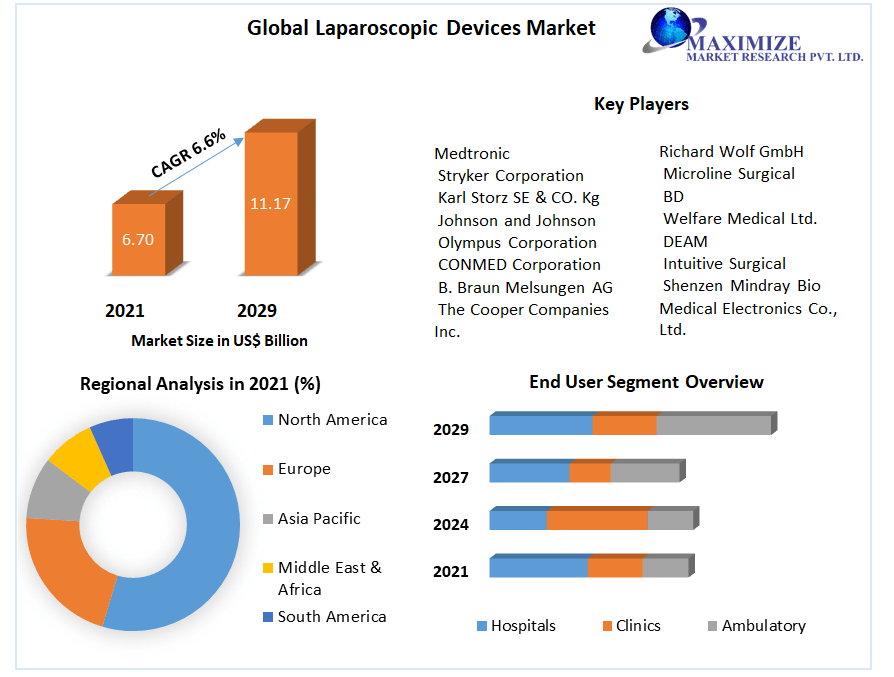
Laparoscopic Devices Market size was valued at US$ 6.70 Bn. in 2021 and the total revenue is expected to grow at a CAGR 6.6% through 2021 to 2029, reaching nearly US$ 11.17 Bn.
Laparoscopic Devices Market Overview:
Laparoscopy is used in the treatment of pelvic organs and to remove implant and scar tissue. Laparoscopy is a minimally invasive procedure with low cost and offers speedy recovery. The basic equipment essential for the procedure is endoscope, camera, light source, video monitor, insufflator, trocars, and surgical instruments. However, there are many variants of each available.
 To know about the Research Methodology :- Request Free Sample Report
Laparoscopic Devices Market Dynamics:
Increasing adoption of minimally invasive surgeries, over open surgeries is likely to boost the market growth in the forecast period. As laparoscopy processes are less invasive and minimal cost consuming and offer speedy recovery as compared to other procedures. Further, almost minimal invasive surgeries are covered under insurance around the globe. These factors are likely to boost the expansion of the laparoscopic device market in the forecast period.
The rate of laparoscopic procedures performed each is around 15million and this no. is likely to grow further in coming years. Increasing adoption of minimally invasive surgeries is hitting the market growth in the coming future due to the rise in chronic diseases like colorectal cancer, rising bariatric surgeries, and various others. Further, technological advancement in the market is likely to fuel the market growth around the globe.
As per the report published by NCBI, colorectal cancer is the fourth most common cancer and second most cause of death due to cancer in the US. The chances of colorectal cancer increase with growing age and are mostly diagnosed in the global population with age between 65-75 years. Further, as per WHO global population of age 65 is likely to develop colorectal cancer with 7% of chances and is estimated to reach around 50% by 2050. Moreover, as per the American Society of Nephrology, Urology disease is the third most common type of disease in the geriatric population and this accounted for around 47% approximately. Henceforth, the geriatric population is projected to hit market expansion in the forecast period.
Laparoscopic Devices Market Segment Analysis:
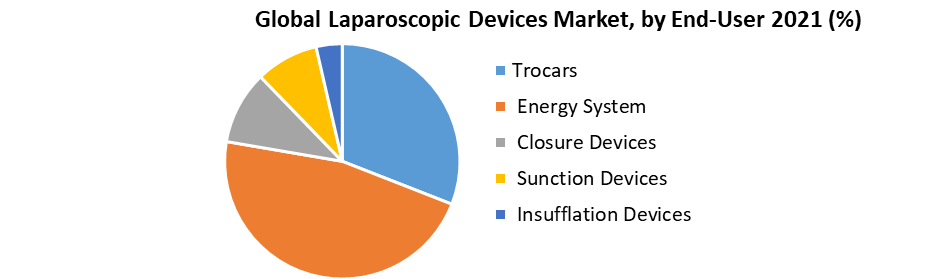
The Energy Systems is anticipated to adhere to the growth of the Laparoscopic Devices Market.
Energy systems accounted for the largest market share of 23.1% in 2021. The growth of the segment is attributed to insufflation devices growing at a CAGR of 7.9% during the forecast period. As the device is easy to handle and allows per-sufflation of the abdominal cavity with humidified Carbon Dioxide. The growth of the segment is further stimulated by other segments like laparoscopes, energy systems, trocars, closure devices, suction/irrigation devices, insufflation devices, robot-assisted systems, Hand Access Instruments, and Robot-assisted systems.
The General Surgery segment is supplementing the growth of the Laparoscopic Devices Market.
The General surgery segment is estimated a market share of 20.8% in 2021. The growth of the market is attributed to key factors like the application of trocars in general surgeries most probably in laparoscopic surgeries. As a wide number of surgeons prefer trocars in surgery as it offers a deep and clear detailed view of tissues with no use of high-definition cameras. Further, benefits like low postoperative infection, rapid recovery as compared to the traditional method in open surgery are estimated to propel the market growth.
Bariatric surgery accounted for significant market growth with a CAGR of 7.8% during the forecast period. Owing to the rising application of laparoscopes in bariatric surgery, urological surgery, colorectal cancer surgery, general surgery, and gynecology surgery.
The hospital segment dominating the end-user segment of the laparoscopy device market.
The hospital segment is projected to adhere to market growth and accounted for the largest market share of 61% with a growing CAGR of 7.1% during the forecast period. The growth of the market is attributed to key factors like growing technological advancement and implementation of growth strategies by the market player. Further, the installation and application of the latest medical facilities by the hospital authorities are likely to boost the laparoscopy device market in the forecast period. Hospitals are now offering a wide range of treatment options to the consumers, with low budgets and insurance services offered by the hospital authorities. As American Society for Metabolic and Bariatric Surgery, around 256,000 people in the US underwent Bariatric surgery for weight loss treatment, in 2021. This factor further boosted the market growth of laparoscopic surgery in the US.
The ambulatory segment is estimated to gain a larger market share in the forecast period due to growing awareness and high preference for outpatient surgeries, adoption of minimally invasive surgeries, and cost-effective procedures.
Laparoscopic Devices Market Regional Insights:
North America is leading in the Laparoscopic Devices market with 35.8% of the market share in 2021 due to the increasing regularity of chronic diseases like Diabetes, cancer, Cardiovascular diseases together with government support and insurance policies are likely to fuel the market expansion in North America. Further, growing healthcare infrastructure and installation of advanced technologies are likely to boost market growth.
In addition, healthcare spending in the regions with growing awareness is like to boost the market growth. For example, as per, Centers for Medical and Medicaid service of US. Healthcare spending has been increased by 4.5% and was valued at USD 3.8 trillion in 2021 which accounted for approximately 17.7% of the total GDP. Moreover, the national healthcare spending is expected to grow further at a CAGR of 5.3% in the forecast period and is estimated to reach USD 6.1 trillion during the forecast period.
The objective of the report is to present a comprehensive analysis of the Global Laparoscopic Devices Market to the stakeholders in the industry. The past and current status of the industry with the forecasted market size and trends are presented in the report with the analysis of complicated data in simple language. The report covers all the aspects of the industry with a dedicated study of key players that include market leaders, followers, and new entrants.
PORTER, SVOR, PESTEL analysis with the potential impact of micro-economic factors of the market have been presented in the report. External as well as internal factors that are supposed to affect the business positively or negatively have been analyzed, which will give a clear futuristic view of the industry to the decision-makers.
The report also helps in understanding the Global Laparoscopic Devices Market dynamics, structure by analyzing the market segments and project the Global Laparoscopic Devices Market size. Clear representation of competitive analysis of key players by Grade, price, financial position, Grade portfolio, growth strategies, and regional presence in the Global Laparoscopic Devices Market make the report investor’s guide.
Laparoscopic Devices Market Scope: Inquire before buying
| Laparoscopic Devices Market | |||
|---|---|---|---|
| Report Coverage | Details | ||
| Base Year: | 2021 | Forecast Period: | 2022-2029 |
| Historical Data: | 2017 to 2021 | Market Size in 2021: | US $ 6.70 Bn. |
| Forecast Period 2022 to 2029 CAGR: | 6.6% | Market Size in 2029: | US $ 11.17 Bn. |
| Segments Covered: | by Product | • Trocars • Energy System • Closure Devices • Suction Devices • Insufflation Devices |
|
| by End User | • Hospitals • Clinics • Ambulatory |
||
| by Application | • Bariatric Surgery • Colorectal Surgery • General Surgery • Urological Surgery • Others |
||
Laparoscopic Devices Market by Region
• North America
o US
o Canada
o Mexico
• Europe
o U.K
o France
o Germany
o Italy
o Spain
o Sweden
o CIS Countries
o Rest of Europe
• Asia Pacific
o China
o India
o Japan
o South Korea
o Australia
o ASEAN
o Rest of Asia Pacific
• The Middle East and Africa
o South Africa
o GCC Countries
o Egypt
o Nigeria
o Rest of ME&A
• South America
o Brazil
o Argentina
o Rest of South America
Laparoscopic Devices Market Key Players
• Medtronic
• Stryker Corporation
• Karl Storz SE & CO. Kg
• Johnson and Johnson
• Olympus Corporation
• CONMED Corporation
• B. Braun Melsungen AG
• The Cooper Companies Inc.
• Richard Wolf GmbH
• Microline Surgical
• BD
• Welfare Medical Ltd.
• DEAM
• Intuitive Surgical
• Shenzen Mindray Bio Medical Electronics Co., Ltd.
FAQs:
1. What is the global Laparoscopic Devices market share in 2021?
Ans: The global Laparoscopic Devices market value in 2021 was estimated as 6.70 Billion USD.
2. What is the global Laparoscopic Devices market growth?
Ans: The global Laparoscopic Devices market is anticipated to grow with a CAGR of 6.6% in the forecast period and is likely to reach USD 11.17 Billion by the end of 2029.
3. Which Application is expected to dominate the global Laparoscopic Devices market during the forecast period?
Ans: The general surgery segment dominated the market and accounted for the largest revenue share of 20.3% in 2021. The application of trocars in general surgery, especially in laparoscopic surgery, has increased to a great extent in recent times.
4. What are the factors driving the Laparoscopic Devices market?
Ans: Key factors that are driving the laparoscopic devices market growth include the increasing number of patients suffering from gallstones, obesity, rectal prolapse, and severe gastroesophageal reflux disease syndrome.
5. Who are the key players in the global Laparoscopic Devices market?
Ans: Key companies operating in the laparoscopic devices market are Medtronic PLC; Karl Storz GmbH; Stryker Corp.; Cooper Surgical; Intuitive Surgical; Richard Wolf; Johnson and Johnson Services, Inc.; CONMED Corp.; and Olympus Corp.