
Keto Meal Delivery Market By Meal Format, By Meal Category, By Dietary Plan, By Business Model, By Customer Type and Regional Insights 2034
Overview
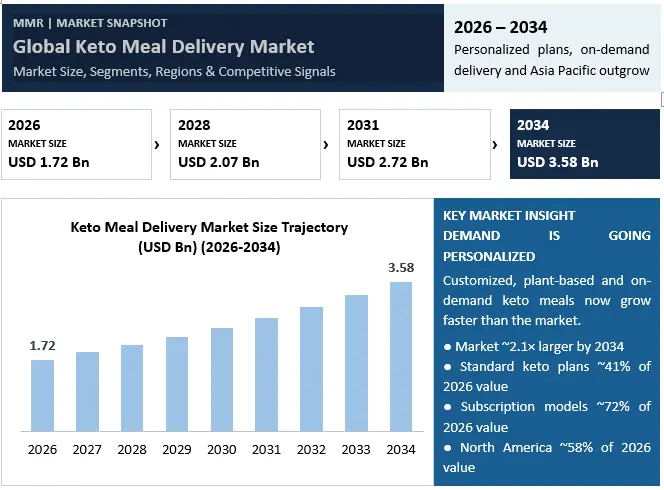
The Global Keto Meal Delivery Market was valued at USD 1.72 billion in 2026 and is projected to reach USD 3.58 billion by 2034, growing at a CAGR of 9.6% during 2026–2034, according to Maximize Market Research (MMR). Keto meal delivery services supply ready-to-eat, heat-and-eat, fresh and frozen ketogenic meals, low in net carbohydrates and high in healthy fats, through subscription, on-demand and corporate programs.
This Keto Meal Delivery Market analysis answers both sides of the search: what the market is worth for meal providers, kitchen operators and investors, and what consumers and wellness buyers want to know, from what counts as a keto meal delivery service to the Keto Meal Delivery Services Market, Ketogenic Meal Delivery Market, Keto Prepared Meals Market and Low-Carb Meal Delivery Market. It offers clear Keto Meal Delivery consumption, Keto Meal Delivery demand and Keto Meal Delivery supply benchmarks.
Ready-to-eat keto meals and subscription delivery anchor the market and North America is the largest regional buyer, but Keto Meal Delivery Market growth is shifting toward customized and high-protein plans, plant-based menus, on-demand ordering and Asia Pacific as AI personalization, nutrition tracking and Online Keto Meal Delivery platforms widen the consumer base.
Maximize Market Research provides comprehensive analysis of global Keto Meal Delivery Market size, share, meal format, meal category, dietary plan, business model, customer type and regional segmentation, the competitive landscape and growth opportunities. It helps keto meal delivery companies, ingredient and packaging suppliers, cold-chain partners, platform providers and investors prioritise segments, channels and countries through 2034, including Keto Meal Delivery Market opportunities, Keto Meal Delivery Market challenges and Keto Meal Delivery consumer demographics.
| 2026 | BASE YEAR | 2034 | FORECAST | GROWTH RATE | LARGEST REGION |
| USD 1.72 Bn | USD 3.58 Bn | 9.6% | North America |
Global Keto Meal Delivery Market Overview:
The market is measured at retail-selling-price level across ready-to-eat, heat-and-eat, fresh and chilled, frozen and kit-based keto meals delivered to consumers, households and corporate customers through subscription, one-time, on-demand and institutional programs. Restaurant delivery of non-keto menus, grocery packaged keto snacks, keto supplements and general meal kits without a keto offering are excluded. The overview and insights cover Keto Meal Delivery Market overview, Keto Meal Delivery industry landscape, Keto Meal Delivery Market analysis, Keto Meal Delivery Market insights, Keto Meal Delivery industry trends, Keto Meal Delivery Market dynamics, Keto Meal Delivery Market size, Keto Meal Delivery key players, Keto Meal Delivery competitive landscape, Keto Meal Delivery Market segmentation, Keto Meal Delivery growth prospects and Keto Meal Delivery Market opportunities, showing how Keto Meal Subscription Services, Fresh Keto Meal Delivery, Frozen Keto Meal Delivery and Customized Keto Meal Delivery are reshaping the industry.
Three shifts shape 2026–2034: demand is broadening from early-adopter dieters to mainstream health, fitness and convenience-seeking consumers; value is moving toward customized, high-protein, plant-based and allergen-aware plans backed by digital nutrition tracking; and growth is rotating toward Asia Pacific, on-demand ordering and sustainable, cold-chain-efficient fulfillment. Providers are answering churn and cost pressure with wider menus, tighter macronutrient accuracy and better retention economics. This market synopsis reflects Keto Meal Delivery challenges, Keto Meal Delivery consumer behavior, Keto Meal Delivery Market entry, Keto Meal Delivery emerging markets, Keto Meal Delivery Market outlook, Keto Meal Delivery Market research findings, Keto Meal Delivery Market summary, Keto Meal Delivery revenue generated, Keto Meal Delivery growth drivers, Keto Meal Delivery Market Synopsis and Keto Meal Delivery Market strategies, along with economic factors, technological advancements and regulatory influences affecting Keto Meal Delivery demand and Keto Meal Delivery supply.
Keto Meal Delivery Market Analysis from 2025 to 2034
To know about the Research Methodology :- Request Free Sample Report
Key Findings: Eight Insights Shaping the Global Keto Meal Delivery Market
MMR’s analysis of published market data, company announcements, regulatory frameworks and industry developments points to eight findings that explain where Keto Meal Delivery Market growth and value are created through 2034. These market insights summarise the Keto Meal Delivery Market forecast, market segmentation and competitive landscape in one view.
| Sr.No. | Findings | Evidence | So what |
| 1 | The market grows about 2.1× by 2034 | USD 1.72 Bn (2026) to USD 3.58 Bn (2034) at 9.6% CAGR | Central-kitchen capacity, cold-chain reach and customer acquisition must scale about 2.1× by 2034 |
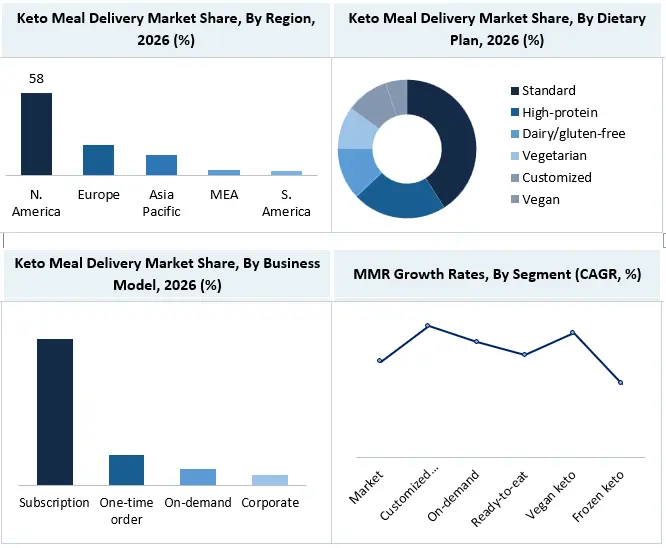
| 2 | Subscription is the revenue base, on-demand the growth edge | Subscription ~72% of 2026 value; on-demand delivery 11.6% CAGR | Retention economics and flexible ordering decide margins |
| 3 | North America is the largest region | ~58% share in 2026, led by the United States | Kitchen footprint, delivery density and brand trust set share in the largest region |
| 4 | Personalization and plant-based keto outgrow the market | Customized plans 13.2% CAGR; vegan keto meals 12.5% CAGR | Nutrition data, AI menus and allergen-aware formulation open premium revenue |
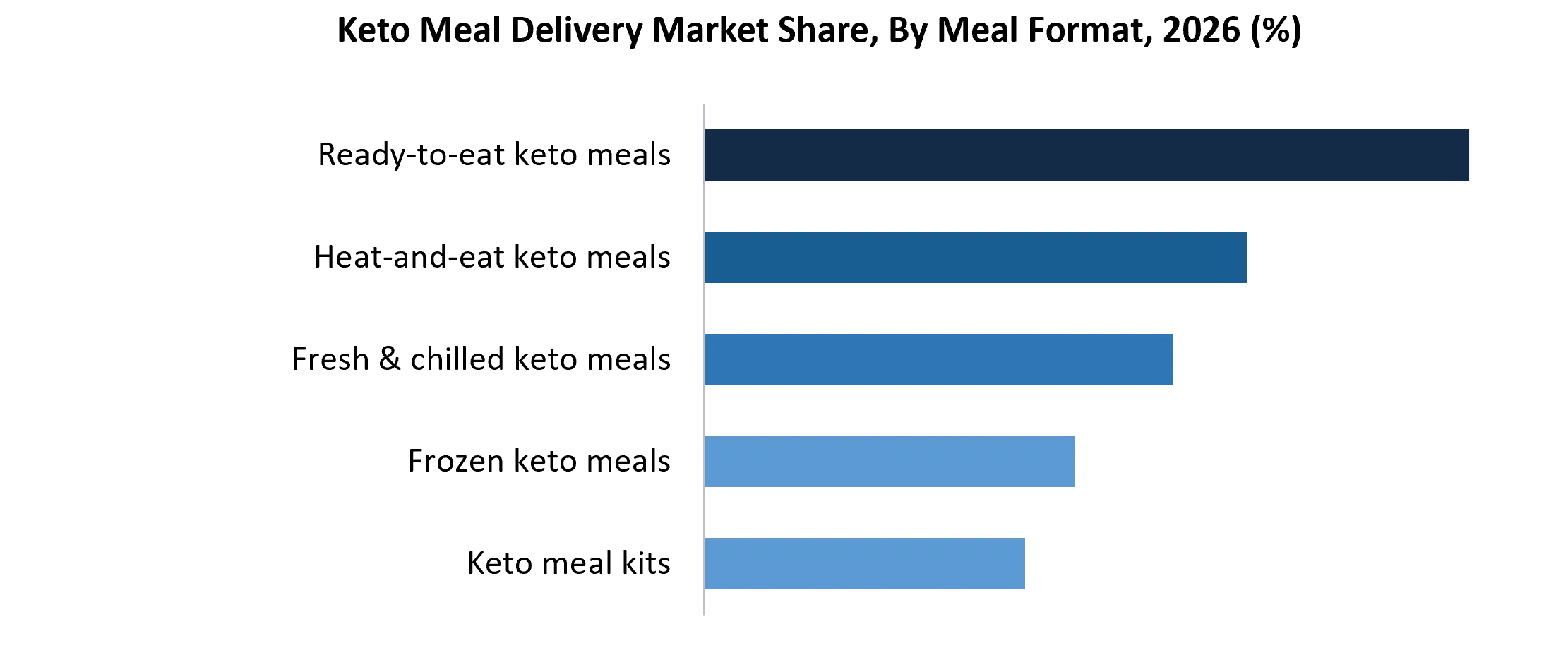
| 5 | Ready-to-eat meals remain the core format | Ready-to-eat ~31% of 2026 value at 10.3% CAGR | Convenience and macronutrient accuracy anchor repeat purchase |
| 6 | Standard ketogenic plans lead dietary demand | Standard keto ~41% of 2026 value; high-protein ~22% | Menu variety and net-carbohydrate transparency drive retention |
| 7 | The provider base is fragmented and brand-led | Meal-kit groups, dedicated keto brands and regional specialists compete across channels | Brand, menu breadth, delivery coverage and unit economics shape position |
| 8 | Sustainability and food safety are competitive levers | Recyclable packaging, food-waste reduction and cold-chain traceability gain weight | Compliance and green logistics raise the bar for new entrants |
Global Keto Meal Delivery Market Dynamics:
Global Keto Meal Delivery Market Growth Drivers: Low-Carb Diet Adoption, Convenience, Personalization and Online Ordering
The Global Keto Meal Delivery Market is supported by wider adoption of low-carbohydrate, high-fat eating, interest in weight and metabolic management and the time pressure that makes home preparation of macro-counted meals difficult. Ready-to-Eat Keto Meals remove shopping, cooking and calculation in one step, which makes keto meal delivery a practical upgrade for consumers who want dietary discipline without the effort. Subscription programs create repeat orders, and these factors support steady Keto Meal Delivery Market growth across mature and emerging regions, although buying decisions still depend on taste, price, menu variety and delivery reliability. Key market drivers include Keto Meal Delivery Market dynamics, Keto Meal Delivery industry fluctuations, Keto Meal Delivery economic factors, Keto Meal Delivery consumer behavior trends, Keto Meal Delivery demand and supply and Keto Meal Delivery competitive forces.
Technology and personalization are adding new layers of demand. Online Keto Meal Delivery platforms, mobile applications and AI-based recommendations let providers tailor macronutrient targets, allergens and portion sizes, while digital nutrition tracking links meals to weight-management and fitness goals. Working professionals, couples, families and gym members keep Keto Meal Delivery consumption high through weekly and monthly plans. Growth catalysts and shifts include Keto Meal Delivery Market drivers, Keto Meal Delivery Market challenges, Keto Meal Delivery technological advancements, Keto Meal Delivery regulatory influences, Keto Meal Delivery emerging trends and Keto Meal Delivery Market opportunities.
Global Keto Meal Delivery Market Restraints:
Cost and retention are the main restraints. Keto menus rely on protein, fresh produce, nuts, oils and dairy, so ingredient inflation, commercial-kitchen labor, refrigerated packaging and last-mile delivery fees keep the price per meal above home cooking. Subscription churn, perishable inventory and high customer acquisition cost squeeze margins, and consumers may pause plans when budgets tighten. Market constraints include Keto Meal Delivery innovation in the industry, Keto Meal Delivery macroeconomic factors, Keto Meal Delivery Market growth factors, Keto Meal Delivery Market constraints, Keto Meal Delivery industry disruptors and Keto Meal Delivery Market shifts.
Regulation, safety and competition also limit growth. Providers must meet food-hygiene, temperature-control, nutritional-labeling and allergen-declaration rules under frameworks such as FDA and USDA requirements, the Food Safety Modernization Act, European Union food information rules and FSSAI standards, while strict ketogenic diets are not suitable for everyone and some consumers prefer medically supervised guidance. Restaurant delivery apps, conventional meal kits and grocery ready meals compete for the same occasions. Challenges and disruptors include Keto Meal Delivery environmental factors, Keto Meal Delivery socioeconomic influences, Keto Meal Delivery Market trends analysis, Keto Meal Delivery demand and supply dynamics, Keto Meal Delivery Market forces and Keto Meal Delivery economic indicators.
What Are the Biggest Keto Meal Delivery Market Opportunities Through 2034?
Customized keto plans, plant-based and allergen-aware menus and on-demand delivery represent the most significant Keto Meal Delivery Market opportunities because they extend revenue beyond standard subscription meals. Customized keto plans are projected to grow at 13.2% CAGR, vegan keto meals at 12.5% and on-demand delivery at 11.6%, as consumers specify net-carbohydrate, protein and ingredient preferences. Corporate wellness programs, medically supervised nutrition services and premium gourmet keto dining at home offer further routes to higher order values. Providers with strong menu variety, verified nutrition data and reliable cold-chain delivery may be better positioned to win loyal subscribers. Keto Meal Delivery Market opportunities, Keto Meal Delivery Market challenges and Keto Meal Delivery consumer demographics, covering individuals, couples, families and fitness consumers, are assessed for each segment. Opportunity areas include Keto Meal Delivery industry evolution, Keto Meal Delivery competitive landscape shifts, Keto Meal Delivery consumer preferences evolution, Keto Meal Delivery regulatory changes, Keto Meal Delivery innovation impact and Keto Meal Delivery technology trends.
Emerging-market expansion, partnerships and digital innovation offer additional growth. Asia Pacific is projected to be the fastest-growing region at 12.1% CAGR as China, Japan, India, South Korea, Australia and Southeast Asia expand online food delivery and personalized nutrition, while Middle East & Africa and South America benefit from premium meal delivery and wellness food demand. Retail partnerships, third-party marketplaces and regional fulfillment centers can widen reach and shorten delivery times. Emerging trends, a market gap in affordable, high-quality keto meals and untapped market areas create attractive segment-specific opportunities, reflected in Keto Meal Delivery Market responsiveness, Keto Meal Delivery external market influences, Keto Meal Delivery Market adaptability, Keto Meal Delivery strategic market changes, Keto Meal Delivery Market segmentation shifts and Keto Meal Delivery customer engagement dynamics.
Keto Meal Delivery Market Trends:
Four Keto Meal Delivery Market trends stand out through 2034. First, personalization: AI-based meal recommendations and digital macro tracking move plans from fixed menus to individual targets. Second, plant-based and clean-label keto: vegetarian, vegan, dairy-free and gluten-free menus with organic and minimally processed ingredients broaden the audience. Third, hybrid formats: fresh, chilled and frozen meals, kits and retail partnerships let providers balance quality, shelf life and cost. Fourth, sustainable fulfillment: recyclable packaging, food-waste reduction and efficient cold-chain routing respond to consumer and regulatory pressure. Customer engagement dynamics and technology trends support market trends analysis and industry evolution, while the interaction of Keto Meal Delivery industry resilience, Keto Meal Delivery Market fluctuation analysis, Keto Meal Delivery growth catalysts, Keto Meal Delivery Market volatility and Keto Meal Delivery Market gap determines how providers respond.
Global Keto Meal Delivery Market Segment Analysis:
Keto Meal Delivery Market by Customer Type and Meal Category: Individuals, Couples, Families, Fitness Consumers and Everyday Meals
Keto Meal Delivery Services Market, Ketogenic Meal Delivery Market, Dietary Plan and Business Model Analysis
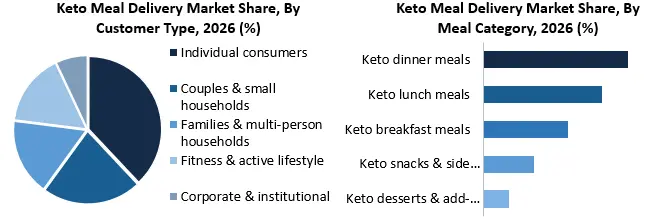
Standard ketogenic meals are the largest dietary plan at about 41% of 2026 value, high-protein keto meals hold about 22%, dairy-free and gluten-free meals 12%, vegetarian keto meals 10%, customized and specialized meals 10% and vegan keto meals 5%, with customized plans growing at 13.2% CAGR. By business model, subscription-based delivery accounts for about 72% of value, one-time and pay-per-order delivery 15%, on-demand delivery 8% and corporate and institutional programs 5%. By meal category, dinner leads at about 34%, followed by lunch at 28%, breakfast at 20%, snacks and side meals at 12% and desserts and specialty add-ons at 6%. By customer type, individual consumers represent about 38%, couples and small households 22%, families 17%, fitness enthusiasts 16% and corporate and institutional customers 7%. This Keto Meal Delivery market segment analysis covers Keto Meal Delivery Market segment analysis, Keto Meal Delivery industry segmentation, Keto Meal Delivery target market analysis, Keto Meal Delivery consumer demographics, Keto Meal Delivery product segmentation, Keto Meal Delivery geographic segmentation, Keto Meal Delivery Market subsegments, Keto Meal Delivery niche markets, Keto Meal Delivery customer profiling, Keto Meal Delivery Market share by segment, Keto Meal Delivery segment growth analysis, Keto Meal Delivery competitive segment landscape, Keto Meal Delivery emerging market segments, Keto Meal Delivery segment attractiveness, Keto Meal Delivery behavioral segmentation, Keto Meal Delivery segment-based marketing and Keto Meal Delivery customized market strategies.
Niche programs show where value is moving next. Consumer demographics and customer profiling center on working professionals, busy urban households, gym members and health-conscious buyers who value convenience and macronutrient accuracy, while specialized diets such as low-sodium, allergen-conscious and medically supervised programs open smaller but higher-value pools. Further analysis of the Low-Carb Meal Delivery Market and the Keto Prepared Meals Market addresses Keto Meal Delivery demographic profiling, Keto Meal Delivery Market niche exploration, Keto Meal Delivery micro-segmentation, Keto Meal Delivery segmentation strategies, Keto Meal Delivery Market segment dynamics, Keto Meal Delivery customer behavior segmentation, Keto Meal Delivery specialized market segments, Keto Meal Delivery unexplored market niches, Keto Meal Delivery segment-specific trends, Keto Meal Delivery untapped market areas, Keto Meal Delivery segment-specific opportunities, Keto Meal Delivery tailored marketing strategies, Keto Meal Delivery Market fragment analysis, Keto Meal Delivery unique market sectors, Keto Meal Delivery granular market breakdown and Keto Meal Delivery comprehensive market sector analysis.
 Global Keto Meal Delivery Market Regional Analysis:
North America is the largest regional market, accounting for about 58% of global value in 2026. The United States is the demand anchor, with a deep base of subscription meal brands, prepared-food kitchens and online ordering habits, while Canada and Mexico add growing consumer interest in low-carbohydrate eating. The region is projected to grow at about 9.0% CAGR. Europe holds about 21% of 2026 value, supported by health-conscious foodservice demand in the United Kingdom, Germany, France and the Nordics and expected to grow at about 9.4% CAGR. Asia Pacific, at about 14% of 2026 value, is the fastest-growing region at about 12.1% CAGR, led by China, Japan, India, South Korea and Australia as online food delivery and personalized nutrition scale. Regional analysis addresses Keto Meal Delivery geographic analysis, Keto Meal Delivery regional market trends, Keto Meal Delivery area-specific market dynamics, Keto Meal Delivery local market influences, Keto Meal Delivery Market performance by region, Keto Meal Delivery regional market segmentation, Keto Meal Delivery geographical trends, Keto Meal Delivery regional economic factors, Keto Meal Delivery local consumer behavior, Keto Meal Delivery regional market challenges, Keto Meal Delivery area-specific opportunities, Keto Meal Delivery regional competitive landscape, Keto Meal Delivery Market growth by location, Keto Meal Delivery region-specific industry outlook, Keto Meal Delivery local market entry strategies, Keto Meal Delivery regional market share, Keto Meal Delivery economic impact by region, Keto Meal Delivery regional market development and Keto Meal Delivery Market trends in specific regions.
Middle East & Africa holds about 4% of 2026 value and is projected to grow at about 10.8% CAGR as premium meal delivery and wellness food demand expand in the United Arab Emirates, Saudi Arabia, Israel, Turkey and South Africa. South America, at about 3%, is projected to grow at about 10.2% CAGR, led by Brazil, Argentina, Chile and Colombia, where specialty-diet and digital foodservice opportunities are emerging. Regional foodservice infrastructure, consumer spending and regulatory development trends decide entry strategies for providers. Further regional insight covers Keto Meal Delivery territorial dynamics, Keto Meal Delivery locational market nuances, Keto Meal Delivery area-centric market shifts, Keto Meal Delivery geographic market intricacies, Keto Meal Delivery regional consumer patterns, Keto Meal Delivery local economic factors, Keto Meal Delivery regional market performance, Keto Meal Delivery regional market segmentation, Keto Meal Delivery territorial competitive landscape, Keto Meal Delivery demographic trends by region, Keto Meal Delivery localized market challenges, Keto Meal Delivery regionally-driven opportunities, Keto Meal Delivery locational market share, Keto Meal Delivery geo-strategic influences, Keto Meal Delivery regional market entry strategies, Keto Meal Delivery area-centric growth factors, Keto Meal Delivery regional industry outlook, Keto Meal Delivery Market trends in designated areas and Keto Meal Delivery geopolitical influences.
Keto Meal Delivery Companies and Competitive Landscape:
The Keto Meal Delivery competitive landscape includes several distinct groups rather than a single set of comparable companies. Dedicated and diet-focused prepared-meal providers, such as Trifecta Nutrition, Fresh n’ Lean, Diet-to-Go, BistroMD, Snap Kitchen and Territory Foods, deliver macro-counted meals directly to consumers. Multi-diet prepared-meal and meal-kit platforms, including Factor, Green Chef, HelloFresh, CookUnity, Home Chef, Sunbasket, Blue Apron and Gousto, offer keto or low-carbohydrate menus within broader portfolios. Regional and emerging providers such as My Muscle Chef, Lite n’ Easy, Right Bite, Calo and Ketofy serve local markets in Asia Pacific and the Middle East. These groups compete on different dimensions and should not be ranked as though they were identical businesses. Analysis of Keto Meal Delivery company revenue, Keto Meal Delivery company net sales, Keto Meal Delivery competitor analysis, Keto Meal Delivery industry rivals examination, Keto Meal Delivery competitive intelligence, Keto Meal Delivery Market rivalry assessment, Keto Meal Delivery competitor benchmarking, Keto Meal Delivery competitive strategy review, Keto Meal Delivery industry player dynamics, Keto Meal Delivery rivalry impact analysis, Keto Meal Delivery competitor evaluation, Keto Meal Delivery competitive landscape trends, Keto Meal Delivery competitive positioning, Keto Meal Delivery Market rivalry intensity, Keto Meal Delivery competitor profiling, Keto Meal Delivery competitive advantage assessment, Keto Meal Delivery industry competition overview and Keto Meal Delivery Market player strategies helps assess competitive positioning among industry players.
Competition is increasingly shaped by menu variety, nutritional accuracy, delivery reliability and customer retention. Large meal-kit groups compete through scale, kitchen networks and marketing reach, dedicated keto brands compete through nutrition credibility and specialization, and regional players differentiate through local cuisines, fresh preparation and delivery speed. Consolidation, retail partnerships and digital personalization investments are likely to continue as providers seek lower acquisition cost and higher lifetime value. Competitive intelligence covers Keto Meal Delivery competitive benchmark analysis, Keto Meal Delivery rival market share, Keto Meal Delivery competitive market evolution, Keto Meal Delivery competitor differentiation, Keto Meal Delivery Market rival scrutiny, Keto Meal Delivery industry adversary exploration, Keto Meal Delivery competitive ecosystem analysis, Keto Meal Delivery rivalry landscape intricacies, Keto Meal Delivery competitive matrix investigation, Keto Meal Delivery business opponent profiling, Keto Meal Delivery sectorial rivalry dynamics, Keto Meal Delivery competitive maneuver examination, Keto Meal Delivery competing force scrutiny, Keto Meal Delivery rivalry intensity mapping, Keto Meal Delivery opponent landscape divergence, Keto Meal Delivery industry opposition tactics and Keto Meal Delivery strategic Analysis, completing the picture of the competitive ecosystem.
Global Keto Meal Delivery Market Recent Developments
| Period | Development | Why it matters |
| 2026 | Independent research houses publish 2024–2026 keto meal delivery estimates ranging from about USD 0.34 Bn to more than USD 2.6 Bn | Scope definition drives wide variance, so clear market boundaries matter |
| 2026 | Published reports place North America at roughly 59–60% of keto meal delivery revenue and subscription models above 70% of the market | Regional and business-model concentration shapes where providers compete |
| 2026 | Asia Pacific is forecast by published sources to be the fastest-growing region, at roughly 11% CAGR | Emerging markets are the next expansion frontier for delivery networks |
| 2026 | Broader ketogenic diet market estimates run from about USD 11.5 Bn to USD 18.6 Bn, covering packaged foods and supplements | Adjacent categories sit outside MMR’s meal delivery scope |
Global Keto Meal Delivery Market Scope:Inquire before buying
| Global Keto Meal Delivery Market | |||
|---|---|---|---|
| Report Coverage | Details | ||
| Base Year: | 2026 | Forecast Period: | 2027-2034 |
| Historical Data: | 2021 to 2026 | Market Size in 2026: | USD 1.72 Billion |
| Forecast Period 2027 to 2034 CAGR: | 9.6% | Market Size in 2034: | USD 3.58 Billion |
| Segments Covered: |
By Meal Format | Ready-to-Eat Keto Meals Heat-and-Eat Keto Meals Keto Meal Kits Frozen Keto Meals Fresh and Chilled Keto Meals |
|
| By Meal Category | Keto Breakfast Meals Keto Lunch Meals Keto Dinner Meals Keto Snacks and Side Meals Keto Desserts and Specialty Meal Add-ons |
||
| By Dietary Plan | Standard Ketogenic Meals High-Protein Keto Meals Vegetarian Keto Meals Vegan Keto Meals Dairy-Free and Gluten-Free Keto Meals Customized and Specialized Keto Meals |
||
| By Business Model | Subscription-Based Meal Delivery One-Time and Pay-Per-Order Delivery On-Demand Meal Delivery Corporate and Institutional Meal Programs |
||
| By Customer Type | Individual Consumers Couples and Small Households Families and Multi-Person Households Fitness Enthusiasts and Active Lifestyle Consumers Corporate and Institutional Customers |
||
Global Keto Meal Delivery Market, By Region
North America (United States, Canada, Mexico, Rest of North America)
Europe (United Kingdom, Germany, France, Italy, Spain, Netherlands, Switzerland, Sweden, Denmark, Belgium, Poland, Rest of Europe)
Asia Pacific (China, Japan, India, South Korea, Australia, New Zealand, Singapore, Indonesia, Thailand, Malaysia, Rest of Asia Pacific)
Middle East & Africa (United Arab Emirates, Saudi Arabia, Israel, Turkey, South Africa, Egypt, Qatar, Kuwait, Nigeria, Morocco, Rest of Middle East & Africa)
South America (Brazil, Argentina, Chile, Colombia, Rest of South America)
Global Keto Meal Delivery Market, Key Players
North America
United States and Canada
1. Factor
2. Trifecta Nutrition
3. Green Chef
4. Territory Foods
5. Fresh n’ Lean
6. Diet-to-Go
7. Pete’s Real Food
8. The Good Kitchen
9. BistroMD
10. Snap Kitchen
11. CookUnity
12. HelloFresh
13. Home Chef
14. Sunbasket
15. Blue Apron
16. Hungryroot
17. MagicKitchen.com
18. Ice Age Meals
19. Ketoned Bodies
20. Fuel Meals
21. Dinnerly
22. Tempo by Home Chef
23. Provenance Meals
24. Factor Canada
Europe
United Kingdom, Germany and Other European Markets
25. Green Chef UK
26. Keto Kitchen Lytham
27. Frive
28. Gousto
29. HelloFresh Germany
30. Prep Kitchen
31. Lions Prep
32. Detox Kitchen
33. Balance Box
34. Natural Ketosis
Asia Pacific
Australia
35. MACROS
36. My Muscle Chef
37. Be Fit Food
38. THR1VE
39. Nourish’d
40. A Life Plus
41. Foober
42. Bondi Meal Prep
43. Papa Macros
44. Fit Chef Aus
45. Dietlicious
46. Chefgood
47. Lite n’ Easy
48. Workout Meals
49. Soulara
Other Asia-Pacific Markets
50. Foodology
51. EatFit
52. HealthifyMe
53. Ketofy
54. Fittr
55. Nutribox
Middle East & Africa
56. Kcal
57. Right Bite
58. Calo
59. Dieture
60. FreshOnTable
61. Eat Clean ME
Others
Global Keto Meal Delivery Market FAQs: Frequently Asked Questions
What is the size and forecast of the global Keto Meal Delivery Market?
MMR values the global Keto Meal Delivery Market at USD 1.72 billion in 2026 and USD 3.58 billion in 2034, a 9.6% CAGR. Published estimates vary by scope: independent 2024–2026 estimates for keto meal delivery range from about USD 0.34 billion to more than USD 2.6 billion, with many reports clustering between roughly USD 1.4 billion and USD 2.6 billion depending on whether prepared meals, meal kits and corporate programs are counted. This market size view reflects Keto Meal Delivery demand, Keto Meal Delivery supply and Keto Meal Delivery consumption trends.
Which region and country is the largest Keto Meal Delivery market?
North America holds the largest Keto Meal Delivery Market share at about 58% in 2026, with the United States as the principal demand and supply anchor. Asia Pacific is the fastest-growing region at about 12.1% CAGR, followed by Middle East & Africa at 10.8%, South America at 10.2%, Europe at 9.4% and North America at 9.0%. Geographic analysis and regional market performance confirm these regional insights.
Which Keto Meal Delivery segments are growing fastest?
Standard ketogenic meals are the largest dietary plan at about 41% of 2026 value, while customized keto plans grow at 13.2% CAGR and vegan keto meals at 12.5%. By business model, subscription-based delivery holds about 72% of value, while on-demand delivery grows at 11.6% CAGR. Ready-to-eat keto meals are the largest meal format at about 31% of value, growing at 10.3% CAGR.
Who are the leading Keto Meal Delivery companies?
Leading names include Factor, Green Chef, HelloFresh, Trifecta Nutrition, Territory Foods, Fresh n’ Lean, Diet-to-Go, BistroMD, Snap Kitchen, CookUnity, Home Chef, Sunbasket, Blue Apron and Gousto, along with regional players such as My Muscle Chef, Lite n’ Easy, Right Bite and Calo. The Keto Meal Delivery competitive landscape is fragmented by role: dedicated keto providers, multi-diet prepared-meal companies and meal-kit platforms each compete in different channels.
Are keto meal delivery services still growing compared with other meal delivery options?
Yes. Keto meal delivery competes with restaurant delivery, conventional meal kits and grocery ready meals, and price, subscription churn and cold-chain cost are real pressures. But convenience, personalization, interest in low-carbohydrate eating and rising online food ordering support a 9.6% CAGR through 2034, while plant-based, allergen-aware and on-demand offerings extend reach into new consumer groups.
Global Keto Meal Delivery Market Research Methodology
MMR sized the market top-down from a 2026 base of USD 1.72 billion and cross-checked it bottom-up using meal volumes, average selling prices and active subscriber estimates by meal format, dietary plan, business model, customer type and region. Inputs included company announcements and filings, menu and pricing reviews, food-safety and labeling regulations, ingredient and cold-chain cost indicators and published third-party estimates, which were reconciled to MMR’s scope of keto meal delivery services (excluding non-keto restaurant delivery, packaged keto snacks and supplements). Segment shares and growth rates were then modelled by meal format, meal category, dietary plan, business model, customer type and region, and reviewed for consistency with the 2026–2034 forecast.