
Interbody Fusion Cage Market by Product, Surgery Type, End-users and Region – Global Market Size Estimation, Industry-Wide Analysis, Competitive Landscape Assessment & Long-Term Forecast to 2034
Overview
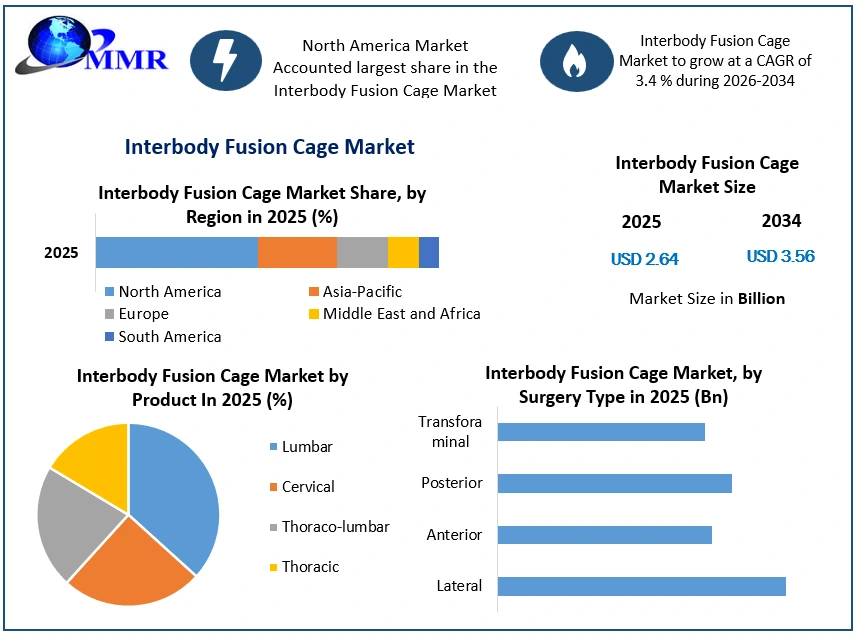
Interbody Fusion Cage Market is expected to grow at a CAGR of 3.4% during the forecast period. Global Interbody Fusion Cage Market is expected to reach US$ 3.56 Bn. by 2034.
Interbody Fusion Cage Market Definition
An interbody fusion cage is a prosthesis used in spinal fusion procedures to maintain foraminal height and decompression. The purpose of all interbody fusion devices is to restore and maintain disk space height and normal sagittal contours and to increase the stability of the operating segment.
Interbody Fusion Cage Market Growth Outlook
To know about the Research Methodology:- Request Free Sample Report
Interbody Fusion Cage Market Dynamics
The radiologists are familiar with the various techniques, devices, and potential complications associated with interbody fusion cage procedures. Spinal interbody fusion techniques have continued to evolve with an increasing number of interbody fusion devices available for use.
Various innovative surgical approaches in the implantation of interbody fusion cages across the disk space are driving the global market. Improvements in the loading capacity of the interbody fusion cage give the opportunity for the global market. Ongoing developments in the cage designs and inventions in optimization methods of the cage are expected to drive the global market in the forecast period.
Interbody Fusion Cage Market Segment Analysis
Posterior lumbar interbody fusion is a preferred surgical treatment option in degenerative spondylolisthesis. Biomedical advantages of cages and their applications in restoring the height of the patient’s disk are driving the segment xx% in the global market. The use of lumbar fusions to treat patients with infections and misaligned spines increase their demand in the Hospitals.
Lumbar Spinal cord surgeries have a large demand for interbody fusion case devices among end-users.
Degenerative disc and facet joint disease of the lumbar spine is common in the ageing population and is one of the most frequent causes of disability. Lateral lumbar interbody fusion has been widely performed for degenerative lumbar disease, and the implantation of the lordotic cage was thought to contribute to lordosis restoration. Successful clinical outcomes are observed by lumbar fusion cage by effective fusion and less subsidence. This gives the best opportunity for patients in the process of healing and high demand for fusion cage devices in surgical procedures.
The hospital segment commanded the largest market share of xx% in the global interbody fusion case market.
The hospital segment has the largest share of surgical inventions in bone surgeries and adoption of newly emerging medical devices, in order to prevent nerve damage. A significant change in the surgical techniques and instrumentation apply during the fusion cage implantation procedure results in a surge in the number of positive post-operation outcomes.
Interbody Fusion Cage Market Regional Analysis
Increasingly, lumbar interbody fusions have been performed in patients with degenerative disk disease and discogenic pain syndromes. It is estimated that more than 300,000 lumbar spine fusion procedures are performed each year in the United States. The use of computed tomography and standard methodology during operating procedures led to give the highest demand for the global market in North America. Corrective post-operation treatment procedures for the patients by the hospitals and health care centres propel the global market in this region.
The objective of the report is to present a comprehensive analysis of the Global market including all the stakeholders of the industry. The past and current status of the industry with forecasted market size and trends are presented in the report with the analysis of complicated data in simple language.
The report covers all the aspects of the industry with a dedicated study of key players that include market leaders, followers, and new entrants. PORTER, SVOR, PESTEL analysis with the potential impact of micro-economic factors of the market has been presented in the report. External as well as internal factors that are supposed to affect the business positively or negatively have been analyzed, which will give a clear futuristic view of the industry to the decision-makers.
The report also helps in understanding the Global Interbody Fusion Cage Market dynamics, structure by analyzing the market segments and project the Global market clear representation of competitive analysis of key players by price, financial position, by detection and equipment portfolio, growth strategies, and regional presence in the Global market make the report investor’s guide.
Interbody Fusion Cage Market Key Highlights:
Global Interbody Fusion Cage Market analysis and forecast, in terms of value.
Comprehensive study and analysis of market drivers, restraints and opportunities influencing the growth of the Global market
Global Interbody Fusion Cage Market segmentation on the basis of type, source, end-user, and region (country-wise) has been provided.
Interbody Fusion Cage Market strategic analysis with respect to individual growth trends, future prospects along with the contribution of various sub-market stakeholders have been considered under the scope of study.
Global Interbody Fusion Cage Market analysis and forecast for five major regions namely North America, Europe, Asia Pacific, the Middle East & Africa (MEA) and Latin America along with country-wise segmentation.
Profiles of key industry players, their strategic perspective, market positioning and analysis of core competencies are further profiled.
Competitive developments, investments, strategic expansion and competitive landscape of the key players operating in the Global market are also profiled.
Interbody Fusion Cage Market Recent Development
| Date | Company | Development | Impact |
|---|---|---|---|
| 07 January 2026 | Medtronic | The company received regulatory clearance for the CD Horizon™ ModuLeX™ Spinal System, which integrates advanced interbody fusion components. | Expands the clinical versatility of their spinal stabilization portfolio for diverse patient anatomies. |
| 15 July 2025 | Orthofix Medical Inc. | Launched the Reef L Interbody System in the U.S. market, featuring NanoMetalene surface technology. | Provides triple the biomechanical stability compared to smooth alternatives while promoting superior bone ongrowth. |
| 10 November 2025 | Stryker Corporation | Announced the expansion of its 3D-printed titanium cage line to address complex degenerative disc disease cases. | Enhances surgical precision and improves long-term fusion success rates through patient-specific design integration. |
| 22 September 2025 | B. Braun Melsungen AG | Released a new generation of expandable interbody fusion cages designed to minimize tissue trauma during minimally invasive procedures. | Reduces patient recovery time and surgical morbidity by enabling smaller incisions for effective disc space restoration. |
Interbody Fusion Cage Market Report Scope: Inquire before buying
| Interbody Fusion Cage Market | |||
|---|---|---|---|
| Report Coverage | Details | ||
| Base Year: | 2025 | Forecast Period: | 2026-2034 |
| Historical Data: | 2020 to 2025 | Market Size in 2025: | US $ 2.64 Bn. |
| Forecast Period 2026 to 2034 CAGR: | 3.4% | Market Size in 2034: | US $ 3.56 Bn. |
| Segments Covered: | by Product | Lumbar Cervical Thoraco-lumbar Thoracic |
|
| by Surgery Type | Lateral Anterior Posterior Transforaminal |
||
| by End-users | Hospitals Clinics Medical Centers |
||
Interbody Fusion Cage Market, by Region
North America (United States, Canada and Mexico)
Europe (UK, France, Germany, Italy, Spain, Sweden, Austria, Turkey, Russia and Rest of Europe)
Asia Pacific (China, India, Japan, South Korea, Australia, ASEAN and Rest of APAC)
Middle East and Africa (South Africa, GCC, Egypt, Nigeria and Rest of ME&A)
South America (Brazil, Argentina, Columbia and Rest of South America)
Interbody Fusion Cage Market Key Players are:
1. Benvenue Medical Inc.
2. Aurora Spine Inc.
3. Ulrich Medicals USA
4. NuVasive Inc.
5. B. Braun Melsungen AG
6. Orthofix International N.V.
7. Medtronic plc
8. Prodorth
9. Zimmer Biomet Inc.
10.Johnson & Johnson
11.Precision Spine USA
12.Spineart France
13.Biomet USA
14.Globus Medical USA
15.Medacta Switzerland
16.K2M USA
17.Shanghai Microport Orthopedic
18.BAUMER
19.Alphatec Spine
20.Medacta
21.Medicrea
22.Stryker
Frequently Asked questions
1. What is the market size of the Global Interbody Fusion Cage Market in 2025?
Ans. The market size Global market in 2025 was US$ 2.64 Billion.
2. What are the different segments of the Global Interbody Fusion Cage Market ?
Ans. The Global market is divided into Product, Surgery Type and End-users.
3. What is the study period of this market?
Ans. The Global market will be studied from 2020 to 2034.
4. Which region is expected to hold the highest Global Interbody Fusion Cage Market share?
Ans. The Asia Pacific dominates the market share in the market.
5. What is the Forecast Period of Global Interbody Fusion Cage Market ?
Ans. The Forecast Period of the market is 2026-2034 in the market.