
Integration Platform as a Service Market Size by Service Type, Deployment Mode, Organization Size, Verticals, Region – Revenue Pool Analysis, Margin Structure Assessment, Capital Flow Trends, Competitive Benchmarking & Forecast to 2032
Overview
Integration Platform as a Service Market size was valued at USD 10.67 Bn. in 2025 and the total revenue is expected to grow at 30.32% through 2026 to 2032, reaching nearly USD 68.1 Bn. by 2032.
Integration Platform as a Service Market Overview:
An iPaaS is a cloud-based integration strategy that connects apps, data, and processes more quickly to meet the needs of users. Additionally, iPaaS technology makes it simple to integrate on-premises applications with cloud-to-cloud, cloud-to-ground, and ground-to-ground connections. IPaaS technology is widely utilised by large companies to maximise the value of their IT investments, future-proof their integration solutions, and manage integration requirements as they change. The expansion of the Integration Platform as a Service Market is being driven by factors such as increased iPaaS efficiency and productivity, cost efficiency, scalability, and higher business agility, and many others.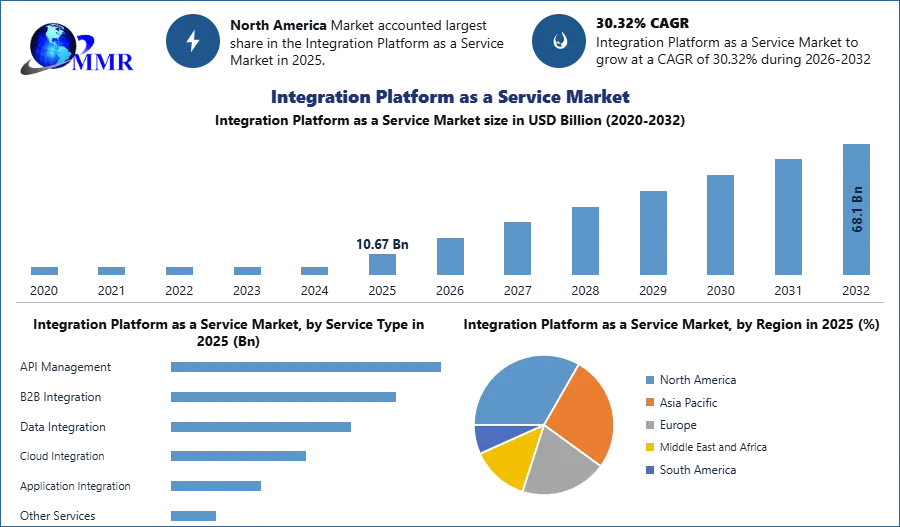
To know about the Research Methodology:- Request Free Sample Report
Integration Platform as a Service Market Dynamics:
Over the forecast period, increasing usage of cloud solutions across various sectors is estimated to drive the growth of the global integration platform as a service market. Reduced capital expenditures, flexibility in data and information storage, improved IT maintenance, customized user interface, greater user experience, and integration with many commercial apps are just a few of the advantages of cloud solutions. Due to their aversion to relying on a single cloud vendor, various enterprises are expected to embrace hybrid and multi-cloud systems in the coming decades. By 2032, 98 % of enterprises aim to use several hybrid clouds, according to IBM Corp. By increasing mobility to operate between both public and private clouds, hybrid cloud gives the benefits of both. Additionally, it allows businesses to protect sensitive data by storing it in the private cloud while also storing public data in the public cloud. As the number of specialised services grows, so will the requirements for unique applications and functionalities.
Another significant factor estimated to drive the global integration platform as a service market is the growing requirement for efficient procedures and better enterprise application management to increase profit margins across different markets throughout the world. Scalability, interference control, multi-platform integration, ubiquitous access, and hyper connection are among the unique solutions offered by the cloud-based platform service, which are intended to help the target market grow.
The growing demand for high-response intelligent systems across various industry verticals to form future strategy plans, mitigate risk and fraud, personalize, and improve overall performance in business processes is expected to fuel the global integration platform as a service market's growth over the forecast period. CRM solutions are increasingly being used by businesses to connect their customer service systems. However, there is still a disconnect between these CRM systems and ERP and BI/Analytics systems.
However, The high cost of implementing iPaaS is a major factor that is likely to limit the global market growth. Additionally, intricacy in the interchange between various applications is another factor that is estimated to limit the intended market's growth to some level.
Integration Platform as a Service Market Segment Analysis:
Based on the Organization Size, the global Integration Platform as a Service market is sub-segmented Large Enterprises and into Small and Medium-sized Enterprises (SMEs). The Small and Medium-sized Enterprises (SMEs) segment held the largest market share of 62.3% in 2025. For SMEs, cost-effectiveness is critical because they operate on a shoestring budget, leaving them with few options for marketing and exposure. The fierce competition in the industry has prompted SMEs to invest in IPaaS solutions in order to reach their intended audience. For SMEs, implementing cloud storage would result in greater income, desired outcomes, and improved operational efficiency. SMEs, on the other hand, confront difficulties in capital management, acquiring trained labour, and scalability.
Based on the Verticals, the global Integration Platform as a Service market is sub-segmented into Banking, Financial Services, and Insurance (BFSI), Government and Public Sector, Healthcare and Life Sciences, Manufacturing, Retail, and Consumer Goods, Telecommunications and Others. The Banking, Financial Services, and Insurance (BFSI) segment held the largest market share of xx% in 2025. BFSI has been disrupting the market with new applications and innovations to the point where people are managing their finances with a variety of apps. It can automate data entry routines, allow SaaS and on-premises systems to share data, and automate workflows between systems for increased efficiency and productivity.
The Retail and Consumer Goods held the 2nd largest market share of xx% in 2025. The rapid growth of e-commerce, which deals in both b2b and b2c platforms, has required firms to perform a variety of tasks, including online selling, placing orders, and inventory management. IPaaS solutions can give a seamless e-commerce integration solution, combining back-end operations, ERP systems, and websites. Additionally, these integration technologies allow for the free flow of data between front-end and back-end systems while lowering IT costs.
Integration Platform as a Service Market Regional Insights:
North America held the largest market share of 45.3% in 2025. Due to the existence of several industry participants, as well as the region's growing adoption of cloud-based services. Demand for IPaaS solutions is likely to be driven by a number of causes, including an increased requirement for enhanced integration services and a transfer of workloads to the cloud. Smart homes are also likely to be one of the main drivers of IoT connectivity development in the coming decades, according to maximize research. By 2032, the business estimates that IoT/machine-to-machine connectivity will account for roughly half of the total 28.5 billion device connections (M2M).
Asia Pacific is expected to grow at the highest CAGR of 11.1% in the global Integration Platform as a Service market during the forecast period. Australia, Singapore, Hong Kong, and South Korea were among the first countries to recognize the benefits of cloud leadership, transforming their businesses into digital enterprises. On the other side, businesses in Sri Lanka, Cambodia, and Myanmar are free of existing systems and may incorporate them into cloud-first models. As a result of the growing use of cloud platforms in the industrial sector, the Asia Pacific market is booming.
The objective of the report is to present a comprehensive analysis of the global Integration Platform as a Service Market to the stakeholders in the industry. The past and current status of the industry with the forecasted market size and trends are presented in the report with the analysis of complicated data in simple language. The report covers all the aspects of the industry with a dedicated study of key players that include market leaders, followers, and new entrants.
PORTER, PESTEL analysis with the potential impact of micro-economic factors of the market has been presented in the report. External as well as internal factors that are supposed to affect the business positively or negatively have been analyzed, which will give a clear futuristic view of the industry to the decision-makers.
The reports also helps in understanding the global Integration Platform as a Service Market dynamic, structure by analyzing the market segments and project the global market size. Clear representation of competitive analysis of key players by product, price, financial position, product portfolio, growth strategies, and regional presence in the global Integration Platform as a Service Market make the report investor’s guide.
Integration Platform as a Service Market Scope: Inquire before buying
| Integration Platform as a Service Market | |||
|---|---|---|---|
| Report Coverage | Details | ||
| Base Year: | 2025 | Forecast Period: | 2026-2032 |
| Historical Data: | 2020 to 2025 | Market Size in 2025: | 10.67 USD Billion |
| Forecast Period 2026-2032 CAGR: | 30.32% | Market Size in 2032: | 68.1 USD Billion |
| Segments Covered: | by Service Type | API Management B2B Integration Data Integration Cloud Integration Application Integration Other Services |
|
| by Deployment Mode | Public Cloud Private Cloud |
||
| by Organization Size | Large Enterprises SMEs |
||
| by Verticals | Banking, Financial Services, and Insurance (BFSI) Government and Public Sector Healthcare and Life Sciences Manufacturing Retail and Consumer Goods Telecommunications Others |
||
Integration Platform as a Service Market, by Region
North America (United States, Canada and Mexico)
Europe (UK, France, Germany, Italy, Spain, Sweden, Austria and Rest of Europe)
Asia Pacific (China, South Korea, Japan, India, Australia, Indonesia, Malaysia, Vietnam, Taiwan, Bangladesh, Pakistan and Rest of APAC)
Middle East and Africa (South Africa, GCC, Egypt, Nigeria and Rest of ME&A)
South America (Brazil, Argentina Rest of South America)
Integration Platform as a Service Market, Key Players
1. Adaptris
2. SAP SE
3. Scribe Software Corporation
4. Oracle Corporation
5. Fujitsu
6. IBM
7. Mulesoft Inc
8. Microsoft Corporation
9. Boomi Inc
10.Celigo inc
11.Informatica Inc.
12.Jitterbit Inc.
13.Workato Inc.
14.SnapLogic Inc.
15.Software AG
16.Tibco
17.Celigo
18.Zapier
19.Flowgear