
Insect Protein Market Size – Industry Structure Evaluation, Demand Drivers Analysis, Regional Growth Analysis and Identification, Competitive Positioning Review & Global Market Size Forecast to 2032
Overview
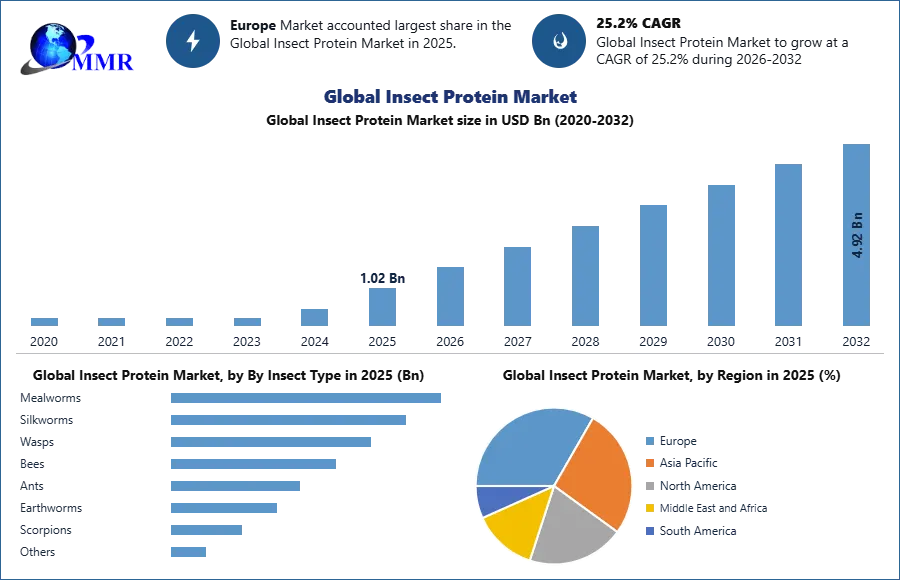
Global Insect Protein Market was valued at USD 1.02 Bn in 2025 and is expected to reach USD 4.92 Bn by 2032, growing at a CAGR of 25.2% during the forecast period.
Insects are a superior source of protein to other animals and plants. Additionally, the cost of producing insect protein is lower. Insect protein was once only utilized in animal feed. However, the high protein content of insects has started to be widely utilized in a variety of industries as more people become aware of this fact. In the current economy, insect protein can be found in a wide range of goods, such as food and drink, pharmaceuticals, nutraceuticals, cosmetics, pet food, and animal and poultry feed. Increased population, rising urbanization, rising venture capital investments in companies producing alternative proteins, technological advancements in the food industry, the high nutritional value of edible insects, and environmental sustainability in the production and consumption of alternative proteins are driving the insect protein market.
Report Scope:
The report provides a complete analysis of the global Insect Protein Market. The report forecasts revenue growth at global, regional & country levels & provides a detailed analysis on the latest trends in each of the segments from 2022 to 2029. It offers qualitative & quantitative analysis of Insect Protein market & comprehensive review of key market drivers, restraints, opportunities, challenges, & market trends of the market.
It also covers various important aspects of the market. Additionally report consists of an analysis of the value chain, PESTLE Analysis, Porter’s Five Forces model, competitive landscape, Key players benchmarking (by Type, Pricing, Investments, Expansion Plans, Physical Presence and Presence in the Market), market dynamics, market forecasts in terms of value & future trends in the Insect Protein market.
To Know About The Research Methodology :- Request Free Sample Report
Insect Protein Market Dynamics:
Rising customer awareness about nutrient-dense foods
During the forecast period, demand for insect protein is expected to be driven by rising consumer awareness of the consumption of nutrient-dense foods & rising inclination for a healthy lifestyle. The increased demand for wholesome food products due to rising health consciousness among customers worldwide has given manufacturers in a variety of industries the chance to sell such foods. Given the rising need for food that comes along with an increasing global population, insect protein has great potential to help end world hunger.
There are numerous uses for insect protein, including the manufacturing of animal feed, foods & beverages, cosmetics, and personal care items.
In western countries, insects are also being investigated as a potential source of human food & animal feed due to the mounting concerns to the world's food crisis. Due to the high consumer awareness level & the existence of consumers who are concerned about their health, the U.S. accounted for the highest revenue share in the North American insect protein market in the year 2022. In addition, more than 50% of Americans have one or more chronic diseases that can be prevented, many of which are brought on by unhealthy eating habits & inactivity. Because of these reason, there is a rising national need for wholesome food products.
Additionally, customers are very concern about their food as well as how it is made & where it comes from. Some of the main factors expected to boost insect protein market growth during the forecast period include rising expenditure on functional food products, an increase in the number of sports & gym enthusiasts, and consumers searching for healthy and sustainable food options. The pandemic impacted the supply chain in a number of regions, including North America & Europe, where the U.S., the U.K., France, & Germany are the top markets for products containing insect protein. Insect protein experienced a modest increase during the pandemic but is expected to recover after the epidemic due to rising consumer knowledge & health consciousness.
Insect protein supply chain disruption due to COVID-19 will slow growth
The majority of nations throughout the world have been impacted by COVID 19. Lockdowns brought on by COVID-19 had a negative impact on the growth of the global insect protein sector. The pandemic brought about a number of difficulties for the food industry; the global beef market has been particularly hard damaged. The insect protein market has been concerned about the risk of ongoing production, supply, distribution, a lack of labour, and fewer development activities.
After affecting 114 nations on March 11, 2020, the WHO declared the COVID-19 outbreak to be a pandemic. As a result, there may be a change in the foods that consumers choose to eat, especially with regard to foods that come from animals. As a result, it is expected that consumption of strange items of animal origin like insects will be rejected more frequently. The possibility of zoonotic illnesses spreading to humans is a concern in the case of insects used as food and feed. Although it has not been documented that these viruses can be spread through ingestion, it is known that insects can carry viruses and directly inject them into humans' blood.
| Exact Date | Company | Development | Impact |
|---|---|---|---|
| 23 February 2026 | Innovafeed | Innovafeed announced the formal validation of its Life Cycle Assessment (LCA) by the Global Feed LCA Institute (GFLI) for its industrial-scale insect ingredients. | This validation provides environmental credibility for insect-based proteins, supporting their integration into sustainable animal feed and pet food global supply chains. |
| 22 January 2026 | NaturAlleva / Innovafeed | NaturAlleva signed a commercial partnership with Innovafeed to integrate Black Soldier Fly (BSFL) ingredients into aquafeed for Mediterranean species. | The collaboration accelerates the commercialization of insect-powered aquaculture, providing a high-performance, sustainable alternative to traditional fishmeal. |
| 28 October 2025 | Protix | Protix released peer-reviewed sustainability data showing its ProteinX® insect meal reduces CO2 emissions by 78% compared to conventional poultry meal. | These findings provide independent confirmation of the sector's ability to lower the environmental footprint of livestock and pet nutrition formulations. |
| 29 September 2025 | Loopworm | Loopworm secured regulatory approval from India’s Coastal Aquaculture Authority (CAA) to use its insect protein and fat as additives in aquaculture. | This milestone enables the direct supply of insect biomolecules to feed manufacturers, boosting palatability and growth performance in India’s shrimp and fish farming sectors. |
| 12 May 2025 | nextProtein | nextProtein secured €18 million in Series B funding to finalize and launch its second production facility in Tunisia. | The expansion scales up annual capacity to 12,000 tons of insect-based ingredients, targeting the rising demand for alternative proteins in the EMEA region. |
| 15 January 2025 | European Commission | The European Commission officially authorized UV-treated powder from Tenebrio molitor larvae (yellow mealworm) as a novel food ingredient. | This regulatory milestone expands the human nutrition segment, allowing for the incorporation of vitamin-enriched insect protein into mainstream food products across the EU. |
Market Trends:
Increased Demand for Alternative Protein Sources Due to Next-Generation Plant-Based Meats & On-the-Go Protein Snacks
The demand for protein among consumers is driving growth & change in the global insect protein market. Today's consumers may find protein in anything from next-generation plant-based meats to on-the-go protein snacks to dairy protein that is bioactive for sports performance. The growing & intense interest of consumers in protein is leading to the creation of new, attractive business prospects that touch on the dietary diversity of proteins, their functional advantages, and new protein sources. As the world's population & standard of living rise, so does the demand for protein as a food & nutritional element. The use of insect-based protein in the food and beverage industry has been growing as a result of food and beverage businesses' increasing need for alternative proteins to meet customers' rising demand.
Demand for Alternative Proteins is growing
Rising urbanization, increasing venture capital investments in companies producing alternative proteins, technological advancements in the food industry, the high nutritional value of edible insects, & environmental sustainability in the production & consumption of alternative proteins are some of the factors driving Insect Protein market. New product introductions and a rising propensity for a vegan diet also contribute to the market's growth. However, the high cost of alternative proteins & the widespread preference for products made from animals limit market growth to some extent. On the other hand, the market for alternative proteins around the world is being challenged by increasing soy- and gluten-free trends.
Insect Protein Market Segment Analysis
In 2025, the Mealworms and Silkworms segments show the highest demand in the global insect protein market due to their high protein content, efficient farming processes, and strong acceptance in both food and feed applications. Mealworms are widely used in animal nutrition and increasingly in human food products such as protein powders and snack ingredients. Silkworms are also gaining traction, particularly in Asia, due to their nutritional benefits and established role in traditional diets. Other insect types such as ants, wasps, and scorpions have niche applications but remain less commercially scalable. Overall, mealworms and silkworms dominate due to their established production infrastructure and growing commercial viability.
Based on Source, Coleoptera and Lepidoptera represent the most significant segments in 2025. Coleoptera, which includes beetles such as mealworms, is widely used due to its high protein yield, efficient feed conversion ratio, and suitability for large-scale farming. Lepidoptera, including silkworms, is also a major contributor due to its strong presence in Asian markets and increasing use in both food and pharmaceutical applications. Other sources such as Orthoptera and Diptera are gaining interest for feed applications, but their commercialization remains at a developing stage compared to Coleoptera and Lepidoptera.
Based on End-use, Animal Nutrition dominates the global insect protein market in 2025. The growing demand for sustainable and high-protein feed ingredients in aquaculture, poultry, and pet food industries significantly drives this segment. Insect protein offers a sustainable alternative to traditional feed sources such as fishmeal and soybean meal, supporting environmentally friendly livestock production. The Food & Beverages segment is also expanding as consumer interest in alternative protein sources grows, particularly in protein bars, snacks, and dietary supplements. Meanwhile, applications in pharmaceuticals, supplements, and personal care products are emerging but remain comparatively smaller in market share.
| Global Insect Protein Market | |||
|---|---|---|---|
| Report Coverage | Details | ||
| Base Year: | 2025 | Forecast Period: | 2026-2032 |
| Historical Data: | 2020 to 2025 | Market Size in 2025: | 1.02 USD Bn |
| Forecast Period 2026-2032 CAGR: | 25.2% | Market Size in 2032: | 4.92 USD Bn |
| Segments Covered: | By Insect Type | Mealworms Silkworms Wasps Bees Ants Earthworms Scorpions Others |
|
| By Source | Coleoptera Lepidoptera Hymenoptera Orthoptera Hemiptera Diptera Others |
||
| By End-use | Food & Beverages Animal Nutrition Pharmaceutical & Supplements Personal Care and Cosmetics |
||
| By Distribution Channel | Online Offline |
||
Insect Protein Market Regional Insights:
Insect Protein Market Scope: Inquiry before Buying
Insect Protein Market, by Region
North America (United States, Canada and Mexico)
Europe (UK, France, Germany, Italy, Spain, Sweden, Austria and Rest of Europe)
Asia Pacific (China, South Korea, Japan, India, Australia, Indonesia, Malaysia, Vietnam, Taiwan, Bangladesh, Pakistan and Rest of APAC)
Middle East and Africa (South Africa, GCC, Egypt, Nigeria and Rest of ME&A)
South America (Brazil, Argentina Rest of South America)
Insect Protein Market Key Players
1. Entomo Farms
2. Exoprotein
3. Nutribug
4. Protix
5. Proti-Farm
6. Coast Protein
7. Aketta
8. C-fu Foods
9. EnviroFlight, LCC
10.nextProtein
11.Thailand Unique
12.Proti-Farm Holding NV
13.Chapul, LLC
14.Cricket Flours LLC
15.Crik Nutrition
16.Seek Food LLC
17.Haocheng Mealworms Inc.
18.Others