
Image Signal Processor Market– Industry Structure Evaluation, Demand Drivers Analysis, Regional Growth Analysis and Identification, Competitive Positioning Review & Global Market Size Forecast to 2032
Overview
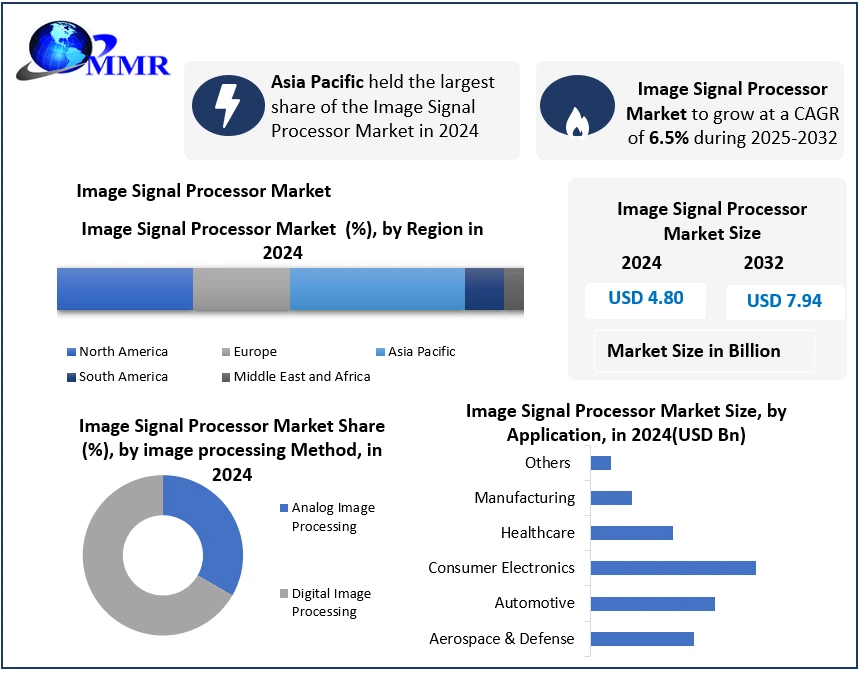
The Global Image Signal Processor Market size was valued at USD 4.80 Bn in 2024, and the total Image Signal Processor Market revenue is expected to grow by 6.5 % from 2025 to 2032, reaching nearly USD 7.94 Bn.
Image Signal Processor Market Overview
Image Signal Processors (ISPs) are application-specific integrated circuits embedded into imaging systems (such as smartphones, cameras, AR/VR devices, and vehicle cameras) to take raw imaginary data from image sensors, which is then transformed into high-quality images or video. For over a decade, ISPs have become more advanced than even a few years ago. ISPs have evolved from basic image processing tasks (demos, icing, and noise reduction) to more advanced functions (AI-based scene detection, effective HDR processing, low-light photography improvements, and real-time HDR and 4k/8k video generation). Today, the need for intelligent imaging in consumer electronics with imaging needs, from consumer flower detection (sensors) to home and industrial security systems, automotive ADAS (Advanced Driver Assistant Systems), to medical imaging, is leading to rapid ISP innovation on a global scale (North America, China, Japan, South Korea, Western Europe).
 To know about the Research Methodology :- Request Free Sample Report
Image Signal Processor Manufacturers are most focused on improving the frame rate, reducing the latency, and implementing AI/ML modules in ISPs, while evolving low-power-consuming devices to coexist with the rapid development of smart mobile and edge devices. Premium smartphones and autonomous vehicles are exploring 6 or more camera setup options, depending on the manufacturer's vision, where they are all cared for by multiple-channel high-performance ISPs that process each camera's complexity and layer the data in real time.
The report provides valuable details on major growth drivers like the growing technological sophistication of smartphone cameras, the demand for computational photography, and the use of AI integration. It analyses the image signal processor market by application type, sensor compatibility, processing speed, and power consumption. Major players in the image signal processor market include Qualcomm (USA), Samsung Electronics (South Korea), Sony Semiconductor (Japan), Omni Vision Technologies (USA/China), and STMicroelectronics (Switzerland), leaders in enabling high-performance visual computing. The report also highlights how convergence with AI chips, growing IoT camera deployments, and demand for enhanced imaging across industries are shaping the future of the Image Signal Processor Market globally.
Image Signal Processor Market Dynamics
Increasing Adoption of High-Resolution Imaging to Drive the Image Signal Processor Market Growth
The increasing demand for high-resolution cameras in smartphones, automotive systems, surveillance equipment, and industrial applications is driving the adoption of advanced image signal processors. Consumers and enterprises alike seek devices capable of delivering exceptional image clarity, low-light performance, and real-time processing. ISPs enable enhanced image quality by reducing noise, improving color accuracy, and supporting advanced computational photography features. This growing integration of ISPs in AI-powered imaging and emerging technologies such as AR/VR and autonomous vehicles is boosting significant Image Signal Processor market growth.
High Integration Costs and Power Consumption Challenges to Hamper the Image Signal Processor Market
The high cost of integrating ISPs into devices remains a challenge, particularly for low-cost consumer electronics. ISP operations require substantial power for real-time image processing, which can impact battery performance in portable devices. These factors may restrain market adoption, especially in cost-sensitive markets and applications with stringent energy efficiency requirements.
Rising Demand for AI-Powered Image Enhancement: A Key Opportunity in the Image Signal Processor Market
The Increasing trend toward AI-driven image processing, including object recognition, facial recognition, and computational photography, presents significant opportunities for ISP manufacturers. By integrating AI accelerators and machine learning algorithms into ISPs, companies can deliver advanced functionalities such as automated scene detection, image segmentation, and real-time video analytics. This innovation wave is opening lucrative growth avenues across consumer electronics, automotive safety systems, and smart surveillance solutions.
Image Signal Processor Market Segment Analysis
By image processing method, the digital image processing segment dominated the market in 2024 and is expected to maintain its dominance at the highest CAGR during the forecast period. The high adoption of digital image processing in applications like compact discs, satellite, medical, mobile phones, and voice detection machines is attributed to the Image Signal Processor Market Growth. Digital Image Processing (DIP) is software that is used to manipulate digital images by using a computer system. It is used to improve the image quality, to obtain important information from it. The digital image processing technology performs various tasks. It acts as a system on a chip with a multi-core processor architecture to enhance the system integration on embedded devices.
By end-use industry, in 2024, the consumer electronics segment dominated the Image Signal Processor (ISP) market and is expected to hold the largest Image Signal Processor Market share over the forecast period. The growth is primarily driven by the rising adoption of high-resolution imaging in smartphones, tablets, smart cameras, and wearable devices. Increasing demand for advanced photography, enhanced video recording, and AI-based image enhancements is boosting ISP integration in consumer electronics. the surge in demand for 4K/8K video capture, augmented reality (AR), and virtual reality (VR) applications is further increasing ISP adoption. The automotive segment is experiencing significant growth due to the integration of ISPs in advanced driver-assistance systems (ADAS), autonomous driving technologies, and in-vehicle infotainment systems. In aerospace and defense, ISPs are being increasingly used for high-precision surveillance, navigation, and reconnaissance applications. The healthcare sector is leveraging ISPs in medical imaging equipment, endoscopy, and diagnostic devices to improve image clarity and diagnostic accuracy. The manufacturing industry is adopting ISP technology in industrial automation, machine vision, and quality inspection systems, while other niche segments are expanding usage in security systems, robotics, and specialized imaging applications, contributing to the Image Signal Processor market growth.
Image Signal Processor Market Regional Analysis
Asia-Pacific held the largest Image Signal Processor Market share in 2024 and is expected to maintain its dominance at the highest CAGR during the forecast period. It is driven by the strong presence of consumer electronics manufacturing hubs in China, Japan, South Korea, and Taiwan, along with rising demand for smartphones, surveillance systems, and automotive camera modules. North America holds a significant market share, supported by advancements in autonomous vehicles, defense imaging technologies, and the integration of AI-driven imaging in healthcare and industrial applications.
Europe’s Image Signal Processor Market growth is supported by increasing adoption of ISP technology in automotive safety systems, industrial automation, and medical imaging, particularly in Germany, the UK, and France. The Middle East & Africa region is witnessing gradual growth due to expanding investments in smart city projects and security infrastructure, while Latin America is experiencing steady demand led by the adoption of ISP-enabled consumer electronics and the growing automotive sector in countries like Brazil and Mexico.
Image Signal Processor Market Competitive Landscape
The Image Signal Processor Market is highly competitive due to rising demand for imaging accuracy, real-time processing, and AI-enhanced visual computing in consumer electronics, automotive, and industrial markets. Key suppliers like Qualcomm (USA) and Samsung Electronics (South Korea) have developed high-performance ISP platforms leveraging SoC (system-on-chip) architectures, enabling high-resolution, low-light, and computational photography features that appear on dozens of flagship smartphones with imaging capabilities. Qualcomm (USA) was able to generate momentum with its Spectra ISP components of its Snapdragon portfolio in 2024 since it is estimated that it's embedded into 250 million mobile devices, underscored by the ability to solely support AI-powered multi-camera support with embedded real-time scene detection.
Sony Semiconductor (Japan), which had controlled the sensor-ISP development and capture space, being at times a favoured supplier, was able to support 2024 but mainly upon its very complex ISP ratings, mostly used for automotive capture and other security imaging applications, and demonstrated strong levels of demand for edge AI devices. Omni Vision Technologies (USA/China) also carved out a nice share in the mid-tier range with its low-power ISP alternatives used in smartphones and IoT cameras, while STMicroelectronics (Switzerland) gained exposure in IMUs with some share in automotive and medical imaging capture. all of these players are continuing to improve their ISP offerings by adding neural processing units (NPUs), which aid in speed of processing images with more power efficiency and especially in the support of 4K / 8K video and multi-camera configuration to supply the constant increase from the industry for intelligent imaging.
Image Signal Processor Market Key Recent Development
October 4, 2024, Sony introduced the ISX038 CMOS image sensor, an industry-first automotive sensor capable of simultaneously processing and outputting RAW and YUV images. It integrates a proprietary ISP to support both high-precision environmental detection for ADAS/autonomous systems and YUV imaging for infotainment, simplifying camera system design and reducing space, cost, and power consumption.
November 19, 2024, Sony announced the IMX925, an industrial-grade stacked CMOS image sensor featuring a global shutter, delivering high-speed processing at 394 fps and 24.55 effective megapixels. It offers significantly faster performance and improved energy efficiency approximately four times faster and twice as efficient ideal for machine vision applications in manufacturing and inspection systems.
April 8, 2024, Ambarella unveiled its CV75S series, a new family of 5 nm AI SoCs featuring the CVflow 3.0 AI engine, USB 3.2, and dual Arm Cortex-A76 CPUs. This series offers powerful, energy-efficient AI-based image processing and vision-language model capabilities tailored for security cameras, robotics, video conferencing, and smart city applications.
Image Signal Processor Market Trends
1. AI-Powered Imaging Enhancements
Image signal processors (ISPs) are increasingly being assimilated with artificial intelligence (AI) and machine learning to enable real-time scene detection, semantic segmentation, auto-focusing, and noise reduction.
Example: Qualcomm (USA, 2024) and Samsung (South Korea, 2024) released ISPs with integrated AI engines for photo and video capture functions such as Astro photo and object identification.
2. Shift from Smartphones to Automotive and Medical Imaging
The capabilities of an ISP are being advanced for multiple applications in autonomous driving systems or medical imaging and diagnostics, where high-dynamic range, real-time processing, and ultra-low latency are required.
Example: Sony (Japan, 2025) released automotive ISPs, while STMicroelectronics (Switzerland, 2025) produced an ultra-precision ISP for medical imaging devices.
3. Ultra-high Resolutions and Multi-Cameras
In the imaging processing segment of the semiconductor industry, the movement is shifting towards ultra-high resolution (60-megapixel (MP) +) multi-camera and 4K/8K video processing with the growing application in mobile devices, surveillance, and content creator applications.
Example: Omni Vision (USA/China, 2024) recently released a 60 MP sensor with integrated ISP for smartphones and webcams in live video streaming with advanced auto-focusing and facial recognition capabilities.
Global Image Signal Processor Market Scope : Inquire before buying
| Global Image Signal Processor Market | |||
|---|---|---|---|
| Report Coverage | Details | ||
| Base Year: | 2024 | Forecast Period: | 2025-2032 |
| Historical Data: | 2019 to 2024 | Market Size in 2024: | USD 4.80 Bn. |
| Forecast Period 2025 to 2032 CAGR: | 6.5% | Market Size in 2032: | USD 7.94 Bn. |
| Segments Covered: | by Component | Hardware Software Services |
|
| by Image Type | 1D 2D 3D |
||
| by Image Processing Method | Analog Image Processing Digital Image Processing |
||
| by Technology | Single Instruction Multiple Data [SMID] Multiple Instruction Multiple Data [MIMD] |
||
| by Distribution Channel | OEMs (Original Equipment Manufacturers) Aftermarket |
||
| by End Use Industry | Aerospace & Defense Automotive Consumer Electronics Healthcare Manufacturing Others |
||
Image Signal Processor Market, by Region
North America (United States, Canada, Mexico)
Europe (United Kingdom, France, Germany, Italy, Spain, Sweden, Russia, Rest of Europe)
Asia Pacific (China, South Korea, Japan, India, Australia, Indonesia, Malaysia, Philippines,
Thailand, Vietnam, Rest of Asia Pacific)
Middle East and Africa (MEA) (South Africa, GCC, Nigeria, Rest of MEA)
South America (Brazil, Argentina, Colombia, Chile, Rest of South America)
Image Signal Processor Key Players are:
North America
1. Qualcomm Technologies Inc. – USA
2. OmniVision Technologies – USA / China
3. Texas Instruments Inc. – USA
4. Semiconductor Components Industries, LLC
5. Ambarella, Inc. – USA
6. Micron Technology, Inc. – USA
Asia-Pacific
1. Samsung Electronics Co., Ltd. – South Korea
2. Sony Semiconductor Solutions – Japan
3. Panasonic Holdings Corp. – Japan
4. MediaTek Inc. – Taiwan
5. HiSilicon (Huawei Technologies) – China
6. Fujifilm
Europe
1. STMicroelectronics – Switzerland
2. Infineon Technologies AG – Germany
3. NXP Semiconductors – Netherlands
Frequently Asked Questions:
1. Which region has the largest share in the Market?
Ans: The Asia Pacific region holds the largest market share in 2024.
2. What is the growth rate of the Market?
Ans: The Image Signal Processor Market is growing at a CAGR of 6.5 % during the forecasting period 2025-2032.
3. What is the scope of the Global market report?
Ans: The Global Image Signal Processor market report helps with the PESTEL, PORTER, recommendations for investors and leaders, and market estimation of the forecast period.
4. Who are the key players in the Image Signal Processor market?
Ans: The important key players in the Image Signal Processor Market are Qualcomm Technologies Inc, OmniVision Technologies, ST Microelectronics, Fujitsu Ltd, Sigma Corporation, Texas Instruments Inc., Sony Semiconductor Solutions, Fujifilm, and Others
5. What is the study period of this market?
Ans: The Image Signal Processor Market is studied from 2024 to 2032.