
Hyper Cars Market Powertrain Type, By Engine Configuration, By Power Output, By Chassis, By Application, By Sales Channel and Regional Insights 2034
Overview
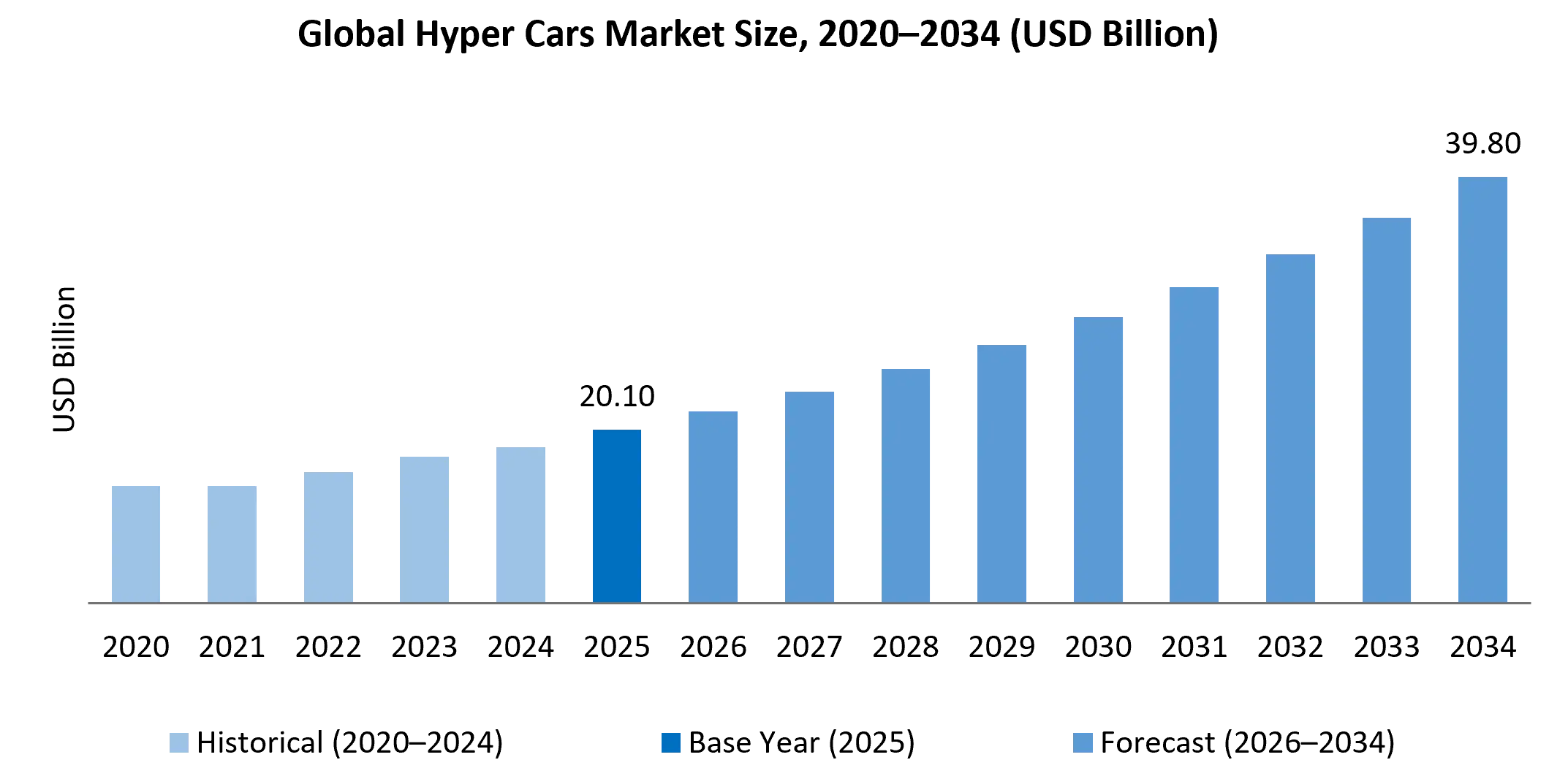
The Global Hyper Cars Market size was valued at USD 20.10 Billion in 2025 and the total market revenue is expected to grow at a CAGR of 7.9% from 2026 to 2034, reaching nearly USD 39.80 Billion by 2034.
| Parameter | Value |
| Market Size (2025) | USD 20.10 Billion |
| Market Size (2034) | USD 39.80 Billion |
| CAGR | 7.9% |
| Historical Period | 2020 to 2025 |
| Forecast Period | 2026 to 2034 |
Hyper Cars Market Overview
The Global Hyper Cars Market encompasses the manufacturing, distribution, and sales of ultra-high-performance, technologically advanced, and exclusive automobiles designed to deliver exceptional speed, acceleration, power output, aerodynamic efficiency, and driving performance. Hypercars represent the premium category of the global automotive industry, distinguished by advanced engineering, lightweight vehicle structures, high-performance powertrains, limited production volumes, and extensive customization capabilities. These vehicles are manufactured by specialized luxury automotive brands and established premium automobile manufacturers, targeting high-net-worth individuals (HNWI), ultra-high-net-worth individuals (UHNWI), automotive collectors, and performance-oriented customers.
The Global Hyper Cars Market includes vehicles powered by internal combustion engines (ICE), hybrid electric powertrains, plug-in hybrid electric systems (PHEV), and battery electric technologies (BEV). Manufacturers are increasingly integrating advanced V6, V8, V10, V12, and W16 engine configurations, high-output electric motors, sophisticated transmission systems, and advanced battery technologies to enhance vehicle performance. Furthermore, the adoption of carbon-fibre composite structures, aluminium chassis, titanium components, active aerodynamic systems, and advanced vehicle control technologies is improving vehicle dynamics, structural rigidity, and power-to-weight ratios.
The growing demand for exclusive luxury automobiles, increasing wealth concentration among high-net-worth individuals, expansion of premium automotive ownership, and introduction of next-generation performance vehicles are influencing global hypercar demand. Manufacturers such as Ferrari, Bugatti, Lamborghini, Koenigsegg, Pagani, McLaren, Aston Martin, and Rimac are strengthening their product portfolios through advanced powertrain development, limited-production models, bespoke customization, and performance-oriented technological innovations.
Furthermore, the transition toward hybrid and battery electric hypercars is creating new opportunities for automotive manufacturers to combine high-output propulsion systems with improved energy efficiency and advanced vehicle performance. Increasing investments in research and development, lightweight materials, battery technology, advanced aerodynamics, and digital vehicle systems are expected to influence the competitive landscape of the global hypercar industry during the forecast period.
To know about the Research Methodology :- Request Free Sample Report
Global Hyper Cars Market Key Highlights
• Growing Demand for Ultra-Luxury Performance Vehicles: Increasing demand for exclusive automobiles among high-net-worth and ultra-high-net-worth individuals is supporting the development of technologically advanced and limited-production hypercars.
• Increasing Adoption of Hybrid Powertrains: Automotive manufacturers are integrating hybrid technologies into high-performance vehicles to improve acceleration, power delivery, torque management, and energy efficiency.
• Advanced Internal Combustion Engine Technologies: V8, V10, V12, and W16 engine configurations continue to represent important performance technologies, supported by developments in turbocharging, combustion efficiency, and engine management systems.
• Expansion of Battery Electric Hypercars: Advancements in electric motors, high-performance battery systems, thermal management, and torque vectoring are creating opportunities for fully electric hypercar development.
• Increasing Demand for Limited-Edition Vehicles: Exclusive production runs, bespoke customization, collector-oriented models, and manufacturer-specific allocation strategies are influencing hypercar purchasing decisions.
• Advanced Lightweight Vehicle Structures: Growing adoption of carbon-fibre composites, aluminium, titanium, and multi-material chassis structures is supporting improvements in vehicle weight, structural rigidity, and performance.
• Europe Maintains a Strong Automotive Manufacturing Base: Germany, Italy, the United Kingdom, France, and Sweden represent important markets for hypercar manufacturing, engineering, technology development, and luxury vehicle ownership.
Global Hyper Cars Market Dynamics:
Increasing Demand for Ultra-Luxury Performance Vehicles to Drive the Global Hyper Cars Market
The global luxury automotive industry is experiencing increasing demand for exclusive, high-performance, and technologically advanced automobiles. The expansion of high-net-worth and ultra-high-net-worth consumer populations, particularly across North America, Europe, Asia Pacific, and the Middle East, is supporting demand for premium automotive products. Hypercars represent an exclusive category within this industry, offering exceptional performance capabilities, distinctive engineering, limited production volumes, and personalized ownership experiences.
Manufacturers are increasingly introducing new hypercar models featuring advanced engine configurations, high-output electric motors, sophisticated transmission systems, and aerodynamic vehicle designs. Customers are also demonstrating interest in vehicles offering a combination of exclusivity, brand heritage, technological differentiation, and long-term collector appeal.
Furthermore, increasing participation in luxury automotive events, exclusive vehicle launches, private automotive collections, and manufacturer-led customer engagement programs is strengthening the visibility of hypercar brands. These developments are encouraging manufacturers to expand their limited-edition product portfolios and introduce specialized performance vehicles.
Increasing Integration of Hybrid and Electric Powertrains to Create Market Opportunities
The automotive industry's transition toward electrification is influencing the development of next-generation hypercars. Manufacturers are increasingly integrating electric motors with conventional combustion engines to improve acceleration, torque delivery, power distribution, and overall vehicle performance.
Hybrid hypercars combine internal combustion engines with electric propulsion systems, enabling manufacturers to maintain high-performance characteristics while improving powertrain efficiency. Plug-in hybrid electric systems provide additional flexibility through rechargeable battery configurations and electric driving capabilities.
Battery electric hypercars are also gaining technological importance through developments in high-performance electric motors, advanced battery chemistry, lightweight battery enclosures, thermal management systems, and sophisticated power electronics.
According to the International Energy Agency (IEA), global electric car sales exceeded 17 million units in 2024, representing more than 20% of new vehicle sales worldwide. Although this data covers the broader electric passenger vehicle industry rather than hypercars specifically, it demonstrates the expanding technological and commercial ecosystem supporting automotive electrification.
Manufacturers such as Rimac, Aspark, Ferrari, Lamborghini, and McLaren are contributing to the development of advanced electric and hybrid performance technologies. Increasing investment in these technologies is expected to create opportunities for hybrid and battery electric hypercar development during the forecast period.
Increasing Demand for Limited-Edition and Bespoke Hypercars to Support Market Growth
Exclusivity and personalization represent important purchasing considerations within the global hypercar industry. Unlike mass-market automobiles, hypercars are frequently manufactured in restricted production quantities, with certain models offered through invitation-based purchasing, customer allocation, or exclusive ordering arrangements.
Manufacturers are increasingly offering bespoke interior configurations, personalized exterior finishes, custom materials, performance packages, and manufacturer-specific customization programs. These offerings enable customers to differentiate their vehicles while strengthening brand engagement and customer loyalty.
Limited-edition vehicles also attract automotive collectors because of their distinctive specifications, restricted production availability, historical significance, and brand positioning. Furthermore, manufacturer announcements, exclusive product launches, and collector-focused ownership experiences are strengthening demand for special-series hypercars.
The increasing preference for personalized and exclusive automobiles is expected to support premium vehicle pricing and create opportunities for manufacturers specializing in low-volume, high-value automotive production.
Technological Advancements in Lightweight Materials and Aerodynamic Engineering
Technological advancements in automotive engineering are playing an important role in the development of next-generation hypercars. Manufacturers are increasingly adopting carbon-fibre composites, aluminium structures, titanium components, and advanced multi-material construction techniques to reduce vehicle weight while maintaining structural strength and safety.
Carbon-fibre monocoque chassis structures are widely utilized in high-performance vehicle development because of their high strength-to-weight characteristics. Advanced aerodynamic systems, including active rear wings, adjustable aerodynamic surfaces, underbody airflow management, and advanced cooling arrangements, are also improving vehicle stability and handling at high speeds.
Furthermore, developments in computational fluid dynamics, artificial intelligence-assisted engineering, advanced simulation systems, and digital vehicle testing are supporting the optimization of vehicle performance.
The integration of lightweight materials and aerodynamic technologies is expected to remain an important competitive differentiator among hypercar manufacturers.
Increasing Investments in Research and Development to Strengthen Market Competitiveness
The development of hypercars requires substantial investments in engineering, research and development, specialized manufacturing infrastructure, powertrain technologies, and advanced materials. Manufacturers are allocating resources toward next-generation engines, electric propulsion systems, battery technologies, transmission systems, aerodynamic engineering, and intelligent vehicle control technologies.
Automotive manufacturers are also establishing technology partnerships with battery suppliers, component manufacturers, engineering companies, and specialist technology developers to improve product development capabilities.
Furthermore, investments in advanced manufacturing facilities, carbon-fibre production, precision engineering, and specialized assembly processes are supporting the development of exclusive and high-performance automobiles.
Companies with strong engineering capabilities, established brand recognition, and access to specialized automotive supply chains are expected to maintain competitive advantages in the global hypercar industry.
Global Hyper Cars Market Segment Analysis
The Global Hyper Cars Market is segmented into powertrain type, engine configuration, power output, chassis, application, sales channel, and region. Each segment represents different vehicle technologies, performance characteristics, manufacturing requirements, customer preferences, and distribution models.
By Powertrain Type
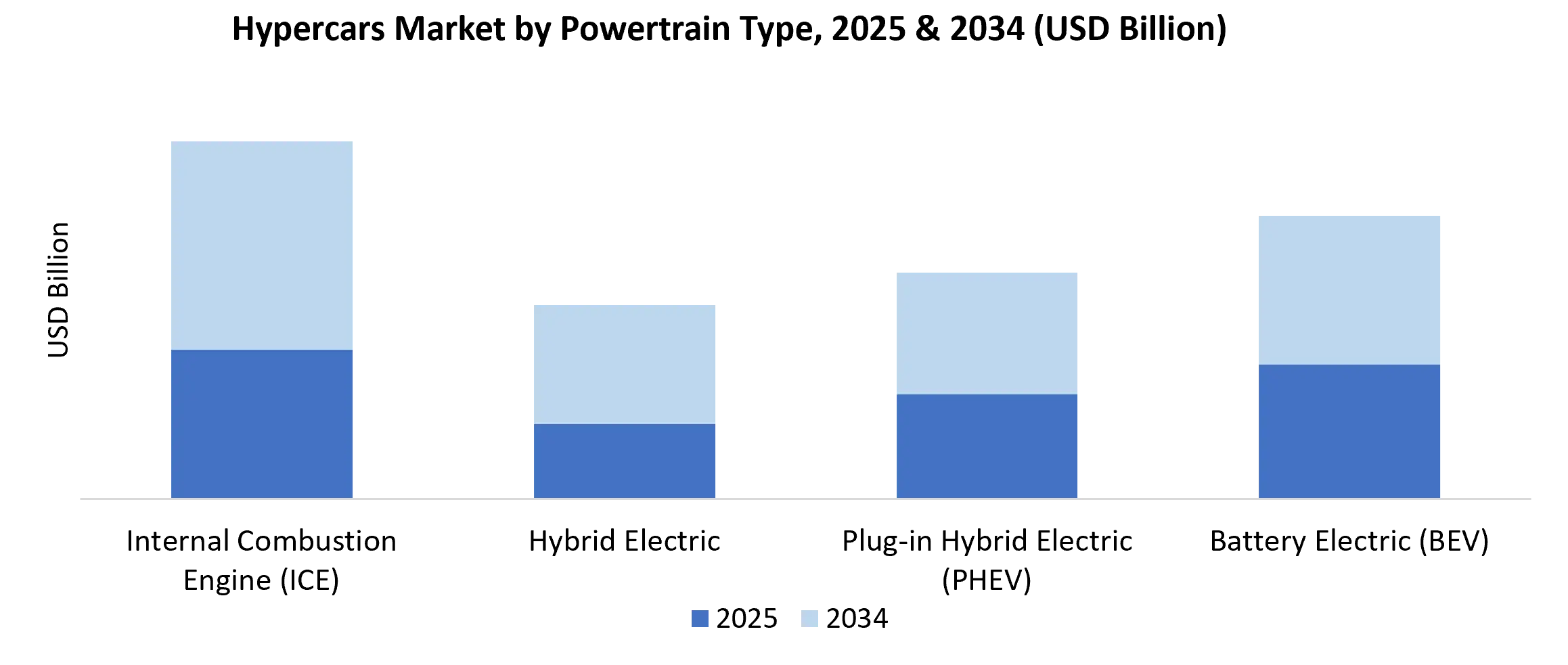
Based on powertrain type, the Global Hyper Cars Market is segmented into Internal Combustion Engine (ICE), Hybrid Electric, Plug-in Hybrid Electric (PHEV), and Battery Electric (BEV).
The Internal Combustion Engine (ICE) segment represents an important category of the global hypercar industry, supported by the established demand for high-performance combustion engines, distinctive engine characteristics, and traditional automotive engineering. Hypercars equipped with V8, V10, V12, and W16 engines are recognized for their high power output, engine sound, acceleration capabilities, and performance-oriented driving experience. Established manufacturers continue to develop advanced combustion technologies through turbocharging, improved engine management, optimized cooling systems, and lightweight engine components.
The Hybrid Electric segment is gaining importance as manufacturers integrate electric motors with conventional internal combustion engines to improve acceleration, torque delivery, and power distribution. Hybrid configurations allow manufacturers to combine traditional engine performance with electric assistance, supporting the development of technologically advanced hypercars.
The Plug-in Hybrid Electric (PHEV) segment is characterized by the integration of rechargeable battery systems, electric motors, and conventional combustion engines. These vehicles provide additional electric driving capabilities while retaining the performance and extended driving range associated with combustion-powered vehicles. Advancements in battery technology, electric motor integration, and energy management systems are supporting the development of plug-in hybrid hypercars.
The Battery Electric (BEV) segment is witnessing technological development through high-output electric motors, advanced battery systems, torque vectoring, and sophisticated thermal management technologies. Electric hypercars offer immediate torque delivery and flexible power distribution, enabling manufacturers to develop vehicles with exceptional acceleration and advanced electronic performance control systems.
By Sales Channel
Based on sales channel, the market is segmented into Direct Sales by Manufacturers, Authorized Dealerships, and Exclusive / Boutique Automotive Dealers.
The Direct Sales by Manufacturers segment includes vehicles sold through manufacturer-managed customer relationships, exclusive ordering arrangements, and direct allocation programs. Manufacturers frequently utilize personalized purchasing processes for limited-edition and special-series hypercars.
The Authorized Dealerships segment includes sales through manufacturer-approved dealership networks. These dealerships provide vehicle demonstrations, customer consultations, purchase arrangements, and after-sales support.
The Exclusive / Boutique Automotive Dealers segment includes specialist luxury automotive dealerships focusing on rare, high-value, and limited-production automobiles. These dealers support transactions involving exclusive hypercars, specialist vehicle collections, and selected pre-owned models.
Global Hyper Cars Market Regional Insights:
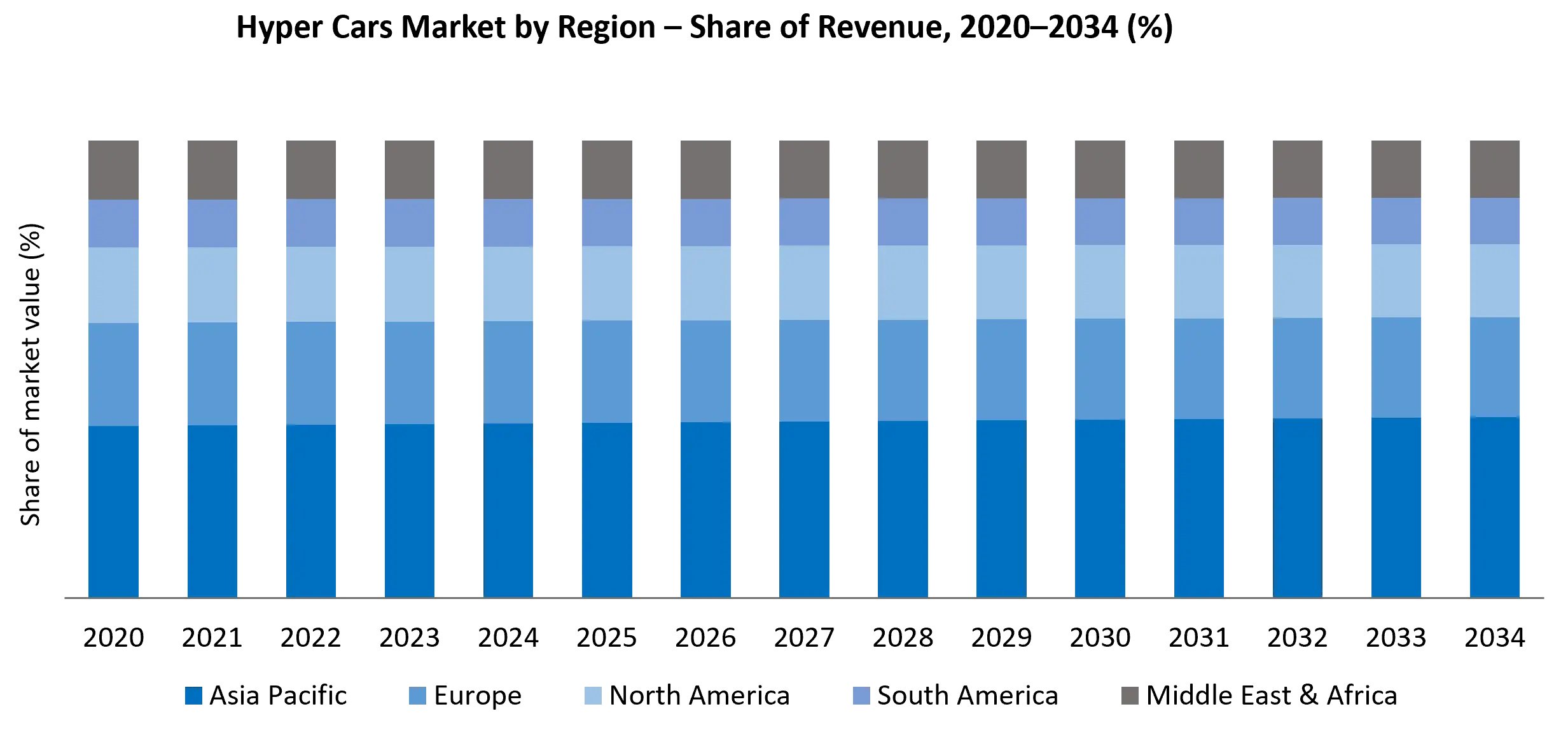
The Global Hyper Cars Market is segmented into North America, Europe, Asia Pacific, Middle East & Africa, and South America. Europe represents a major regional hub for hypercar manufacturing, engineering, and ownership, supported by established automotive industries in Italy, the United Kingdom, Germany, France, and Sweden. Leading manufacturers, including Ferrari, Lamborghini, Bugatti, Pagani, Koenigsegg, McLaren, and Aston Martin, strengthen the region’s competitive position through advanced engineering, hybrid propulsion, lightweight materials, aerodynamic technologies, and limited-edition vehicle development. North America represents another significant market, driven by high purchasing power, luxury vehicle ownership, and demand for high-performance automobiles. The United States leads regional demand, supported by companies such as Hennessey Performance Engineering, SSC North America, Czinger Vehicles, Saleen Automotive, and Drako Motors. Canada and Mexico contribute through luxury vehicle consumption, distribution, and international automotive trade.
Asia Pacific is emerging as an important market, supported by growing high-net-worth populations, increasing luxury vehicle ownership, and investments in advanced automotive technologies. China, Japan, and South Korea contribute through luxury vehicle demand, automotive engineering, and electric performance technologies, while India, Australia, and Southeast Asian countries offer additional growth opportunities. Middle East & Africa represents an attractive market, particularly across Saudi Arabia, the UAE, Qatar, Kuwait, Bahrain, and Oman, where affluent consumers, premium dealerships, and demand for bespoke and limited-production vehicles support hypercar ownership. Dubai remains an important luxury automotive distribution hub, while South Africa contributes to regional premium vehicle sales. South America, including Brazil, Argentina, Chile, and Colombia, represents an emerging market for hypercar distribution and ownership. However, import duties, taxation, currency fluctuations, and limited specialized after-sales infrastructure may constrain accessibility. Expanding dealership networks and international brand availability are expected to support future regional opportunities.
Global Hyper Cars Market – Industry Analysis
The objective of the report is to present a comprehensive analysis of the Global Hyper Cars Market, covering major stakeholders across the luxury automotive manufacturing, high-performance vehicle engineering, and exclusive automobile distribution industries. The study evaluates the historical and current market scenario, industry developments, market size, vehicle sales volume, and future growth outlook through 2034.
The report provides an in-depth assessment of market dynamics, including major growth drivers, restraints, opportunities, and challenges influencing global hypercar demand. It also examines global vehicle production, ownership patterns, replacement demand, powertrain technologies, engine configurations, power output classifications, chassis materials, vehicle pricing, and international trade flows.
The study further evaluates the competitive positioning of leading hypercar manufacturers and specialist high-performance automotive companies. Company-level analysis includes product portfolios, vehicle specifications, production capabilities, geographical presence, total company revenue, hypercar business contribution where disclosed, research and development investments, profitability, strategic developments, and business expansion initiatives.
PORTER's Five Forces, PESTLE, and SWOT analyses are incorporated to evaluate the competitive environment and the influence of macroeconomic, regulatory, technological, and industry-specific factors on the market. The report also provides regional market assessments and country-level forecasts to identify emerging opportunities and future investment hotspots.
The research helps automotive manufacturers, luxury vehicle brands, component suppliers, technology developers, investors, distributors, specialist dealerships, and other industry stakeholders understand the evolving hypercar landscape and make informed strategic business decisions.
Global Hyper Cars Market Scope: Inquire before buying
| Hyper Cars Market | |||
|---|---|---|---|
| Report Coverage | Details | ||
| Base Year: | 2025 | Forecast Period: | 2026-2034 |
| Historical Data: | 2020 to 2025 | Market Size in 2025: | 20.10 USD Billion |
| Forecast Period 2026-2034 CAGR: | 7.9% | Market Size in 2034: | 39.80 USD Billion |
| Segments Covered: | by Powertrain Type | Internal Combustion Engine (ICE) Hybrid Electric Plug-in Hybrid Electric (PHEV) Battery Electric (BEV) |
|
| by Engine Configuration | V6 Engine V8 Engine V10 Engine V12 Engine W16 Engine Other Engine Configurations |
||
| by Power Output | Below 800 HP 800–1,000 HP 1,001–1,200 HP 1,201–1,500 HP Above 1,500 HP |
||
| by Chassis | Carbon Fiber Composite Aluminium Steel Titanium and Other Advanced Materials Multi-Material Composite Structures |
||
| by Application | Road-Legal / Private Driving Track-Only Hypercars Racing / Competition Collector and Limited-Edition Vehicles |
||
| by Sales Channel | Direct Sales by Manufacturers Authorized Dealerships Exclusive / Boutique Automotive Dealers |
||
Hyper Cars Market, by Region
North America (United States, Canada and Mexico)
Europe (UK, France, Germany, Italy, Spain, Sweden, Austria and Rest of Europe)
Asia Pacific (China, South Korea, Japan, India, Australia, Indonesia, Malaysia, Vietnam, Taiwan, Bangladesh, Pakistan and Rest of APAC)
Middle East and Africa (South Africa, GCC, Egypt, Nigeria and Rest of ME&A)
South America (Brazil, Argentina, Rest of South America)
Hyper Cars Key Players:
Europe
1. Bugatti Automobiles
2. Ferrari
3. Automobili Lamborghini
4. Pagani Automobili
5. Koenigsegg Automotive
6. McLaren Automotive
7. Aston Martin
8. Mercedes-AMG
9. Porsche
10. Rimac Automobili
11. Automobili Pininfarina
12. Lotus Cars
13. Gordon Murray Automotive
14. Zenvo Automotive
15. Apollo Automobile
16. Hispano Suiza
17. De Tomaso
18. Praga Cars
19. Delage Automobiles
20. Mazzanti Automobili
21. Dallara
22. Maserati
23. Alpine
24. Arrinera Automotive
25. Noble Automotive
26. Arash Motor Company
27. Donkervoort
North America
28. Hennessey Performance Engineering
29. SSC North America
30. Czinger Vehicles
31. Scuderia Cameron Glickenhaus
32. Saleen Automotive
33. Nilu27
34. Drako Motors
35. Ford Performance
Asia-Pacific
36. Aspark
37. NIO
38. Yangwang
39. Vanda Electrics
40. Vazirani Automotive
41. Toyota Gazoo Racing
42. Nissan
Middle East & Africa
43. W Motors
44. Jannarelly Automotive
Others
Frequently Asked Questions:
1. What is the Global Hyper Cars Market size?
Ans: The Global Hyper Cars Market was valued at USD 20.10 Billion in 2025 and is projected to reach USD 39.80 Billion by 2034.
2. Which powertrain types are covered in the Global Hyper Cars Market?
Ans: The market includes Internal Combustion Engine (ICE), Hybrid Electric, Plug-in Hybrid Electric (PHEV), and Battery Electric (BEV) hypercars.
3. Which region is expected to dominate the Global Hyper Cars Market?
Ans: Europe represents an important region in the global hypercar industry, supported by established luxury automotive manufacturers, advanced engineering capabilities, and a strong premium vehicle manufacturing ecosystem. Regional market dominance will be determined through the 2025 market share assessment.
4. Who are the major key players in the Global Hyper Cars Market?
Ans: Major companies include Bugatti Automobiles, Ferrari, Automobili Lamborghini, Pagani Automobili, Koenigsegg Automotive, McLaren Automotive, Aston Martin, Porsche, Rimac Automobili, Hennessey Performance Engineering, SSC North America, Czinger Vehicles, Aspark, NIO, Yangwang, W Motors, and others.
5. What is the forecast period for the Global Hyper Cars Market?
Ans: The report considers 2020–2025 as the historical period and 2026–2034 as the forecast period, with 2025 as the base year.