
Hybrid Battery Energy Storage System Market - Industry Structure Evaluation, Demand Drivers Analysis, Regional Growth Analysis and Identification, Competitive Positioning Review & Global Market Size Forecast to 2032
Overview
The Global Hybrid Battery Energy Storage System Market size was valued at USD 16.59 billion in 2024, and the total Hybrid Battery Energy Storage System Market revenue is expected to grow by 6.91% from 2025 to 2032, reaching nearly USD 28.31 billion.
Hybrid Battery Energy Storage System Market Overview
Hybrid Battery Energy Storage Systems (BESS) are advanced storage systems combining two or more battery technologies, usually lithium-ion with lead-acid, flow, and/or supercapacitor systems, to achieve improved performance, throughput, lifecycle times, and efficiencies in both power and energy. Hybrid BESS also inherently considers several energy demand requirements - fast response, long duration, grid stability, etc, allowing it to also fulfil energy requirements across both centralized and distributed energy realms. Hybrid BESS is used in a wide range of applications across utilities, renewable generation and integration, commercial and industrial back-up power, residential energy storage, and electric vehicle (EV) infrastructures, to name a few.
The increasing shift toward renewable energy integration, grid modernization, and the rising demand for reliable, flexible, and efficient energy storage solutions drive the Hybrid Battery Energy Storage System Market. Hybrid systems, which combine two or more battery technologies such as lithium-ion, flow, lead-acid, or nickel-based batteries, are increasingly being deployed to overcome the limitations of single-battery chemistries by offering a balance of high energy density, long cycle life, fast response times, and cost-effectiveness. Lithium-ion batteries remain the leading technology in hybrid storage systems, often paired with flow or lead-acid batteries to address both short-duration and long-duration storage needs, ensuring greater operational flexibility and grid stability.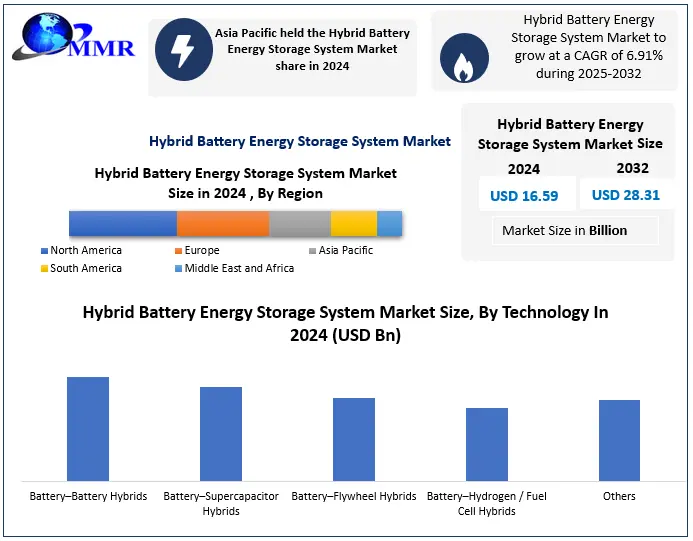 To know about the Research Methodology :- Request Free Sample Report
Hybrid Battery Energy Storage System Market Dynamics
Increasing demand for clean energy and other factors to drive the Hybrid Battery Energy Storage System Market
Governments and utilities are increasingly investing in solar, wind, and other renewable projects, which require reliable storage solutions to stabilize intermittent generation. Hybrid battery systems, combining multiple chemistries such as lithium-ion and flow batteries, provide enhanced flexibility, efficiency, and resilience in managing fluctuating energy supply. Their ability to support grid stability, enable peak shaving, provide frequency regulation, and ensure backup power is making them indispensable in the transition to clean energy. The advancements in battery technologies, declining costs, and supportive regulatory frameworks in regions such as North America, Europe, and Asia-Pacific are boosting the Hybrid Battery Energy Storage System Market growth. Industrial and commercial users are adopting HBESS for energy cost savings, demand response programs, and sustainability goals, expanding the market beyond traditional utility-scale deployments.
Lack of possibilities for power flow control and energy management to restrain the Hybrid Battery Energy Storage System Market
The complexity of power flow control and energy management. Integrating multiple battery chemistries or coupling with renewable sources requires sophisticated control systems, advanced software, and seamless interoperability between hardware and digital platforms. Without effective energy management, hybrid systems risk inefficiencies, underutilization, or safety concerns. The high initial capital costs, coupled with the need for advanced monitoring and optimization tools, make adoption challenging for smaller utilities and developing regions. Technical barriers such as limited standardization, integration hurdles with existing grid infrastructure, and potential regulatory gaps restrain the widespread deployment of hybrid battery storage solutions, which hamper the Hybrid Battery Energy Storage System Market.
Hybrid Battery Energy Storage System Market Segment Analysis
Based on Battery Type, the Hybrid Battery Energy Storage System Market is segmented into Lithium-ion Batteries (Li-ion), Lead-acid Batteries, Nickel-based Batteries, Flow Batteries and Others. Lithium-ion (Li-ion) batteries dominated the market in 2024 and are expected to maintain their leadership over the forecast period. Their dominance can be attributed to their exceptional energy density, high round-trip efficiency (up to 95%), long cycle life exceeding thousands of charge-discharge cycles, and significantly reduced costs due to economies of scale in EV and consumer electronics production. Li-ion batteries are highly adaptable across utility-scale renewable integration, residential and commercial energy storage, and industrial backup power applications.
In hybrid systems, they serve as the primary short-duration, high-power source, complementing technologies such as flow batteries that provide long-duration storage, thereby ensuring grid stability, frequency regulation, and renewable energy firming. The innovations in Li-ion chemistries such as Lithium Iron Phosphate (LFP) and Nickel Manganese Cobalt (NMC) are expanding safety, lifespan, and application suitability. Major players such as CATL, LG Energy Solution, and Panasonic continue to invest in next-generation prismatic and pouch cells tailored for hybrid storage solutions.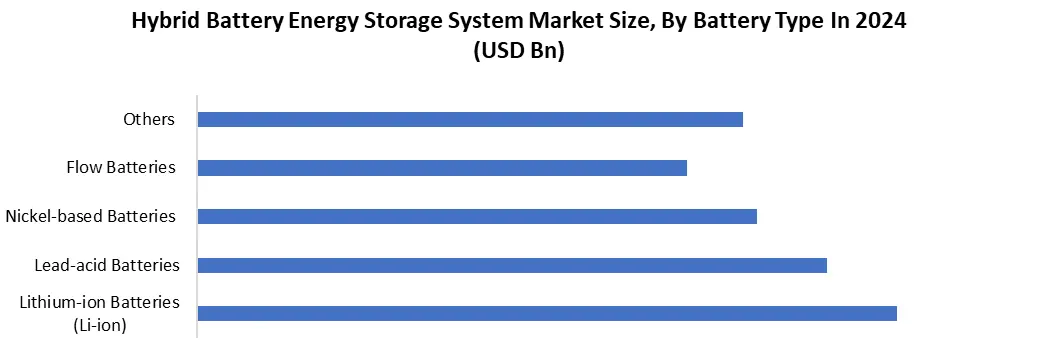 Based on Power Rating, the Hybrid Battery Energy Storage System Market is categorized into the Below 100 kW, 100 kW – 1 MW, 1 MW – 10 MW and Above 10 MW. The 1 MW – 10 MW segment dominates the Hybrid Battery Energy Storage System (BESS) Market and is expected to remain the leading segment over the forecast period. This power rating range is particularly well-suited for utility-scale renewable energy integration, commercial microgrids, and large industrial facilities, where hybrid storage plays a pivotal role in managing renewable intermittency, enhancing grid stability, and ensuring reliable power supply during peak demand periods. These systems provide an optimal balance between scalability, performance, and cost-efficiency, making them the most widely adopted configuration in the global Hybrid Battery Energy Storage System Market.
In renewable-heavy grids, these systems smooth out fluctuations in solar and wind generation, enabling higher renewable penetration without compromising stability. For industrial users, such systems mitigate demand charges, ensure uninterrupted power during outages, and support energy cost optimization by enabling load shifting. Their ability to deliver both fast-response ancillary services, such as frequency regulation and sustained energy supply for peak shaving gives them a competitive edge over smaller or larger systems.
Hybrid Battery Energy Storage System Market Regional Analysis
Asia Pacific dominated the Hybrid Battery Energy Storage System Market in 2024 and is expected to continue its dominance over the forecast period. The rapid urbanization, rising electricity demand, and strong government policies support renewable integration, driving the Hybrid Battery Energy Storage System Market growth. Countries such as China, Japan, South Korea, and India are spearheading large-scale adoption of hybrid storage solutions to enhance grid stability, manage peak loads, and enable higher penetration of renewable energy sources such as solar and wind.
China remains the global hub, with leading players such as CATL, BYD, and Contemporary Amperex Technology actively developing next-generation lithium-ion and LFP technologies with extended lifespans and cost efficiencies, while Japan and South Korea are advancing high-performance battery chemistries through Panasonic, Samsung SDI, and LG Energy Solution. India’s growing investments in solar-plus-storage and government-backed initiatives such as the Production Linked Incentive (PLI) scheme are further accelerating hybrid storage deployment. The region benefits from strong supply chain capabilities, extensive raw material availability, and significant R&D investments, giving it a competitive edge in manufacturing and innovation.
In North America, large-scale grid projects drove growth, with the U.S. recording record deployments of more than 2.7 GW of new capacity in the second quarter of 2024 alone, reflecting accelerating demand for hybrid lithium-ion and flow battery systems. Europe witnessed major initiatives such as Fluence’s 100 MW / 200 MWh project in Germany, strengthening hybrid storage capacity for renewable integration and grid stability.
Hybrid Battery Energy Storage System Market Competitive Landscape:
The competitive landscape of the Hybrid Battery Energy Storage System (HBESS) market is characterized by a diverse combination of global battery manufacturers, technology innovators, and system integrators competing to address rising demand for reliable, flexible, and sustainable energy storage solutions. Major players such as Tesla, Fluence Energy, General Electric, Lockheed Martin, and EnerSys dominate the North American market through large-scale grid-connected projects, commercial and industrial installations, and advanced battery integration, while companies such as Siemens, ABB, Leclanché, Neoen, AEG Power Solutions, and Eaton strengthen Europe’s position with a focus on renewable integration, smart grid applications, and compliance with strict EU sustainability frameworks.
In Asia-Pacific, leaders including CATL, BYD, LG Energy Solution, Panasonic, Hitachi, Samsung SDI, and NEC are driving the Hybrid Battery Energy Storage System Market with technological advancements in lithium-ion, sodium-ion, and hybrid chemistries, along with government-backed renewable projects and microgrids. Competitive strategies in this sector revolve around product innovation, expansion of hybrid configurations (such as lithium-ion paired with flow batteries, supercapacitors, or sodium-based chemistries), strategic partnerships, and regional capacity expansions. Recent developments highlight this trend: CATL’s 25-year BESS warranty and 530 Ah LFP cells, China’s first lithium–sodium hybrid storage station in Yunnan, and Shaanxi’s hybrid supercapacitor–lithium system demonstrate technological progress and real-world applications.
Hybrid Battery Energy Storage System Market Key Developments:
• January 2025 – CATL: Contemporary Amperex Technology Co., Ltd. (CATL) unveiled a groundbreaking advancement in the battery energy storage market by introducing a Battery Energy Storage System (BESS) backed with a 25-year warranty, guaranteeing a minimum of 65% state-of-health throughout its lifecycle. This marks one of the most ambitious warranty commitments in the industry, reinforcing CATL’s leadership in long-term reliability for large-scale hybrid storage deployments. In addition, the company launched its next-generation 530 Ah LFP prismatic cells, engineered to deliver an impressive 13,000 charge/discharge cycles.
• In 2024, Fluence continued to expand its Gridstack deployments, scaling its portfolio to meet hybrid and wired applications with advanced reliability and safety features. The newly launched Gridstack Pro offers utilities, developers, and power producers a factory-built, configurable solution designed for higher site density, simplified maintenance, and reduced operating costs. With multiple gigawatt-hours of systems already in operation, Fluence has become a trusted partner in delivering safe, large-scale energy storage.
Hybrid Battery Energy Storage System Market Key Trends:
| Trend | Description |
| Linking to Renewables and Smart Grids | Hybrid systems are increasingly paired with solar and wind to mitigate intermittency, improve grid stabilization, and enable smart grid integration. |
| Demand for Peak Shaving and Backup Power | Widely adopted in commercial & industrial sectors to reduce electricity costs by shaving peak demand and providing secure backup power. |
| Continued Development of Hybrid Technologies | Manufacturers are combining Li-ion with flow batteries, supercapacitors, or other technologies to achieve higher efficiency, longer lifespan, and broader applications. |
| Sustainability and Second-Life Batteries | Growing adoption of recycled and second-life EV batteries in HBESS, supporting the circular economy and a cleaner, renewable energy supply. |
Hybrid Battery Energy Storage System Market Scope: Inquire before buying
| Global Market | |||
|---|---|---|---|
| Report Coverage | Details | ||
| Base Year: | 2024 | Forecast Period: | 2025-2032 |
| Historical Data: | 2019 to 2024 | Market Size in 2024: | USD 16.59 Bn. |
| Forecast Period 2025 to 2032 CAGR: | 6.91% | Market Size in 2032: | USD 28.31 Bn. |
| Segments Covered: | by Battery Type | Lithium-ion Batteries (Li-ion) Lead-acid Batteries Nickel-based Batteries Flow Batteries Others |
|
| by Power Rating | Below 100 kW 100 kW – 1 MW 1 MW – 10 MW Above 10 MW |
||
| by Technology | Battery–Battery Hybrids Battery–Supercapacitor Hybrids Battery–Flywheel Hybrids Battery–Hydrogen / Fuel Cell Hybrids Others |
||
| by Application | Renewable Energy Integration Grid Stabilization & Frequency Regulation Peak Shaving & Load Leveling Backup Power & Uninterrupted Power Supply (UPS) Electric Vehicle (EV) Charging Infrastructure Microgrids & Off-grid Solutions Others |
||
| by End-User Industry | Utilities & Power Producers Commercial & Industrial Enterprises Residential Sector Transportation & Mobility Military & Defense Others |
||
Hybrid Battery Energy Storage System Market, by Region
North America (United States, Canada and Mexico)
Europe (United Kingdom, France, Germany, Italy, Spain, Sweden, Russia and the Rest of Europe)
Asia Pacific (China, South Korea, Japan, India, Australia, Indonesia, Malaysia, Philippines, Thailand, Vietnam and the Rest of the Asia Pacific)
Middle East and Africa (MEA) (South Africa, GCC, Nigeria and the Rest of MEA)
South America (Brazil, Argentina, Colombia, Chile and the Rest of South America)
Hybrid Battery Energy Storage System Market Key Players
North America Key Players
1. Tesla, Inc.
2. Fluence Energy, Inc.
3. General Electric (GE)
4. Lockheed Martin
5. Amphenol Corporation
6. EnerSys
7. Redwood Materials
8. FlexGen Power Systems
9. Enphase Energy
10. Base Power
Europe Key Players
1. Siemens AG
2. AEG Power Solutions
3. Siemens Gamesa
4. Leclanché SA
5. Neoen
6. ABB Ltd.
7. Eaton Corporation Plc
8. Hitachi Energy
9. Panasonic Corporation
10. Samsung SDI
Asia Pacific Key Players
1. Panasonic Corporation
2. Hitachi Ltd.
3. Samsung SDI Co., Ltd.
4. NEC Corporation
5. LG Chem Ltd. / LG Energy Solution
6. BYD Company Ltd.
7. Contemporary Amperex Technology Co., Ltd. (CATL)
8. Fluence Energy
9. Wärtsilä Corporation
10. CRRC
FAQ’S
1. Which region has the largest share in Global Hybrid Battery Energy Storage System Market?
Ans: Asia Pacific region held the Global Hybrid Battery Energy Storage System Market share in 2024.
2. What is the growth rate of Global Hybrid Battery Energy Storage System Market?
Ans: The global Hybrid Battery Energy Storage System Market is growing at a CAGR of 6.91% during the forecasting period 2025-2032.
3. What is the scope of the Global Hybrid Battery Energy Storage System Market report?
Ans: Global market report helps with the PESTEL, PORTER, Recommendations for Investors & Leaders, and market estimation of the forecast period.
4. Who are the key players in Global Hybrid Battery Energy Storage System Market?
Ans: The important key players in the Global Hybrid Battery Energy Storage System Market are Tesla, Inc., Fluence Energy, Inc., General Electric (GE), Lockheed Martin, Amphenol Corporation, EnerSys and others.
5. What is the study period of this Market?
Ans: The Global Hybrid Battery Energy Storage System Market is studied from 2024 to 2032.