
High Speed Camera Market - Industry Structure Evaluation, Demand Drivers Analysis, Regional Growth Analysis and Identification, Competitive Positioning / Landscape Review & Global Market Size Forecast to 2034
Overview
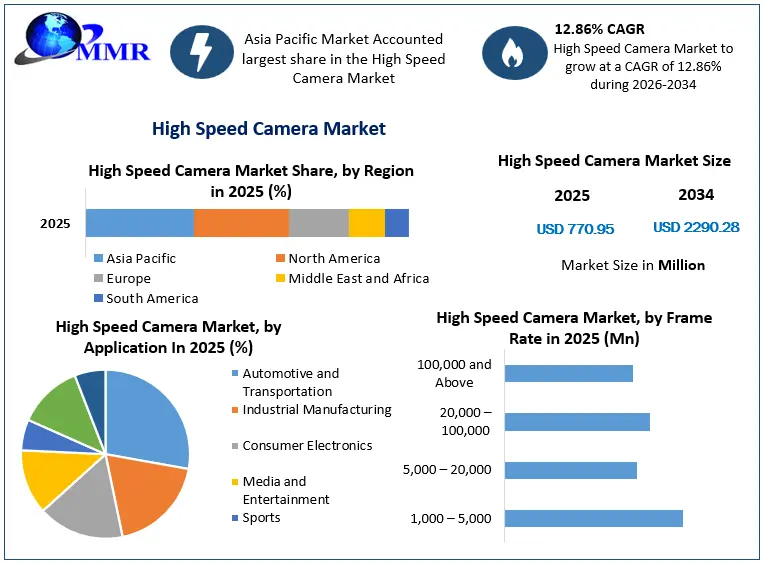
High Speed Camera Market was valued at USD 770.95 Million in 2025, and it is expected to reach USD 2290.28 Million by 2034, exhibiting a CAGR of 12.86 % during the forecast period (2026-2034)
High Speed Camera Market Overview:
High speed cameras refer to innovative devices used to capture images of fast-moving substances. High speed cameras include lenses, image sensors, memory systems, image processors, batteries, and fans & cooling systems. The cameras are commonly utilized as a research and media tool to study processes performed at a very high speed. Furthermore, the cameras are rapidly replacing traditional digital cameras owing to their advanced features.
As a result, high-speed cameras find wide applications across various sectors, such as industrial manufacturing, healthcare, automotive, entertainment and media, consumer electronics, research, design, testing laboratories, and aerospace and defense.
High-speed cameras are in demand as a result of research and development efforts because of their high frame rate, resolution capacity, image processing abilities, and light sensitivity, making them perfect for collecting any important information and processing it at any time. High-speed cameras are expected to have significant sales potential in the forthcoming years for achieving detailed analyses, as makers attempt to make their devices feature-rich.
High Speed Camera Market Snapshot
To know about the Research Methodology :- Request Free Sample Report
High Speed Camera Market Dynamics:
Increased Use of High-Speed Cameras in Automobiles and Transportation Sector
Digital high speed cameras are attaining traction in many industry verticals owing to their enhanced features and prised image capturing techniques. High speed cameras are utilised for a variety of reasons in the automotive and transportation sectors due to growing safety concerns.
High-speed cameras in this market vertical have lucrative potential in a variety of automotive applications, including safety test applications, tire, and suspension testing, combustion system testing, transmission testing, and over-road testing, among others. The automobile and transportation industries' adoption of improved picture-taking capabilities opens up new markets for high-speed cameras globally.
Developing Application of High Speed Cameras in ITS (Intelligent Transportation System)
The intelligent transportation system is an attractive major technology and is prominent in the usage of machine vision cameras. Intelligent traffic systems are helping with the heavy traffic on the roads. High-speed cameras are used for toll collecting, traffic monitoring, object detection on highways, and traffic enforcement.
The ability to read a vehicle's licence plate as it passes through toll gates allows high-speed cameras to immediately withdraw the appropriate payment from the account linked to each plate. High-speed cameras also aid in traffic flow monitoring. For instance, Automatic Incident Detection is increasingly using high-speed cameras to enable speedy reactions to accidents and other obstructions, especially in crucial sites like tunnels and bridges.
Growing Resolution Is Going to provide Higher Frame Rate in Even Higher Resolution
Recent years have witnessed the development of high-speed cameras with various resolutions. Generally, the resolutions range from one to five megapixels (MP). When the high-speed camera's field of view is large or when a low spatial resolution is anticipated due to a lot of minute features in the high-speed event that needs to be analysed, higher resolutions are required. It is a general truth that the maximum frame rate decreases as camera resolution increases.
In comparison to a 1 MP camera, a 5 MP camera has five times as many pixels to process. As a result, using a higher resolution camera to produce the same frame rates as a lower resolution camera is not feasible. In the future, it will be possible to use a 5 MP camera to achieve the same frame rate as a 1 MP camera because of advances in image sensors and processing power. As a result, during the forecast period of 2022–2029, technological improvement will enable higher frame rates and resolutions.
High Speed Camera Market Trends:
The increasing trend towards the development of new product applications across end-use industries is expected to driving the market growth. For example, high-speed cameras are frequently used in research and the media to accurately examine high-speed processes. A driving force behind rising product demand in the industrial sector is anticipated to be the growing need for extremely precise outlines, such as fire tests and movement visualisation in aeronautics, propellants, pyrotechnics, and missiles.
High Speed Camera Market Opportunities:
The domain of high-speed imaging has greatly expanded; from a few thousand frames per second to millions of frames per second now, digital sensors, computers, and storage media have replaced films. The use of high-speed imaging in industrial operations has increased thanks to technological developments, and the range of applications for high-speed cameras has been steadily growing. Examples include counting the precise number of tablets filled in a container in a pharmaceutical plant to ballistics research in the defense sector.
High Speed Camera Market Challenges:
A high-speed camera and artificial intelligence (AI) combined will allow for quicker fault detection, maintenance, and intimidation. Most common applications can now be completed with off-the-shelf plug-and-play technology, which has significantly reduced the need for machine vision system development. This is due to smart cameras and configurable vision systems.
High Speed Camera Market Segment Analysis:
Based on Component, the Image Sensors segment is estimated to be a dominating component segment during the forecast period as it is widely adopted in businesses and enterprises. A high-speed camera is composed of various important parts, such as the sensor, processor, lens, memory systems, fans, cooling systems, etc. Every high-speed camera depends on these main factors for effective outcomes. Depending on the high-speed camera type, components come in a variety of sizes and shapes. These features set high-speed cameras apart and depending on the application, they are tailored. Any industry that uses these products needs components for high-speed cameras.
By Resolution, the 2 – 5 MP segment held the largest share of the market in 2025. Applications like combustion research, spray analysis, and vibration analysis in scientific research, design and testing laboratories need high-speed cameras with a high resolution to professionally analyse events. Such high-speed cameras are used in applications including production line monitoring, maintenance, and troubleshooting. These cameras are more affordable than high-speed cameras with a resolution of >5 MP and give images of sufficient quality for the detection of faults and monitoring of production lines in industrial manufacturing plants.

High Speed Cameras Top Players:
1. The industry leader for high-end, fast camera systems is Photron. The extremely difficult high-speed applications found in the automotive, military, aerospace, medical, and scientific, R&D, and manufacturing industries are perfect for Photron's ongoing development of new cutting-edge solutions.
2. For applications in the field of aircraft and aerial testing, AOS Technologies is a top manufacturer of high-speed cameras capable of high-speed streaming and video systems in the most demanding environments.
3. The fastest cameras on the open market, Shimadzu ultra-high-speed cameras can capture motion sequences at ten million frames per second and 10 nanosecond shutter rates.
High Speed Camera Market Regional Analysis:
Asia Pacific Region is an Emerging Market Place for High Speed Camera-
Asia Pacific is expected to grow rapidly during the forecast period. The primary markets in this region are China, Japan, and India. The market growth for high-speed cameras is receiving significant assistance from the constantly growing consumer electronics sector. High-speed cameras are slowly being replaced in a variety of industries, including healthcare, food and beverage, automotive, and consumer electronics, for applications like troubleshooting, analysis, machinery diagnostics, and preventive maintenance.
The manufacturing and automotive sectors in China, India, and Japan are projected to use robots and machine vision technologies more frequently, which will help drive the growth of the Asia-Pacific market.
North America: Thanks to prominent industry participants like Motion Capture Technologies, Vision Research, Inc., Fastec Imaging Corporation, and others, North America is expected to experience considerable growth in the high-speed camera market. The region's significant investments and strong industry standards will fuel the market for high-speed cameras.
Europe: Europe is likely to record a healthy growth rate globally owing to the adoption of high industry standards. The goal of the European manufacturing sector is to boost overall productivity while cutting down on time and maintaining a high standard of quality. Therefore, the high-speed camera market is projected to have significant growth over the next few years due to Europe.
High Speed Camera Market Recent Industry Developments
| Date | Company | Development | Impact |
|---|---|---|---|
| 26 February 2025 | Vision Research | Vision Research released its Phantom KT-series, a new family of compact high-speed cameras incorporating 1- and 4.2-megapixel back-side illuminated (BSI) sensors. | Sustains an imaging throughput of up to 16 Gpx/s, providing researchers with superior absolute sensitivity and minimal motion blur during sub-microsecond exposures. |
| 09 December 2025 | Photron, Inc. | Photron finalized the strategic acquisition of AOS Technologies AG, a prominent Swiss manufacturer of high-speed cameras and industrial streaming systems. | Expands Photron's global market reach and scales its product portfolio across automotive crash testing and defense imaging sectors. |
| 11 December 2025 | Photron Limited | Photron announced the upcoming live demonstration of its new High-Speed Polarization Imaging Extension integrated with Anton Paar MCR rheometers. | Leverages the world's fastest 2D polarization camera to facilitate real-time structural analysis of fluid dynamics and materials under high-stress flow conditions. |
| 09 March 2026 | Excelitas Technologies | Excelitas launched the pco.dimax 3.6 DS ST CLHS, a high-speed double-shutter camera merging 3.6-megapixel resolution with advanced CMOS technology. | Delivers over 1,000 double images per second with an ultra-short 250 ns interframing time, increasing spatial precision for particle image velocimetry and combustion diagnostics. |
| 26 March 2026 | Vision Research | Vision Research introduced its advanced Phantom C-Series product line consisting of back-side illuminated high-speed cameras and high-integration junction boxes. | Establishes a new efficiency and connectivity standard optimized explicitly for multi-camera automotive crash and safety imaging workflows. |
| 09 June 2026 | SinceVision | SinceVision officially released its SH8 Series ultra-high-speed cameras featuring a 20µm large-pixel back-illuminated sensor architecture. | Pushes capturing capabilities up to a blistering 1,100,000 fps with a 150 ns minimum exposure time, eliminating motion blur during highly rapid mechanical or transient scientific events. |
High Speed Camera Market Competitive Landscape:
The competitive landscape section in the High Speed Camera Market offers a detailed analysis of the company profiles operating in the global market landscape. It offers captivating insights into the key developments, differential strategies, and other crucial aspects of the key players having a stronghold in the High Speed Camera Market. Such as, NAC is pleased to announce that their quickest camera line has now become even faster in August 2021.
Owing to a significant upgrade to NAC's patented Boost Mode technology, the market-leading ACS-1 M60 camera can now produce a blistering 150,000 frames per second at a resolution of 1280 x 896. For those who need even more performance, the improved Boost Mode offers 300,000 frames per second at a resolution of 1280 x 384.
The patented on-sensor technology known as NAC's Boost Mode significantly boosts sensor speed while minimising image quality loss. One of the well-known industry leaders in high-speed video cameras and camera systems, NAC Image Technology is committed to creating full, integrated systems with the best possible light sensitivity, image quality, memory capacity, smallest camera heads, and fastest download rates. MEMRECAM High Speed Digital Cameras, MEMRECAM HX Series, MEMRECAM MX Series, MEMRECAM Q Series, and Image Intensifeiers are some of their market segments.
High Speed Camera Market Scope: Inquire before buying
| High Speed Camera Market | |||
|---|---|---|---|
| Report Coverage | Details | ||
| Base Year: | 2025 | Forecast Period: | 2026-2034 |
| Historical Data: | 2020 to 2025 | Market Size in 2025: | US $ 770.95 Mn. |
| Forecast Period 2026 to 2034 CAGR: | 12.86% | Market Size in 2034: | US $ 2290.28 Mn. |
| Segments Covered: | by Component | Image Sensors Lens Batteries Image Processors Fans and Cooling System Memory Systems Others |
|
| by Resolution | 0–2 MP 2 – 5 MP 5 MP and Above |
||
| by Application | Automotive and Transportation Industrial Manufacturing Consumer Electronics Media and Entertainment Sports Healthcare Others |
||
| by Frame Rate | 1,000 – 5,000 5,000 – 20,000 20,000 – 100,000 100,000 and Above |
||
High Speed Camera Market, by Region
North America (United States, Canada and Mexico)
Europe (UK, France, Germany, Italy, Spain, Sweden, Austria and Rest of Europe)
Asia Pacific (China, South Korea, Japan, India, Australia, Indonesia, Malaysia, Vietnam, Taiwan, Bangladesh, Pakistan and Rest of APAC)
Middle East and Africa (South Africa, GCC, Egypt, Nigeria and Rest of ME&A)
South America (Brazil, Argentina Rest of South America)
High Speed Camera Market, Key Players are
1. Vision Research (US)
2. Integrated Design Tools (US)
3. Monitoring Technology (US)
4. Fastec Imaging (US)
5. Weisscamm (US)
6. Del Imaging Systems (US)
7. Xcitex (US)
8. Motion Capture (US)
9. Mega Speed USA
10. Edgertronic (US)
11. The Slow Motion Camera Company (UK)
12. PCO AG (Germany)
13. Mikrotron (Germany)
14. Optronis (Taiwan)
15. AOS Technologies (Switzerland)
16. Motion Engineering (France)
17. IX Camera (India)
18. Photron (Japan)
19. Nac Image Technology(Japan)
Frequently Asked Questions:
1] What segments are covered in the Global High Speed Camera Market report?
Ans. The segments covered in the High Speed Camera Market report are based on Component, Resolution, Frame Rate, and Application.
2] Which region is expected to hold the highest share in the Global High Speed Camera Market?
Ans. APAC region is expected to hold the highest share in the High Speed Camera Market.
3] What is the market size of the Global High Speed Camera Market by 2034?
Ans. The market size of the High Speed Camera Market by 2034 is expected to reach USD 2290.28 Mn.
4] What is the forecast period for the Global High Speed Camera Market?
Ans. The forecast period for the High Speed Camera Market is 2026-2034.
5] What was the market size of the Global High Speed Camera Market in 2025?
Ans. The market size of the High Speed Camera Market in 2025 was valued at USD 770.95 Mn.