
High Heat Foam Market Size by Type, Application, Region – Revenue Pool Analysis, Margin Structure Assessment, Capital Flow Trends, Competitive Benchmarking & Forecast to 2032
Overview
Global High Heat Foam Market Overview:
The High Heat Foam Market is witnessing steady growth due to the rising demand for advanced thermal insulation materials across industries such as automotive, aerospace, electronics, and industrial manufacturing. High heat foams are specialized materials designed to withstand extreme temperatures while providing excellent insulation, fire resistance, and acoustic performance. These foams are commonly manufactured using materials such as silicone, polyimide, melamine, and phenolic resins, which offer superior thermal stability and lightweight properties. In addition, the aerospace sector is a major contributor to market growth as aircraft manufacturers increasingly use high heat foams for cabin insulation, engine components, and fire protection systems. These materials help reduce aircraft weight while maintaining strict fire, smoke, and toxicity standards. The growing demand for electric vehicles (EVs) and energy-efficient transportation solutions is further accelerating the adoption of advanced thermal insulation materials.
 To know about the Research Methodology :- Request Free Sample Report
Global High Heat Foam Market Dynamics:
Rising public awareness of the advantages to the environment.
The rising awareness of the environmental benefits of using foam insulation is the key driver for the global high heat foam market. The high-temperature foam prevents heat from leaking into the environment and ambient heat from entering an insulated room. This eliminates the need for additional energy use. For example, foam insulation can assist limit the amount of heat that escapes and enters the cabin of a car. This reduces the need for further heating/cooling to generate/lose heat.
Rising need from the construction and automobile industry.
The global high heat foam market is being driven by rising demand from the automotive and construction industries. In the building industry, high-quality high-heat foam insulation can assist save money by lowering total energy usage. The global construction sector has benefited from sustained urbanization in developing nations like Egypt, Malaysia, India, and others and rising demand for rehabilitation and other redevelopment projects in developed regions, and it is likely to remain a prominent end-use segment of the global high heat foam market over the forecast period.
Volatile petrochemicals cost.
Petrochemical prices have been volatile, backed by a recovery in demand, despite disrupted petrochemical supplies caused by the COVID-19 epidemic. As petrochemicals are derivatives of crude oil, the rising trend in petrochemical pricing have been impacted by the improvement in crude oil prices. Brent crude oil prices have increased dramatically from a low of US $18.5 per barrel in April 2020 to the US $66 per barrel in March 2021 and most of these petrochemicals are used as raw materials to manufacture High Heat Foam. Thus, the volatile prices of petrochemicals leading to fluctuations in the production cost of foams in the global market is expected to challenge the market growth during the forecast period.
Global High Heat Foam Market Segment Analysis:
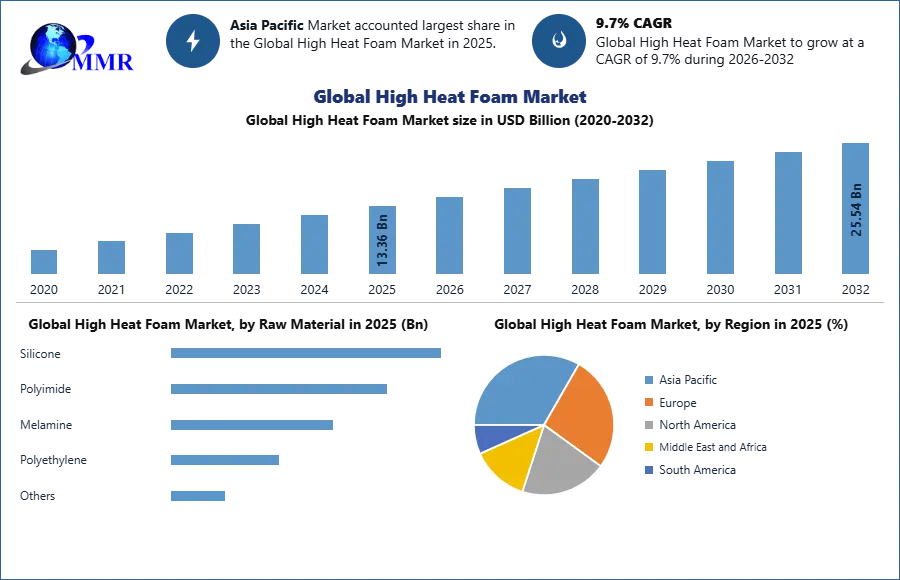
Based on Type, the global high heat foam market is segmented into four types as follows, Silicone, Polyamide , Melamine, Polyethylene, and Others. In 2025, the silicone segment was dominant and held xx% of the overall market share. This segment is anticipated to grow at a CAGR of 6.25% during the forecast period. A silicone, often known as polysiloxane. It is a polymer composed of siloxane. Colorless oils or rubber-like compounds are the most common types of silicone. Adhesives, lubricants, sealants medications, culinary utensils, and thermal and electrical insulation all use silicones.
Based on Application, the global high heat foam market is segmented into five types are as follows, Railway, Industrial, Aerospace, Automotive, and Others. In 2025, the automotive segment was dominant and held largest market share in terms of revenue. The segment is expected to grow at a CAGR of 6.2% over the forecast period. Thanks to its energy-saving properties, high heat foam is frequently used as insulation in the automotive industry. Internal combustion engines produce greater heat during their combustion cycle.
When these elements reach many heat-sensitive modules, such as batteries, starting motors, and sensors, have an adverse influence. To keep the heat from the exhaust from reaching these modules, high-temperature foams are required. To improve engine performance, high-performance cars use a lot of high-heat foams in the interiors.
Global High Heat Foam Market Regional Insights:
In 2025, Asia Pacific was dominant and held 63.32% of the overall market share in terms of revenue. In terms of demand, it is anticipated to remain the leading regional market in the near future. Other important factors contributing to the growth of the market in this region include increased foreign investment, expanding production facilities, a strong industrial foundation for the construction, packaging, and automotive sectors, and rising standard of living. The high heat foam market in this area is developing because of the rising demand for energy-efficient, a good insulators, and recyclable foam in industries such as automotive, railway, industrial, aerospace, and others.
In 2025, Europe held the second-highest revenue share of xx% in terms of revenue followed by the markets in North America. The existence of prominent competitors in the market, as well as rising demand for lightweight vehicles that can improve fuel efficiency in automobiles are primary factors driving growth in the European market throughout the forecast period.
Over the forecast period, the high heat foam market is expected to grow at a modest rate of xx% in South America and the Middle East, and Africa.
The objective of the report is to present a comprehensive analysis of the global market to the stakeholders in the industry. The past and current status of the industry with the forecasted market size and trends are presented in the report with the analysis of complicated data in simple language. The report covers all the aspects of the industry with a dedicated study of key players that include market leaders, followers, and new entrants.
PORTER, PESTEL analysis with the potential impact of micro-economic factors of the market have been presented in the report. External as well as internal factors that are supposed to affect the business positively or negatively have been analyzed, which will give a clear futuristic view of the industry to the decision-makers.
The report also helps in understanding the global market dynamics, structure by analyzing the market segments and project the global market size. Clear representation of competitive analysis of key players by product, price, financial position, product portfolio, growth strategies, and regional presence in the global market makes the report investor's guide.
Global High Heat Foam Market Scope: Inquire before buying
| Global High Heat Foam Market | |||
|---|---|---|---|
| Report Coverage | Details | ||
| Base Year: | 2025 | Forecast Period: | 2026-2032 |
| Historical Data: | 2020 to 2025 | Market Size in 2025: | 13.36 USD Billion |
| Forecast Period 2026-2032 CAGR: | 9.7% | Market Size in 2032: | 25.54 USD Billion |
| Segments Covered: | by Raw Material | Silicone Polyimide Melamine Polyethylene Others |
|
| by Application | Automotive Railway Industrial Aerospace Others |
||
Global High Heat Foam Market, by Region
North America (United States, Canada and Mexico)
Europe (UK, France, Germany, Italy, Spain, Sweden, Austria and Rest of Europe)
Asia Pacific (China, South Korea, Japan, India, Australia, Indonesia, Malaysia, Vietnam, Taiwan, Bangladesh, Pakistan and Rest of APAC)
Middle East and Africa (South Africa, GCC, Egypt, Nigeria and Rest of ME&A)
South America (Brazil, Argentina Rest of South America)
Global High Heat Foam Market Key Players
- BASF SE
- Rogers Corporation
- Evonik Industries AG
- Armacell International S.A.
- Wacker Chemie AG
- SABIC
- Dow Inc.
- DuPont
- 3M Company
- UBE Corporation
- puren gmbh
- Intec Foams Ltd.
- SINOYQX (China)
- Morgan Advanced Materials
- RATH Group
- Knauf Insulation
- Grupo Nutec
- Stepan Company
- Saint-Gobain
- Huntsman Corporation
- Covestro AG
- Momentive Performance Materials
- Trelleborg AB
- JSP Corporation
- Airex AG