
High Energy Lasers Market by Laser Type, Power Output, End Use Industry and Region – Global Market Size Estimation, Industry-Wide Analysis, Competitive Landscape Assessment & Long-Term Forecast to 2032
Overview
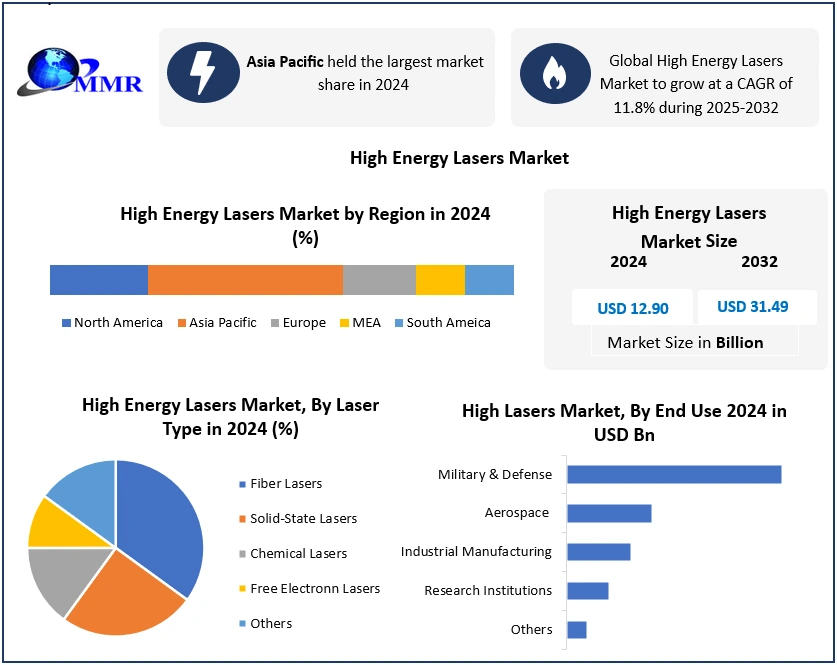
The High Energy Lasers Market was valued at USD 12.90 Bn in 2024, and total global High Energy Lasers Market revenue is expected to grow at a CAGR of 11.8% and reach nearly USD 31.49 Bn from 2025 to 2032.
The global High Energy Lasers market report is a comprehensive analysis of the industry, market, and key players. The report has covered the market by demand and supply-side by segments. The global High Energy Lasers report also provides trends by market segments, technology, and investment with a competitive landscape.
 To know about the Research Methodology :- Request Free Sample Report
Overview of High Energy Lasers:
In the military, High Energy Laser (HEL) systems have become a reality. Beam Quality, Throughput and Reliability are system-level characteristics. For the present and future generations of HEL weapons, SWaP and cost are likely to continue to be at the forefront of debates. A camera examines the threat and often provides a better, higher-resolution image than the radar. After that, the decision-maker evaluates if the object represents a threat that must be dealt with. Laser weapon systems are in high demand in the navy around the world to combat airborne threats like missiles and drones.
High Energy Lasers Market Dynamics:
Lasers have shown to be effective against missiles and are now being used as the first line of defense. Militaries around the world are adopting high-energy laser-based equipment and investing considerably in research and development, thanks to rising defense budgets and research grants.
Modern technology has become a necessity for governments as the number of nuclear-capable states increases and modern warfare differs significantly from traditional warfare. Along with technological developments, these have raised the flow of investment into the sector. High energy laser systems are one of the advanced technologies that governments are now researching extensively. As a result, the market has experienced substantial growth.
Due to a shift in the nature of combat, military laser technologies have gained traction. For instance, the Israeli Ministry of Defense (MoD) had successfully tested the use of an aerial laser to shoot down unmanned aircraft (UAVs). When it comes to dealing with drone swarms, laser weapon systems have several distinct benefits. They feature a fast “flyout” time and large magazines, allowing the user to fire the laser and hit a target almost instantly as long as they have a power source. Lasers also have a cheap cost per shot, so using them against low-cost threats like drones makes sense. High-energy lasers may be utilized in the future to cope with more difficult threats, such as missile classes. Interceptor missiles and rapid-fire rifles like the Phalanx are other defensive weaponry.
However, because the number of defensive missiles and ammo magazines are limited, high-energy lasers may be able to assist in total defense in the future when faced with various threats.
Challenges:
The most difficult task facing researchers is developing a laser capable of reaching high enough levels to partially damage or defeat a target while concurrently tracking many objects. The laser must propagate efficiently and remain precisely focused on the target in turbulent air conditions such as dust and humidity. The system must account for the target's movement, the platform's motion, and the beam's distortion due to weather or environmental circumstances.
High Energy Lasers Market Segmentation:
Based on Laser Type, the market is segmented into Fiber Lasers, Chemical Lasers, Solid-State Lasers, Free Electron Lasers, and Others. Fiber lasers are experiencing the fastest adoption due to their high efficiency, compact size, and lower maintenance, making them a preferred choice in defense and industrial applications. Chemical lasers, while powerful, face decline owing to safety and environmental concerns. Solid-state lasers are gaining traction in aerospace and military uses because of their robustness and precision. Free electron lasers remain at an experimental stage, with potential for high-power defense systems. Other emerging technologies continue to attract investments for specialized applications.
Based on End Use Industry, the market is segmented into Military & Defense, Aerospace, Industrial Manufacturing, Research Institutions, and Others. Military & defense is expected to dominate the HEL market during the forecast period, driven by rising adoption of directed energy weapons, UAV countermeasures, and missile defense systems. Aerospace players are integrating HEL technologies for aircraft protection and satellite defense. Industrial manufacturing is leveraging high-energy lasers for precision cutting, welding, and material treatment. Research institutions are focusing on new HEL designs for power scaling and efficiency improvements. Other sectors, such as maritime and homeland security, are exploring HEL for advanced protection.
High Energy Lasers Market Regional Insights:
With the rise of the market, significant countries such as China, India, and Japan, the Asia-Pacific region is a key adopter of high energy lasers across many disciplines. Tensions between the United States and China, as well as inter-border disputes and an emphasis on nuclear power, have driven high-energy lasers into defense and military systems in several countries in the region.
China is the single largest market for industrial laser products, accounting for roughly a third of all industrial lasers—mostly fiber lasers—imported or manufactured in the country to power the hundreds of thousands of sheet metal cutting systems produced domestically or exported to ASEAN, India, and increasingly western world markets. This complies with government directives to increase Chinese machine exports that are integrated with domestic IP technology.
Furthermore, global providers of imported industrial lasers from Europe and the United States have been hit twice by the Chinese capital investment slowdown and, increasingly, the effect of the US government's targeted tariffs. The US Air Force deployed its first High-Energy Laser Weapon System (HELWS) overseas in 2023, and it has now logged over 4,000 hours of service.
The United States receives more R&D funding than other directed-energy weapons because they are the most promising in terms of lightweight, effective, and low-cost operation.
In the 2023s, Defense contractors are focusing on showcasing increasingly more powerful laser weapon systems.
These systems are designed to defend military bases or battleships from drone attacks, guard a high-profile airliner against attack, fire down ICMB and hypersonic ballistic bombs, and protect satellites, among other things. In orbit, as well as for air-to-air combat. These and other applications will need a very precise and reliable system. With increasing levels of power needs, a reliable laser system is required. The most important system-level characteristics to examine are: Beam
Quality, Throughput, Reliability, SWaP, and Cost are all factors that are moving technology ahead.
The objective of the report is to present a comprehensive analysis of the Global High Energy Lasers Market to the stakeholders in the industry. The past and current status of the industry with the forecasted market size and trends are presented in the report with the analysis of complicated data in simple language. The report covers all the aspects of the industry with a dedicated study of key players that include market leaders, followers, and new entrants.
PORTER, SVOR, PESTEL analysis with the potential impact of micro-economic factors of the market have been presented in the report. External as well as internal factors that are supposed to affect the business positively or negatively have been analysed, which will give a clear futuristic view of the industry to the decision-makers.
The report also helps in understanding the Global High Energy Lasers Market dynamics, structure by analyzing the market segments and project the global High Energy Lasers market size. Clear representation of competitive analysis of key players By Type, price, financial position, product portfolio, growth strategies, and regional presence in the Global High Energy Lasers Market make the report investor’s guide.
High Energy Lasers Market Scope: Inquire before buying
| Global High Energy Lasers Market | |||
|---|---|---|---|
| Report Coverage | Details | ||
| Base Year: | 2024 | Forecast Period: | 2025-2032 |
| Historical Data: | 2019 to 2024 | Market Size in 2024: | USD 12.90 Bn. |
| Forecast Period 2025 to 2032 CAGR: | 11.8% | Market Size in 2032: | USD 31.49 Bn. |
| Segments Covered: | by Laser Type | Fiber Lasers Chemical Lasers Solid-State Lasers Free Electron Lasers Others |
|
| by Power Output | Less than 1 kW 1–100 kW Above 100 kW |
||
| by End Use Industry | Military & Defense Aerospace Industrial Manufacturing Research Institutions Others |
||
High Energy Lasers Market, by Region
North America (United States, Canada and Mexico)
Europe (UK, France, Germany, Italy, Spain, Sweden, Austria and Rest of Europe)
Asia Pacific (China, South Korea, Japan, India, Australia, Indonesia, Malaysia, Vietnam, Taiwan, Bangladesh, Pakistan and Rest of APAC)
Middle East and Africa (South Africa, GCC, Egypt, Nigeria and Rest of ME&A)
South America (Brazil, Argentina Rest of South America)
High Energy Lasers Market Key Players are:
1. Beamtech Optronics
2. Laserline
3. IPG Photonics
4. Daheng Optics
5. REO
6. Coherent Dilas
7. MPB
8. EI EN Group
9. TRUMPF Pvt. Ltd.
10.nLight Inc.
11.BAE Systems Plc
12.Northrop Grumman Corporation
13.Moog Inc.
14.Rheinmetall AG
15.Textron Inc.
16.Lockheed Martin Corporation
17.Raytheon Company
18.L-3 Communications Holdings Inc.
19.Qinetiq Group Plc.
20.The Boeing Company
21.Other Key Players
Frequently Asked questions
1. What is the market size of the Global High Energy Lasers Market in 2024?
Ans. The market size Global High Energy Lasers Market in 2024 was USD 12.90 Billion.
2. What are the different segments of the Global High Energy Lasers Market?
Ans. The Global High Energy Lasers Market is divided into Laser Type, Power Output, and End-use industry.
3. What is the study period of this market?
Ans. The Global High Energy Lasers Market will be studied from 2024 to 2032.
4. Which region is expected to hold the highest Global High Energy Lasers Market share?
Ans. The Asia Pacific is expected to hold the largest market share in the Global High high-energy lasers Market.
5. What is the Forecast Period of the Global High Energy Lasers Market?
Ans. The Forecast Period of the Global High Energy Lasers Market is 2025-2032.