
Traffic Sensor Market Size by Sensor Type, Technology, Application and Region – Segment-Level Market Assessment, Growth Opportunity Analysis, Competitive Mapping & Forecast to 2034
Overview
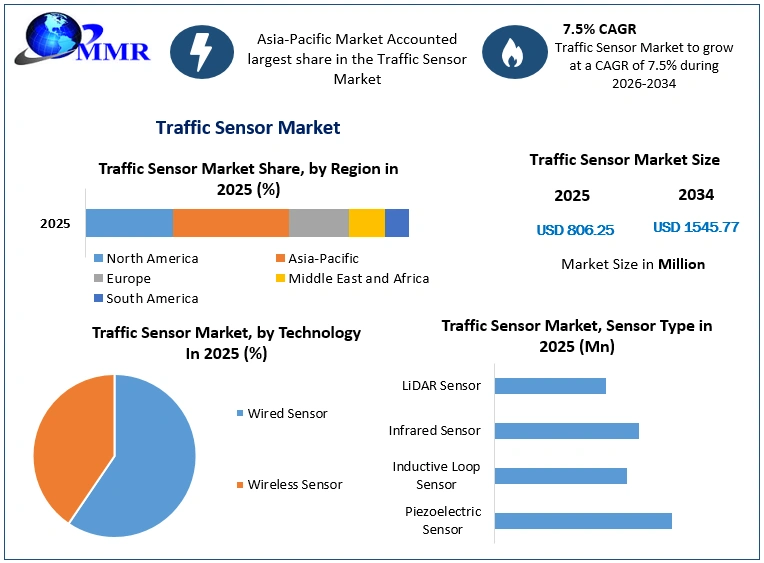
Traffic Sensor Market was valued at USD 806.25 Mn. in 2025 and is expected to grow at a compound annual growth rate of 7.5% between 2026 and 2034. reaching nearly USD 1545.77 Mn.
Traffic Sensor Market Overview
The Traffic Sensor sector contains systems and devices that sense, monitor, and take measurements of vehicular activity such as speed, volume, and movement patterns across roadways, intersections, and highways. Traffic sensors are electronic devices, such as inductive loops, infrared sensors, radar, and video image processors, to collect traffic information in real time.
The Traffic Sensors market is the global industry that produces, disseminates, and implements such technologies for intelligent transportation systems (ITS), traffic management, and infrastructure planning. Some companies are actively producing advanced sensors with wireless capabilities and AI-enabled analytics. Demand is strong and continues to grow due to increasing urbanization, smart city projects, and significant government investment in road safety. The supply chains are also robust with participation from Asia Pacific, North America, and the Europe Region, with the latter leading the market due to tremendous upgrades to infrastructure.
The Traffic Sensor Market Key players such as TE Connectivity, FLIR Systems, Kapsch TrafficCom, Siemens AG, and Sensys Networks. End users significantly impact market uptake of these systems, primarily driving growth in municipalities, transport departments, and highway authorities.
Traffic Sensor Market Size, Growth & Share Analysis
To know about the Research Methodology :- Request Free Sample Report
Traffic Sensor Market Dynamics
Intelligent Transport Systems to Fuel Demand in the Global Traffic Sensor Market
The Traffic Sensor market is expanding as a factor on both sides of the demand-supply equation. Manufacturers on the supply side are innovating by making smaller sensors that use less energy, integrating AI, and cutting the use of sensors, while increasing data accuracy. Manufacturing is also increasing to meet the regional demand as some areas' infrastructure is rising, especially in the Asia-Pacific region. Demand is on the rise for both government authorities and urban planners as they are using traffic sensors to improve congestion, improve road safety, and enhance smart-city initiatives. Increases in the number of vehicles on the road and the need for real-time traffic monitoring systems continue to drive demand. As the intelligent transport systems (ITS) market continues its growth, as well as the market for environmental monitoring and sustainable urban mobility, there is growth internationally in the demand-based market.
Public-Private Partnerships to Create Traffic Sensor Market Opportunity
The Traffic Sensor market presents significant opportunities driven by rapidly advancing urban populations, the expansion of Smart City projects, and increasing investments in intelligent transportation systems (ITS). The developing economies of Asia-Pacific, Latin America, and the Middle East are actively upgrading their road systems, driving demand for modern traffic management systems. The rise in Internet of Things (IoT), Artificial Intelligence (AI), and 5G meets up with traffic sensors, facilitating opportunities for real-time data analytics and predictive traffic control, whilst enhancing efficiency, safety, and improved flows. The desire to reduce carbon emissions resulting from traffic optimization also supports environmentally friendly sensor-based systems. Significant investments are being made by both industry and governments, through public and private partnerships, opening up avenues for market expansion and enhancement of technology.
Sensor Accuracy, Integration, and Privacy to Create Traffic Sensor Market Challenges
The Traffic Sensor market faces challenges such as hefty installation and maintenance costs especially in developing areas. Other detractors to the market include the inability to integrate with existing infrastructure, data privacy issues, limited technical ability for advanced system deployment, and weather conditions which affect the accuracy and reliability of sensors.
Infrastructure Costs and Data Concerns to Restrain the Traffic Sensor Market
The key restraint in the Traffic Sensor market is the high initial capital investment for technological infrastructure development and sensor deployment, limiting adoption in developing or cost-conscious regions. Furthermore, interoperability with legacy traffic systems and modern sensor technology further complicates integration. Data security concerns and a lack of standardized data transfer protocols are also significant barriers to application, especially with public sector deployments.
Traffic Sensor Market Segment
Based on Sensor Type, the inductive loop sensors dominated the Traffic Sensor Market in 2025, due to their long-standing reliability, accuracy, and cost-effectiveness. These sensors are embedded into the road surface and detect vehicles by sensing changes in magnetic fields caused by metal objects passing above them. Sensor's ability to provide highly accurate vehicle detection, classification, and speed measurement makes them ideal for traffic signal control, toll collection, and congestion monitoring. Inductive loop sensors are widely used by government agencies and municipalities across highways, urban intersections, and smart city projects due to their proven performance and seamless integration with intelligent transportation systems. Sensor affordability and durability make them especially suitable for long-term installations in high-traffic areas. Newer technologies such as radar, infrared, and LiDAR are gaining popularity, but inductive loop sensors remain the preferred choice for many regions owing to their dependable results, easy maintenance, and compatibility with existing traffic infrastructure.
Based on Technology, wired sensor technology Segment Dominated the Traffic Sensor Market in 2025, thanks to the accuracy, stable transfer of data, and resistance to interferences provides reliability, which is the needs for mission-critical traffic management systems which are mission-critical. Wired sensors are used in fixed views such as intersections, highways, and toll booths that need reliability and performance. Wired sensor technology is relied on by governments and municipalities for long-term infrastructure investments specifically because wired technology provides reliable, stable, and consistent power and data transfer policies. Wireless sensors are easier and less labour-intensive to install, offering remote flexibility and deployment. Offered wired systems still prevail in the market due to their reliable performance in high-density traffic flows. Wired sensors can be integrated with existing legacy traffic control infrastructure, making it a low-investment and trusted system. Thus, it is clear that there is market demand for reality and confidence in the traffic monitoring and control applications where dependable systems are needed.
Traffic Sensor Market Regional Analysis
The Asia-Pacific region has led the global market through urbanization, increasing vehicle density, and robust governmental capital spending on smart city projects in China, India, and Japan. North America is closely behind with increasing deployments of advanced intelligent transportation systems (ITS), high vehicle ownership rates, and strong public-private partnerships in the US and Canada. Europe remains a significant player due to stringent road safety legislation, environmentally friendly traffic solutions, and comprehensive smart mobility projects from Germany, the UK, and France. The Middle East and Latin America are emerging markets; traffic sensor uptake is increasing incrementally through infrastructure modernization and urban development projects.
Traffic Sensor Market Competitive Analysis
The Traffic Sensor Market is characterized by intense competition among global players focusing on smart infrastructure development, real-time traffic monitoring, and intelligent transportation systems. Key players include Kapsch TrafficCom AG (Austria), with a revenue of around USD 600 million, exporting ITS and sensor technologies primarily to North America, Europe, and Asia. TE Connectivity (Switzerland), generating over USD XX billion annually, supplies advanced traffic and vehicle detection sensors globally, with strong exports to the U.S. and Germany. FLIR Systems (USA), now part of Teledyne Technologies, earns over USD XX billion and is prominent for infrared and video detection sensors, exporting heavily to Europe and the Middle East. Jenoptik AG (Germany), with revenue around USD XX billion, is a key provider of traffic enforcement and monitoring sensors, particularly active in European and Gulf countries. Sensys Networks (USA) focuses on wireless vehicle detection systems and exports primarily to smart city projects in Asia and Latin America. LeddarTech (Canada) is emerging in the LiDAR traffic sensor segment with exports to smart mobility projects across Europe. These companies compete by expanding R&D investments, forming strategic partnerships, and setting up regional export hubs to meet the growing global demand for accurate, AI-enabled traffic monitoring solutions.
Traffic Sensor Market Trends
Adoption of Smart City Initiatives:
Smart city projects are being implemented by governments around the world, which is creating a demand for smart traffic sensors that can provide real-time control of traffic and deal with congestion.
Integration with AI and IoT:
Traffic sensors are now standardized with Artificial intelligence and the Internet of Things (IoT), which allows for flow analysis of traffic and automated traffic control.
Growth and Popularization of Wireless Sensor Technology:
Wireless sensors are now more popular than traditional hardwired sensors as they are easier to install, scale, and maintain. This is especially evident in urban traffic systems, where wireless connectivity supports more flexibility and adaptability, whereas before, only one type of detection was available.
Increased Demand for Real-Time Data Analytics
Authorities are using traffic sensors to collect real-time data on traffic conditions to enhance traffic planning, prevent accidents, and enhance law enforcement capabilities.
Traffic Sensor Market Recent Industry Developments
| Date | Company | Development | Impact |
|---|---|---|---|
| 06 March 2025 | Seyond | Seyond partnered with TrafficSensors.com to deploy its SIMPL LiDAR-based intelligent transportation platform and Falcon K LiDAR sensors across Australia and New Zealand. | The strategic collaboration expands high-resolution 3D LiDAR perception across highways and urban intersections, improving real-time vehicle and pedestrian tracking without collecting biometric data. |
| 14 May 2025 | Iteris, Inc. | Iteris, Inc. secured a $1.7 million contract with the City of Burleson, Texas, to supply and integrate its Vantage Apex® hybrid 1080p HD video and 4D radar traffic sensors. | The project upgrades intersection sensing capabilities to provide high-definition traffic monitoring, real-time AI analytics, and multi-modal classification of vehicles, cyclists, and pedestrians. |
| 25 August 2025 | Sensys Networks | Sensys Networks launched MultiSens Intersection, an advanced traffic detection platform that integrates deep-learning video AI with wireless in-road sensors into a unified system. | The solution delivers multimodal sensor fusion for intersections and advance detection, increasing signal actuation precision and improving traffic flow during adverse weather conditions. |
| 18 November 2025 | Iteris, Inc. | Iteris, Inc. launched VantagePriority™, an advanced transit signal priority and emergency vehicle preemption feature integrated within its Vantage CV™ connected vehicle detection platform. | The cloud-based system enables municipalities to reduce emergency response times and enhance transit reliability without requiring costly new roadside hardware infrastructure. |
| 29 January 2026 | Kapsch TrafficCom | Kapsch TrafficCom partnered with Valeo to demonstrate an automated vehicle-to-everything (C-V2X) tolling solution combining Valeo onboard units with Kapsch roadside sensors. | The integrated solution enables direct, secure communication between autonomous vehicles and tolling infrastructure, driving frictionless toll transactions and reducing operational costs. |
| 26 May 2026 | Sensys Networks | Sensys Networks showcased the large-scale deployment of its RTMS Echo radar traffic sensor, designed to monitor up to 12 lanes from a single pole-mounted device. | The multi-lane radar sensor simplifies highway infrastructure, allowing agencies to replace hundreds of legacy sensors while capturing high-accuracy per-vehicle data. |
Traffic Sensor Market Scope: Inquiry Before Buying
| Traffic Sensor Market | |||
|---|---|---|---|
| Report Coverage | Details | ||
| Base Year: | 2025 | Forecast Period: | 2026-2034 |
| Historical Data: | 2020 to 2025 | Market Size in 2025: | USD 806.25 Mn. |
| Forecast Period 2026 to 2034 CAGR: | 7.5% | Market Size in 2034: | USD 1545.77 Mn. |
| Segments Covered: | by Sensor Type | Piezoelectric Sensor Inductive Loop Sensor Infrared Sensor LiDAR Sensor |
|
| by Technology | Wired Sensor Wireless Sensor |
||
| by Application | Vehicle Measurement and Profiling Weigh in Motion Traffic Monitoring |
||
Traffic Sensor Market, by Region
North America (United States, Canada and Mexico)
Europe (UK, France, Germany, Italy, Spain, Sweden, Austria, and the Rest of Europe)
Asia Pacific (China, South Korea, Japan, India, Australia, Indonesia, Malaysia, Vietnam, Taiwan, Bangladesh, Pakistan, and Rest of APAC)
Middle East and Africa (South Africa, GCC, Egypt, Nigeria, and Rest of ME&A)
South America (Brazil, Argentina, Rest of South America)
Traffic Sensor Key Competitors Key Players
North America
1. FLIR Systems – USA
2. Sensys Networks – USA
3. Teledyne Technologies – USA
4.Iteris Inc. – USA
Europe
5. Kapsch TrafficCom AG – Austria
6. Jenoptik AG – Germany
7. Siemens Mobility – Germany
8. Axis Communications – Sweden
Asia-Pacific
9.Aisin Seiki Co., Ltd. – Japan
10. Kyosan Electric Mfg. Co., Ltd. – Japan
11. Delopt – India
12. China ITS (Holdings) Co., Ltd. – China
Middle East & Africa
13. Siemens Mobility – Germany
14. Kapsch TrafficCom – Austria
15. Huawei Technologies – China
Latin America
16. Indra Sistemas – Spain
17. Axis Communications – Sweden
18. TE Connectivity – Switzerland
Frequently Asked Questions:
1] What is the expected CAGR of the Global Traffic Sensor Market during the forecast period?
Ans. During the forecast period, the Global Traffic Sensor Market is expected to grow at a CAGR of 7.5%.
2] What was the Traffic Sensor Market size in 2025?
Ans. USD 750 Mn was the Traffic Sensor Market size in 2025.
3] What is the expected Traffic Sensor Market size by 2034?
Ans. USD 1340 Mn. is the expected Traffic Sensor Market size by 2034.
4] What are the Traffic Sensor Market segments?
Ans. The market is divided by Sensor Type, Technology and Application.
5] Which region’s Traffic Sensor Market share is expected to increase at a high rate during the forecast period?
Ans. The Asia Pacific is expected to increase at a high rate during the forecast period.