
Hemophilia Market - Industry Structure Evaluation, Demand Drivers Analysis, Regional Growth Analysis and Identification, Competitive Positioning Review & Global Market Size Forecast to 2032
Overview
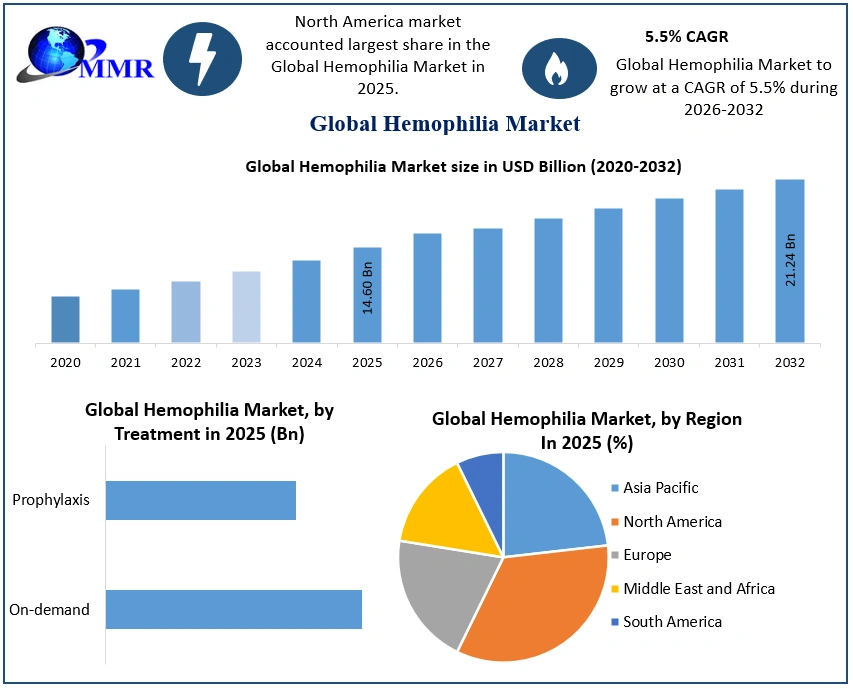
The Hemophilia Market size was valued at USD 14.60 Billion in 2025 and the total Hemophilia revenue is expected to grow at a CAGR of 5.5% from 2026 to 2032, reaching nearly USD 21.24 Billion by 2032.
Hemophilia is a hereditary blood clotting illness that affects the capacity of the body to form clots. A person with haemophilia is more likely to bleed for a longer period of time following an injury, cut, or bruise, as well as an increased risk of bleeding inside joints or the brain. The report offers a comprehensive picture of the sector, using both qualitative and quantitative data.
It gives a comprehensive analysis of the worldwide Hemophilia Market, as well as projections for the key categories. It also includes market size and forecast estimates for five key regions: North America, Europe, Asia-Pacific (APAC), Middle East and Africa (MEA), and South America, for the years 2026 to 2032. The Hemophilia Market is further divided by countries and sectors within each location.
To know about the Research Methodology :- Request Free Sample Report
Hemophilia Market Dynamics
Increased R&D efforts have come from the availability of restricted treatment therapy alternatives and the increased responsibility of regulatory authorities to address treatment. Both public and commercial healthcare organizations are substantially investing in the establishment of specialty clinics that are designed to satisfy patients' specific demands. In this context, the number of Hemophilia treatment centers is growing, with the goal of providing treatment to impoverished individuals. Authorities urge that persons with Hemophilia get therapy at a treatment facility for the best care and health education in order to stay healthy. Thus, the growth of the Hemophilia Market is expected to be fuelled by the construction of healthcare centers.
One of the primary reasons driving the haemophilia market development is the increased prevalence of haemophilia, which is pushing up demand for treatment choices. Patients with severe haemophilia require a frequent haemophilia treatment program to keep enough clotting factors in their circulation to avoid bleeding. Hemophilia A affects 1 in every 5,000 male births in the United States, according to the Centers for Disease Control and Prevention. Because the number of dependent patients requiring excellent care is growing, this significant prevalence is expected to have a significant influence on the market. Additionally, patients who get quality care are more likely to have fewer co-morbid diseases and have a decreased risk of serious bleeding. As a result, as the number of patients with haemophilia continues to rise, so does the need for haemophilia therapy. As a result, the ever-increasing number of patients has increased the demand for haemophilia therapy, which will raise product adoption rates.
Hemophilia Market Segmentation Analysis
By Type, Hemophilia type A is the most common kind, with a prevalence of four times that of haemophilia type B.
According to WebMD LLC figures published in 2025, the prevalence of type A varies by country, ranging from 5.4-to 14.5 instances per 100,000 males. Furthermore, around 50-60% of patients had severe haemophilia A, which is linked with severe bleeding symptoms. Moreover, the majority of available medicines are used to treat type A haemophilia. However, due to the availability of strong pipeline items, type B is expected to be the fastest-growing sector throughout the forecast period. Similarly, type B haemophilia accounts for around 20% of all haemophilia cases worldwide, with 50% of them having factor IX levels greater than 1%.
By Therapy: The haemophilia market is divided into two segments based on therapy:
prophylactic and on-demand medication. Prophylaxis was expected to be the fastest-growing sector throughout the forecast period, with on-demand holding the biggest market share in 2025.
Prophylaxis is a regular infusion of clotting factor concentrates used in individuals with severe haemophilia. It is a largely acknowledged treatment among patients, resulting in a high rate of growth. The length of therapy is determined by the severity of the patients. Additionally, prophylactic therapy is expected to prevent productivity loss while improving quality of life.

Hemophilia Market Regional Insight
By 2032, the North American market is estimated to be worth USD 8.26 billion. The changing preference for prophylactic medical care among people living in this region is likely to contribute significantly to market growth. Owing to increased awareness and better healthcare infrastructure, the Asia Pacific market is expected to remain the fastest expanding market between 2026 and 2032, with a CAGR of 5.6 percent. A surge in per capita healthcare expenditure and improved healthcare infrastructure in developing countries such as India and China is likely to drive significant growth.
Report Objectives:
Landscape analysis of the Hemophilia Market
competitive benchmarking
Past and current status of the industry with the forecasted market size and trends
Evaluation of potential key players that include market leaders, followers, and new entrants
Technology trends
The potential impact of micro-economic factors on the market
External and Internal factors affecting the market have been analyzed
The report also helps in understanding the Hemophilia Market dynamics, and structure by analyzing the market segments to project the Hemophilia Market size. Clear representation of competitive analysis of key players by product, price, financial position, product portfolio, growth strategies, and regional presence in the Hemophilia Market make the report investor’s guide.
Hemophilia Market Scope: Inquiry Before Buying
| Hemophilia Market | |||
|---|---|---|---|
| Report Coverage | Details | ||
| Base Year: | 2025 | Forecast Period: | 2026-2032 |
| Historical Data: | 2020 to 2025 | Market Size in 2025: | USD 14.60 Bn |
| Forecast Period 2026 to 2032 CAGR: | 5.5 % | Market Size in 2032: | USD 21.24 Bn. |
| Segments Covered: | by Type | Hemophilia A Hemophilia B Hemophilia C Others |
|
| by Treatment | On-demand Prophylaxis |
||
| by Therapy | Replacement therapy ITI therapy Gene therapy |
||
Hemophilia Market, by Region
North America (United States, Canada and Mexico)
Europe (UK, France, Germany, Italy, Spain, Sweden, Austria, Turkey, Russia and Rest of Europe)
Asia Pacific (China, India, Japan, South Korea, Australia, ASEAN and Rest of APAC)
Middle East and Africa (South Africa, GCC, Egypt, Nigeria and Rest of ME&A)
South America (Brazil, Argentina, Columbia and Rest of South America)
Hemophilia Market, Key Players
1. Bayer AG
2. Bio Marin Pharmaceutical, Inc.
3. CSL Behring
4. Kedrion
5. Novo Nordisk
6. Pfizer, Inc.
7. Roche (Chugai Pharmaceutical Co.)
8. Sanofi (Genzyme Corporation)
9. Takeda Pharmaceutical (Shire Plc)
10. Shire (Baxalta)
11. Spark Therapeutics, Inc.
12. Genzyme Corporation
13. Chugai Pharmaceutical Co. Ltd.
14. Novo Nordisk A/S.
15. Octapharma AG
Frequently Asked Questions
1. What was the Global Hemophilia Market size in 2025?
Ans: The Global Hemophilia Market size was USD 14.60 Billion in 2025.
2. What is the key driving factor for the growth of the Hemophilia Market?
Ans- One of the primary reasons driving the haemophilia market development is the increased prevalence of haemophilia, which is pushing up demand for treatment choices.
3. Which Region accounted for the largest Hemophilia Market share?
Ans- North America is accounted for the largest Hemophilia Market share.
4. What are the segments involved in the market’s segmental analysis?
Ans- Type, Treatment, and Therapy are the major segments in the market analysis.
5. What are the top players operating in the Hemophilia Market?
Ans- Bayer AG, BioMarin Pharmaceutical, Inc., CSL Behring, Kedrion, Novo Nordisk, Pfizer, Inc.