Hemophilia Market - Industry Structure Evaluation, Demand Drivers Analysis, Regional Growth Analysis and Identification, Competitive Positioning Review & Global Market Size Forecast to 2032

5.5%
CAGR (2026-2032)
14.6 USD Bn.
Forecast Market Size
321
Report Pages
126
Market Tables

Overview

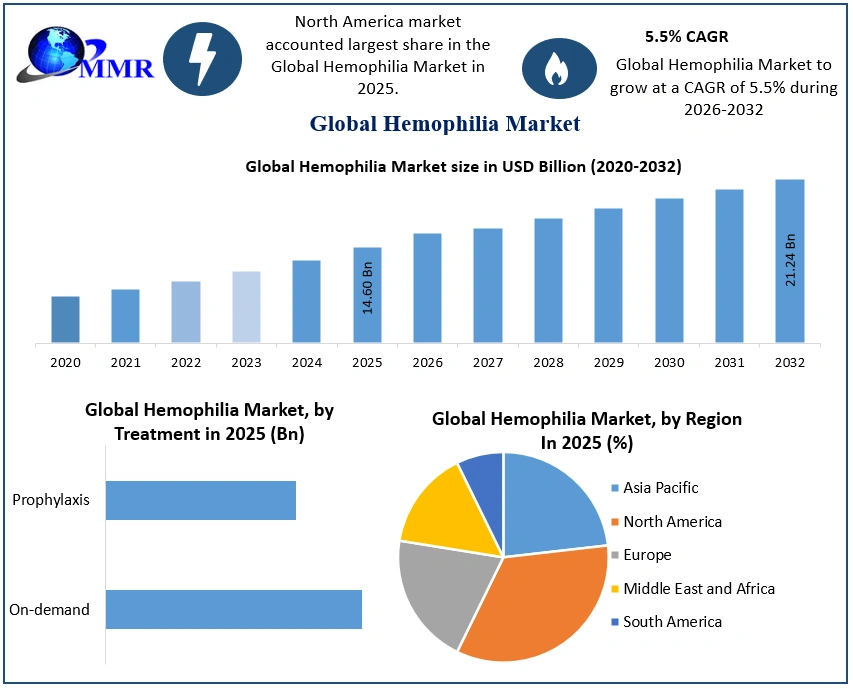
The Hemophilia Market size was valued at USD 14.60 Billion in 2025 and the total Hemophilia revenue is expected to grow at a CAGR of 5.5% from 2026 to 2032, reaching nearly USD 21.24 Billion by 2032.
Hemophilia Market Overview:

The global hemophilia market encompasses therapies, diagnostics, and disease management solutions used to prevent and treat hemophilia A and hemophilia B, rare inherited bleeding disorders caused by deficiencies in clotting factors VIII and IX, respectively. The market includes recombinant and plasma-derived clotting factor concentrates, extended half-life therapies, non-factor replacement therapies, gene therapies, and supportive treatment options that improve bleeding control and long-term patient outcomes. Rising awareness of rare bleeding disorders, increasing diagnosis rates, expanding newborn screening programs, and improved access to specialized hemophilia treatment centers are driving market growth. In addition, continuous advancements in recombinant technologies, prophylactic treatment regimens, personalized medicine, and innovative gene therapies are transforming disease management by reducing bleeding episodes, enhancing patient quality of life, and minimizing treatment burden across pediatric and adult patient populations.

The Hemophilia Market is expected to witness robust growth through 2032, supported by increasing investments in rare disease research, favorable regulatory incentives for orphan drugs, and rapid progress in biotechnology and gene-editing technologies. The growing adoption of extended half-life clotting factors, subcutaneous non-factor therapies, and one-time gene therapies is expanding treatment options while improving long-term clinical outcomes. Digital health platforms, telemedicine, AI-enabled patient monitoring, and wearable technologies are further enhancing treatment adherence and personalized care management. Although the high cost of advanced biologics and gene therapies, reimbursement challenges, and limited access in low- and middle-income countries remain important constraints, ongoing clinical innovation, expanding global healthcare infrastructure, and increasing collaboration among pharmaceutical companies, research institutions, and patient advocacy organizations are expected to create significant growth opportunities for the global hemophilia market during the forecast period.

Hemophilia Market 2025-2032

To know about the Research Methodology :- Request Free Sample Report

Hemophilia Market Dynamics:

Advancements in gene therapy and innovative biologics are accelerating market growth

Continuous innovation in gene therapy, recombinant clotting factors, and non-factor replacement therapies is significantly driving the growth of the global hemophilia market. Pharmaceutical companies are investing heavily in the development of long-lasting treatment options that reduce bleeding episodes and minimize the frequency of infusions. The commercialization of one-time gene therapies and extended half-life factor VIII and factor IX products has transformed disease management by improving treatment efficacy and patient convenience. In addition, increasing adoption of prophylactic therapy, expanding clinical research activities, and favorable regulatory support for orphan drugs are encouraging product innovation. Rising awareness among healthcare professionals and patients, coupled with the expansion of specialized hemophilia treatment centers, is further supporting the adoption of advanced therapies across both developed and emerging healthcare markets.

Growing access to personalized medicine is creating new opportunities

The increasing focus on personalized healthcare and precision medicine is creating substantial opportunities for the Hemophilia Market. Advances in genetic diagnostics, biomarker identification, and individualized treatment strategies enable clinicians to tailor therapies according to disease severity, inhibitor status, and patient-specific clinical requirements. Digital health platforms, AI-powered patient monitoring, telemedicine services, and mobile applications are improving treatment adherence and facilitating remote disease management. Emerging economies are also witnessing greater investments in rare disease diagnosis, healthcare infrastructure, and reimbursement programs, expanding access to innovative hemophilia treatments. Furthermore, ongoing research in gene editing technologies, including CRISPR-based approaches, and the development of next-generation non-factor therapies are expected to create new avenues for long-term market expansion.

High treatment costs continue to limit widespread adoption

Despite significant therapeutic advancements, the high cost of recombinant clotting factors, monoclonal antibodies, and gene therapies remains a major barrier to market growth. Lifelong prophylactic treatment imposes substantial financial burdens on healthcare systems, insurers, and patients, particularly in low- and middle-income countries. Although gene therapies offer the potential for long-term clinical benefits, their high upfront costs and reimbursement uncertainties continue to restrict adoption. In addition, disparities in healthcare infrastructure, limited availability of specialized treatment centers, and inconsistent reimbursement policies across different regions further constrain patient access to advanced hemophilia therapies.

Limited diagnosis rates and inhibitor development remain major industry challenges

Early diagnosis and effective long-term management remain challenging in several developing countries due to inadequate awareness, limited diagnostic capabilities, and shortages of hematology specialists. Many patients continue to be underdiagnosed or receive delayed treatment, increasing the risk of severe bleeding complications and joint damage. Furthermore, the development of inhibitors against clotting factor replacement therapies remains one of the most significant clinical challenges in hemophilia management, reducing treatment effectiveness and increasing healthcare costs. Manufacturers must also navigate stringent regulatory requirements, complex clinical trial processes, and long-term safety monitoring for gene therapies, which can delay product approvals and commercialization.

Hemophilia Market Trends:

Gene therapies are transforming long-term hemophilia treatment - The approval and commercialization of gene therapies for hemophilia A and B are reshaping the treatment landscape by offering the potential for sustained clotting factor production following a single administration. Pharmaceutical companies continue to invest in next-generation gene therapy platforms to improve durability, efficacy, and patient outcomes.

Non-factor replacement therapies are gaining widespread adoption - Subcutaneous non-factor therapies are increasingly being adopted due to their ability to reduce treatment burden and improve patient adherence compared with conventional intravenous factor replacement therapies. These therapies are becoming an important option for patients with inhibitors and those requiring long-term prophylaxis.

Extended half-life clotting factors continue to improve patient care - Manufacturers are developing recombinant clotting factors with extended half-lives to reduce infusion frequency while maintaining effective bleeding control. These therapies improve patient convenience, support long-term prophylaxis, and enhance overall quality of life for both pediatric and adult patients.

Digital health and remote patient monitoring are enhancing disease management - Healthcare providers are increasingly utilizing digital platforms, wearable technologies, electronic treatment diaries, and telemedicine services to monitor bleeding episodes, improve treatment adherence, and facilitate personalized care. AI-enabled analytics are also supporting better clinical decision-making and long-term disease management.

Expansion of newborn screening and early diagnosis programs is increasing treatment uptake - Governments and healthcare organizations are strengthening newborn screening initiatives, genetic testing, and awareness campaigns to enable earlier diagnosis and timely intervention. Improved diagnostic capabilities are expanding patient access to prophylactic therapies and specialized hemophilia care centers worldwide.

Hemophilia Market Segmentation Analysis:

Based on Type, the hemophilia market is divided into Hemophilia A, Hemophilia B, Hemophilia C, and Others.

Hemophilia A dominated the global hemophilia market in 2025 due to its significantly higher prevalence, accounting for nearly 80% of all diagnosed hemophilia cases worldwide. The segment benefits from the widespread availability of recombinant factor VIII concentrates, extended half-life replacement therapies, non-factor replacement therapies such as monoclonal antibodies, and the growing adoption of gene therapies. Continuous advancements in prophylactic treatment regimens, increasing diagnosis rates, favorable reimbursement policies, and expanding access to specialized hemophilia treatment centers have further strengthened the segment's market leadership. Ongoing clinical research focused on improving long-term efficacy and reducing treatment burden continues to drive innovation within the Hemophilia A segment.

Hemophilia B is expected to witness the fastest growth during the forecast period owing to increasing adoption of extended half-life factor IX products and the commercialization of innovative gene therapies offering sustained therapeutic benefits. Growing awareness, improved genetic testing, and expanding access to advanced biologics are supporting market expansion. Meanwhile, Hemophilia C and the Others segment, which includes rare inherited bleeding disorders with similar coagulation deficiencies, continue to represent smaller market shares due to their lower prevalence but are expected to benefit from advancements in precision medicine, improved diagnostics, and increasing investments in rare disease research.

Based on Therapy, the hemophilia market is divided into Replacement Therapy, ITI (Immune Tolerance Induction) Therapy, and Gene Therapy.

Replacement therapy accounted for the largest share of the global hemophilia market in 2025 due to its long-standing role as the standard of care for managing bleeding episodes and preventing complications in patients with hemophilia A and B. The widespread use of recombinant and plasma-derived clotting factor concentrates, together with the increasing adoption of extended half-life products for prophylactic treatment, has reinforced the segment's dominance. Continuous product innovations, improved manufacturing technologies, enhanced safety profiles, and expanding reimbursement coverage across developed healthcare markets continue to support the growth of replacement therapy.

Hemophilia Market by Therapy

Gene therapy is projected to register the fastest growth throughout the forecast period, driven by the successful commercialization of one-time treatments capable of delivering long-term clotting factor expression and reducing dependence on lifelong replacement therapy. Increasing investments in biotechnology research, favorable orphan drug incentives, and a robust clinical pipeline are accelerating innovation in this segment. ITI (Immune Tolerance Induction) therapy continues to play a critical role in patients who develop inhibitors against clotting factor replacement therapies, helping restore treatment effectiveness and improve long-term disease management, although its adoption remains limited to specific patient populations.

Global Hemophilia Prevalence :

Metric Value
Registered hemophilia patients worldwide 257,146 patients (reported through the World Federation of Hemophilia Annual Global Survey 2024)
Estimated patients living with hemophilia worldwide 830,000–850,000 patients, including diagnosed and undiagnosed cases
Estimated patients with severe hemophilia 282,000–289,000 patients
Global prevalence 3.75 cases per 100,000 population
Hemophilia A 17.1 cases per 100,000 males (≈1 in 5,800 male births); accounts for 80–85% of all hemophilia cases
Hemophilia B 3.8 cases per 100,000 males (≈1 in 30,000 male births); accounts for 15–20% of all hemophilia cases

Global hemophilia market Regional Insights:

North America dominated the global hemophilia market in 2025 and is expected to maintain its leading position throughout the forecast period. The region's leadership is driven by the high prevalence of diagnosed hemophilia, well-established hemophilia treatment centers (HTCs), strong reimbursement frameworks, and widespread adoption of advanced therapies, including recombinant clotting factors, non-factor replacement therapies, and recently approved gene therapies. The United States accounts for the largest regional share owing to substantial investments in rare disease research, favorable orphan drug regulations, and the presence of leading biopharmaceutical companies actively developing innovative hemophilia treatments. Canada further supports regional growth through universal healthcare coverage, expanding access to specialized care, and increasing adoption of prophylactic treatment strategies. Continuous clinical research, regulatory approvals, and advancements in personalized medicine continue to strengthen North America's position in the global hemophilia market.

Asia Pacific is projected to witness the fastest growth during the forecast period, supported by improving diagnosis rates, expanding healthcare infrastructure, increasing awareness of inherited bleeding disorders, and growing government initiatives to enhance access to rare disease treatments. Countries such as China, Japan, India, South Korea, and Australia are investing in specialized hematology centers, genetic testing, and advanced biologic therapies, driving market expansion across the region. Europe remains a significant market due to its strong healthcare systems, favorable reimbursement policies, and active participation in clinical research for novel hemophilia therapies, with Germany, the United Kingdom, France, Italy, and Spain leading regional demand. Meanwhile, Latin America and the Middle East & Africa are experiencing gradual market growth, supported by improving healthcare access, expanding patient advocacy programs, and increasing availability of recombinant therapies and diagnostic services, although limited healthcare resources and reimbursement challenges continue to restrain broader market adoption in several countries.

Global Hemophilia Market Recent Developments:

Date Recent Development
May 2026 Novo Nordisk announced positive Phase III clinical results for its investigational hemophilia A therapy, reinforcing its pipeline for next-generation prophylactic treatment.
March 2026 Pfizer expanded global access initiatives for BEQVEZ™ (fidanacogene elaparvovec), its gene therapy for hemophilia B, following additional regulatory approvals in international markets.
December 2025 CSL Behring reported positive long-term clinical data supporting the durability and safety of HEMGENIX®, further strengthening confidence in gene therapy for hemophilia B.
September 2025 Takeda Pharmaceutical Company Limited expanded real-world evidence programs evaluating long-term outcomes of ADVATE® and ADYNOVATE® in patients with hemophilia A.
June 2025 Roche announced new clinical data demonstrating sustained efficacy and safety of Hemlibra® (emicizumab) across pediatric and adult patients with hemophilia A, including those with inhibitors.
February 2025 BioMarin Pharmaceutical Inc. published additional follow-up data confirming the long-term effectiveness of ROCTAVIAN®, its gene therapy for adults with severe hemophilia A.
October 2024 Sanofi and Sobi reported continued expansion of global access for ALTUVIIIO®, supported by new reimbursement agreements and regulatory approvals across multiple countries.
April 2024 Bayer AG initiated additional clinical studies evaluating extended treatment strategies for Jivi® to improve long-term prophylactic management in patients with hemophilia A.

Global Hemophilia Market Competitive Landscape:

The global hemophilia market is characterized by intense competition among leading biopharmaceutical companies focused on developing innovative therapies that improve long-term disease management and patient quality of life. Market participants are investing heavily in research and development to expand their portfolios of recombinant clotting factors, extended half-life therapies, non-factor replacement treatments, and next-generation gene therapies. Strategic priorities include obtaining regulatory approvals, advancing clinical trials, expanding manufacturing capacity, and strengthening global distribution networks. Companies are also pursuing collaborations, licensing agreements, acquisitions, and partnerships with research institutions to accelerate innovation in rare disease therapeutics. The growing emphasis on personalized medicine, digital patient monitoring, and precision healthcare is further shaping the competitive landscape while supporting the adoption of advanced hemophilia treatments across developed and emerging markets.

Leading companies such as F. Hoffmann-La Roche Ltd., Pfizer Inc., Novo Nordisk A/S, Takeda Pharmaceutical Company Limited, CSL Behring, Sanofi S.A., BioMarin Pharmaceutical Inc., Bioverativ Inc. (Sanofi), Bayer AG, Swedish Orphan Biovitrum AB (Sobi), Octapharma AG, Grifols S.A., Kedrion Biopharma Inc., Spark Therapeutics, Inc., and uniQure N.V. compete through continuous product innovation, expansion of gene therapy pipelines, strategic collaborations, and geographic expansion. These companies are strengthening their market positions by investing in next-generation biologics, improving treatment accessibility, expanding prophylactic therapy offerings, and advancing clinical research to address unmet needs in hemophilia care while enhancing long-term patient outcomes.

Hemophilia Market Scope: Inquiry Before Buying

Hemophilia Market
Report Coverage Details
Base Year: 2025 Forecast Period: 2026-2032
Historical Data: 2020 to 2025 Market Size in 2025: USD 14.60 Bn
Forecast Period 2026 to 2032 CAGR: 5.5 % Market Size in 2032: USD 21.24 Bn.
Segments Covered: By Type  Hemophilia A
Hemophilia B
Hemophilia C
Others
By Treatment On-demand
Prophylaxis
By Therapy  Replacement therapy
ITI therapy
Gene therapy

Hemophilia Market, by Region

North America (United States, Canada and Mexico)
Europe (UK, France, Germany, Italy, Spain, Sweden, Austria, Turkey, Russia and Rest of Europe)
Asia Pacific (China, India, Japan, South Korea, Australia, ASEAN and Rest of APAC)
Middle East and Africa (South Africa, GCC, Egypt, Nigeria and Rest of ME&A)
South America (Brazil, Argentina, Columbia and Rest of South America)

Hemophilia Market, Key Players

North America

  1. Pfizer Inc. (New York, New York, United States)
  2. BioMarin Pharmaceutical Inc. (San Rafael, California, United States)
  3. CSL Behring LLC (King of Prussia, Pennsylvania, United States)
  4. Grifols USA, LLC (Research Triangle Park, North Carolina, United States)
  5. Sangamo Therapeutics, Inc. (Richmond, California, United States)
  6. Spark Therapeutics, Inc. (Philadelphia, Pennsylvania, United States)
  7. Genentech, Inc. (South San Francisco, California, United States)

Europe

  1. Novo Nordisk A/S (Bagsværd, Denmark)
  2. F. Hoffmann-La Roche Ltd. (Basel, Switzerland)
  3. Octapharma AG (Lachen, Switzerland)
  4. Swedish Orphan Biovitrum AB (Sobi) (Stockholm, Sweden)
  5. Bayer AG (Leverkusen, Germany)
  6. Kedrion S.p.A. (Barga, Italy)
  7. uniQure N.V. (Amsterdam, Netherlands)
  8. Grifols S.A. (Barcelona, Spain)

Asia Pacific

  1. Takeda Pharmaceutical Company Limited (Tokyo, Japan)
  2. Chugai Pharmaceutical Co., Ltd. (Tokyo, Japan)
  3. GC Biopharma Corp. (Yongin-si, South Korea)
  4. KM Biologics Co., Ltd. (Kumamoto, Japan)
  5. SK Plasma Co., Ltd. (Seongnam-si, South Korea)

Others

Frequently Asked Questions:

1. What was the Global Hemophilia Market size in 2025?
Ans:
The Global Hemophilia Market size was USD 14.60 Billion in 2025.

2. What is the key driving factor for the growth of the Hemophilia Market?
Ans- One of the primary reasons driving the haemophilia market development is the increased prevalence of haemophilia, which is pushing up demand for treatment choices.

3. Which Region accounted for the largest Hemophilia Market share?
Ans- North America is accounted for the largest Hemophilia Market share.

4. What are the segments involved in the market’s segmental analysis?
Ans- Type, Treatment, and Therapy are the major segments in the market analysis.

5. What are the top players operating in the Hemophilia Market?
Ans- Bayer AG, BioMarin Pharmaceutical, Inc., CSL Behring, Kedrion, Novo Nordisk, Pfizer, Inc.

Table of Contents

1. Hemophilia Market Introduction 1.1. Study Assumption and Market Definition 1.2. Scope of the Study 1.3. Executive Summary 2. Global Hemophilia Market: Competitive Landscape 2.1. MMR Competition Matrix 2.2. Competitive Landscape 2.3. Key Players Benchmarking 2.3.1. Company Name 2.3.2. Business Segment 2.3.3. End-user Segment 2.3.4. Revenue (2025) 2.3.5. Company Locations 2.4. Leading Hemophilia Market Companies, by market capitalization 2.5. Market Structure 2.5.1. Market Leaders 2.5.2. Market Followers 2.5.3. Emerging Players 2.6. Mergers and Acquisitions Details 3. Hemophilia Market: Dynamics 3.1. Hemophilia Market Trends by Region 3.1.1. North America Hemophilia Market Trends 3.1.2. Europe Hemophilia Market Trends 3.1.3. Asia Pacific Hemophilia Market Trends 3.1.4. Middle East and Africa Hemophilia Market Trends 3.1.5. South America Hemophilia Market Trends 3.2. Hemophilia Market Dynamics by Region 3.2.1. North America 3.2.1.1. North America Hemophilia Market Drivers 3.2.1.2. North America Hemophilia Market Restraints 3.2.1.3. North America Hemophilia Market Opportunities 3.2.1.4. North America Hemophilia Market Challenges 3.2.2. Europe 3.2.2.1. Europe Hemophilia Market Drivers 3.2.2.2. Europe Hemophilia Market Restraints 3.2.2.3. Europe Hemophilia Market Opportunities 3.2.2.4. Europe Hemophilia Market Challenges 3.2.3. Asia Pacific 3.2.3.1. Asia Pacific Hemophilia Market Drivers 3.2.3.2. Asia Pacific Hemophilia Market Restraints 3.2.3.3. Asia Pacific Hemophilia Market Opportunities 3.2.3.4. Asia Pacific Hemophilia Market Challenges 3.2.4. Middle East and Africa 3.2.4.1. Middle East and Africa Hemophilia Market Drivers 3.2.4.2. Middle East and Africa Hemophilia Market Restraints 3.2.4.3. Middle East and Africa Hemophilia Market Opportunities 3.2.4.4. Middle East and Africa Hemophilia Market Challenges 3.2.5. South America 3.2.5.1. South America Hemophilia Market Drivers 3.2.5.2. South America Hemophilia Market Restraints 3.2.5.3. South America Hemophilia Market Opportunities 3.2.5.4. South America Hemophilia Market Challenges 3.3. PORTER's Five Forces Analysis 3.4. PESTLE Analysis 3.5. Technology Roadmap 3.6. Regulatory Landscape by Region 3.6.1. North America 3.6.2. Europe 3.6.3. Asia Pacific 3.6.4. Middle East and Africa 3.6.5. South America 3.7. Key Opinion Leader Analysis For Hemophilia Industry 3.8. Analysis of Government Schemes and Initiatives For Hemophilia Industry 3.9. Hemophilia Market Trade Analysis 3.10. The Global Pandemic Impact on Hemophilia Market 4. Hemophilia Market: Global Market Size and Forecast by Segmentation (in USD Billion) 2025-2034 4.1. Hemophilia Market Size and Forecast, by Type (2025-2034) 4.1.1. Hemophilia A 4.1.2. Hemophilia B 4.1.3. Hemophilia C 4.1.4. Others 4.2. Hemophilia Market Size and Forecast, by Treatment (2025-2034) 4.2.1. On-demand 4.2.2. Prophylaxis 4.3. Hemophilia Market Size and Forecast, by Therapy (2025-2034) 4.3.1. Replacement Therapy 4.3.2. ITI Therapy 4.3.3. Gene Therapy 4.4. Hemophilia Market Size and Forecast, by Region (2025-2034) 4.4.1. North America 4.4.2. Europe 4.4.3. Asia Pacific 4.4.4. Middle East and Africa 4.4.5. South America 5. North America Hemophilia Market Size and Forecast by Segmentation (in USD Billion) 2025-2034 5.1. North America Hemophilia Market Size and Forecast, by Type (2025-2034) 5.1.1. Hemophilia A 5.1.2. Hemophilia B 5.1.3. Hemophilia C 5.1.4. Others 5.2. North America Hemophilia Market Size and Forecast, by Treatment (2025-2034) 5.2.1. On-demand 5.2.2. Prophylaxis 5.3. North America Hemophilia Market Size and Forecast, by Therapy (2025-2034) 5.3.1. Replacement Therapy 5.3.2. ITI Therapy 5.3.3. Gene Therapy 5.4. North America Hemophilia Market Size and Forecast, by Country (2025-2034) 5.4.1. United States 5.4.1.1. United States Hemophilia Market Size and Forecast, by Type (2025-2034) 5.4.1.1.1. Hemophilia A 5.4.1.1.2. Hemophilia B 5.4.1.1.3. Hemophilia C 5.4.1.1.4. Others 5.4.1.2. United States Hemophilia Market Size and Forecast, by Treatment (2025-2034) 5.4.1.2.1. On-demand 5.4.1.2.2. Prophylaxis 5.4.1.3. United States Hemophilia Market Size and Forecast, by Therapy (2025-2034) 5.4.1.3.1. Replacement Therapy 5.4.1.3.2. ITI Therapy 5.4.1.3.3. Gene Therapy 5.4.2. Canada 5.4.2.1. Canada Hemophilia Market Size and Forecast, by Type (2025-2034) 5.4.2.1.1. Hemophilia A 5.4.2.1.2. Hemophilia B 5.4.2.1.3. Hemophilia C 5.4.2.1.4. Others 5.4.2.2. Canada Hemophilia Market Size and Forecast, by Treatment (2025-2034) 5.4.2.2.1. On-demand 5.4.2.2.2. Prophylaxis 5.4.2.3. Canada Hemophilia Market Size and Forecast, by Therapy (2025-2034) 5.4.2.3.1. Replacement Therapy 5.4.2.3.2. ITI Therapy 5.4.2.3.3. Gene Therapy 5.4.3. Mexico 5.4.3.1. Mexico Hemophilia Market Size and Forecast, by Type (2025-2034) 5.4.3.1.1. Hemophilia A 5.4.3.1.2. Hemophilia B 5.4.3.1.3. Hemophilia C 5.4.3.1.4. Others 5.4.3.2. Mexico Hemophilia Market Size and Forecast, by Treatment (2025-2034) 5.4.3.2.1. On-demand 5.4.3.2.2. Prophylaxis 5.4.3.3. Mexico Hemophilia Market Size and Forecast, by Therapy (2025-2034) 5.4.3.3.1. Replacement Therapy 5.4.3.3.2. ITI Therapy 5.4.3.3.3. Gene Therapy 6. Europe Hemophilia Market Size and Forecast by Segmentation (in USD Billion) 2025-2034 6.1. Europe Hemophilia Market Size and Forecast, by Type (2025-2034) 6.2. Europe Hemophilia Market Size and Forecast, by Treatment (2025-2034) 6.3. Europe Hemophilia Market Size and Forecast, by Therapy (2025-2034) 6.4. Europe Hemophilia Market Size and Forecast, by Country (2025-2034) 6.4.1. United Kingdom 6.4.1.1. United Kingdom Hemophilia Market Size and Forecast, by Type (2025-2034) 6.4.1.2. United Kingdom Hemophilia Market Size and Forecast, by Treatment (2025-2034) 6.4.1.3. United Kingdom Hemophilia Market Size and Forecast, by Therapy (2025-2034) 6.4.2. France 6.4.2.1. France Hemophilia Market Size and Forecast, by Type (2025-2034) 6.4.2.2. France Hemophilia Market Size and Forecast, by Treatment (2025-2034) 6.4.2.3. France Hemophilia Market Size and Forecast, by Therapy (2025-2034) 6.4.3. Germany 6.4.3.1. Germany Hemophilia Market Size and Forecast, by Type (2025-2034) 6.4.3.2. Germany Hemophilia Market Size and Forecast, by Treatment (2025-2034) 6.4.3.3. Germany Hemophilia Market Size and Forecast, by Therapy (2025-2034) 6.4.4. Italy 6.4.4.1. Italy Hemophilia Market Size and Forecast, by Type (2025-2034) 6.4.4.2. Italy Hemophilia Market Size and Forecast, by Treatment (2025-2034) 6.4.4.3. Italy Hemophilia Market Size and Forecast, by Therapy (2025-2034) 6.4.5. Spain 6.4.5.1. Spain Hemophilia Market Size and Forecast, by Type (2025-2034) 6.4.5.2. Spain Hemophilia Market Size and Forecast, by Treatment (2025-2034) 6.4.5.3. Spain Hemophilia Market Size and Forecast, by Therapy (2025-2034) 6.4.6. Sweden 6.4.6.1. Sweden Hemophilia Market Size and Forecast, by Type (2025-2034) 6.4.6.2. Sweden Hemophilia Market Size and Forecast, by Treatment (2025-2034) 6.4.6.3. Sweden Hemophilia Market Size and Forecast, by Therapy (2025-2034) 6.4.7. Austria 6.4.7.1. Austria Hemophilia Market Size and Forecast, by Type (2025-2034) 6.4.7.2. Austria Hemophilia Market Size and Forecast, by Treatment (2025-2034) 6.4.7.3. Austria Hemophilia Market Size and Forecast, by Therapy (2025-2034) 6.4.8. Rest of Europe 6.4.8.1. Rest of Europe Hemophilia Market Size and Forecast, by Type (2025-2034) 6.4.8.2. Rest of Europe Hemophilia Market Size and Forecast, by Treatment (2025-2034) 6.4.8.3. Rest of Europe Hemophilia Market Size and Forecast, by Therapy (2025-2034) 7. Asia Pacific Hemophilia Market Size and Forecast by Segmentation (in USD Billion) 2025-2034 7.1. Asia Pacific Hemophilia Market Size and Forecast, by Type (2025-2034) 7.2. Asia Pacific Hemophilia Market Size and Forecast, by Treatment (2025-2034) 7.3. Asia Pacific Hemophilia Market Size and Forecast, by Therapy (2025-2034) 7.4. Asia Pacific Hemophilia Market Size and Forecast, by Country (2025-2034) 7.4.1. China 7.4.1.1. China Hemophilia Market Size and Forecast, by Type (2025-2034) 7.4.1.2. China Hemophilia Market Size and Forecast, by Treatment (2025-2034) 7.4.1.3. China Hemophilia Market Size and Forecast, by Therapy (2025-2034) 7.4.2. S Korea 7.4.2.1. S Korea Hemophilia Market Size and Forecast, by Type (2025-2034) 7.4.2.2. S Korea Hemophilia Market Size and Forecast, by Treatment (2025-2034) 7.4.2.3. S Korea Hemophilia Market Size and Forecast, by Therapy (2025-2034) 7.4.3. Japan 7.4.3.1. Japan Hemophilia Market Size and Forecast, by Type (2025-2034) 7.4.3.2. Japan Hemophilia Market Size and Forecast, by Treatment (2025-2034) 7.4.3.3. Japan Hemophilia Market Size and Forecast, by Therapy (2025-2034) 7.4.4. India 7.4.4.1. India Hemophilia Market Size and Forecast, by Type (2025-2034) 7.4.4.2. India Hemophilia Market Size and Forecast, by Treatment (2025-2034) 7.4.4.3. India Hemophilia Market Size and Forecast, by Therapy (2025-2034) 7.4.5. Australia 7.4.5.1. Australia Hemophilia Market Size and Forecast, by Type (2025-2034) 7.4.5.2. Australia Hemophilia Market Size and Forecast, by Treatment (2025-2034) 7.4.5.3. Australia Hemophilia Market Size and Forecast, by Therapy (2025-2034) 7.4.6. Indonesia 7.4.6.1. Indonesia Hemophilia Market Size and Forecast, by Type (2025-2034) 7.4.6.2. Indonesia Hemophilia Market Size and Forecast, by Treatment (2025-2034) 7.4.6.3. Indonesia Hemophilia Market Size and Forecast, by Therapy (2025-2034) 7.4.7. Malaysia 7.4.7.1. Malaysia Hemophilia Market Size and Forecast, by Type (2025-2034) 7.4.7.2. Malaysia Hemophilia Market Size and Forecast, by Treatment (2025-2034) 7.4.7.3. Malaysia Hemophilia Market Size and Forecast, by Therapy (2025-2034) 7.4.8. Vietnam 7.4.8.1. Vietnam Hemophilia Market Size and Forecast, by Type (2025-2034) 7.4.8.2. Vietnam Hemophilia Market Size and Forecast, by Treatment (2025-2034) 7.4.8.3. Vietnam Hemophilia Market Size and Forecast, by Therapy (2025-2034) 7.4.9. Taiwan 7.4.9.1. Taiwan Hemophilia Market Size and Forecast, by Type (2025-2034) 7.4.9.2. Taiwan Hemophilia Market Size and Forecast, by Treatment (2025-2034) 7.4.9.3. Taiwan Hemophilia Market Size and Forecast, by Therapy (2025-2034) 7.4.10. Rest of Asia Pacific 7.4.10.1. Rest of Asia Pacific Hemophilia Market Size and Forecast, by Type (2025-2034) 7.4.10.2. Rest of Asia Pacific Hemophilia Market Size and Forecast, by Treatment (2025-2034) 7.4.10.3. Rest of Asia Pacific Hemophilia Market Size and Forecast, by Therapy (2025-2034) 8. Middle East and Africa Hemophilia Market Size and Forecast by Segmentation (in USD Billion) 2025-2034 8.1. Middle East and Africa Hemophilia Market Size and Forecast, by Type (2025-2034) 8.2. Middle East and Africa Hemophilia Market Size and Forecast, by Treatment (2025-2034) 8.3. Middle East and Africa Hemophilia Market Size and Forecast, by Therapy (2025-2034) 8.4. Middle East and Africa Hemophilia Market Size and Forecast, by Country (2025-2034) 8.4.1. South Africa 8.4.1.1. South Africa Hemophilia Market Size and Forecast, by Type (2025-2034) 8.4.1.2. South Africa Hemophilia Market Size and Forecast, by Treatment (2025-2034) 8.4.1.3. South Africa Hemophilia Market Size and Forecast, by Therapy (2025-2034) 8.4.2. GCC 8.4.2.1. GCC Hemophilia Market Size and Forecast, by Type (2025-2034) 8.4.2.2. GCC Hemophilia Market Size and Forecast, by Treatment (2025-2034) 8.4.2.3. GCC Hemophilia Market Size and Forecast, by Therapy (2025-2034) 8.4.3. Nigeria 8.4.3.1. Nigeria Hemophilia Market Size and Forecast, by Type (2025-2034) 8.4.3.2. Nigeria Hemophilia Market Size and Forecast, by Treatment (2025-2034) 8.4.3.3. Nigeria Hemophilia Market Size and Forecast, by Therapy (2025-2034) 8.4.4. Rest of ME&A 8.4.4.1. Rest of ME&A Hemophilia Market Size and Forecast, by Type (2025-2034) 8.4.4.2. Rest of ME&A Hemophilia Market Size and Forecast, by Treatment (2025-2034) 8.4.4.3. Rest of ME&A Hemophilia Market Size and Forecast, by Therapy (2025-2034) 9. South America Hemophilia Market Size and Forecast by Segmentation (in USD Billion) 2025-2034 9.1. South America Hemophilia Market Size and Forecast, by Type (2025-2034) 9.2. South America Hemophilia Market Size and Forecast, by Treatment (2025-2034) 9.3. South America Hemophilia Market Size and Forecast, by Therapy (2025-2034) 9.4. South America Hemophilia Market Size and Forecast, by Country (2025-2034) 9.4.1. Brazil 9.4.1.1. Brazil Hemophilia Market Size and Forecast, by Type (2025-2034) 9.4.1.2. Brazil Hemophilia Market Size and Forecast, by Treatment (2025-2034) 9.4.1.3. Brazil Hemophilia Market Size and Forecast, by Therapy (2025-2034) 9.4.2. Argentina 9.4.2.1. Argentina Hemophilia Market Size and Forecast, by Type (2025-2034) 9.4.2.2. Argentina Hemophilia Market Size and Forecast, by Treatment (2025-2034) 9.4.2.3. Argentina Hemophilia Market Size and Forecast, by Therapy (2025-2034) 9.4.3. Rest Of South America 9.4.3.1. Rest Of South America Hemophilia Market Size and Forecast, by Type (2025-2034) 9.4.3.2. Rest Of South America Hemophilia Market Size and Forecast, by Treatment (2025-2034) 9.4.3.3. Rest Of South America Hemophilia Market Size and Forecast, by Therapy (2025-2034) 10. Company Profile: Key Players 10.1. Pfizer Inc. – United States 10.1.1. Company Overview 10.1.2. Business Portfolio 10.1.3. Financial Overview 10.1.4. SWOT Analysis 10.1.5. Strategic Analysis 10.1.6. Scale of Operation (small, medium, and large) 10.1.7. Details on Partnership 10.1.8. Regulatory Accreditations and Certifications Received by Them 10.1.9. Awards Received by the Firm 10.1.10. Recent Developments 10.2. Takeda Pharmaceutical Company (Baxalta Heritage) – United States 10.3. CSL Behring LLC – United States 10.4. Novo Nordisk A/S – Denmark 10.5. Octapharma AG – Switzerland 10.6. GC Biopharma Corp. – South Korea 10.7. BioMarin Pharmaceutical Inc. – United States 10.8. Swedish Orphan Biovitrum AB (Sobi) – Sweden 10.9. Takeda Pharmaceutical Company Limited – Japan 10.10. F. Hoffmann-La Roche Ltd. – Switzerland 10.11. Chugai Pharmaceutical Co. 10.12. Ltd. – Japan 10.13. Sangamo Therapeutics 10.14. Inc. – United States 10.15. CSL Behring AG – Switzerland 10.16. Grifols USA 10.17. LLC – United States 10.18. Kedrion S.p.A. – Italy 11. Key Findings 12. Industry Recommendations 13. Hemophilia Market: Research Methodology 14. Terms and Glossary

Custom Market Research Services

We Will Customise The Research For You, In Case The Report Listed Above Does Not Meet With Your Requirements