
Helium Market by Phase, Application, End-User Industry, and Region – Global Market Size Estimation, Industry-Wide Analysis, Competitive Landscape Assessment & Long-Term Forecast to 2032
Overview
The Helium Market size was valued at USD 5.42 Billion in 2025 and the total Helium revenue is expected to grow at a CAGR of 8.29% from 2026 to 2032, reaching nearly USD 9.47 Billion.
Helium Market Overview:
Helium is a critical component of many significant technologies that impact our lives daily, but the capacity of current and anticipated helium supply sources to meet future demand is highly questionable. Many circumstances have combined to produce a problematic scenario, beginning with the United States government's decision in 1996 to sell virtually all of its helium stockpile, which was held in a depleted natural gas field in Amarillo, Texas. For much of the last decade, this resulted in an increase in supply and artificially low pricing. Because this was the only site in the world to store helium until recently, all of the helium sold out of this reserve has already been spent.
Many big energy projects have been canceled or delayed as a result of declining oil and gas prices induced by the introduction of shale drilling, in addition to the depletion of the US government's helium reserve. Helium was previously generated as a byproduct in a few major conventional oil and gas projects that occurred to contain a lot of helium. Most helium-related projects have been cancelled in recent years, as spending on oil and gas production from shale, which cannot capture or create considerable amounts of helium, has taken its place. There are no substantial projects in the works in North America to replace the helium supply lost as a result of US government stockpile sales. Recent shortages have made existing helium demand less elastic, and new sources of helium demand that are rapidly emerging could accelerate demand growth.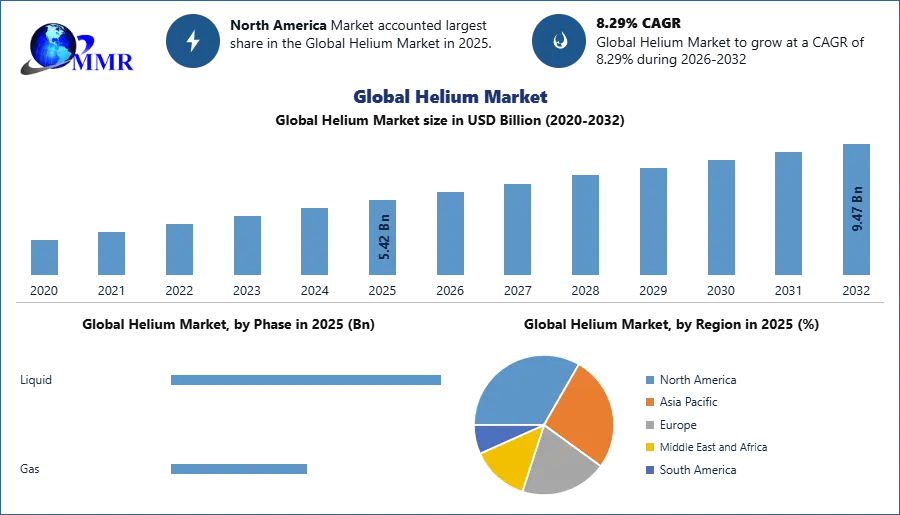 To know about the Research Methodology :- Request Free Sample Report
Helium Market Dynamics:
Growing consumption of helium in the electronics and semiconductor industry
Helium is also necessary for the use of the Internet. Liquid helium is used to cool the magnets used in the production process of semiconductors, which are found in almost all modern gadgets. Meanwhile, the fiber optic cables that deliver Internet access and cable TV to people's homes must be manufactured in an all-helium atmosphere to avoid trapped bubbles.
Silicon is processed into working chips at a fabrication facility with high-tech equipment and ultra-clean conditions. Modern fabs cost billions of dollars, and each of the several pieces of equipment costs millions of dollars, so it's critical that the processing runs smoothly to make the most of that investment. Helium is used in a variety of ways in these operations.
Helium is used in the semiconductor manufacturing process for a variety of reasons. It is also an "inert" gas, which means it does not react with other substances. As a result, it's suitable as a setting for the chemical reactions that occur during the procedure. Because many of these are based on gases or liquids, having an inert atmosphere surrounding the silicon eliminates any undesirable reactions.
Helium also has a high thermal conductivity, which means it effectively carries heat away. This helps in maintaining the silicon's temperature during these procedures. As the size of the circuitry on silicon shrinks, this is becoming increasingly significant. Without the process control that helium gives, this downsizing would be difficult to achieve. Thus, the unique features of helium which, cannot be replaced with any other element are expected to drive the market growth over the forecast period.
Growing consumption of liquid helium in the medical industry
Liquid helium is used to cool the superconducting magnet that generates the magnetic field in magnetic resonance imaging devices. MRIs are used by doctors to diagnose malignancies, tumors, strokes, heart problems, and brain illnesses, as well as by researchers for chemical, biology, and medical investigations. Newer machines use "dramatically less helium," but the National Research Council estimates that inventing a magnet that doesn't require liquid helium will take at least five years and may not happen at all.
Health risks associated with helium
Helium is a non-toxic, inert gas. Excessive concentrations can cause nausea, dizziness, vomiting, unconsciousness, and death when inhaled. Errors in judgment, confusion, or loss of consciousness can all lead to death if self-rescue is not possible. When oxygen levels are low, unconsciousness and death can happen quickly and without warning. As a result, this is the factor expected to hamper the market growth during the forecast period.
Global Helium Market Segment Analysis:
Based on Phase, the global helium market is segmented as Liquid Phase, and Gas Phase.
Based on Application, the global helium market is segmented as, Breathing Mixes, Cryogenics, Lead Detection, Pressurizing and Purging, Welding, Controlled Atmosphere, and Others.
In 2025, the cryogenics segment was dominant and held 28% of the overall market share in terms of revenue as helium is used as a super coolant for cryogenic applications such as magnetic resonance imaging (MRI), nuclear magnetic resonance (NMR) spectroscopy, particle accelerators, large hadron collider, superconducting quantum interference device (SQUID), electron spin resonance spectroscopy (ESR), superconducting magnetic energy storage (SMEs).
Based on End-use Industry, the global helium market is segmented as Aerospace & Aircraft, Electronics & Semiconductors, Nuclear Power, Healthcare, Welding and Metal Fabrication, and Others.
In 2025, the healthcare segment was dominant and held more than 34% of the overall market share in terms of revenue. Helium has many applications in the medical field. Liquid helium can reach a temperature of -269° C, making it the ideal choice for cooling MRI magnets. Also, helium is consumed to monitor breathing. It is an important content in the cure of emphysema, asthma, and other breathing disorders.
Typically, the gas is used to treat lung illnesses. The mixture of helium and oxygen is used to cure chronic and acute respiratory illnesses because it enters the lungs faster than any other gas. There is no alternative available for helium in cryogenic applications.
Recent Industry Developments
| Exact Date | Company | Development | Impact |
|---|---|---|---|
| 25 February 2025 | Helium Evolution Incorporated | Announced plans to develop helium production and processing facilities in the Mankota region of Saskatchewan following positive results from the 5-30 helium discovery well. | The project is expected to enable commercial helium production by late 2025, strengthening North American supply capacity. |
| 09 April 2025 | New Era Helium Inc. | Provided an operational update confirming progress on the Pecos Slope helium processing plant, with construction advancing toward completion. | The facility is expected to boost helium recovery and processing capacity in the Permian Basin, supporting supply for industrial and semiconductor applications. |
| 29 May 2025 | Pulsar Helium Inc. | Reported progress at its Topaz helium project in Minnesota, including successful drilling results confirming a helium-bearing reservoir. | The results support future commercial helium production and project development planning, contributing to new helium supply sources. |
| 10 June 2025 | Helium One Global Ltd. | Announced completion of the 2025 drilling program at the Galactica-Pegasus helium project in Colorado with positive well testing results. | Successful drilling advances the project toward commercial helium production and expanded supply for industrial markets. |
| 09 September 2025 | Pulsar Helium Inc. | Signed a Limited Notice to Proceed agreement with Chart Industries to begin engineering for a helium recovery and CO₂ capture plant at the Topaz project. | The partnership accelerates plant engineering and equipment procurement, enabling faster commercialization of new helium production capacity. |
Helium Market Regional Insights:
North America region dominated the market:
In 2025, North America accounted for the greatest portion of the market, with the United States alone accounting for 30% of global consumption. In terms of scale, the US electronics market is the largest in the world. Also, thanks to the application of modern technology, an increase in the number of R&D centers, and rising consumer demand, it is likely to be the leading market over the forecast period. Helium reserves are primarily found in the United States, Russia, Qatar, Algeria, and Iran, although fresh finds in Western Canada show substantial potential. North American Helium is at the vanguard of developing large helium production in Saskatchewan, which will be needed in North America and possibly the rest of the globe.
The focus on generating high-end products has resulted in a large growth in the number of manufacturing plants and development centers in the United States. Over the forecast period, this is expected to increase helium demand. Also, the United States possesses the world's largest aerospace industry. The total active general aviation fleet is expected to decline by 0.9 percent from 212,335 aircraft in 2019 to 210,380 aircraft by 2040, according to the Federal Aviation Administration (FAA), thanks to unfavorable pilot demographics, the availability of much lower-cost alternatives for recreational use, and the overall increasing cost of aircraft ownership. However, between 2019 and 2040, the more expensive and complex turbine-powered fleet (including rotorcraft) is expected to grow by 14,640 aircraft, or 1.82% per year, while the turbojet fleet is expected to grow by 2.32% per year.
The objective of the report is to present a comprehensive analysis of the global market to the stakeholders in the industry. The past and current status of the industry with the forecasted market size and trends are presented in the report with the analysis of complicated data in simple language. The report covers all the aspects of the industry with a dedicated study of key players that include market leaders, followers, and new entrants.
PORTER, PESTEL analysis with the potential impact of micro-economic factors of the market have been presented in the report. External as well as internal factors that are supposed to affect the business positively or negatively have been analyzed, which will give a clear futuristic view of the industry to the decision-makers.
The report also helps in understanding the global market dynamics, structure by analyzing the market segments and project the global market size. Clear representation of competitive analysis of key players by product, price, financial position, product portfolio, growth strategies, and regional presence in the global market makes the report investor's guide.
Global Helium Market Scope: Inquire before buying
| Global Helium Market | |||
|---|---|---|---|
| Report Coverage | Details | ||
| Base Year: | 2025 | Forecast Period: | 2026-2032 |
| Historical Data: | 2020 to 2025 | Market Size in 2025: | 5.42 USD Billion |
| Forecast Period 2026-2032 CAGR: | 8.29% | Market Size in 2032: | 9.47 USD Billion |
| Segments Covered: | by Phase | Liquid Gas |
|
| by Application | Breathing Mixes Cryogenics Leak Detection Pressurizing and Purging Welding Controlled Atmospheres Other |
||
| by Grade | Balloon Grade Industrial Grade High-Purity Grade Ultra-High Purity (UHP) Research Grade |
||
| by End User | Healthcare & Medical Electronics & Semiconductor Aerospace & Defense Manufacturing & Metalworking Research & Development Energy & Power |
||
| by Distribution Channel | Direct Sales Distributors / Industrial Gas Suppliers Online Channels Merchant / Bulk Supply |
||
Helium Market, by Region
North America (United States, Canada and Mexico)
Europe (UK, France, Germany, Italy, Spain, Sweden, Austria, Turkey, Russia and Rest of Europe)
Asia Pacific (China, India, Japan, South Korea, Australia, ASEAN and Rest of APAC)
Middle East and Africa (South Africa, GCC, Egypt, Nigeria and Rest of ME&A)
South America (Brazil, Argentina, Columbia and Rest of South America)
Key players / competitors profiles covered in the Global Helium Market report in strategic perspective
Air Products and Chemicals, Inc.
Air Liquide
Linde AG
Praxair, Inc.
Taiyo Nippon Sanso Corporation
Iwatani Corporation
Gulf Cryo
Messer Group
Qatar Gas Operating Company Limited
Global Gases
Matheson Tri-Gas Inc
ONEOK Inc.
Exxon Mobil Corporation
Polish Oil and Gas Company
Weil Group
Gazprom
RasGas Company Limited
Helium One Global Ltd.
Desert Mountain Energy Corp.
Blue Star Helium Ltd.
Royal Helium Ltd.
Avanti Helium Corp.
North American Helium Inc.
Helium Evolution Incorporated
Pulse Seismic Inc.
Air Water Inc.
Sumitomo Seika Chemicals Company Ltd.
PGNiG SA
BASF SE
New Era Helium Inc.
Pulsar Helium Inc.
Frequently Asked Questions:
1. What is the forecast period considered for the Helium market report?
Ans. The considered forecast period for the helium market is 2026-2032.
2. Which key factors are hindering the growth of the Helium market?
Ans. The health risk associated with helium and the costly extraction process is the key factor expected to hinder the growth of the market during the forecast period.
3. What is the compound annual growth rate (CAGR) of the Helium market for the next 8 years?
Ans. The global Helium market is expected to grow at a CAGR of 8.29% during the forecast period (2026-2032).
4. What are the key factors driving the growth of the Helium market?
Ans. The growing use of helium in the booming electronics, semiconductors, and medical industry are the key factors expected to drive the growth of the market during the forecast period.