Heavy Payload Robotic Arm Market Size by Payload Capacity, End User Industry, Region, Industry-Wide Analysis, Competitive Landscape Assessment & Long-Term Forecast to 2034

3.7%
CAGR (2026-2034)
14 USD Bn.
Forecast Market Size
312
Report Pages
157
Market Tables

Overview

The Heavy Payload Robotic Arm Market size was valued at USD 14.0 Billion in 2025 and the total Heavy Payload Robotic Arm revenue is expected to grow at a CAGR of 3.7% from 2026 to 2034, reaching nearly USD 19.41 Billion.

Robotic arms are programmable electromechanical machines that reproduce controlled human-arm movements to lift, move, position, assemble, weld, process, inspect, and manipulate components with high precision and repeatability. Heavy payload robotic arms are designed specifically for applications requiring the movement of large components, heavy tools, and high-weight workpieces. Their applications span automotive manufacturing, aerospace, metal fabrication, foundries, construction equipment, machinery production, logistics, warehousing, shipbuilding, energy, and heavy engineering. These systems generally incorporate multi-axis articulated structures, servo drives, robotic controllers, end-of-arm tooling, industrial sensors, machine vision, safety systems, and automation software. Payload capability varies substantially by robot architecture and application; for example, commercially available heavy-duty handling robots can reach payload capacities of up to around 1,300 kg, demonstrating the scale of loads that modern robotic systems can manage.

The heavy payload robotic arms market is expanding as industries increase investment in industrial automation, smart factories, Industry 4.0, flexible manufacturing, automated material handling, robotic welding, machine tending, palletizing, heavy-part assembly, and AI-enabled robotics. Manufacturers are increasingly combining robotic arms with machine vision, digital twins, predictive maintenance, force sensing, AI-based programming, IoT connectivity, and advanced motion control, improving productivity while reducing dependence on manual heavy-load operations.

The competitive environment includes major robotics companies such as FANUC, KUKA, ABB, Yaskawa, Kawasaki Heavy Industries, Comau, Mitsubishi Electric, and Nachi-Fujikoshi. Industry consolidation is also reshaping the competitive landscape: in October 2025, SoftBank agreed to acquire ABB's Robotics division for an enterprise value of $5.375 billion, with completion expected in mid-to-late 2026, subject to regulatory approvals. The transaction highlights the growing convergence of AI, physical automation, and industrial robotics.

Heavy Payload Robotic Arm Market Growth and Regional Share Outlook
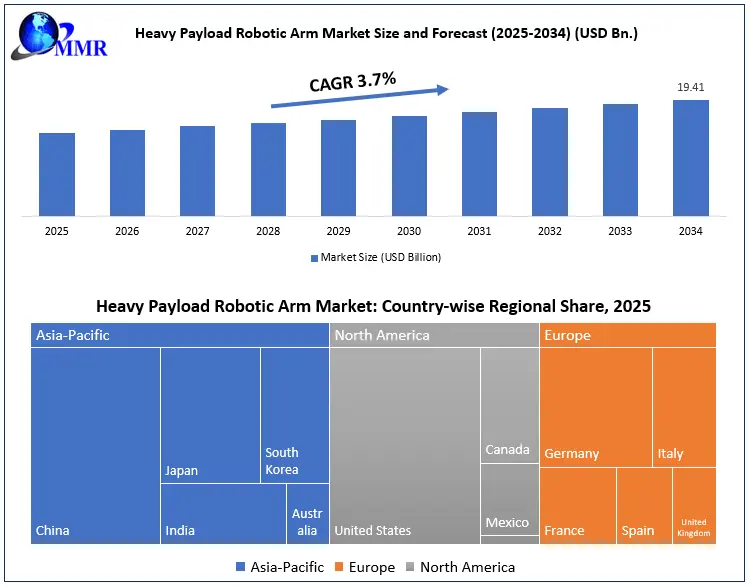
Heavy Payload Robotic Arm Market Growth

To know about the Research Methodology:-Request Free Sample Report

Why MMR?

The Maximize Market Research Heavy Payload Robotic Arm Market Report provides actionable market intelligence covering robot type, payload capacity, application, technology, end-user industry, and region, supported by market sizing, forecasting, competitive benchmarking, CR3, CR5, HHI, product portfolios, technology adoption, value-chain analysis, regional trends, partnerships, and strategic developments. The report evaluates the impact of AI, machine vision, digital twins, predictive maintenance, connected robotics, Industry 4.0, and industrial automation, helping stakeholders identify high-growth applications, emerging technologies, competitive opportunities, investment priorities, and market-entry potential.

Heavy Payload Robotic Arm Market Recent Developments and Outlook
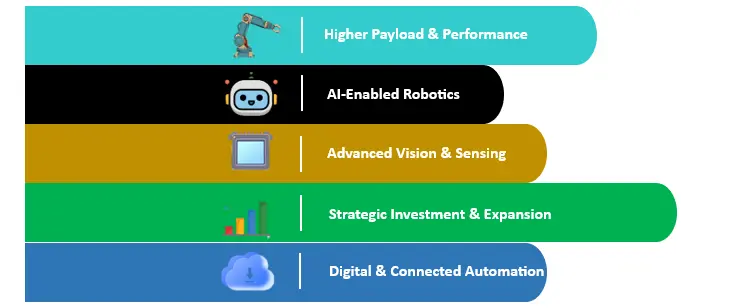
Heavy Payload Robotic Arm Recent Developments
1. Higher Payload & Performance
Recent development: Robot manufacturers are increasing payload capacity while improving reach, speed and precision. FANUC introduced an 800 kg palletizing robot in 2025, up from 700 kg in its previous generation.
Outlook: Higher-capacity robots are expected to gain adoption in automotive, metals, machinery, logistics and heavy manufacturing.

2. AI-Enabled Robotics
Recent development: AI, machine vision and intelligent software are increasingly being integrated into industrial robots to improve adaptability and decision-making.
Outlook: Heavy-payload robots are expected to become more adaptive, intelligent and less dependent on fixed programming, supporting complex material handling and manufacturing tasks.

3. Advanced Vision & Sensing
Recent development: Machine vision and advanced sensing are improving robots' ability to identify, locate and handle components accurately.
Outlook: Greater use of sensor fusion, vision and feedback systems will support precision handling, inspection, collision avoidance and adaptive operations.

4. Strategic Investment & Market Expansion
Recent development: Strategic investment is reshaping the robotics industry, including SoftBank's $5.375 billion acquisition of ABB's Robotics division announced in 2025. China accounted for 54% of global industrial robot installations in 2024.
Outlook: Increasing investment, AI integration and industry partnerships are expected to strengthen automation adoption and innovation, particularly across Asian manufacturing markets.

5. Digital & Connected Automation
Recent development: Industrial robots are increasingly connected with IoT, analytics, digital twins and predictive maintenance systems.
Outlook: Heavy-payload robotics will become more integrated with smart-factory infrastructure, enabling real-time monitoring, optimization and reduced downtime.

Heavy Payload Robotic Arm Market – Market Dynamics

Driver: Expanding industrial robot deployment is creating a larger base for high-payload automation

Manufacturers are increasingly automating material handling, welding, machine tending, palletizing, and heavy component positioning, supporting demand for robots with greater payload and reach. Global industrial robot installations reached 542,076 units in 2024, with Asia accounting for 74% of new deployments, indicating the scale of the manufacturing automation ecosystem into which heavy-payload systems are being integrated.

Restraint: High integration requirements can weaken the business case for heavy-payload automation

The investment required for a heavy payload robotic arm extends beyond the robot itself to controllers, end-effectors, safety equipment, programming, installation, and production-line integration. This can make automation less attractive for facilities with low production volumes or limited robot utilization, where the capital invested may take longer to recover. The need to match robot capacity with actual workload therefore remains an important purchasing consideration.

Opportunity: AI and advanced sensing can increase the value of heavy-payload robotic systems

Combining high-payload robots with machine vision, force/torque sensing, AI-based motion planning, digital twins, and predictive maintenance can enable more adaptive and data-driven operations. The opportunity is moving beyond simply lifting heavier loads toward improving precision, cycle time, flexibility, and autonomous decision-making. Current product development already demonstrates this direction, with ABB's large-robot portfolio offering payloads up to 800 kg, while its IRB 8700 can handle up to 1,000 kg with the wrist down.

Challenge: Increasing payload capacity without compromising speed and precision remains technically demanding

Higher payloads increase the mechanical forces and inertia that robotic joints, motors, gearboxes, and structural components must manage. Manufacturers therefore need to balance payload, reach, speed, repeatability, energy consumption, and reliability rather than maximizing payload alone. For example, ABB's IRB 8700 combines up to 800 kg payload with a 3.5 m reach, while newer large-robot platforms emphasize both payload capability and motion accuracy, illustrating the engineering trade-offs involved in heavy-payload automation.

Heavy Payload Robotic Arm Market - Key Trends
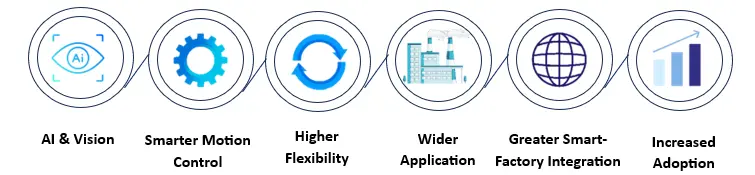
Heavy Payload Robotic Arm Market Key Trends
Heavy Payload Robotic Arm Market Segment Analysis

The Heavy Payload Robotic Arm Market is segmented by type, actuation type, control type, payload capacity, application, and end-user industry, enabling analysis of technology preferences, load-handling requirements, automation levels, operational use cases, and industry-specific demand. Articulated robots, electric actuation, automatic control, high-payload systems, material handling, welding, automotive, aerospace, metal fabrication, and general manufacturing represent key areas shaping market adoption, competitive positioning, and future growth.

1. By Type
Articulated robotic arms are expected to dominate the Heavy Payload Robotic Arm Market, accounting for an estimated 49.5% share in 2025. Their multi-axis configuration provides high flexibility, extended reach and precise positioning for handling heavy components. Strong adoption across automotive manufacturing, welding, material handling, machine tending and metal fabrication is expected to sustain their leading position. Cartesian robotic arms follow with an estimated 21.4% share, supported by their high accuracy and suitability for linear heavy-load movement and automated handling operations.

2. By Application
Material handling is expected to represent the largest application segment, accounting for approximately 25.0% of the market in 2025. Increasing automation of heavy-component transfer, loading, unloading and movement across production facilities is driving demand for high-payload robotic arms. Welding represents another major application at around 21.0%, supported by increasing automation in automotive, metal fabrication and heavy machinery manufacturing, where robotic systems improve consistency, productivity and workplace safety.
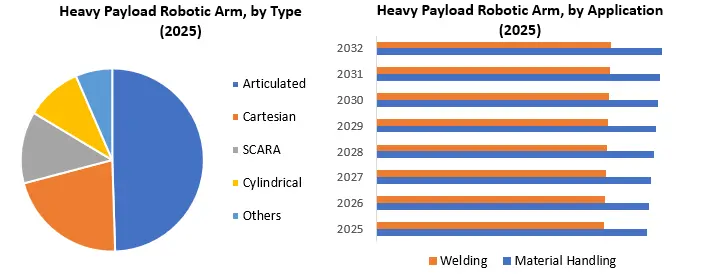
Heavy Payload Robotic Arm Market Segment Analysis

Heavy Payload Robotic Arm Market Regional Analysis

North America held a leading position in the Heavy Payload Robotic Arm Market in 2025, supported by high automation adoption across automotive, aerospace, metal fabrication, machinery and general manufacturing. The region benefits from established robotic integrators, advanced industrial automation infrastructure and increasing investment in smart manufacturing.

Asia-Pacific is expected to record the fastest growth, driven by large-scale manufacturing capacity, industrialization and rising automation investments across China, Japan, South Korea and India. Asia accounted for 74% of new industrial robot deployments globally in 2024, with China alone representing 54%, highlighting the region's strong automation ecosystem.

Europe remains an important market, particularly for automotive, machinery, metalworking and aerospace applications, with Germany, Italy, France and Spain serving as major automation hubs. Europe recorded approximately 85,000 industrial robot installations in 2024, demonstrating a substantial installed automation base despite an 8% annual decline.

South America is witnessing gradual adoption as automotive production, manufacturing modernization and nearshoring encourage investments in robotic automation, particularly in Brazil.

Middle East & Africa represent emerging opportunities, supported by industrial diversification, infrastructure development and increasing automation across manufacturing and logistics.

Region 2025 Position Growth Outlook Key Demand Drivers
North America Leading Moderate Automotive, aerospace, smart manufacturing
Asia-Pacific Major / High-growth Fastest Industrialization, automotive, electronics, manufacturing
Europe Major Moderate Automotive, machinery, Industry 4.0
Latin America Emerging High Nearshoring, automotive, manufacturing
Middle East & Africa Emerging High Industrial diversification, infrastructure, automation

Heavy Payload Robotic Arm Market Innovation Landscape

High Current Adoption → Established Innovations
Machine Vision & Sensor Fusion → IIoT & Connected Robotics → AI-Enabled Welding & Inspection

Moderate Current Adoption + High Potential → Emerging Innovations
AI-Based Motion Optimization → Digital Twin & Virtual Commissioning → Predictive Maintenance → Adaptive Force & Torque Control → Energy-Efficient Drives

Low Current Adoption + Very High Potential → Next-Generation Innovations
Autonomous Programming → Self-Learning Robotic Arms → AI-Driven Self-Correction → Real-Time Digital Twin-Based Control

Heavy Payload Robotic Arm Market Competitive Landscape

The Heavy Payload Robotic Arm Market is characterized by intense competition, technological innovation, product differentiation and strategic expansion among established industrial robotics manufacturers, with ABB, FANUC, KUKA, Yaskawa Electric, Kawasaki Heavy Industries, Nachi-Fujikoshi, Mitsubishi Electric, Comau, Stäubli and SIASUN representing key market participants. Companies are strengthening their competitive positioning through high-payload articulated robotic arms, multi-axis robotic systems, extended-reach robots, high-speed motion control, precision positioning, advanced servo motors, machine vision, AI-enabled robotics, adaptive control, force and torque sensing, digital twins, predictive maintenance, industrial IoT connectivity, robotic software, autonomous programming and smart-factory integration.

Competitive differentiation is increasingly shifting beyond payload capacity toward cycle-time optimization, energy efficiency, operational flexibility, repeatability, safety, automation scalability, real-time monitoring, intelligent motion planning and application-specific robotic solutions for automotive manufacturing, aerospace, metal fabrication, welding, machining, machine tending, material handling, assembly, palletizing, packaging and general manufacturing. Market participants are also pursuing new product launches, technology partnerships, strategic collaborations, geographic expansion, customized automation solutions and integrated robotics ecosystems, while regional and emerging robotics suppliers are increasing competitive pressure through cost-efficient systems, localized manufacturing, application customization and expanding service networks, particularly across the rapidly industrializing Asia-Pacific market.

The competitive environment is further influenced by investments in AI-driven automation, connected robotics, advanced vision systems and software-enabled control technologies. Companies are increasingly differentiating through faster deployment, lower lifecycle costs, higher productivity and application-specific robotic solutions to strengthen customer retention and expand their industrial footprint.

Heavy Payload Robotic Arm Market ROI Analysis

ROI Factor Impact on Investment Returns
Labor Cost Reduction Reduces dependence on manual labor for repetitive and heavy-load operations, improving operating margins.
Higher Productivity Faster cycle times and continuous operation increase production output and asset utilization.
Improved Product Quality Higher precision, repeatability and automated process control reduce defects, rework and material wastage.
Lower Downtime Predictive maintenance and real-time monitoring help minimize unplanned equipment stoppages.
Workplace Safety Automation of hazardous lifting, welding and material-handling tasks can reduce workplace incidents and associated costs.
Operational Flexibility Multi-axis robots and programmable systems can support multiple production processes, improving equipment utilization.
Maintenance & Integration Cost Initial installation, programming, system integration and maintenance requirements can extend the payback period.
Overall ROI Outlook Favorable, particularly for high-volume manufacturing operations with repetitive, labor-intensive and heavy-load processes.

Heavy Payload Robotic Arm Market Investors’ Takeaway

The Heavy Payload Robotic Arm Market presents attractive long-term investment potential as manufacturers accelerate industrial automation, labor optimization, smart-factory adoption and high-payload material handling. Investment opportunities are supported by increasing demand for AI-enabled robotics, machine vision, predictive maintenance, digital twins, connected automation and energy-efficient robotic systems, particularly across automotive, aerospace, metal fabrication and general manufacturing. Investors should focus on companies with strong technology portfolios, high-payload capabilities, recurring service revenue, advanced robotics software, global distribution networks and strategic partnerships, while monitoring capital intensity, integration costs, competitive pricing and manufacturing cyclicality as key investment risks.

Heavy Payload Robotic Arm Market Scope: Inquire before buying

Heavy Payload Robotic Arm Market
Report Coverage Details
Base Year: 2025 Forecast Period: 2026-2032
Historical Data: 2020 to 2025 Market Size in 2025: USD 14 Bn.
Forecast Period 2026 to 2032 CAGR: 3.7% Market Size in 2032: USD 19.41 Bn.
Segments Covered: by Type Articulated
Cartesian
SCARA
Cylindrical
Others
by Actuation Type Electric
Hydraulic
Pneumatic
by Control Type Automatic
Manual
Semi Automatic
by Payload Capacity 500-700 Kg
701-1000 Kg
1001-3000 Kg
3001 Kg & Above
by Application Assembly
Machine Tending
Painting
Welding
Material Handling
 Packaging
 Palletizing
 Sorting
Others
by End User Industry Aerospace
Automotive
Electronics
General Manufacturing
Food And Beverage
Metal Fabrication
Medical
Others

Heavy Payload Robotic Arm Market, by Region

North America (United States, Canada and Mexico)
Europe (UK, France, Germany, Italy, Spain, Sweden, Austria, Turkey, Russia and Rest of Europe)
Asia Pacific (China, India, Japan, South Korea, Australia, ASEAN and Rest of APAC)
Middle East and Africa (South Africa, GCC, Egypt, Nigeria and Rest of ME&A)
South America (Brazil, Argentina, Columbia and Rest of South America)

Key Players / Competitors Profiles Covered in Brief in Global Heavy Payload Robotic Arm Market Report in Strategic Perspective:

1. ABB Ltd.
2. Apex Automation & Robotics Pty Ltd.
3. Ellison Technologies Inc.
4. Fanuc Corporation
5. Comau S.p.A.
6. Kawasaki Heavy Industries Limited
7. Kuka Robotics
8. Nachi-Fujikoshi Corporation
9. Yaskawa Electric Corporation
10. Mitsubishi Electric Corporation
11. Stäubli International AG
12. Denso Corporation
13. Universal Robots A/S
14. Seiko Epson Corporation
15. Omron Corporation
16. Panasonic Corporation
17. Hyundai Robotics
18. Siasun Robot & Automation Co. Ltd.
19. Estun Automation Co. Ltd.
20. Doosan Robotics
21. Techman Robot Inc.
22. OTC DAIHEN Inc.
23. Efort Intelligent Equipment Co. Ltd.
24. Yamaha Motor Co. Ltd.
25. Kassow Robots

Frequently Asked Questions

1. What is the projected size of the Heavy Payload Robotic Arm Market by 2034?
The market is projected to reach approximately USD 19.41 Billion by 2034, from USD 14.0 Billion in 2025, at a CAGR of 3.7% during 2026–2034.

2. Which robotic arm type is expected to dominate the market?
Articulated robotic arms are expected to remain the leading type due to their multi-axis flexibility, extended reach, high payload capability and broad industrial applicability.

3. Which application represents a major demand area?
Material handling represents a major application area, supported by increasing automation of heavy-component loading, unloading, transfer, sorting and movement operations.

4. Which industries are driving demand for heavy payload robotic arms?
Automotive, aerospace, metal fabrication, general manufacturing, machinery and electronics are key end-use industries adopting heavy-payload robotic systems to improve productivity, precision and workplace safety.

5. What are the major trends shaping the market?
Key trends include AI-enabled robotics, machine vision, adaptive motion control, predictive maintenance, digital twins, IIoT connectivity, autonomous programming, energy-efficient drives and smart-factory integration.

Table of Contents

1. Heavy Payload Robotic Arm Market Introduction 1.1. Study Assumption and Market Definition 1.2. Scope of the Study 1.3. Executive Summary 2. Global Heavy Payload Robotic Arm Market: Competitive Landscape 2.1. MMR Competition Matrix 2.2. Competitive Landscape 2.3. Key Players Benchmarking 2.3.1. Company Name 2.3.2. Business Segment 2.3.3. End-user Segment 2.3.4. Revenue (2025) 2.3.5. Company Locations 2.4. Leading Heavy Payload Robotic Arm Market Companies, by market capitalization 2.5. Market Structure 2.5.1. Market Leaders 2.5.2. Market Followers 2.5.3. Emerging Players 2.6. Mergers and Acquisitions Details 3. Heavy Payload Robotic Arm Market: Dynamics 3.1. Heavy Payload Robotic Arm Market Trends by Region 3.1.1. North America Heavy Payload Robotic Arm Market Trends 3.1.2. Europe Heavy Payload Robotic Arm Market Trends 3.1.3. Asia Pacific Heavy Payload Robotic Arm Market Trends 3.1.4. Middle East and Africa Heavy Payload Robotic Arm Market Trends 3.1.5. South America Heavy Payload Robotic Arm Market Trends 3.2. Heavy Payload Robotic Arm Market Dynamics by Region 3.2.1. North America 3.2.1.1. North America Heavy Payload Robotic Arm Market Drivers 3.2.1.2. North America Heavy Payload Robotic Arm Market Restraints 3.2.1.3. North America Heavy Payload Robotic Arm Market Opportunities 3.2.1.4. North America Heavy Payload Robotic Arm Market Challenges 3.2.2. Europe 3.2.2.1. Europe Heavy Payload Robotic Arm Market Drivers 3.2.2.2. Europe Heavy Payload Robotic Arm Market Restraints 3.2.2.3. Europe Heavy Payload Robotic Arm Market Opportunities 3.2.2.4. Europe Heavy Payload Robotic Arm Market Challenges 3.2.3. Asia Pacific 3.2.3.1. Asia Pacific Heavy Payload Robotic Arm Market Drivers 3.2.3.2. Asia Pacific Heavy Payload Robotic Arm Market Restraints 3.2.3.3. Asia Pacific Heavy Payload Robotic Arm Market Opportunities 3.2.3.4. Asia Pacific Heavy Payload Robotic Arm Market Challenges 3.2.4. Middle East and Africa 3.2.4.1. Middle East and Africa Heavy Payload Robotic Arm Market Drivers 3.2.4.2. Middle East and Africa Heavy Payload Robotic Arm Market Restraints 3.2.4.3. Middle East and Africa Heavy Payload Robotic Arm Market Opportunities 3.2.4.4. Middle East and Africa Heavy Payload Robotic Arm Market Challenges 3.2.5. South America 3.2.5.1. South America Heavy Payload Robotic Arm Market Drivers 3.2.5.2. South America Heavy Payload Robotic Arm Market Restraints 3.2.5.3. South America Heavy Payload Robotic Arm Market Opportunities 3.2.5.4. South America Heavy Payload Robotic Arm Market Challenges 3.3. PORTER's Five Forces Analysis 3.4. PESTLE Analysis 3.5. Technology Roadmap 3.6. Regulatory Landscape by Region 3.6.1. North America 3.6.2. Europe 3.6.3. Asia Pacific 3.6.4. Middle East and Africa 3.6.5. South America 3.7. Key Opinion Leader Analysis For Heavy Payload Robotic Arm Industry 3.8. Analysis of Government Schemes and Initiatives For Heavy Payload Robotic Arm Industry 3.9. Heavy Payload Robotic Arm Market Trade Analysis 3.10. The Global Pandemic Impact on Heavy Payload Robotic Arm Market 4. Heavy Payload Robotic Arm Market: Global Market Size and Forecast by Segmentation (in USD Billion) 2025-2034 4.1. Heavy Payload Robotic Arm Market Size and Forecast, by Type (2025-2034) 4.1.1. Articulated 4.1.2. Cartesian 4.1.3. SCARA 4.1.4. Cylindrical 4.1.5. Others 4.2. Heavy Payload Robotic Arm Market Size and Forecast, by Actuation Type (2025-2034) 4.2.1. Electric 4.2.2. Hydraulic 4.2.3. Pneumatic 4.3. Heavy Payload Robotic Arm Market Size and Forecast, by Control Type (2025-2034) 4.3.1. Automatic 4.3.2. Manual 4.3.3. Semi Automatic 4.4. Heavy Payload Robotic Arm Market Size and Forecast, by Payload Capacity (2025-2034) 4.4.1. 500-700 Kg 4.4.2. 701-1000 Kg 4.4.3. 1001-3000 Kg 4.4.4. 3001 Kg & Above 4.5. Heavy Payload Robotic Arm Market Size and Forecast, by Application (2025-2034) 4.5.1. Assembly 4.5.2. Machine Tending 4.5.3. Painting 4.5.4. Welding 4.5.5. Material Handling 4.5.6. Others 4.6. Heavy Payload Robotic Arm Market Size and Forecast, by End User Industry (2025-2034) 4.6.1. Aerospace 4.6.2. Automotive 4.6.3. Electronics 4.6.4. General Manufacturing 4.6.5. Food And Beverage 4.6.6. Metal Fabrication 4.6.7. Medical 4.6.8. Others 4.7. Heavy Payload Robotic Arm Market Size and Forecast, by Region (2025-2034) 4.7.1. North America 4.7.2. Europe 4.7.3. Asia Pacific 4.7.4. Middle East and Africa 4.7.5. South America 5. North America Heavy Payload Robotic Arm Market Size and Forecast by Segmentation (in USD Billion) 2025-2034 5.1. North America Heavy Payload Robotic Arm Market Size and Forecast, by Type (2025-2034) 5.1.1. Articulated 5.1.2. Cartesian 5.1.3. SCARA 5.1.4. Cylindrical 5.1.5. Others 5.2. North America Heavy Payload Robotic Arm Market Size and Forecast, by Actuation Type (2025-2034) 5.2.1. Electric 5.2.2. Hydraulic 5.2.3. Pneumatic 5.3. North America Heavy Payload Robotic Arm Market Size and Forecast, by Control Type (2025-2034) 5.3.1. Automatic 5.3.2. Manual 5.3.3. Semi Automatic 5.4. North America Heavy Payload Robotic Arm Market Size and Forecast, by Payload Capacity (2025-2034) 5.4.1. 500-700 Kg 5.4.2. 701-1000 Kg 5.4.3. 1001-3000 Kg 5.4.4. 3001 Kg & Above 5.5. North America Heavy Payload Robotic Arm Market Size and Forecast, by Application (2025-2034) 5.5.1. Assembly 5.5.2. Machine Tending 5.5.3. Painting 5.5.4. Welding 5.5.5. Material Handling 5.5.6. Others 5.6. North America Heavy Payload Robotic Arm Market Size and Forecast, by End User Industry (2025-2034) 5.6.1. Aerospace 5.6.2. Automotive 5.6.3. Electronics 5.6.4. General Manufacturing 5.6.5. Food And Beverage 5.6.6. Metal Fabrication 5.6.7. Medical 5.6.8. Others 5.7. North America Heavy Payload Robotic Arm Market Size and Forecast, by Country (2025-2034) 5.7.1. United States 5.7.1.1. United States Heavy Payload Robotic Arm Market Size and Forecast, by Type (2025-2034) 5.7.1.1.1. Articulated 5.7.1.1.2. Cartesian 5.7.1.1.3. SCARA 5.7.1.1.4. Cylindrical 5.7.1.1.5. Others 5.7.1.2. United States Heavy Payload Robotic Arm Market Size and Forecast, by Actuation Type (2025-2034) 5.7.1.2.1. Electric 5.7.1.2.2. Hydraulic 5.7.1.2.3. Pneumatic 5.7.1.3. United States Heavy Payload Robotic Arm Market Size and Forecast, by Control Type (2025-2034) 5.7.1.3.1. Automatic 5.7.1.3.2. Manual 5.7.1.3.3. Semi Automatic 5.7.1.4. United States Heavy Payload Robotic Arm Market Size and Forecast, by Payload Capacity (2025-2034) 5.7.1.4.1. 500-700 Kg 5.7.1.4.2. 701-1000 Kg 5.7.1.4.3. 1001-3000 Kg 5.7.1.4.4. 3001 Kg & Above 5.7.1.5. United States Heavy Payload Robotic Arm Market Size and Forecast, by Application (2025-2034) 5.7.1.5.1. Assembly 5.7.1.5.2. Machine Tending 5.7.1.5.3. Painting 5.7.1.5.4. Welding 5.7.1.5.5. Material Handling 5.7.1.5.6. Others 5.7.1.6. United States Heavy Payload Robotic Arm Market Size and Forecast, by End User Industry (2025-2034) 5.7.1.6.1. Aerospace 5.7.1.6.2. Automotive 5.7.1.6.3. Electronics 5.7.1.6.4. General Manufacturing 5.7.1.6.5. Food And Beverage 5.7.1.6.6. Metal Fabrication 5.7.1.6.7. Medical 5.7.1.6.8. Others 5.7.2. Canada 5.7.2.1. Canada Heavy Payload Robotic Arm Market Size and Forecast, by Type (2025-2034) 5.7.2.1.1. Articulated 5.7.2.1.2. Cartesian 5.7.2.1.3. SCARA 5.7.2.1.4. Cylindrical 5.7.2.1.5. Others 5.7.2.2. Canada Heavy Payload Robotic Arm Market Size and Forecast, by Actuation Type (2025-2034) 5.7.2.2.1. Electric 5.7.2.2.2. Hydraulic 5.7.2.2.3. Pneumatic 5.7.2.3. Canada Heavy Payload Robotic Arm Market Size and Forecast, by Control Type (2025-2034) 5.7.2.3.1. Automatic 5.7.2.3.2. Manual 5.7.2.3.3. Semi Automatic 5.7.2.4. Canada Heavy Payload Robotic Arm Market Size and Forecast, by Payload Capacity (2025-2034) 5.7.2.4.1. 500-700 Kg 5.7.2.4.2. 701-1000 Kg 5.7.2.4.3. 1001-3000 Kg 5.7.2.4.4. 3001 Kg & Above 5.7.2.5. Canada Heavy Payload Robotic Arm Market Size and Forecast, by Application (2025-2034) 5.7.2.5.1. Assembly 5.7.2.5.2. Machine Tending 5.7.2.5.3. Painting 5.7.2.5.4. Welding 5.7.2.5.5. Material Handling 5.7.2.5.6. Others 5.7.2.6. Canada Heavy Payload Robotic Arm Market Size and Forecast, by End User Industry (2025-2034) 5.7.2.6.1. Aerospace 5.7.2.6.2. Automotive 5.7.2.6.3. Electronics 5.7.2.6.4. General Manufacturing 5.7.2.6.5. Food And Beverage 5.7.2.6.6. Metal Fabrication 5.7.2.6.7. Medical 5.7.2.6.8. Others 5.7.3. Mexico 5.7.3.1. Mexico Heavy Payload Robotic Arm Market Size and Forecast, by Type (2025-2034) 5.7.3.1.1. Articulated 5.7.3.1.2. Cartesian 5.7.3.1.3. SCARA 5.7.3.1.4. Cylindrical 5.7.3.1.5. Others 5.7.3.2. Mexico Heavy Payload Robotic Arm Market Size and Forecast, by Actuation Type (2025-2034) 5.7.3.2.1. Electric 5.7.3.2.2. Hydraulic 5.7.3.2.3. Pneumatic 5.7.3.3. Mexico Heavy Payload Robotic Arm Market Size and Forecast, by Control Type (2025-2034) 5.7.3.3.1. Automatic 5.7.3.3.2. Manual 5.7.3.3.3. Semi Automatic 5.7.3.4. Mexico Heavy Payload Robotic Arm Market Size and Forecast, by Payload Capacity (2025-2034) 5.7.3.4.1. 500-700 Kg 5.7.3.4.2. 701-1000 Kg 5.7.3.4.3. 1001-3000 Kg 5.7.3.4.4. 3001 Kg & Above 5.7.3.5. Mexico Heavy Payload Robotic Arm Market Size and Forecast, by Application (2025-2034) 5.7.3.5.1. Assembly 5.7.3.5.2. Machine Tending 5.7.3.5.3. Painting 5.7.3.5.4. Welding 5.7.3.5.5. Material Handling 5.7.3.5.6. Others 5.7.3.6. Mexico Heavy Payload Robotic Arm Market Size and Forecast, by End User Industry (2025-2034) 5.7.3.6.1. Aerospace 5.7.3.6.2. Automotive 5.7.3.6.3. Electronics 5.7.3.6.4. General Manufacturing 5.7.3.6.5. Food And Beverage 5.7.3.6.6. Metal Fabrication 5.7.3.6.7. Medical 5.7.3.6.8. Others 6. Europe Heavy Payload Robotic Arm Market Size and Forecast by Segmentation (in USD Billion) 2025-2034 6.1. Europe Heavy Payload Robotic Arm Market Size and Forecast, by Type (2025-2034) 6.2. Europe Heavy Payload Robotic Arm Market Size and Forecast, by Actuation Type (2025-2034) 6.3. Europe Heavy Payload Robotic Arm Market Size and Forecast, by Control Type (2025-2034) 6.4. Europe Heavy Payload Robotic Arm Market Size and Forecast, by Payload Capacity (2025-2034) 6.5. Europe Heavy Payload Robotic Arm Market Size and Forecast, by Application (2025-2034) 6.6. Europe Heavy Payload Robotic Arm Market Size and Forecast, by End User Industry (2025-2034) 6.7. Europe Heavy Payload Robotic Arm Market Size and Forecast, by Country (2025-2034) 6.7.1. United Kingdom 6.7.1.1. United Kingdom Heavy Payload Robotic Arm Market Size and Forecast, by Type (2025-2034) 6.7.1.2. United Kingdom Heavy Payload Robotic Arm Market Size and Forecast, by Actuation Type (2025-2034) 6.7.1.3. United Kingdom Heavy Payload Robotic Arm Market Size and Forecast, by Control Type (2025-2034) 6.7.1.4. United Kingdom Heavy Payload Robotic Arm Market Size and Forecast, by Payload Capacity (2025-2034) 6.7.1.5. United Kingdom Heavy Payload Robotic Arm Market Size and Forecast, by Application (2025-2034) 6.7.1.6. United Kingdom Heavy Payload Robotic Arm Market Size and Forecast, by End User Industry (2025-2034) 6.7.2. France 6.7.2.1. France Heavy Payload Robotic Arm Market Size and Forecast, by Type (2025-2034) 6.7.2.2. France Heavy Payload Robotic Arm Market Size and Forecast, by Actuation Type (2025-2034) 6.7.2.3. France Heavy Payload Robotic Arm Market Size and Forecast, by Control Type (2025-2034) 6.7.2.4. France Heavy Payload Robotic Arm Market Size and Forecast, by Payload Capacity (2025-2034) 6.7.2.5. France Heavy Payload Robotic Arm Market Size and Forecast, by Application (2025-2034) 6.7.2.6. France Heavy Payload Robotic Arm Market Size and Forecast, by End User Industry (2025-2034) 6.7.3. Germany 6.7.3.1. Germany Heavy Payload Robotic Arm Market Size and Forecast, by Type (2025-2034) 6.7.3.2. Germany Heavy Payload Robotic Arm Market Size and Forecast, by Actuation Type (2025-2034) 6.7.3.3. Germany Heavy Payload Robotic Arm Market Size and Forecast, by Control Type (2025-2034) 6.7.3.4. Germany Heavy Payload Robotic Arm Market Size and Forecast, by Payload Capacity (2025-2034) 6.7.3.5. Germany Heavy Payload Robotic Arm Market Size and Forecast, by Application (2025-2034) 6.7.3.6. Germany Heavy Payload Robotic Arm Market Size and Forecast, by End User Industry (2025-2034) 6.7.4. Italy 6.7.4.1. Italy Heavy Payload Robotic Arm Market Size and Forecast, by Type (2025-2034) 6.7.4.2. Italy Heavy Payload Robotic Arm Market Size and Forecast, by Actuation Type (2025-2034) 6.7.4.3. Italy Heavy Payload Robotic Arm Market Size and Forecast, by Control Type (2025-2034) 6.7.4.4. Italy Heavy Payload Robotic Arm Market Size and Forecast, by Payload Capacity (2025-2034) 6.7.4.5. Italy Heavy Payload Robotic Arm Market Size and Forecast, by Application (2025-2034) 6.7.4.6. Italy Heavy Payload Robotic Arm Market Size and Forecast, by End User Industry (2025-2034) 6.7.5. Spain 6.7.5.1. Spain Heavy Payload Robotic Arm Market Size and Forecast, by Type (2025-2034) 6.7.5.2. Spain Heavy Payload Robotic Arm Market Size and Forecast, by Actuation Type (2025-2034) 6.7.5.3. Spain Heavy Payload Robotic Arm Market Size and Forecast, by Control Type (2025-2034) 6.7.5.4. Spain Heavy Payload Robotic Arm Market Size and Forecast, by Payload Capacity (2025-2034) 6.7.5.5. Spain Heavy Payload Robotic Arm Market Size and Forecast, by Application (2025-2034) 6.7.5.6. Spain Heavy Payload Robotic Arm Market Size and Forecast, by End User Industry (2025-2034) 6.7.6. Sweden 6.7.6.1. Sweden Heavy Payload Robotic Arm Market Size and Forecast, by Type (2025-2034) 6.7.6.2. Sweden Heavy Payload Robotic Arm Market Size and Forecast, by Actuation Type (2025-2034) 6.7.6.3. Sweden Heavy Payload Robotic Arm Market Size and Forecast, by Control Type (2025-2034) 6.7.6.4. Sweden Heavy Payload Robotic Arm Market Size and Forecast, by Payload Capacity (2025-2034) 6.7.6.5. Sweden Heavy Payload Robotic Arm Market Size and Forecast, by Application (2025-2034) 6.7.6.6. Sweden Heavy Payload Robotic Arm Market Size and Forecast, by End User Industry (2025-2034) 6.7.7. Austria 6.7.7.1. Austria Heavy Payload Robotic Arm Market Size and Forecast, by Type (2025-2034) 6.7.7.2. Austria Heavy Payload Robotic Arm Market Size and Forecast, by Actuation Type (2025-2034) 6.7.7.3. Austria Heavy Payload Robotic Arm Market Size and Forecast, by Control Type (2025-2034) 6.7.7.4. Austria Heavy Payload Robotic Arm Market Size and Forecast, by Payload Capacity (2025-2034) 6.7.7.5. Austria Heavy Payload Robotic Arm Market Size and Forecast, by Application (2025-2034) 6.7.7.6. Austria Heavy Payload Robotic Arm Market Size and Forecast, by End User Industry (2025-2034) 6.7.8. Rest of Europe 6.7.8.1. Rest of Europe Heavy Payload Robotic Arm Market Size and Forecast, by Type (2025-2034) 6.7.8.2. Rest of Europe Heavy Payload Robotic Arm Market Size and Forecast, by Actuation Type (2025-2034) 6.7.8.3. Rest of Europe Heavy Payload Robotic Arm Market Size and Forecast, by Control Type (2025-2034) 6.7.8.4. Rest of Europe Heavy Payload Robotic Arm Market Size and Forecast, by Payload Capacity (2025-2034) 6.7.8.5. Rest of Europe Heavy Payload Robotic Arm Market Size and Forecast, by Application (2025-2034) 6.7.8.6. Rest of Europe Heavy Payload Robotic Arm Market Size and Forecast, by End User Industry (2025-2034) 7. Asia Pacific Heavy Payload Robotic Arm Market Size and Forecast by Segmentation (in USD Billion) 2025-2034 7.1. Asia Pacific Heavy Payload Robotic Arm Market Size and Forecast, by Type (2025-2034) 7.2. Asia Pacific Heavy Payload Robotic Arm Market Size and Forecast, by Actuation Type (2025-2034) 7.3. Asia Pacific Heavy Payload Robotic Arm Market Size and Forecast, by Control Type (2025-2034) 7.4. Asia Pacific Heavy Payload Robotic Arm Market Size and Forecast, by Payload Capacity (2025-2034) 7.5. Asia Pacific Heavy Payload Robotic Arm Market Size and Forecast, by Application (2025-2034) 7.6. Asia Pacific Heavy Payload Robotic Arm Market Size and Forecast, by End User Industry (2025-2034) 7.7. Asia Pacific Heavy Payload Robotic Arm Market Size and Forecast, by Country (2025-2034) 7.7.1. China 7.7.1.1. China Heavy Payload Robotic Arm Market Size and Forecast, by Type (2025-2034) 7.7.1.2. China Heavy Payload Robotic Arm Market Size and Forecast, by Actuation Type (2025-2034) 7.7.1.3. China Heavy Payload Robotic Arm Market Size and Forecast, by Control Type (2025-2034) 7.7.1.4. China Heavy Payload Robotic Arm Market Size and Forecast, by Payload Capacity (2025-2034) 7.7.1.5. China Heavy Payload Robotic Arm Market Size and Forecast, by Application (2025-2034) 7.7.1.6. China Heavy Payload Robotic Arm Market Size and Forecast, by End User Industry (2025-2034) 7.7.2. S Korea 7.7.2.1. S Korea Heavy Payload Robotic Arm Market Size and Forecast, by Type (2025-2034) 7.7.2.2. S Korea Heavy Payload Robotic Arm Market Size and Forecast, by Actuation Type (2025-2034) 7.7.2.3. S Korea Heavy Payload Robotic Arm Market Size and Forecast, by Control Type (2025-2034) 7.7.2.4. S Korea Heavy Payload Robotic Arm Market Size and Forecast, by Payload Capacity (2025-2034) 7.7.2.5. S Korea Heavy Payload Robotic Arm Market Size and Forecast, by Application (2025-2034) 7.7.2.6. S Korea Heavy Payload Robotic Arm Market Size and Forecast, by End User Industry (2025-2034) 7.7.3. Japan 7.7.3.1. Japan Heavy Payload Robotic Arm Market Size and Forecast, by Type (2025-2034) 7.7.3.2. Japan Heavy Payload Robotic Arm Market Size and Forecast, by Actuation Type (2025-2034) 7.7.3.3. Japan Heavy Payload Robotic Arm Market Size and Forecast, by Control Type (2025-2034) 7.7.3.4. Japan Heavy Payload Robotic Arm Market Size and Forecast, by Payload Capacity (2025-2034) 7.7.3.5. Japan Heavy Payload Robotic Arm Market Size and Forecast, by Application (2025-2034) 7.7.3.6. Japan Heavy Payload Robotic Arm Market Size and Forecast, by End User Industry (2025-2034) 7.7.4. India 7.7.4.1. India Heavy Payload Robotic Arm Market Size and Forecast, by Type (2025-2034) 7.7.4.2. India Heavy Payload Robotic Arm Market Size and Forecast, by Actuation Type (2025-2034) 7.7.4.3. India Heavy Payload Robotic Arm Market Size and Forecast, by Control Type (2025-2034) 7.7.4.4. India Heavy Payload Robotic Arm Market Size and Forecast, by Payload Capacity (2025-2034) 7.7.4.5. India Heavy Payload Robotic Arm Market Size and Forecast, by Application (2025-2034) 7.7.4.6. India Heavy Payload Robotic Arm Market Size and Forecast, by End User Industry (2025-2034) 7.7.5. Australia 7.7.5.1. Australia Heavy Payload Robotic Arm Market Size and Forecast, by Type (2025-2034) 7.7.5.2. Australia Heavy Payload Robotic Arm Market Size and Forecast, by Actuation Type (2025-2034) 7.7.5.3. Australia Heavy Payload Robotic Arm Market Size and Forecast, by Control Type (2025-2034) 7.7.5.4. Australia Heavy Payload Robotic Arm Market Size and Forecast, by Payload Capacity (2025-2034) 7.7.5.5. Australia Heavy Payload Robotic Arm Market Size and Forecast, by Application (2025-2034) 7.7.5.6. Australia Heavy Payload Robotic Arm Market Size and Forecast, by End User Industry (2025-2034) 7.7.6. Indonesia 7.7.6.1. Indonesia Heavy Payload Robotic Arm Market Size and Forecast, by Type (2025-2034) 7.7.6.2. Indonesia Heavy Payload Robotic Arm Market Size and Forecast, by Actuation Type (2025-2034) 7.7.6.3. Indonesia Heavy Payload Robotic Arm Market Size and Forecast, by Control Type (2025-2034) 7.7.6.4. Indonesia Heavy Payload Robotic Arm Market Size and Forecast, by Payload Capacity (2025-2034) 7.7.6.5. Indonesia Heavy Payload Robotic Arm Market Size and Forecast, by Application (2025-2034) 7.7.6.6. Indonesia Heavy Payload Robotic Arm Market Size and Forecast, by End User Industry (2025-2034) 7.7.7. Malaysia 7.7.7.1. Malaysia Heavy Payload Robotic Arm Market Size and Forecast, by Type (2025-2034) 7.7.7.2. Malaysia Heavy Payload Robotic Arm Market Size and Forecast, by Actuation Type (2025-2034) 7.7.7.3. Malaysia Heavy Payload Robotic Arm Market Size and Forecast, by Control Type (2025-2034) 7.7.7.4. Malaysia Heavy Payload Robotic Arm Market Size and Forecast, by Payload Capacity (2025-2034) 7.7.7.5. Malaysia Heavy Payload Robotic Arm Market Size and Forecast, by Application (2025-2034) 7.7.7.6. Malaysia Heavy Payload Robotic Arm Market Size and Forecast, by End User Industry (2025-2034) 7.7.8. Vietnam 7.7.8.1. Vietnam Heavy Payload Robotic Arm Market Size and Forecast, by Type (2025-2034) 7.7.8.2. Vietnam Heavy Payload Robotic Arm Market Size and Forecast, by Actuation Type (2025-2034) 7.7.8.3. Vietnam Heavy Payload Robotic Arm Market Size and Forecast, by Control Type (2025-2034) 7.7.8.4. Vietnam Heavy Payload Robotic Arm Market Size and Forecast, by Payload Capacity (2025-2034) 7.7.8.5. Vietnam Heavy Payload Robotic Arm Market Size and Forecast, by Application (2025-2034) 7.7.8.6. Vietnam Heavy Payload Robotic Arm Market Size and Forecast, by End User Industry (2025-2034) 7.7.9. Taiwan 7.7.9.1. Taiwan Heavy Payload Robotic Arm Market Size and Forecast, by Type (2025-2034) 7.7.9.2. Taiwan Heavy Payload Robotic Arm Market Size and Forecast, by Actuation Type (2025-2034) 7.7.9.3. Taiwan Heavy Payload Robotic Arm Market Size and Forecast, by Control Type (2025-2034) 7.7.9.4. Taiwan Heavy Payload Robotic Arm Market Size and Forecast, by Payload Capacity (2025-2034) 7.7.9.5. Taiwan Heavy Payload Robotic Arm Market Size and Forecast, by Application (2025-2034) 7.7.9.6. Taiwan Heavy Payload Robotic Arm Market Size and Forecast, by End User Industry (2025-2034) 7.7.10. Rest of Asia Pacific 7.7.10.1. Rest of Asia Pacific Heavy Payload Robotic Arm Market Size and Forecast, by Type (2025-2034) 7.7.10.2. Rest of Asia Pacific Heavy Payload Robotic Arm Market Size and Forecast, by Actuation Type (2025-2034) 7.7.10.3. Rest of Asia Pacific Heavy Payload Robotic Arm Market Size and Forecast, by Control Type (2025-2034) 7.7.10.4. Rest of Asia Pacific Heavy Payload Robotic Arm Market Size and Forecast, by Payload Capacity (2025-2034) 7.7.10.5. Rest of Asia Pacific Heavy Payload Robotic Arm Market Size and Forecast, by Application (2025-2034) 7.7.10.6. Rest of Asia Pacific Heavy Payload Robotic Arm Market Size and Forecast, by End User Industry (2025-2034) 8. Middle East and Africa Heavy Payload Robotic Arm Market Size and Forecast by Segmentation (in USD Billion) 2025-2034 8.1. Middle East and Africa Heavy Payload Robotic Arm Market Size and Forecast, by Type (2025-2034) 8.2. Middle East and Africa Heavy Payload Robotic Arm Market Size and Forecast, by Actuation Type (2025-2034) 8.3. Middle East and Africa Heavy Payload Robotic Arm Market Size and Forecast, by Control Type (2025-2034) 8.4. Middle East and Africa Heavy Payload Robotic Arm Market Size and Forecast, by Payload Capacity (2025-2034) 8.5. Middle East and Africa Heavy Payload Robotic Arm Market Size and Forecast, by Application (2025-2034) 8.6. Middle East and Africa Heavy Payload Robotic Arm Market Size and Forecast, by End User Industry (2025-2034) 8.7. Middle East and Africa Heavy Payload Robotic Arm Market Size and Forecast, by Country (2025-2034) 8.7.1. South Africa 8.7.1.1. South Africa Heavy Payload Robotic Arm Market Size and Forecast, by Type (2025-2034) 8.7.1.2. South Africa Heavy Payload Robotic Arm Market Size and Forecast, by Actuation Type (2025-2034) 8.7.1.3. South Africa Heavy Payload Robotic Arm Market Size and Forecast, by Control Type (2025-2034) 8.7.1.4. South Africa Heavy Payload Robotic Arm Market Size and Forecast, by Payload Capacity (2025-2034) 8.7.1.5. South Africa Heavy Payload Robotic Arm Market Size and Forecast, by Application (2025-2034) 8.7.1.6. South Africa Heavy Payload Robotic Arm Market Size and Forecast, by End User Industry (2025-2034) 8.7.2. GCC 8.7.2.1. GCC Heavy Payload Robotic Arm Market Size and Forecast, by Type (2025-2034) 8.7.2.2. GCC Heavy Payload Robotic Arm Market Size and Forecast, by Actuation Type (2025-2034) 8.7.2.3. GCC Heavy Payload Robotic Arm Market Size and Forecast, by Control Type (2025-2034) 8.7.2.4. GCC Heavy Payload Robotic Arm Market Size and Forecast, by Payload Capacity (2025-2034) 8.7.2.5. GCC Heavy Payload Robotic Arm Market Size and Forecast, by Application (2025-2034) 8.7.2.6. GCC Heavy Payload Robotic Arm Market Size and Forecast, by End User Industry (2025-2034) 8.7.3. Nigeria 8.7.3.1. Nigeria Heavy Payload Robotic Arm Market Size and Forecast, by Type (2025-2034) 8.7.3.2. Nigeria Heavy Payload Robotic Arm Market Size and Forecast, by Actuation Type (2025-2034) 8.7.3.3. Nigeria Heavy Payload Robotic Arm Market Size and Forecast, by Control Type (2025-2034) 8.7.3.4. Nigeria Heavy Payload Robotic Arm Market Size and Forecast, by Payload Capacity (2025-2034) 8.7.3.5. Nigeria Heavy Payload Robotic Arm Market Size and Forecast, by Application (2025-2034) 8.7.3.6. Nigeria Heavy Payload Robotic Arm Market Size and Forecast, by End User Industry (2025-2034) 8.7.4. Rest of ME&A 8.7.4.1. Rest of ME&A Heavy Payload Robotic Arm Market Size and Forecast, by Type (2025-2034) 8.7.4.2. Rest of ME&A Heavy Payload Robotic Arm Market Size and Forecast, by Actuation Type (2025-2034) 8.7.4.3. Rest of ME&A Heavy Payload Robotic Arm Market Size and Forecast, by Control Type (2025-2034) 8.7.4.4. Rest of ME&A Heavy Payload Robotic Arm Market Size and Forecast, by Payload Capacity (2025-2034) 8.7.4.5. Rest of ME&A Heavy Payload Robotic Arm Market Size and Forecast, by Application (2025-2034) 8.7.4.6. Rest of ME&A Heavy Payload Robotic Arm Market Size and Forecast, by End User Industry (2025-2034) 9. South America Heavy Payload Robotic Arm Market Size and Forecast by Segmentation (in USD Billion) 2025-2034 9.1. South America Heavy Payload Robotic Arm Market Size and Forecast, by Type (2025-2034) 9.2. South America Heavy Payload Robotic Arm Market Size and Forecast, by Actuation Type (2025-2034) 9.3. South America Heavy Payload Robotic Arm Market Size and Forecast, by Control Type (2025-2034) 9.4. South America Heavy Payload Robotic Arm Market Size and Forecast, by Payload Capacity (2025-2034) 9.5. South America Heavy Payload Robotic Arm Market Size and Forecast, by Application (2025-2034) 9.6. South America Heavy Payload Robotic Arm Market Size and Forecast, by End User Industry (2025-2034) 9.7. South America Heavy Payload Robotic Arm Market Size and Forecast, by Country (2025-2034) 9.7.1. Brazil 9.7.1.1. Brazil Heavy Payload Robotic Arm Market Size and Forecast, by Type (2025-2034) 9.7.1.2. Brazil Heavy Payload Robotic Arm Market Size and Forecast, by Actuation Type (2025-2034) 9.7.1.3. Brazil Heavy Payload Robotic Arm Market Size and Forecast, by Control Type (2025-2034) 9.7.1.4. Brazil Heavy Payload Robotic Arm Market Size and Forecast, by Payload Capacity (2025-2034) 9.7.1.5. Brazil Heavy Payload Robotic Arm Market Size and Forecast, by Application (2025-2034) 9.7.1.6. Brazil Heavy Payload Robotic Arm Market Size and Forecast, by End User Industry (2025-2034) 9.7.2. Argentina 9.7.2.1. Argentina Heavy Payload Robotic Arm Market Size and Forecast, by Type (2025-2034) 9.7.2.2. Argentina Heavy Payload Robotic Arm Market Size and Forecast, by Actuation Type (2025-2034) 9.7.2.3. Argentina Heavy Payload Robotic Arm Market Size and Forecast, by Control Type (2025-2034) 9.7.2.4. Argentina Heavy Payload Robotic Arm Market Size and Forecast, by Payload Capacity (2025-2034) 9.7.2.5. Argentina Heavy Payload Robotic Arm Market Size and Forecast, by Application (2025-2034) 9.7.2.6. Argentina Heavy Payload Robotic Arm Market Size and Forecast, by End User Industry (2025-2034) 9.7.3. Rest Of South America 9.7.3.1. Rest Of South America Heavy Payload Robotic Arm Market Size and Forecast, by Type (2025-2034) 9.7.3.2. Rest Of South America Heavy Payload Robotic Arm Market Size and Forecast, by Actuation Type (2025-2034) 9.7.3.3. Rest Of South America Heavy Payload Robotic Arm Market Size and Forecast, by Control Type (2025-2034) 9.7.3.4. Rest Of South America Heavy Payload Robotic Arm Market Size and Forecast, by Payload Capacity (2025-2034) 9.7.3.5. Rest Of South America Heavy Payload Robotic Arm Market Size and Forecast, by Application (2025-2034) 9.7.3.6. Rest Of South America Heavy Payload Robotic Arm Market Size and Forecast, by End User Industry (2025-2034) 10. Company Profile: Key Players 10.1. ABB Ltd. 10.1.1. Company Overview 10.1.2. Business Portfolio 10.1.3. Financial Overview 10.1.4. SWOT Analysis 10.1.5. Strategic Analysis 10.1.6. Scale of Operation (small, medium, and large) 10.1.7. Details on Partnership 10.1.8. Regulatory Accreditations and Certifications Received by Them 10.1.9. Awards Received by the Firm 10.1.10. Recent Developments 10.2. Apex Automation & Robotics Pty Ltd. 10.3. Ellison Technologies Inc. 10.4. Fanuc Corporation 10.5. Comau S.p.A. 10.6. Kawasaki Heavy Industries Limited 10.7. Kuka Robotics 10.8. Nachi-Fujikoshi Corporation 10.9. Yaskawa Electric Corporation 10.10. Mitsubishi Electric Corporation 10.11. Stäubli International AG 10.12. Denso Corporation 10.13. Universal Robots A/S 10.14. Seiko Epson Corporation 10.15. Omron Corporation 10.16. Panasonic Corporation 10.17. Hyundai Robotics 10.18. Siasun Robot & Automation Co. Ltd. 10.19. Estun Automation Co. Ltd. 10.20. Doosan Robotics 10.21. Techman Robot Inc. 10.22. OTC DAIHEN Inc. 10.23. Efort Intelligent Equipment Co. Ltd. 10.24. Yamaha Motor Co. Ltd. 10.25. Kassow Robots 11. Key Findings 12. Industry Recommendations 13. Heavy Payload Robotic Arm Market: Research Methodology 14. Terms and Glossary

Custom Market Research Services

We Will Customise The Research For You, In Case The Report Listed Above Does Not Meet With Your Requirements