
Healthcare Supply Chain Management Market – Industry Structure Evaluation, Demand Drivers Analysis, Regional Growth Analysis and Identification, Competitive Positioning Review & Global Market Size Forecast to 2029
Overview
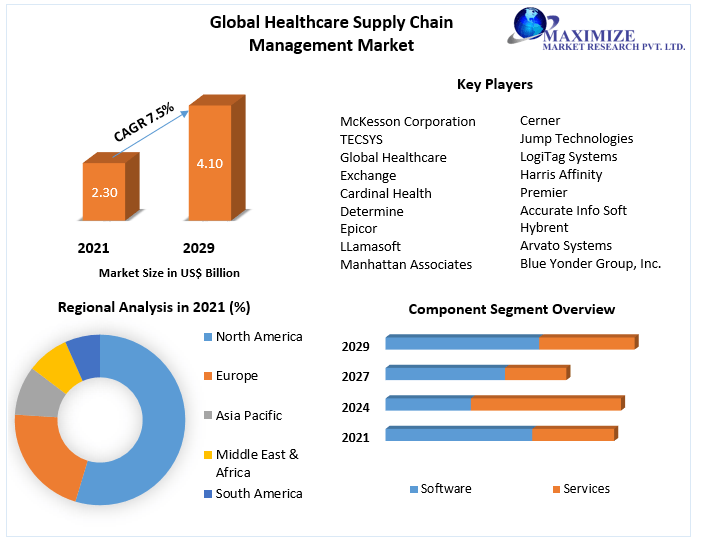
Healthcare Supply Chain Management Market size is expected to grow at a CAGR of 7.5% during the forecast period and the market size is expected to reach nearly US$ 4.10 Bn. by 2029.
The report includes an analysis of the impact of COVID-19 lockdown on the revenue of market leaders, followers, and disruptors. Since the lockdown was implemented differently in various regions and countries; the impact of the same is also seen differently by regions and segments. The report has covered the current short-term and long-term impact on the market, and it would help the decision-makers to prepare the outline and strategies for companies by region.
 To know about the Research Methodology :- Request Free Sample Report
Healthcare Supply Chain Management Definition:
The Healthcare Supply Chain (HSC) is a special kind of supply chain in, which medicines are produced, transported, and consumed. HSC begins with suppliers of drug manufacturer and finishes at the patient to fulfil the need through a definite delivery channel. Supply chain coordination and collaborations deal with the connection of operations throughout the chain with material and information flowing smoothly across these supply chain operations in achieving efficiency. The healthcare supply chain is one of such complex systems involving many stakeholders in the supply chain.
Global Healthcare Supply Chain Management Market Dynamics:
Within the healthcare industry, the supply chain associated with pharmaceutical products is critical in ensuring a high standard of care for patients and providing adequate supplies of medication for pharmacies. In terms of cost, it is estimated that supply accounts for 25-30 per cent of operational costs for hospitals. Therefore, this must be managed effectively to ensure both service and cost objectives.
Healthcare systems and processes play a critical role in supporting the healthcare needs of any society. In the functioning of hospitals, it is usually observed that some resources get wasted and delays occur at different levels and at different times due to patients seeing multiple providers spread across multiple locations.
Lack of medical information sharing not only negatively affects the efficiency in the healthcare supply chain, or makes the organizations unable to track and trace medical products but also leads to patient safety issues, which has made it necessary for the use of proper healthcare supply chain management.
A large amount of data is generated in the healthcare industry. The data includes record keeping, compliance, and regulatory requirements, and patient care. If the data can be interpreted and translated into information and shared among the supply chain members, healthcare cost is reduced, and the quality and effectiveness of the healthcare system can be improved, which is propelling the demand for the Global Healthcare Supply Chain Management Market.
A large amount of data to handle and security concerns can hamper the growth of the Global Healthcare Supply Chain Management Market.
Global Healthcare Supply Chain Management Market Segment Analysis:
The report groups the Global Healthcare Supply Chain Management Market in different segments like by component, by delivery mode, by end-user, and by region to forecast the revenues and analyze the market share of each segment over the forecast period.
Based on delivery mode, the Global Healthcare Supply Chain Management Market is segmented into Cloud-based and On-Premise. The Cloud-based segment was dominant in 2021 and is expected to command a market share of xx% by 2029. Cloud-based solutions help healthcare organizations share and integrate information from different locations. The cost of installation and maintenance is also low, which acts as the driving factor for the growth of the segment.
Based on components, the Global Healthcare Supply Chain Management Market is segmented into software and hardware. The Software segment was dominant in 2021 and is expected to command a market share of xx % by 2029. The software system is highly acceptable as compared to the hardware system because of the increasing number of online purchases, improving business intelligence, and growing preferences for eco-friendly logistics, which is expected to enhance the growth of the healthcare supply chain management market.
Based on end-users, the Global Healthcare Supply Chain Management Market is segmented into Healthcare Products Manufacturers, distributors, suppliers, and others. The Healthcare Products manufacturer segment was dominant in 2021 and is expected to command a market share of xx% by 2029. Manufacturers mainly look for SCM solutions for transportation and warehouse management to ensure faster, accurate, and efficient functioning.
Global Healthcare Supply Chain Management Market Regional Insights:
GLOBAL HEALTHCARE SUPPLY CHAIN MANAGEMENT MARKET REGIONAL MAP
North America is expected to command the largest market share of xx% by 2029
In North America, members of the healthcare industry implemented the standard product identification to connect the supply chain operations nationwide. Pharmaceutical products are identified not only by the barcode on exterior package labels but also at the unit-of-use packaging.
There is a national collaborative effort in developed economies like the US and Canada, as the Institute for Safe Medication Practices Canada (ISMP Canada) and Canadian Patient Safety Institute (CPSI) has worked with the pharmaceutical manufacturer to ensure that the automated identification technology helps improve patient safety on medication dispensing and administration systems as well as the benefits from enhancing efficacies along the entire supply chain.
In Canada, a system of supply chain standards has been a concern by healthcare institutions. Since 2008, the healthcare providers and suppliers within Canada’s healthcare gear toward improving patient safety, optimizing supply chain processes, enabling traceability, and maximizing the intellectual capital of healthcare professionals across the country.
The objective of the report is to present a comprehensive analysis of the Global Healthcare Supply Chain Management Market to the stakeholders in the industry. The past and current status of the industry with forecasted market size and trends are presented in the report with the analysis of complicated data in simple language.
The report covers all the aspects of the industry with a dedicated study of key players that include market leaders, followers, and new entrants. PORTER, SVOR, PESTEL analysis with the potential impact of micro-economic factors of the market have been presented in the report. External as well as internal factors that are supposed to affect the business positively or negatively have been analyzed, which will give a clear futuristic view of the industry to the decision-makers.
The report also helps in understanding the Global Healthcare Supply Chain Management Market dynamics, structure by analyzing the market segments and the Global Healthcare Supply Chain Management Market size. Clear representation of competitive analysis of key players by product, price, financial position, product portfolio, growth strategies, and regional presence in the Global Healthcare Supply Chain Management Market make the report investor’s guide.
Global Healthcare Supply Chain Management Market Scope: Inquire before buying
| Global Healthcare Supply Chain Management Market | |||
|---|---|---|---|
| Report Coverage | Details | ||
| Base Year: | 2021 | Forecast Period: | 2022-2029 |
| Historical Data: | 2017 to 2021 | Market Size in 2021: | US $ 2.30 Bn. |
| Forecast Period 2022 to 2029 CAGR: | 7.5% | Market Size in 2029: | US $ 4.10 Bn. |
| Segments Covered: | by Component | • Software • Services |
|
| by Delivery mode | • On-Premise • Cloud |
||
| by End users | • Healthcare Products Manufacturers • Suppliers • Distributors • Others |
||
Global Healthcare Supply Chain Management Market Key Players:
• McKesson Corporation
• TECSYS
• Global Healthcare Exchange
• Cardinal Health
• Determine
• Epicor
• LLamasoft
• Manhattan Associates
• Blue Yonder Group, Inc. (JDA Software)
• Cerner
• Jump Technologies
• LogiTag Systems
• Harris Affinity
• Premier
• Accurate Info Soft
• Hybrent
• Arvato Systems
Frequently Asked Questions:
1. Which region has the largest share in Global Healthcare Supply Chain Management Market?
Ans: North America region holds the highest share in 2021.
2. What is the growth rate of Global Healthcare Supply Chain Management Market?
Ans: The Global Healthcare Supply Chain Management Market is growing at a CAGR of 7.5% during forecasting period 2022-2029.
3. What is scope of the Global Healthcare Supply Chain Management market report?
Ans: Global Healthcare Supply Chain Management Market report helps with the PESTEL, PORTER, COVID-19 Impact analysis, Recommendations for Investors & Leaders, and market estimation of the forecast period.
4. Who are the key players in Global Healthcare Supply Chain Management market?
Ans: The important key players in the Global Healthcare Supply Chain Management Market are – McKesson Corporation, TECSYS, Global Healthcare Exchange, Cardinal Health, Determine, Epicor, LLamasoft, Manhattan Associates, Blue Yonder Group, Inc. (JDA Software), Cerner, Jump Technologies, LogiTag Systems, Harris Affinity, Premier, Accurate Info Soft, Hybrent, and Arvato Systems
5. What is the study period of this market?
Ans: The Global Healthcare Supply Chain Management Market is studied from 2021 to 2029.