
Global Healthcare Cold Chain Logistics Market Size: by Country, Revenue Growth, Technology Trends, Awareness
Overview
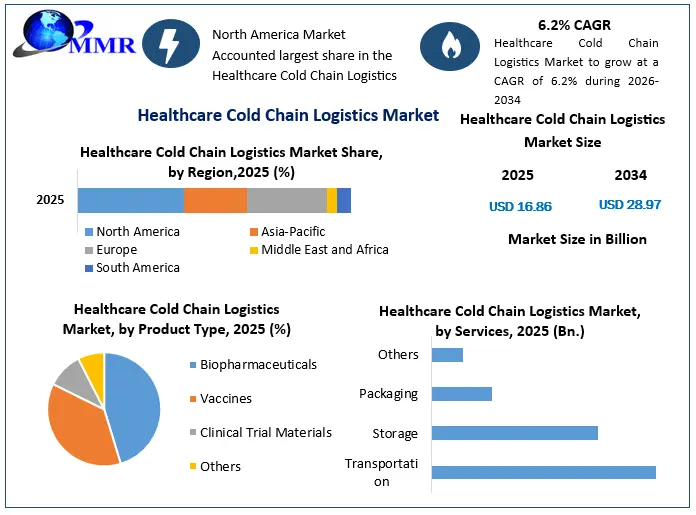
The Healthcare Cold Chain Logistics Market was valued at USD 16.86 billion in 2025, and total global Healthcare Cold Chain Logistics Market revenue is expected to grow at a CAGR of 6.2% from 2026 to 2034, reaching USD 28.97billion.
Healthcare Cold Chain Logistics Market Definition
The Healthcare Cold Chain Logistics Market is a specialized logistics sector that focuses on the storage, handling, transportation, and distribution of temperature-sensitive healthcare products. The market encompasses temperature-controlled warehousing and storage, cold and frozen transportation, packaging, monitoring systems, inventory handling, and distribution of pharmaceuticals, vaccines, biologics, clinical trial materials, blood products, diagnostic specimens, and other healthcare products. The market provides specialized cold chain logistics solutions and services to maintain the quality and integrity of temperature-sensitive healthcare products throughout the supply chain, from storage, transportation, transfer, and distribution. It includes temperature monitoring, excursion management, data logging, validated packaging, and specialized handling of healthcare products that are critical to ensuring quality, compliance, and safety.
Healthcare Cold Chain Logistics Market Overview
The Healthcare Cold Chain Logistics Market is expanding as pharmaceutical and healthcare supply chains increasingly require specialized solutions for vaccines, biologics, specialty pharmaceuticals, clinical trial materials, blood products, and other temperature-sensitive products. The market size and market forecast reflect a growing demand for reliable transportation, specialized warehousing, validated packaging, shipment monitoring, and temperature-controlled distribution across increasingly complex healthcare networks. North America currently represents the leading regional market, supported by its established pharmaceutical industry, advanced logistics infrastructure, regulatory capabilities, and high demand for temperature-sensitive therapies. Recent market assessments also identify North America as the largest regional market, while Asia Pacific is demonstrating strong expansion potential as pharmaceutical manufacturing, biotechnology activity, and healthcare infrastructure are developing across China, India, and other emerging markets.
The market offers substantial opportunities through advanced cold-chain monitoring, digital shipment visibility, cryogenic logistics, sustainable temperature-controlled packaging, and integrated third-party logistics services. A significant market gap is providing cost-efficient cold-chain solutions for complex products that require tighter temperature control, faster delivery and continuous monitoring across fragmented distribution networks.
The market report analyzes the market size, market forecast, product categories, service models, temperature ranges, end users, regional performance, competitive landscape, growth opportunities, and key market trends. Leading companies include DHL Supply Chain, UPS Healthcare, FedEx, Kuehne Nagel, DB Schenker, CEVA Logistics, DSV, World Courier, Marken, and Cryoport, with competition increasingly focused on specialized infrastructure, digital visibility, advanced-therapy logistics, and integrated healthcare supply-chain capabilities.
Global Healthcare Cold Chain Logistics Market Growth Outlook
To know about the Research Methodology :- Request Free Sample Report
Healthcare Cold Chain Logistics Market Dynamics
Healthcare Cold Chain Logistics Market Drivers
Rising Demand for Biologics, Vaccines, and Specialty Pharmaceuticals
The growing adoption of biologics, vaccines, specialty injectables and other temperature-sensitive healthcare products is increasing demand for specialized cold chain logistics and transportation solutions that are capable of maintaining appropriate storage conditions during transit. With the rising pipeline of pharmaceuticals and availability of high-end drugs, the need for specialized logistics is further expected to grow.
Expansion of Pharmaceutical and Healthcare Distribution Networks
The rising demand for pharmaceuticals and healthcare products across the world is fueling the need for reliable transportation solutions within the distribution network. This is estimated to increase the need for dependable logistics management solutions that can meet the unique requirements of transporting temperature-sensitive pharmaceuticals and healthcare products from manufacturers to distribution centers, hospitals, pharmacies, clinics and other relevant destinations.
Healthcare Cold Chain Logistics Market Opportunities
Development of Advanced Digital Cold Chain Monitoring
Within healthcare cold chain logistics, IoT-enabled remote monitoring technologies offer significant opportunities for logistics providers to offer more value-added services to a growing customer base. The application of digital cold chain monitoring solutions not only helps in ensuring product quality but also enables efficient decision-making through the provision of relevant insights at appropriate times. Besides, remote monitoring of storage temperatures has been endorsed by the World Health Organization as a critical component of temperature monitoring within the cold chain logistics industry.
Growing need for cold chain infrastructure in emerging markets
The healthcare and pharmaceutical industry is witnessing significant growth in emerging markets, thus creating significant opportunities for cold chain logistics providers. As the pharmaceutical and healthcare product manufacturing and distribution networks grow in these emerging economies, there is a growing need for temperature-controlled warehousing, storage, transportation and last-mile delivery solutions.
Healthcare Cold Chain Logistics Market Restraints
High Infrastructure and Operating Costs
Healthcare cold chain logistics require specialized infrastructure and equipment, including warehouses, vehicles, freezers, monitoring systems and backup generators, among others, in addition to highly-skilled labor. Besides the high capital costs of such infrastructure and machinery, there are also high energy and maintenance costs associated with their operations.
Complex Regulatory and Compliance Requirements
Healthcare cold chain logistics have complex and evolving regulations concerning temperature control, documentation, storage, equipment handling and monitoring, among others. Apart from being highly-stringent, these regulations also differ for different healthcare products and geographical regions, thus raising the complexity of compliance significantly during transportation.
Healthcare Cold Chain Logistics Market Challenges
Temperature Excursions and Product Integrity Risks
One of the major challenges associated with cold chain transportation is the risk of temperature excursions due to a range of factors, such as equipment malfunction, improper handling, inadequate packaging, power failures, delays and inappropriate storage conditions among others. Temperature excursions pose a significant risk to the quality of pharmaceutical and healthcare products and should be avoided at all costs.
Last-Mile Delivery and Infrastructure Reliability
The last-mile of delivery is one of the critical stages in cold chain logistics, yet it is fraught with several challenges that jeopardize the integrity of pharmaceutical and healthcare products. Some of the major challenges include lack of reliable infrastructure and expertise in temperature-controlled transportation, especially in remote areas.
Healthcare Cold Chain Logistics Market Segment Analysis
Healthcare Cold Chain Logistics Market, by Service
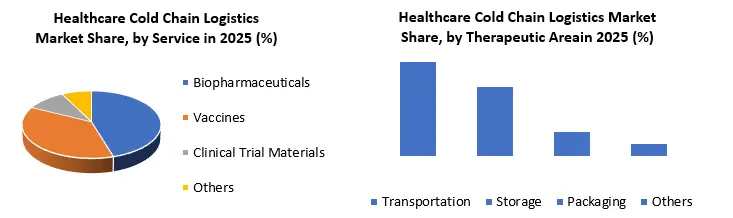
The market is segmented into Storage, Transportation, Packaging and Others. Storage dominates Healthcare Cold Chain Logistics Market in 2025, due to the critical need to maintain the integrity of temperature-sensitive healthcare products, such as vaccines, biologics, and clinical trial materials. Cold storage facilities, including refrigerated warehouses, ultra-low temperature freezers, and cryogenic storage units, are essential for ensuring that these products remain within specified temperature ranges from production until distribution.
The increasing demand for long-term storage of vaccines and biopharmaceuticals, particularly in the wake of global immunization campaigns and pandemic preparedness programs, has further strengthened the storage segment’s market share. Advanced technologies, such as IoT-enabled temperature monitoring, automated storage and retrieval systems, and sustainable refrigeration solutions, have enhanced the efficiency and reliability of storage operations. While transportation and packaging services are critical for moving products safely, the storage segment remains central because it provides the foundational infrastructure that ensures the effectiveness, safety, and compliance of healthcare cold chain operations worldwide.
Healthcare Cold Chain Logistics Market, by Product Type
Vaccines dominate the Healthcare Cold Chain Logistics Market due to their critical role in global immunization programs and pandemic response efforts. These products are highly temperature-sensitive, with requirements ranging from ultra-cold storage for mRNA vaccines to standard refrigerated conditions for other types. Maintaining this strict temperature control throughout transportation and storage is vital to ensure vaccine efficacy and safety, which in turn creates strong demand for specialized cold chain solutions, including refrigerated vehicles, advanced packaging technologies, and real-time monitoring systems.
Government initiatives and international support play a key role in reinforcing this demand. Large-scale vaccination campaigns, funding from organizations such as the World Health Organization (WHO) and UNICEF, and national immunization programs all necessitate robust cold chain infrastructure to distribute vaccines efficiently, especially in remote or underserved regions. The recent surge in mRNA vaccines, which require storage at extremely low temperatures, has further heightened the need for advanced logistics capabilities, prompting investments in ultra-low temperature freezers, insulated packaging, and predictive temperature monitoring.
Healthcare Cold Chain Logistics Market Segment Insights
Healthcare Cold Chain Logistics Market Regional Analysis
North America dominated the global Healthcare Cold Chain Logistics Market in 2025
The region has a robust healthcare infrastructure and a rising prevalence of diseases that demand healthcare products requiring meticulous storage and transportation. There is an increasing emphasis on sustainability within the logistics industry, including cold chain operations. The regional companies are exploring environmentally friendly practices and green technologies to reduce the environmental impact of healthcare cold chain logistics. The integration of e-commerce in the pharmaceutical sector is gaining momentum in the region. This trend creates opportunities for logistics providers to develop specialized cold chain solutions for the online distribution of temperature-sensitive medications, which boosts the Healthcare Cold Chain Logistics Market growth.
The Asia Pacific Healthcare Cold Chain Logistics Market is expected to grow at a high CAGR during the forecast period. This growth can be attributed to an increasing demand for cold storage facilities, a greater adoption of technologically advanced infrastructure, and a surge in merger and acquisition activities among industry players. Indian Healthcare Cold Chain Logistics Market is the second largest producer of fruits and vegetables, the largest producer of milk and one of the leading producers of meat and fish. Growing production, increases the need for cold chain logistics management results in good transportation of products and increases the susceptibility of food. Addressing the issue of perishability, Cold chain extends the shelf life and thus usability of the commodity in its best form.
Government regulations play a crucial role in shaping the landscape of the market in the Asia-Pacific (APAC) region. Achieving adherence to diverse regulatory frameworks across APAC nations demands thorough and careful strategic planning.
Healthcare Cold Chain Logistics Market Regulatory Framework
| Government Regulations | Description |
| Good Distribution Practices (GDP) | A collection of rules resought pharmaceutical product distribution from manufacturers to end users. Aims to ensure product quality and safety. |
| World Health Organization (WHO) Guidelines on Cold Chain Management | Offers guidance on managing cold chains for vaccines and other temperature-sensitive healthcare goods. Encompasses planning, design, monitoring, and evaluation. |
| European Union (EU) Temperature Controlled Transport Regulations | Establishes criteria for shipping temperature-sensitive goods across all transportation modes (road, rail, sea, air). Ensures quality and safety during transportation. |
| Food and Drug Administration (FDA) Compliance Policy Guide | Guides compliance with FDA standards for distributing temperature-sensitive medicinal items. Covers aspects such as labeling, packaging, transportation, and storage. |
Healthcare Cold Chain Logistics Market Competitive Landscape
The Healthcare Cold Chain Logistics Market is highly competitive, with global Healthcare Cold Chain Logistics players leading by their strategic innovation and robust infrastructure. DHL Supply Chain (Germany) stands out as a leader by its early investment in GDP-compliant logistics, development of regional cold chain hubs, and integration of AI and IoT for real-time tracking by its Life Sciences Temp Control service. FedEx (USA) has reinforced its position by launching AI-powered platforms, like SenseAware and FedEx Surround, which enable predictive analytics and proactive risk mitigation for sensitive healthcare shipments, mainly those involving biologics and vaccines.
Kuehne & Nagel (Switzerland) continues to lead by its KN Pharma Chain network, leveraging blockchain for chain-of-custody and SeaExplorer for optimized pharma shipping. Its strong GDP-compliant warehousing and real-time temperature tracking enhance reliability. UPS Healthcare (USA) is another major player, recognized for its large-scale vaccine distribution capabilities, advanced cold storage, and smart diagnostics enabled UPS Premier Service. These companies are market leaders by their combine global reach, regulatory compliance, and cutting-edge digital logistics solutions that ensure safety and efficiency of temperature sensitive pharmaceutical products.
Healthcare Cold Chain Logistics Market Recent Developments
| Date | Company | Development | Impact |
| 24 February 2025 | Federal Express Corporation (FedEx) | FedEx introduced its specialized healthcare cold chain solutions and proprietary FedEx SenseAware tracking system in the United Arab Emirates. | The implementation leverages IoT and sensor-based AI technology to provide real-time temperature, location, and security tracking for high-value pharmaceutical shipments. |
| 17 March 2025 | AstraZeneca | AstraZeneca entered a definitive agreement to acquire Belgian biotechnology company EsoBiotec for up to $1 billion to boost its advanced oncology and cell therapy pipelines. | This acquisition directly drives localized market demand for specialized, ultra-cold, and cryogenic healthcare cold chain logistics networks necessary to safely transport sensitive cell treatments. |
| 29 July 2025 | Geotab | Geotab officially unveiled a major technology upgrade to its global Cold Chain solution, introducing next-generation hardware and enhanced telematics software. | The deployment provides logistics fleet operators with significantly greater data visibility, automated oversight, and strict regulatory compliance assurance for temperature-sensitive pharmaceutical cargo. |
| 20 February 2026 | DHL Group | DHL Group heavily expanded its dedicated Airfreight Cold Chain Network by integrating a newly customized Boeing 777 freighter on the critical Brussels to Cincinnati trade lane. | The expansion utilizes over 30 GDP-compliant aviation hubs to safeguard the end-to-end transport integrity of highly volatile biologics, vaccines, and advanced cell and gene therapies. |
| 22 May 2026 | UPS Healthcare | UPS Healthcare completed a major 21,860 square meter expansion of its central European hub facility located in Roermond, Netherlands. | The scale-up adds space for over 200 ultra-low temperature (ULT) freezers running at -80°C and 3,200 pallet positions for 2°C to 8°C chilled storage to accommodate scaling biopharma volumes. |
Healthcare Cold Chain Logistics Market Key Trends
| Key Trends | Description |
| Growth in Biopharmaceuticals | The increasing demand for temperature-sensitive biologics and vaccines is increasing reliance on cold chain logistics across global healthcare supply chains. |
| Technological Advancements | Use of IoT, GPS tracking, and data loggers improves real-time temperature monitoring, reducing spoilage and ensuring regulatory compliance. |
| Expansion in Emerging Markets | Growing healthcare infrastructure in Asia-Pacific, South America, and Africa boosts cold chain logistics to support vaccine distribution and chronic disease management. |
| Stringent Regulatory Requirements | Governments and global agencies enforce strict guidelines for temperature control, packaging, and documentation to ensure drug efficacy and safety. |
Healthcare Cold Chain Logistics Market Scope: Inquiry Before Buying
| Global Healthcare Cold Chain Logistics Market | |||
|---|---|---|---|
| Report Coverage | Details | ||
| Base Year: | 2025 | Forecast Period: | 2026-2034 |
| Historical Data: | 2020 to 2025 | Market Size in 2025: | USD 16.86 Bn. |
| Forecast Period 2026 to 2034 CAGR: | 6.2% | Market Size in 2034: | USD 28.97 Bn. |
| Segments Covered: | by Product Type | Biopharmaceuticals Vaccines Clinical Trial Materials Others |
|
| by Services | Storage Transportation Packaging Others |
||
| by Mode of Delivery | Last-Mile Delivery Hubs-to-Distributor |
||
| by Storage Technique | Electrical refrigeration Dry Ice Gel Packs Liquid nitrogen Others |
||
| by Temperature | Ultra-Low Temperature (-80°C and below) Frozen (-20°C to -40°C) Refrigerated (2°C to 8°C) Others |
||
| by End User | Hospitals & Clinics Pharmacies & Retail Chains Biopharmaceutical & Pharmaceutical Companies Vaccine & Blood Banks Others |
||
Healthcare Cold Chain Logistics Market, by Region
North America (United States, Canada, and Mexico)
Europe (UK, France, Germany, Italy, Spain, Sweden, Austria, and the Rest of Europe)
Asia Pacific (China, South Korea, Japan, India, Australia, ASEAN, Indonesia, Philippines, Malaysia, Vietnam, Thailand, ASEAN, Rest of Asia Pacific)
Middle East & Africa (South Africa, GCC, Nigeria, Rest of ME&A)
South America (Brazil, Argentina, Rest of South America)
Healthcare Cold Chain Logistics Market key players
North America
1. Americold (USA)
2. Lineage Logistics (USA)
3. United States Cold Storage (USA)
4. Burris Logistics (USA)
5. Cardinal Health (USA)
6. CEVA Logistics (USA)
7. FedEx (USA)
8. UPS (USA)
9. Owens & Minor (USA)
10. McKesson Corporation (USA)
11. Thermo Fisher Scientific (USA)
12. Catalent (USA)
13. Cencora (USA)
14. Cavalier Logistics (USA)
15. NMDP BioTherapies (USA)
16. Sonoco ThermoSafe (USA)
17. Wabash National (USA)
Europe
18. DHL Group (Germany)
19. DB Schenker (Germany)
20. Kuehne + Nagel (Switzerland)
21. A.P. Moller–Maersk (Denmark)
22. CEVA Logistics (Switzerland)
23. NewCold (Netherlands)
24. Atelerix (UK)
Asia Pacific
26. SF Holding (China)
27. Delhivery (India)
28. Yusen Logistics (Japan)
Frequently Asked Questions
1. Which region held the largest Healthcare Cold Chain Logistics Market share in 2025?
Ans: The North America region held the largest Cold Chain Logistics Market share in 2025.
2. What is the expected CAGR of the Global Healthcare Cold Chain Logistics Market during the forecast period?
Ans: The Global market is expected to grow at a CAGR of 6.2% during the forecasting period.
3. What is scope of the Global Healthcare Cold Chain Logistics market report?
Ans: Global market report helps with the PESTLE, PORTER, Recommendations for Investors & Leaders, and market estimation of the forecast period.
4. Who are the key players in the Healthcare Cold Chain Logistics Industry?
Ans: The key players in the Healthcare Cold Chain Logistics Industry are – AmerisourceBergen Corporation, DB Schenker, FedEx, Marken, American Airlines Inc., Cavalier Logistics, DHL international GmbH, KUEHNE + NAGEL and Others.
5. What is the forecast period of the Healthcare Cold Chain Logistics Market research?
Ans: The forecast period of the Healthcare Cold Chain Logistics Market research is from 2026 to 2034.